
Drug Screening and Treatment Methods
a technology applied in the field of drug screening and treatment methods, can solve the problems of significant immune suppression and bone loss, unrecognized etiology of such disorders, and elevated levels of natural gr agonists and pharmacological levels of synthetic gr agonists
Patent Information
- Authority / Receiving Office
- US · United States
- Patent Type
- Applications(United States)
- Current Assignee / Owner
- Publication Date
- 2008-06-19
- Estimated Expiration
- Not applicable · inactive patent
Smart Images
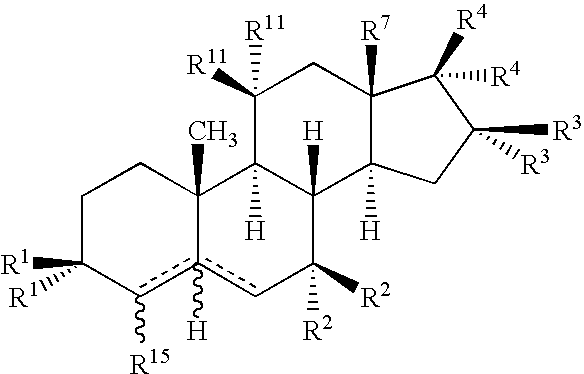
Figure 1 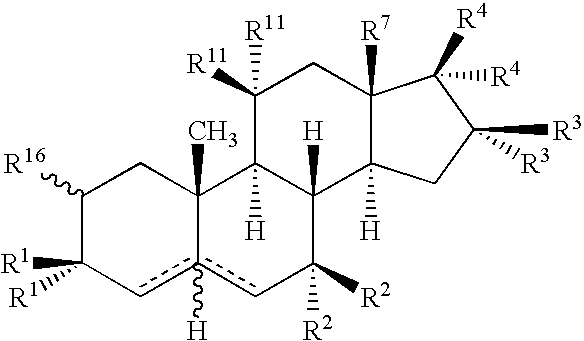
Figure 2 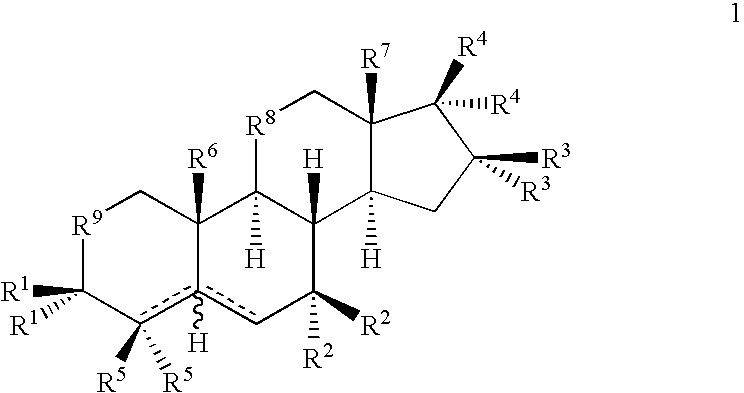
Figure 3
Abstract
Description
CROSS REFERENCE TO RELATED APPLICATIONS
[0001] This nonprovisional U.S. patent application is a continuation-in-part of and claims priority from pending U.S. application Ser. No. 11 / 941,934, filed Nov. 17, 2007, and claims priority from pending U.S. provisional application Ser. No. 60 / 866,395, filed Nov. 17, 2006, pending U.S. provisional application Ser. No. 60 / 866,700, filed Nov. 21, 2006, pending U.S. provisional application Ser. No. 60 / 868,042, filed Nov. 30, 2006, pending U.S. provisional application Ser. No. 60 / 885,003, filed Jan. 15, 2007, and pending U.S. provisional application Ser. No. 60 / 888,058, filed Feb. 2, 2007, all of which are incorporated herein by reference.FIELD OF THE INVENTION
[0002] The invention relates to methods and compounds such as 4α-fluoro-17α-ethynylandrost-5-ene-3β,7β,17β-triol to modulate inflammation, metabolic disorders and other conditions described herein. The compounds can be used to treat or slow the progression of conditions such as type 2 diabete...
Examples
example 1
[0148]Treatment of lung inflammation. Three compounds, 3β,16α-dihydroxy-17-oxoandrostane, 3α,160,17β-trihydroxyandrostane and 3α,16α,177-trihydroxyandrostane were used to treat inflammation in mice essentially as described (D. Auci et al., Ann. New York Acad. Sci. 1051:730-742 2005). Five to 8 week old CD1 male mice (Charles River, Calco, Italy) were used for the study. The animals were housed in a controlled environment and provided with standard rodent chow and water. Animal care was in compliance with applicable regulations on protection of animals. Mice were allocated into one of the following groups: (1) mice treated with 2% carrageenan-λ in saline (carrageenan-λ treated control group), (2) mice treated with 0.1 mg, 0.01 mg or 0.001 mg 3β,16α-dihydroxy-17-oxoandrostane by subcutaneous (s.c.) injection 24 h and 1 h before carrageenan-λ administration, (3) mice treated with 0.1 mg, 0.01 mg or 0.001 mg of 3α,16α,17α-trihydroxyandrostane by s.c. injection 24 and 1 h before carragee...
example 2
[0154]Analysis of the immune response. The compound 3α,16α,17α-trihydroxyandrostane was found to have biological properties that make the compound superior as an agent to treat an inflammation condition such as asthma. Specifically, the use of the compound was not accompanied by a rebound in IL-13, which is a known side effect of antiinflammatory glucocorticoid compounds such as dexamethasone. The IL-13 rebound after glucocorticoid makes an asthma patient more prone to have subsequent acute flare, so an antiinflammatory agent that does not do this would be advantageous. This lack of an IL-13 rebound was unexpected.
[0155]The capacity of 3α,16α,17α-trihydroxyandrostane to limit eosinophil burden and to reduce key inflammatory mediators (IL-5, IL-13, cysteinyl leukotrienes) was observed in the ovalbumin (OVA) sensitized mouse model of asthma. BALB / c mice were sensitized by intraperitoneal injection with OVA (in alum adjuvant) on days 1, and 12. Airways were challenged with OVA on days ...
example 3
[0160]Treatment of lethal inflammation / shock. Two compounds, 16α-bromoepiandrosterone (3β-hydroxy-16α-bromoandrostane-17-one) and 3β,16α-dihydroxy-17-oxoandrostane, were used in a lethal shock protocol. In one protocol, 3 mg of 16α-bromoepiandrosterone was administered to one group of animals by oral gavage, while another group received 3 mg of 16α-bromoepiandrosterone by subcutaneous injection. A group of control animals received a placebo control. In this protocol, the 16α-bromoepiandrosterone was administered to mice at 24 hours before and at 1 hour after administration of a lethal amount of bacterial lipopolysaccharide (LPS). By the end of the observation period, 72 hours after LPS administration, none of the vehicle treated placebo control animals had survived, while 65% of animals that received 16α-bromoepiandrosterone by oral administration survived. 50% of the animals that received 16α-bromoepiandrosterone by subcutaneous injection survived. Animals that survived for 72 hour...