
Hyperbranched Polymers
a polymer and hyperbranched technology, applied in the field of hyperbranched polymers, can solve the problems of inability to prepare a high molar mass polymer, negative environmental impact, and inability to direct dehydration condensation reaction, and achieve the effect of high yield
Patent Information
- Authority / Receiving Office
- US · United States
- Patent Type
- Applications(United States)
- Current Assignee / Owner
- Publication Date
- 2008-09-11
- Estimated Expiration
- Not applicable · inactive patent
Smart Images
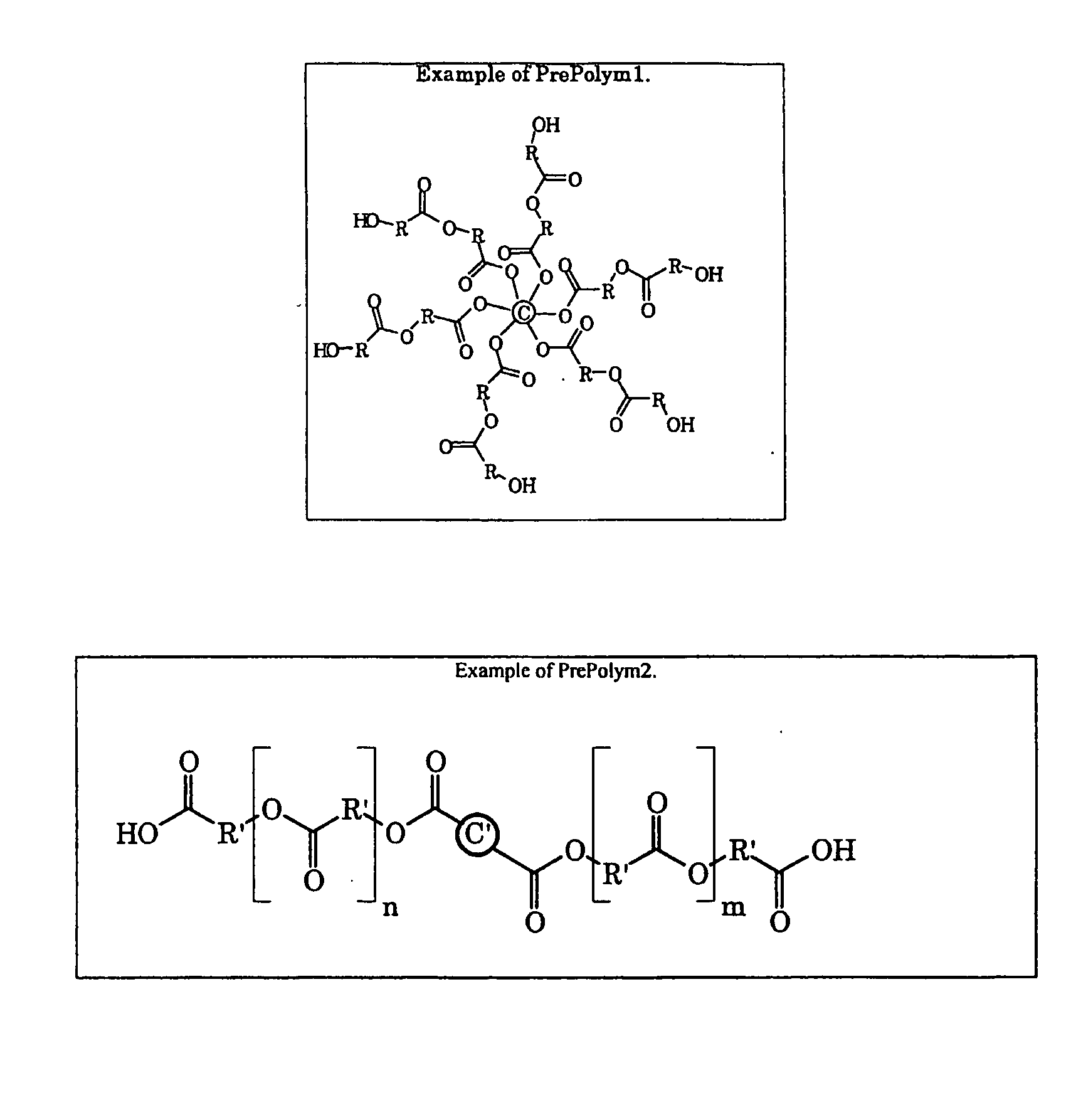
Figure 1 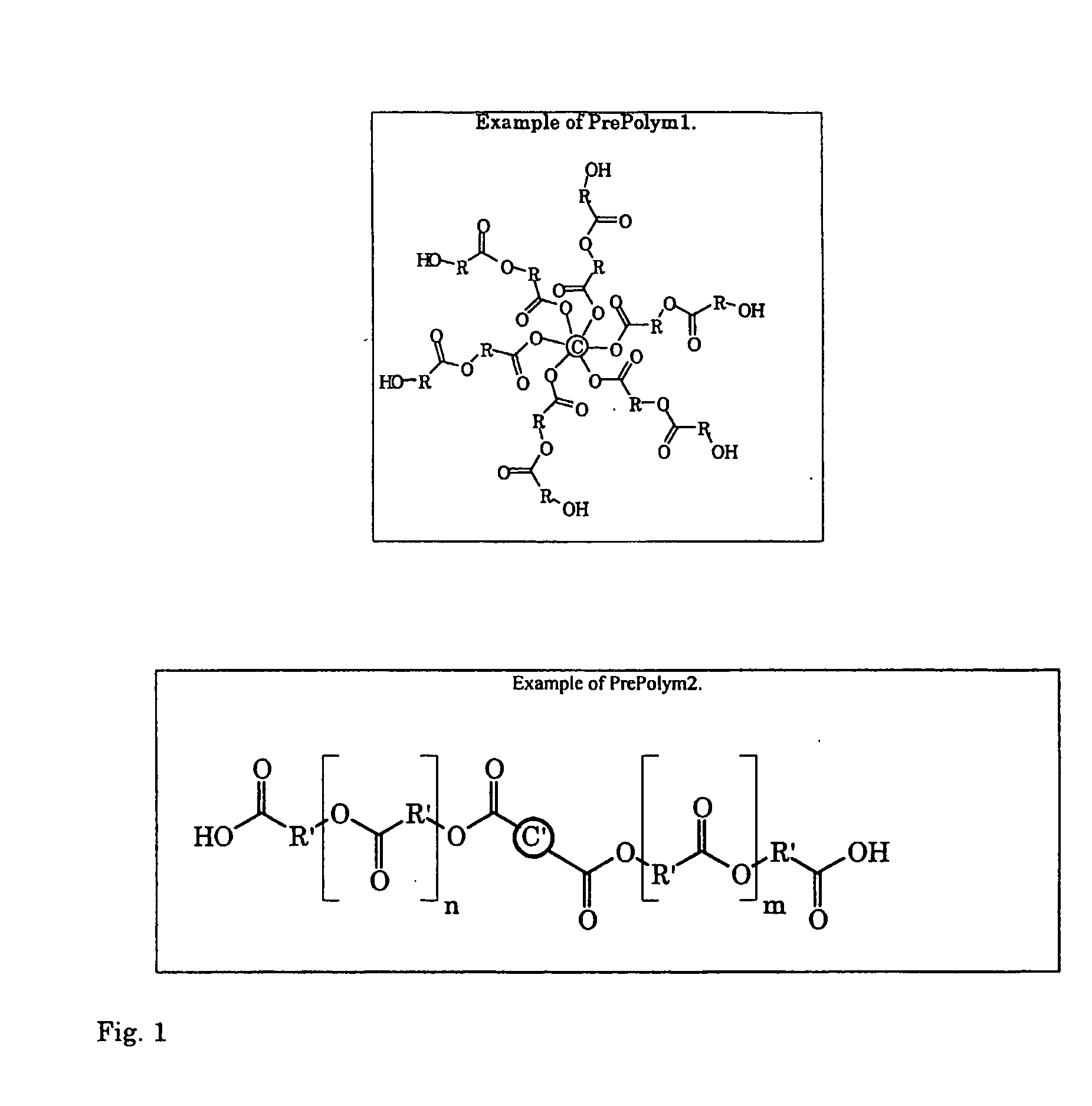
Figure 2 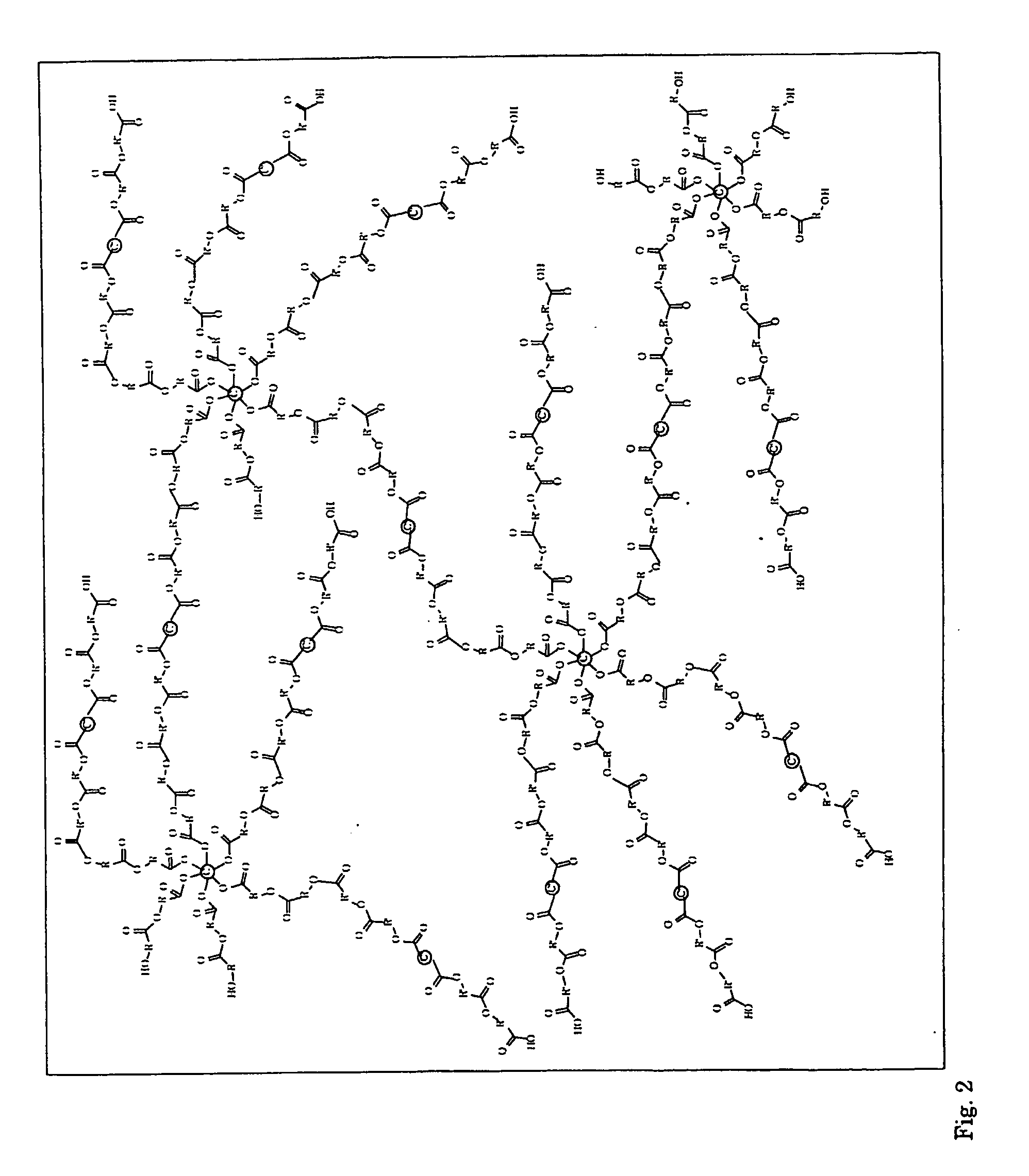
Figure 3
Abstract
Description
[0001]A process for preparing a hyperbranched polymer having a weight-average molar mass of at least 30,000, includes coupling a first prepolymer having at least three functional end groups with a second prepolymer having at least two functional end groups by a dehydration condensation reaction between the end groups in the prepolymers. The number of arms and / or molar mass of the functionalized prepolymers can accurately be adjusted, thus affecting the properties of the resulting hyperbranched polymer in a desired way. The polymer can be equipped e.g. with hydrophobic and hydrophilic parts. Also, the number of functional end groups, that optionally can be used for further chemical reactions, in the hyperbranched polymer can easily be adjusted to a desired level. The hyperbranched high molar mass polymer can be prepared in high yields without the use of organic solvents or linking compounds, which is advantageous from an environmental as well as an economical point of view.TECHNICAL ...
Examples
example 1
Preparation of Prepolymers by Dehydration Condensation Reaction
[0056]To a round-bottomed flask, different hydroxycarboxylic acid(s) (see Table 1) containing free water, initiating compound containing carboxylic acid groups or hydroxyl groups, and 0.1 wt % of stannous 2-ethylhexanoate were charged and heated under stirring in a rotary evaporator unit under reduced pressure to remove the free water from the reaction mixture and oligomerize the hydroxycarboxylic acid. After the calculated free water was removed and some oligomerization had occurred, the rotary evaporator unit was cleaned with acetone, the pressure again lowered stepwise to the minimal pressure specified in Table 1, and the dehydration condensation reaction continued at 180° C. for the time specified in Table 1. After discontinuing the reaction, the polymerization products were cooled and stored under ambient conditions until analyzed and used for further linking-reactions. The conditions during the dehydration condensa...
example 2
Preparation of Prepolymers by Ring-Opening Polymerization
[0057]To a pre-heated (170° C.) reaction vessel, monomer, initiating compound, and 0.05 wt % of stannous 2-ethylhexanoate were charged under inert atmosphere. After the predetermined polymerization time the polymerization was discontinued, the polymer cooled and stored under ambient conditions before analyses and further linking-reactions. The prepolymer characteristics are shown in Table 2.
TABLE 2Molar mass and its distribution for prepolymersprepared by ring-opening polymerization.ExperimentInitiatingMwNo.MonomerCompound(g / mol)Mw / Mn 13 aε-caprolactonepentaerythritol10 3001.1714ε-caprolactonepentaerythritol 6 7001.4315rac-lactidephloroglucinol33 8001.6916rac-lactideinositol16 4001.3017rac-lactideDipentaerythritol21 6001.1818L,L-lactidepentaerythritol31 7001.45 19 b, cε-caprolactone / pentaerythritol10 2001.24L,L-lactide 20 c, dε-caprolactone / pentaerythritol10 5001.41L,L-lactide 21 dε-caprolactone / pentaerythritol22 6001.35r...
example 3
Build-Up in Molar Mass vs. Polymerization Time
[0058]To a round-bottomed flask, 59.95 g of the hydroxyl-terminated prepolymer from Experiment No. 5 and 12.68 g of the carboxylic acid-terminated prepolymer from Experiment No. 10 were charged and heated at 180° C. under stirring in a rotary evaporator unit. The pressure was stepwise lowered to a minimum value of 3 mbar and the dehydration condensation reaction was monitored by the build-up of weight-average molar mass as a function of polymerization time. Within 10 h a rigid poly(hydroxycarboxylic acid) having a weight-average molar mass exceeding 200,000 g / mol was obtained. FIG. 3 shows the weight-average molar mass vs. polymerization time.