
Controlled release oxycodone compositions
a technology of oxycodone and compositions, which is applied in the direction of drug compositions, biocide, heterocyclic compound active ingredients, etc., can solve the problems of unacceptably long duration of patient without acceptable pain control, particularly in the time-consuming and resource-consuming titration process, etc., and achieve the effect of improving the efficiency and quality of pain managemen
Patent Information
- Authority / Receiving Office
- US · United States
- Patent Type
- Applications(United States)
- Current Assignee / Owner
- Publication Date
- 2010-02-11
- Estimated Expiration
- Not applicable · inactive patent
Smart Images
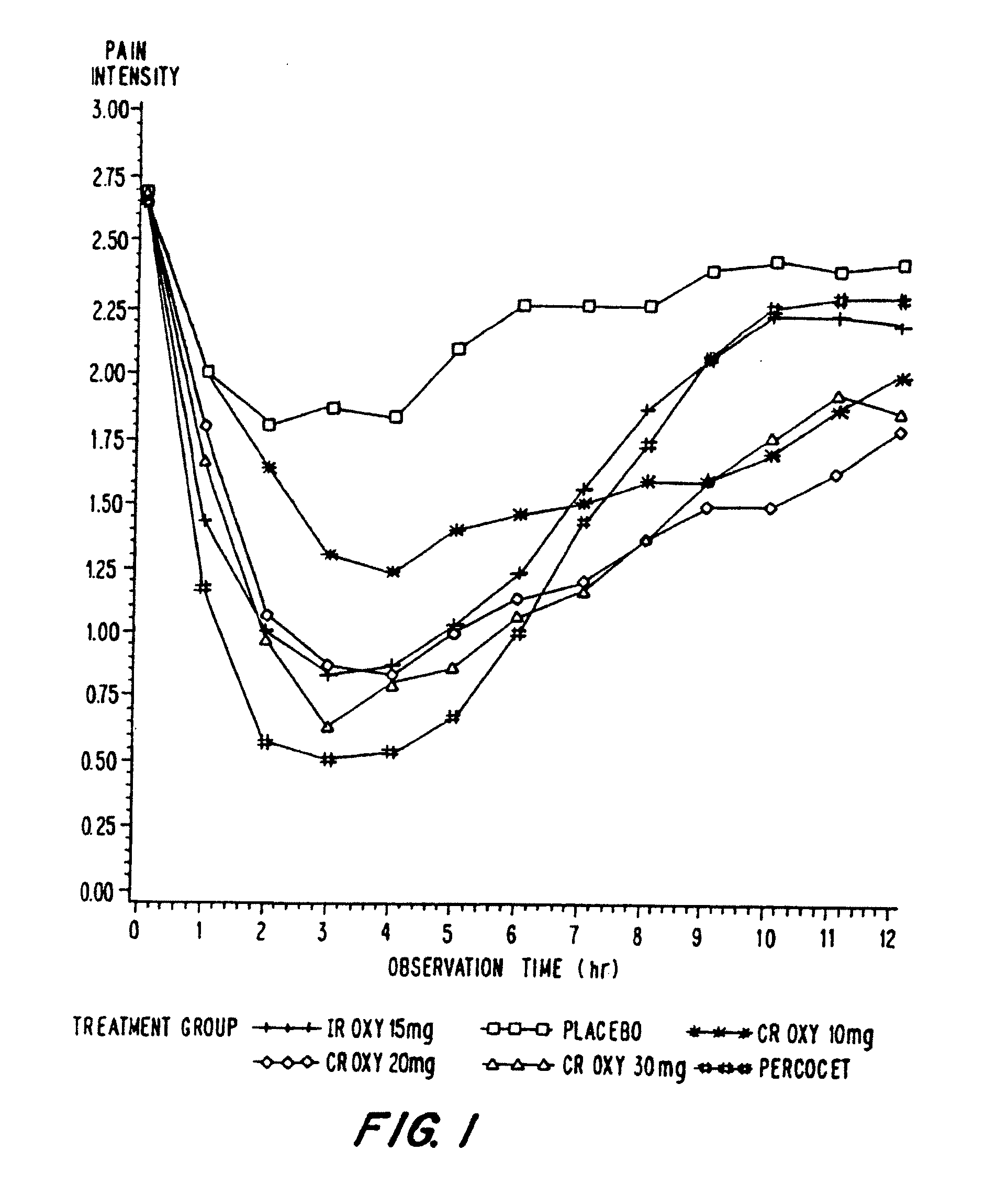
Figure 1 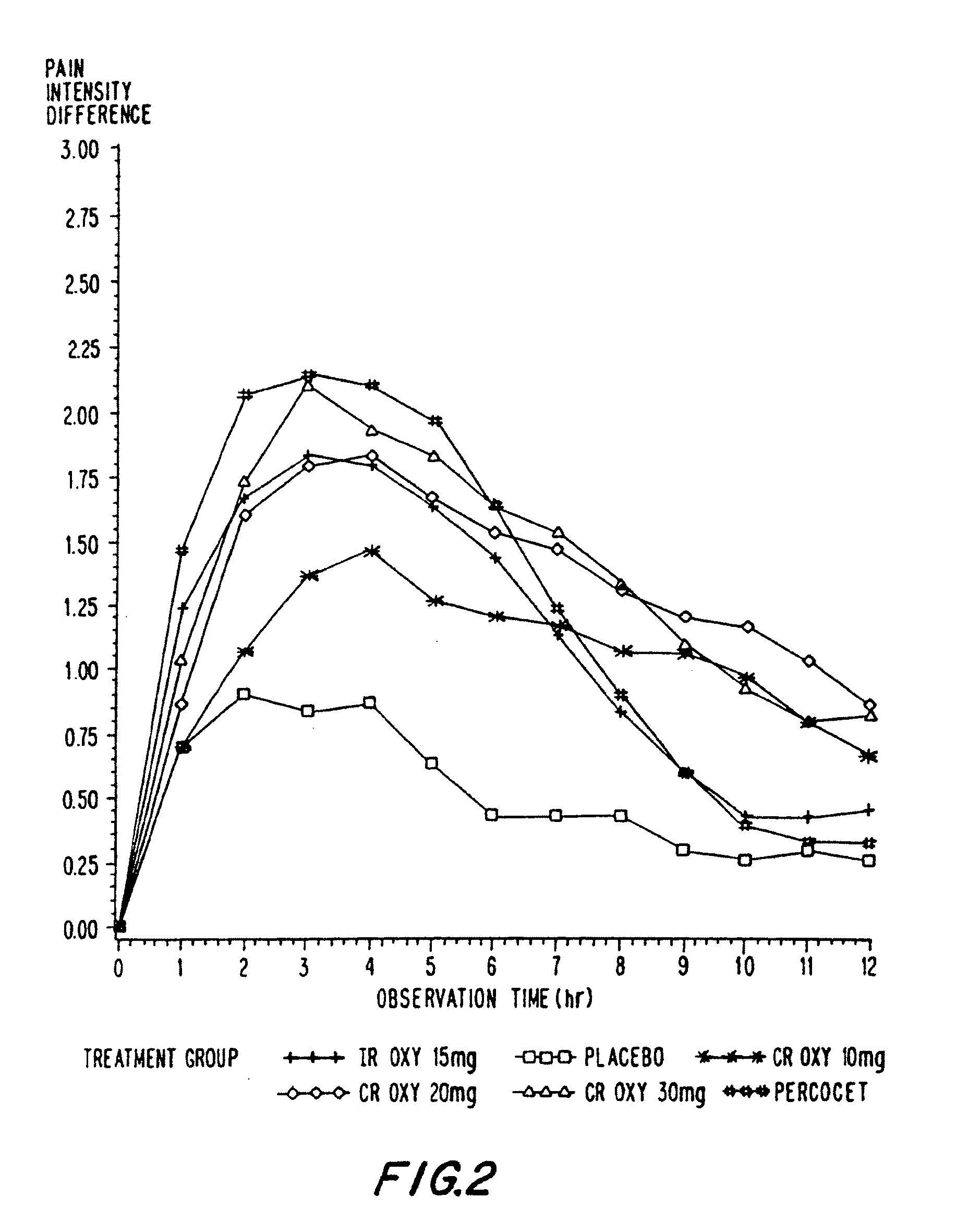
Figure 2 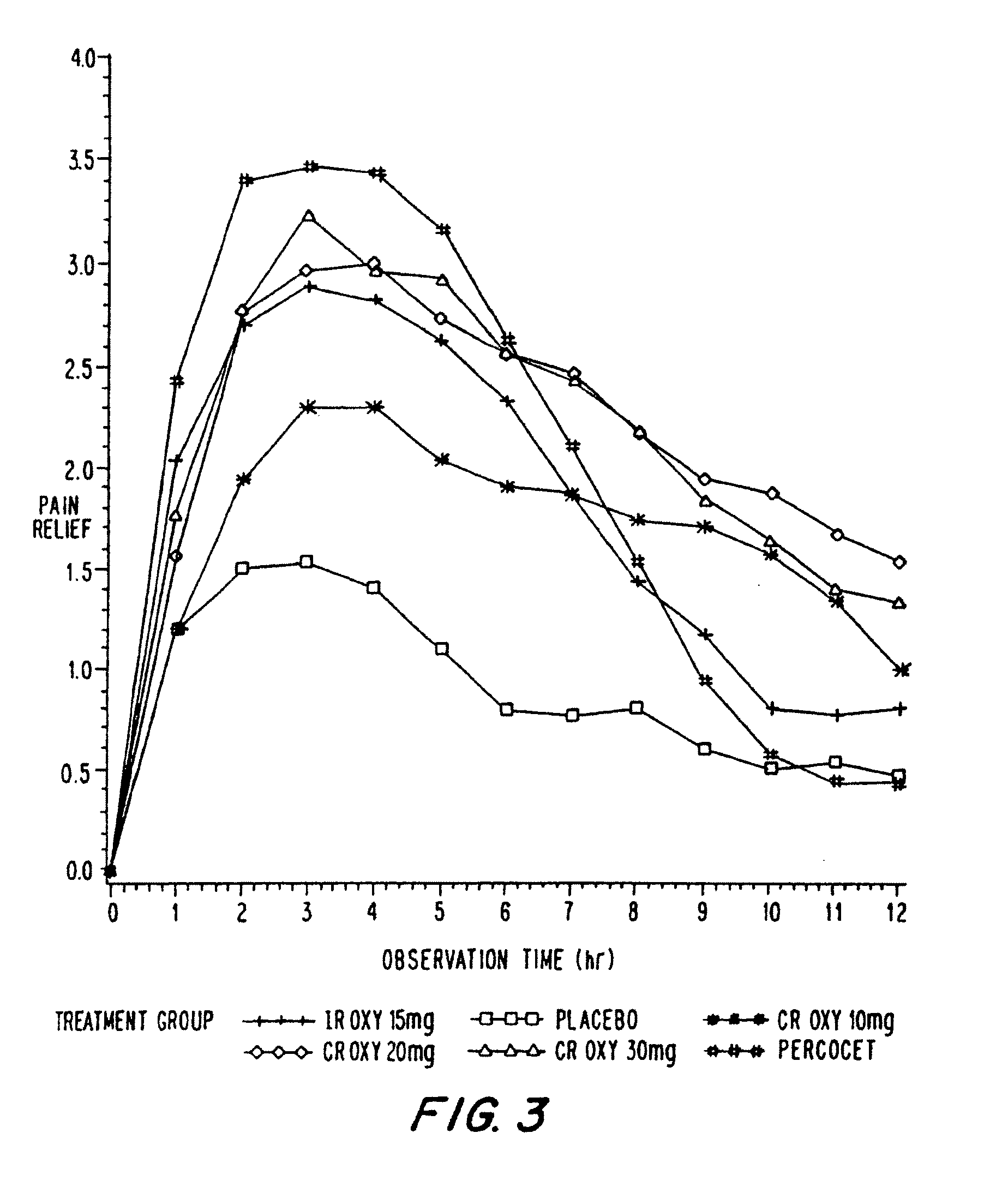
Figure 3
Abstract
Description
CROSS-REFERENCE TO RELATED APPLICATIONS
[0001] This application is a continuation of U.S. application Ser. No. 11 / 728,983, filed Mar. 26, 2007, which is a divisional of U.S. application Ser. No. 11 / 207,144, filed Aug. 17, 2005, abandoned, which is a continuation of U.S. application Ser. No. 10 / 163,484, filed Jun. 5, 2002, abandoned, which is a continuation of U.S. application Ser. No. 09 / 933,411, filed Aug. 20, 2001, abandoned, which is a continuation of U.S. application Ser. No. 09 / 784,888, filed Feb. 16, 2001, abandoned, which is a continuation of U.S. application Ser. No. 09 / 481,909, filed Jan. 12, 2000, abandoned, which is a continuation of U.S. application Ser. No. 08 / 909,328, filed Aug. 11, 1997, abandoned, which is continuation of U.S. application Ser. No. 08 / 618,344, filed Mar. 19, 1996, now U.S. Pat. No. 5,656,295, which is a continuation of U.S. application Ser. No. 08 / 081,302, filed Jun. 18, 1993, now U.S. Pat. No. 5,549,912, the disclosures of each of which are incorporate...
Examples
example 1
Controlled Release Oxycodone HCl 30 mg Tablets—Aqueous Manufacture
[0071]The required quantities of oxycodone hydrochloride, spray-dried lactose, and Eudragit® RS PM are transferred into an appropriate-size mixer, and mixed for approximately 5 minutes. While the powders are mixing, the mixture is granulated with enough water to produce a moist granular mass. The granules are then dried in a fluid bed dryer at 60° C., and then passed through an 8-mesh screen. Thereafter, the granules are redried and pushed through a 12-mesh screen. The required quantity of stearyl alcohol is melted at approximately 60-70° C., and while the granules are mixing, the melted stearyl alcohol is added. The warm granules are returned to the mixer.
[0072]The coated granules are removed from the mixer and allowed to cool. The granules are then passed through a 12-mesh screen. The granulate is then lubricated by mixing the required quantity of talc and magnesium stearate in a suitable blender. Tablets are compre...
example 2
Controlled Oxycodone HCl 10 mg
Release Tablets—Organic Manufacture
[0074]The required quantities of oxycodone hydrochloride and spray dried lactose are transferred into an appropriate sized mixer and mix for approximately 6 minutes. Approximately 40 percent of the required Eudragit® RS PM powder is dispersed in Ethanol. While the powders are mixing, the powders are granulated with the dispersion and the mixing continued until a moist granular mass is farmed. Additional ethanol is added if needed to reach granulation end point. The granulation is transferred to a fluid bed dryer and dried at 30° C.; and then passed through a 12-mesh screen. The remaining Eudragit® RS PM is dispersed in a solvent of 90 parts ethanol and 10 parts purified water; and sprayed onto the granules in the fluid bed granulator / dryer at 30° C. Next, the granulate is passed through a 12-mesh screen. The required quantity of stearyl alcohol is melted at approximately 60-70° C. The warm granules are returned to the ...
example 3-4
Controlled Release Oxycodone
10 and 20 mg Tablets Aqueous Manufacture
[0079]Eudragit® RS 30D and Triacetin® are combined while passing though a 60 mesh screen, and mixed under low shear for approximately 5 minutes or until a uniform dispersion is observed.
[0080]Next, suitable quantities of Oxycodone HCl, lactose, and povidone are placed into, a fluid bed granulator / dryer (FBD) bowl, and the suspension sprayed onto the powder in the fluid bed. After spraying, the granulation is passed through a #12 screen if necessary to reduce lumps. The dry granulation is placed in a mixer.
[0081]In the meantime, the required amount of stearyl alcohol is melted at a temperature of approximately 70° C. The melted stearyl alcohol is incorporated into the granulation while mixing. The waxed granulation is transferred to a fluid bed granulator / dryer or trays and allowed to cool to room temperature or below. The cooled granulation is then passed through a #12 screen. Thereafter, the waxed granulation is pl...