
Lightweight, durable enclosures and laminates for making the same
Patent Information
- Authority / Receiving Office
- US · United States
- Current Assignee / Owner
- Publication Date
- 2010-11-18
Smart Images
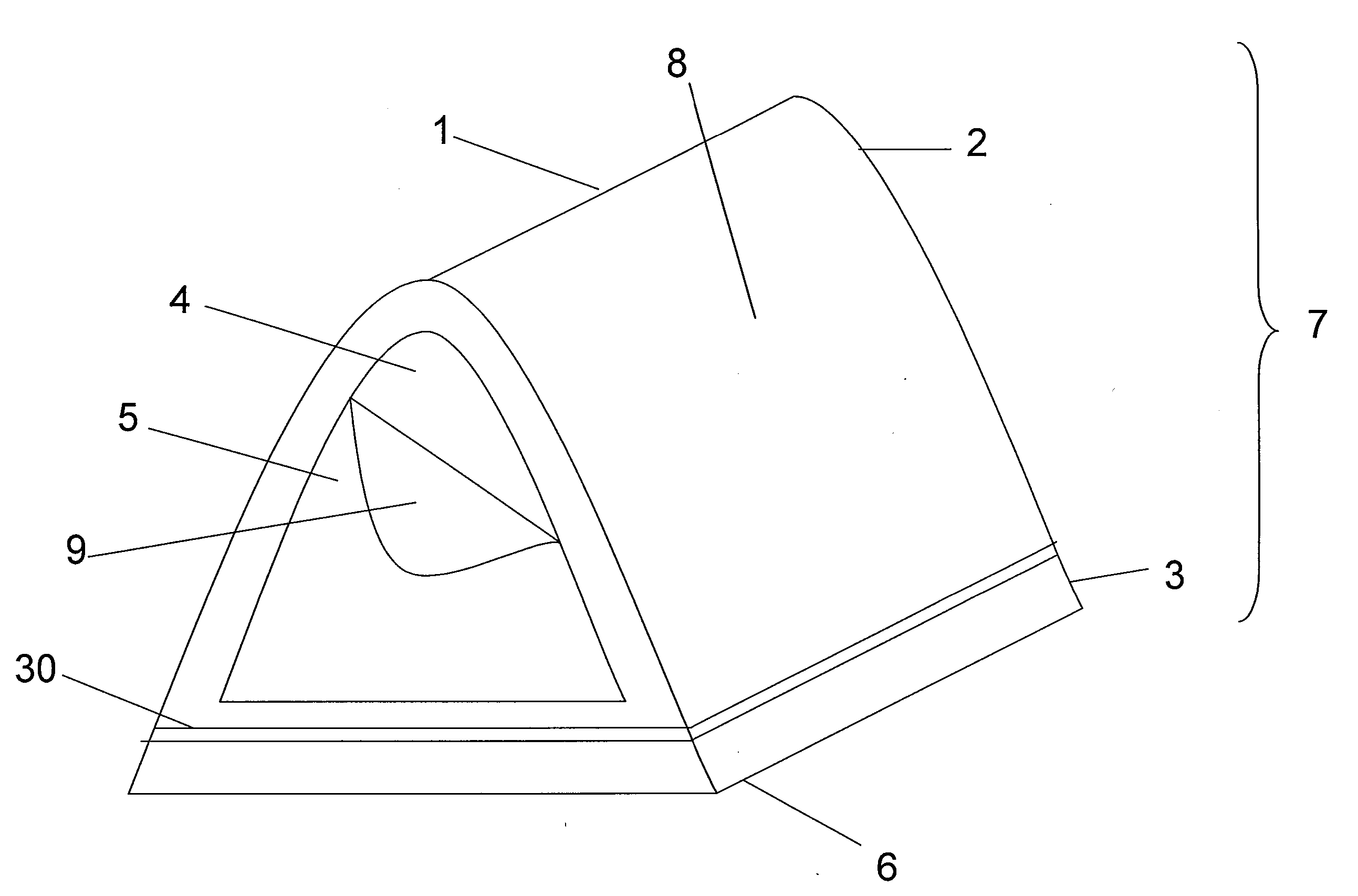
Figure 1 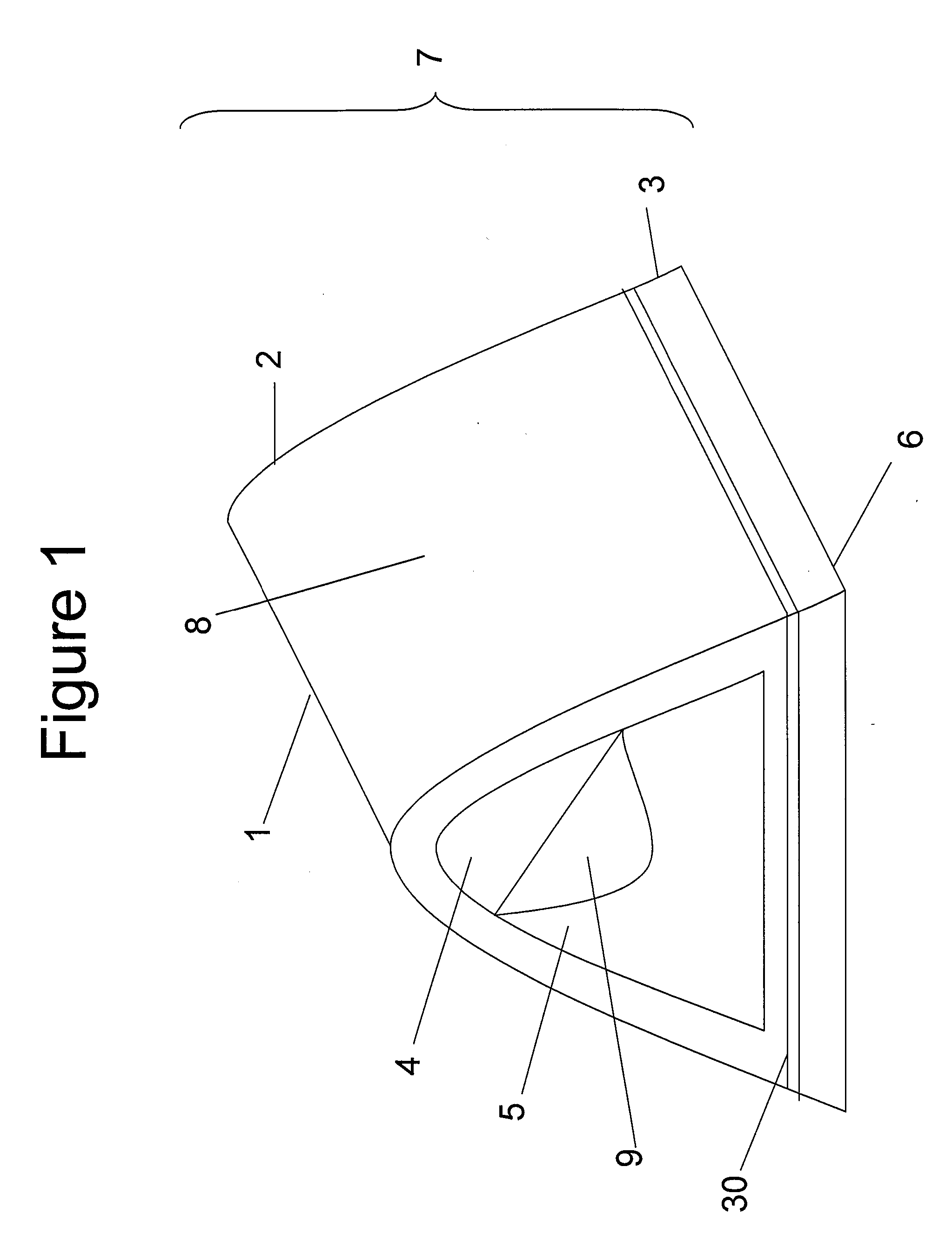
Figure 2 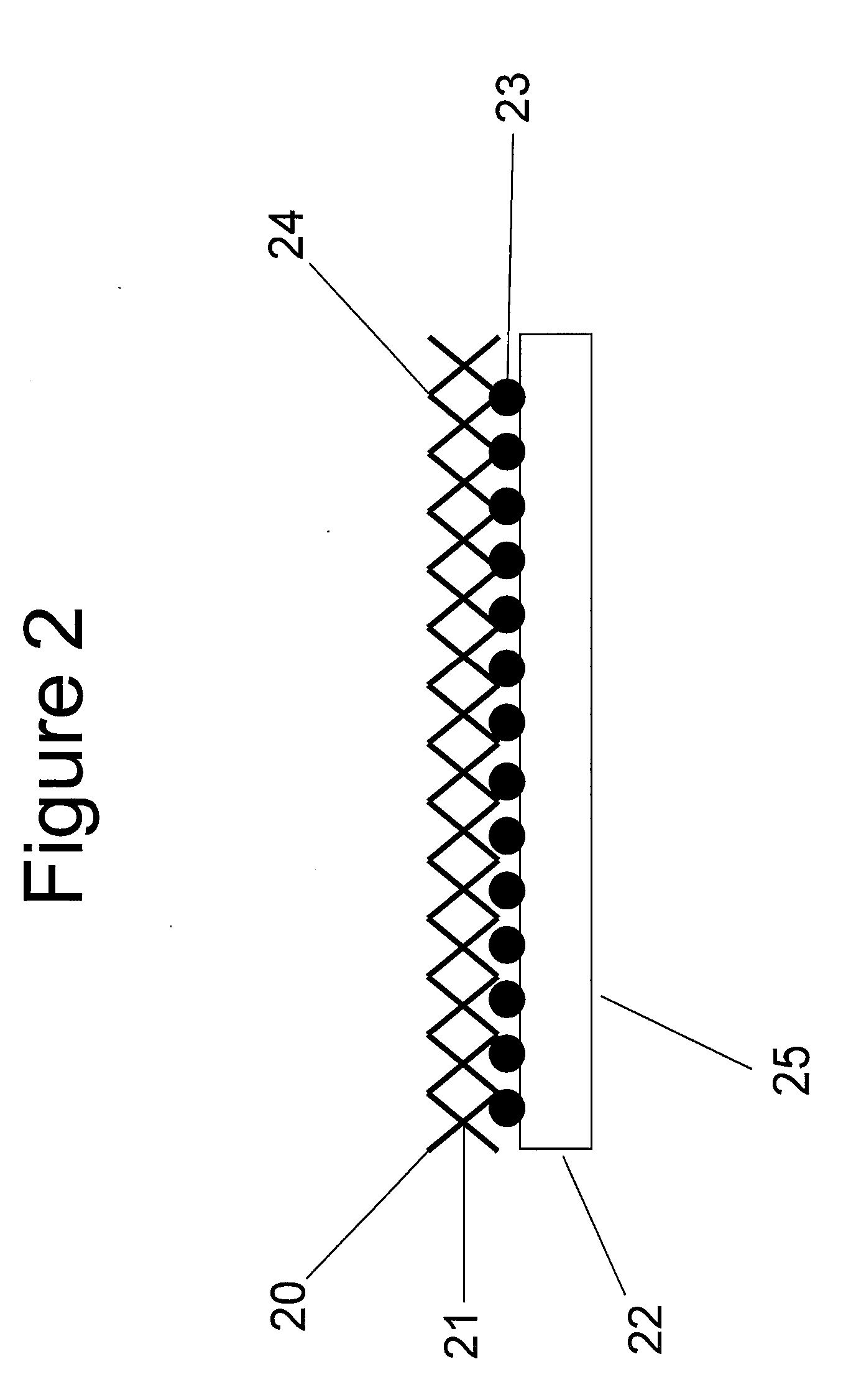
Figure 3
Abstract
Description
FIELD OF THE INVENTION
[0001] Described, herein, is a lightweight, air permeable enclosure having an exterior non-textile surface. Further described are lightweight laminates for making the enclosures.BACKGROUND OF THE INVENTION
[0002] Lightweight enclosures that provide some protection from environmental conditions are known, such as tents, bivy bags, bivy sacks, and the like. Polyester and nylon materials used to construct lightweight enclosures are coated to provide water resistance or waterproofness, and can be printed to achieve a desired aesthetic.
[0003] Lightweight tent constructions are typically considered as having either a double wall construction that has a separate rain fly and tent body, or a single wall construction having only a tent body comprised of, for example, a laminate material, and having no separate rain fly. Double wall tents rely on a rain fly to provide waterproofness by being positioned over a tent body otherwise constructed of highly air permeable and water ...
Examples
example 1
[0102]A three-layer laminate was formed comprising an outwardly facing printed outer film surface, a non-colorized inner film surface and a flame-resistant textile laminated between the two film layers.
[0103]The flame-resistant textile was a 1.5 oz / yd2 woven textile (1.7 denier per filament, cut to a staple length of 1.5″-2″ NOMEX Type 462 (93% NOMEX® aramid fibers, 5% Kevlar® aramid fibers, 2% P-140) Gore PN WCBZ000) with the tradename Nomex® Synergy Lite.
[0104]An expanded polytetrafluorethylene (PTFE) membrane was made from PTFE containing PFBE according to U.S. Pat. No. 6,541,589, and processed into an expanded membrane comprising polytetrafluoroethylene (PTFE) according to the process taught in U.S. Pat. No. 3,953,566. The microporous expanded PTFE membrane was water vapor and air permeable, and had the properties shown as Membrane Example 1 (M1) in Table 1.
[0105]The laminate was constructed as follows. One membrane was laminated to one side of the woven textile using a flame-re...
example 2
[0110]A three-layer laminate was formed comprising an outwardly facing outer film surface, an porous inner film, and a flame-resistant textile laminated between the two film layers, where both the outer and inner film surfaces were colorized with a black colorant.
[0111]Film layers were produced from microporous expanded PTFE membranes described in Example 1. Prior to lamination with a flame-resistant textile as described in Example 1, the surface of the porous membranes were rendered oleophobic by treating them with an aqueous latex of an organic polymer having pendant perfluoroalkyl side chains obtained from W. L. Gore & Associates, Inc. prepared based on Example 1B in U.S. Pat. No. 5,539,072 (incorporated herein by reference) and containing about 0.7% by weight of carbon black (Vulcan® XC72, Cabot Corporation, Boston, Mass). The resulting carbon coated membranes were dried at 200° C. After drying, the coated films had oil ratings of 6. The Gurley number of each sample was virtuall...
example 3
[0114]A three-layer laminate was formed comprising an outwardly facing printed outer film surface, an inner porous film colorized black, and a flame-resistant textile laminated between the two film layers.
[0115]Microporous membranes were made according to Example 1. One microporous expanded PTFE membrane layer was colorized black according to the method used Example 2 to form a colorized film layer. The colorized film was laminated to a flame resistant textile described in Example 1 to form a two-layer laminate. A second microporous membrane made according to Example 1 was laminated to the flame-resistant textile layer of the two-layer laminate to form a three-layer laminate. The black colorized film formed the porous inner film of the laminate.
[0116]The membrane surface on the side of the three-layer laminate opposite the black colorized film layer was printed with a desert camouflage pattern to form the laminate printed outer film surface. The outer porous film was printed accordi...