
Solid state neutron detector
a solid-state neutron and detector technology, applied in the field of neutron detectors, can solve the problems of low false-positive detection capability of neutrons, relatively poor gamma insensitivity, manufacturing and operation risks, etc., and achieve high neutron capture cross section, low cost, and high intrinsic efficiency
Patent Information
- Authority / Receiving Office
- US · United States
- Patent Type
- Applications(United States)
- Current Assignee / Owner
- Publication Date
- 2011-11-03
- Estimated Expiration
- Not applicable · inactive patent
Smart Images
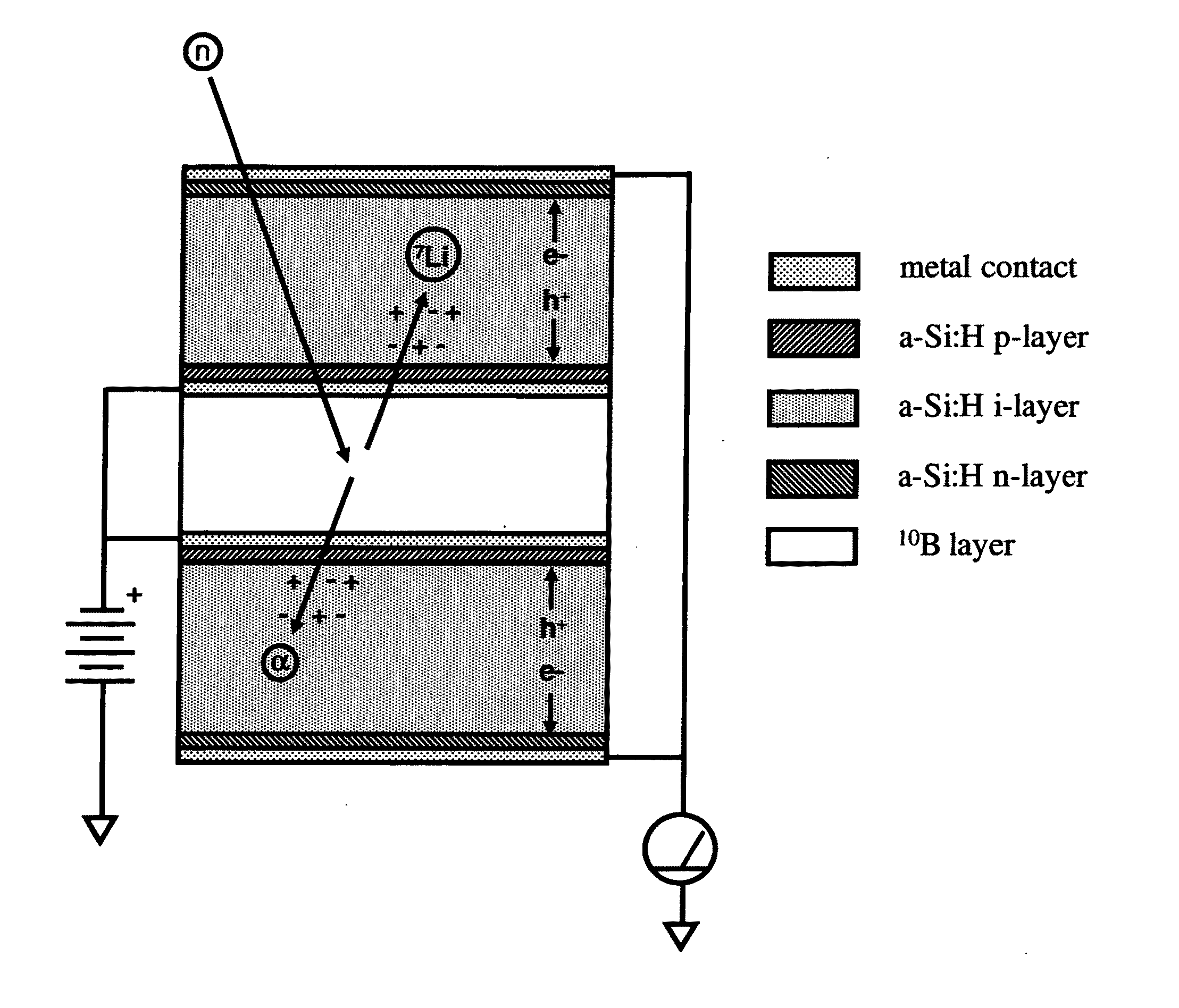
Figure 1 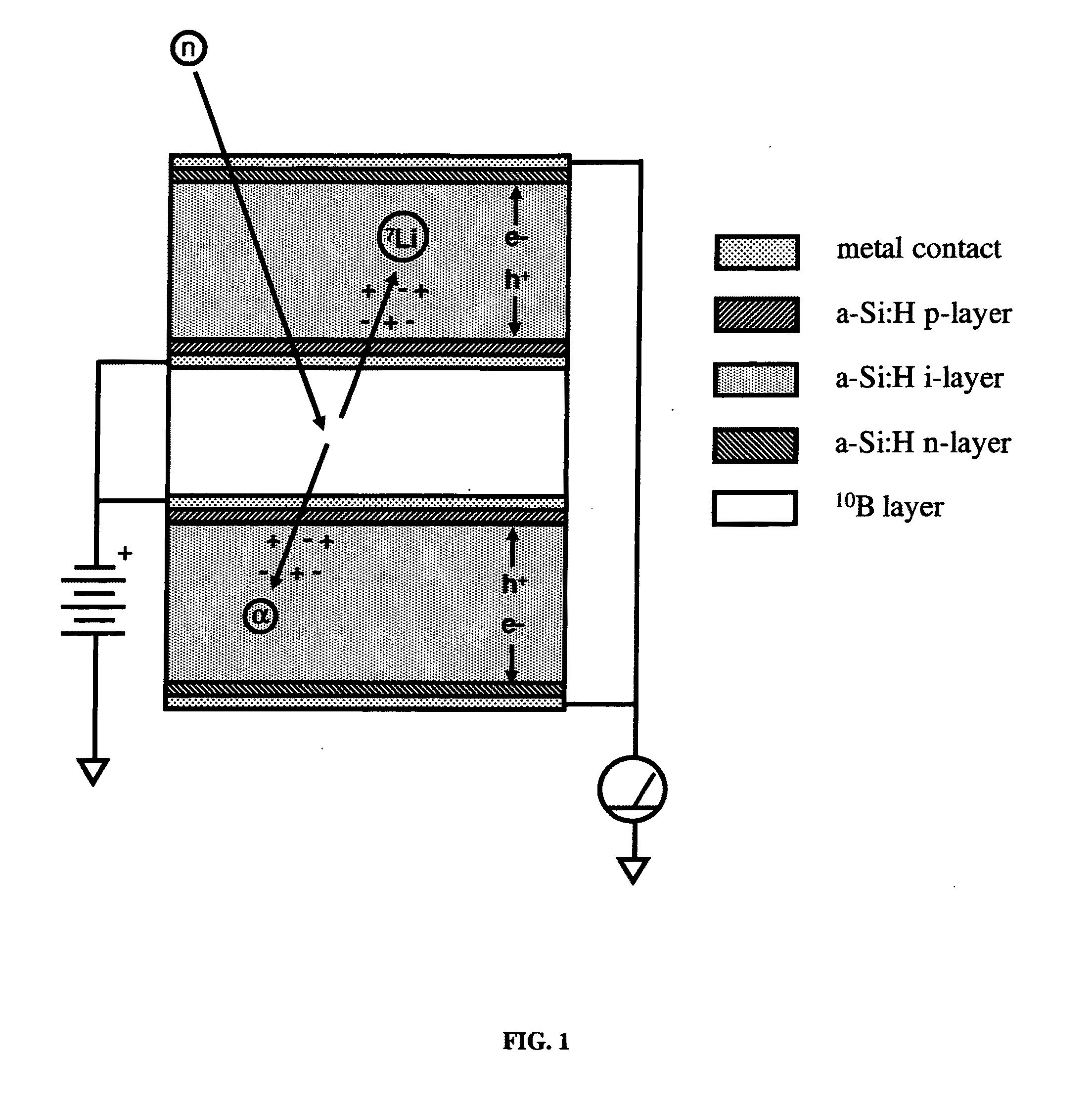
Figure 2 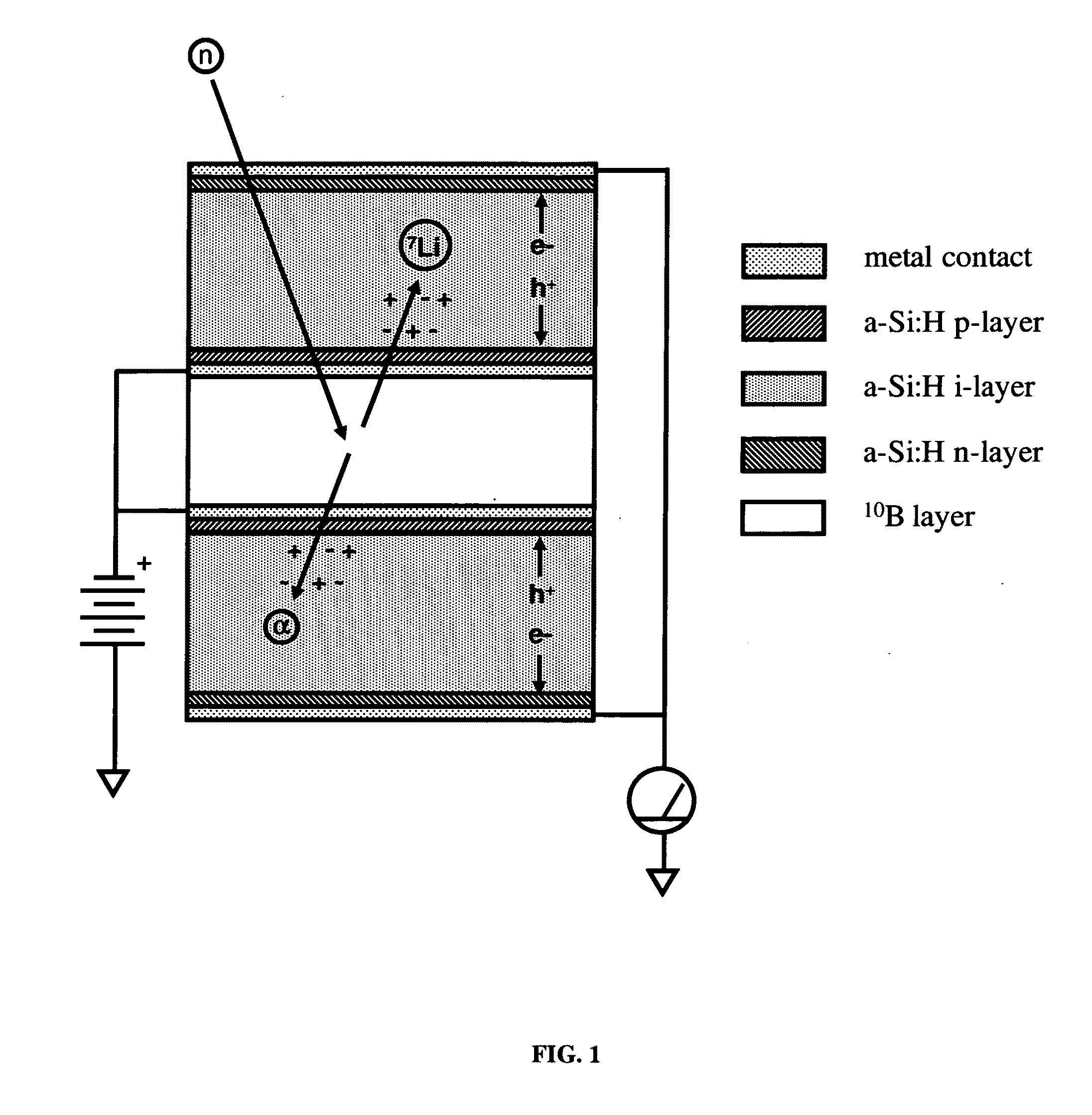
Figure 3
Abstract
Description
CROSS REFERENCE TO RELATED APPLICATIONS
[0001] This application claims the benefit of Provisional Patent Application Ser. No. 61 / 343,488 filed Apr. 28, 2010.FIELD OF THE INVENTION
[0002] This invention relates to neutron detectors and in particular to solid state neutron detectors.BACKGROUND OF THE INVENTION
[0003] Neutron detectors are used for monitoring of cargo containers and vehicles for nuclear weapons because neutrons are emitted by radiological materials of interest such as plutonium and they are difficult to shield. Neutron detectors are also used in other applications such as medical diagnostics, oil and gas exploration; and scientific research. The prior art includes several different types of neutron detectors, as described here.Helium-3 Tube Detectors
[0004] Helium-3 (3He) tube detectors are the dominant technology used for neutron detection due to their superior sensitivity to neutrons. These detectors are also relatively insensitive to high energy electromagnetic (gamma) radi...
Examples
first preferred embodiment
Five 10B Layer Neutron Detector
[0034]FIG. 5 shows a cross-sectional diagram of the preferred embodiment of the invention involving five 10B layers interleaved between six hydrogenated amorphous silicon (a-Si:H) PIN diodes. As a single neutron passes through the detector, it will have an eight percent probability of being absorbed in the first 10B layer, assuming a 1.6 micron thick layer of greater than 90% enriched 10B in the 10B layers. If the first 10B layer (N=1) does not absorb the neutron, then the other 10B layers (N=2, 3, 4, 5) will contribute to the total intrinsic efficiency PABS(N=5) according to the equation
[0035]PABS(N)=1−exp└−NPABS,SINGLELAYER┘
where PABS,SINGLELAYER=0.08 is the intrinsic efficiency for neutron detection in a single 10B layer device. FIG. 6 shows a graph of the intrinsic efficiency for detecting neutrons PABS (N) versus number of 10B layers N. FIG. 6 shows that the preferred embodiment has PABS(N=5)=34% intrinsic efficiency for detecting neutrons.
[0036]F...