
Protein nanocarriers for topical delivery
a technology of nanocarriers and peptides, applied in the direction of peptide/protein ingredients, powder delivery, granular delivery, etc., can solve the problems of phagocytosis of particles greater than 500 nm in diameter, large particle size distribution, and large zein particle size, so as to reduce the skin irritation rating of a topically applied retinoid, and reduce the toxicity of a therapeutic agen
Patent Information
- Authority / Receiving Office
- US · United States
- Patent Type
- Applications(United States)
- Current Assignee / Owner
- Publication Date
- 2012-08-02
Smart Images
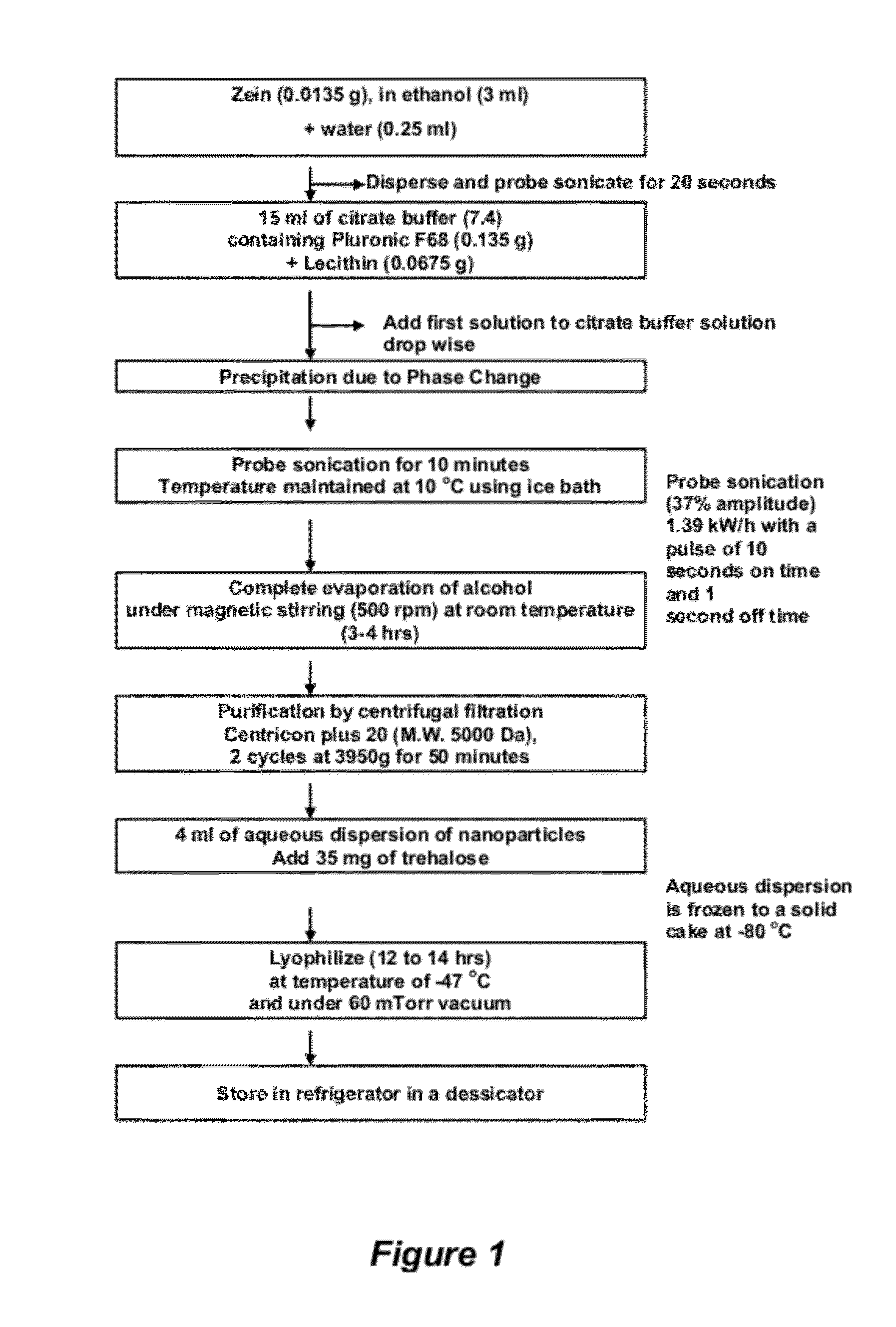
Figure 1 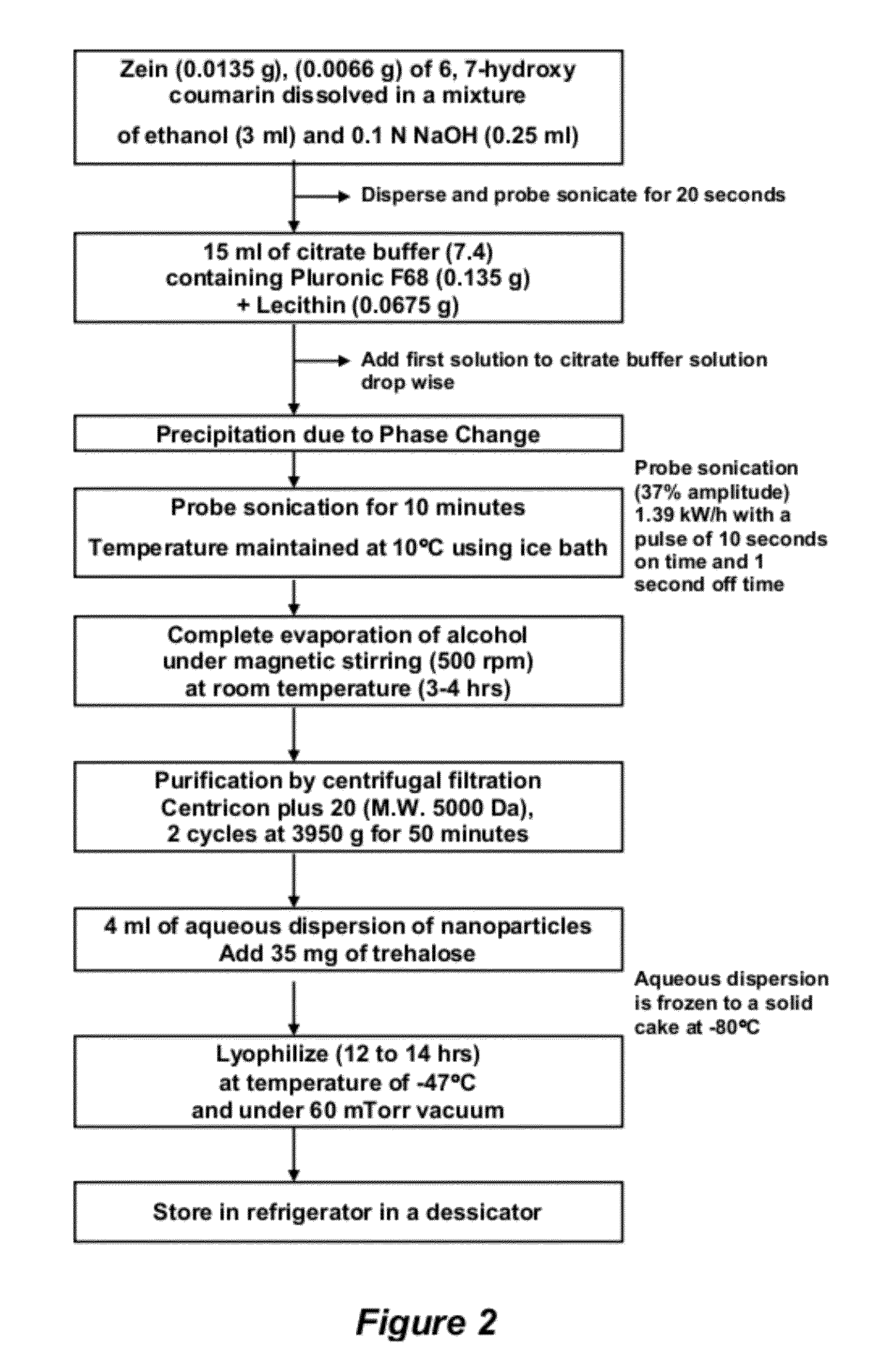
Figure 2 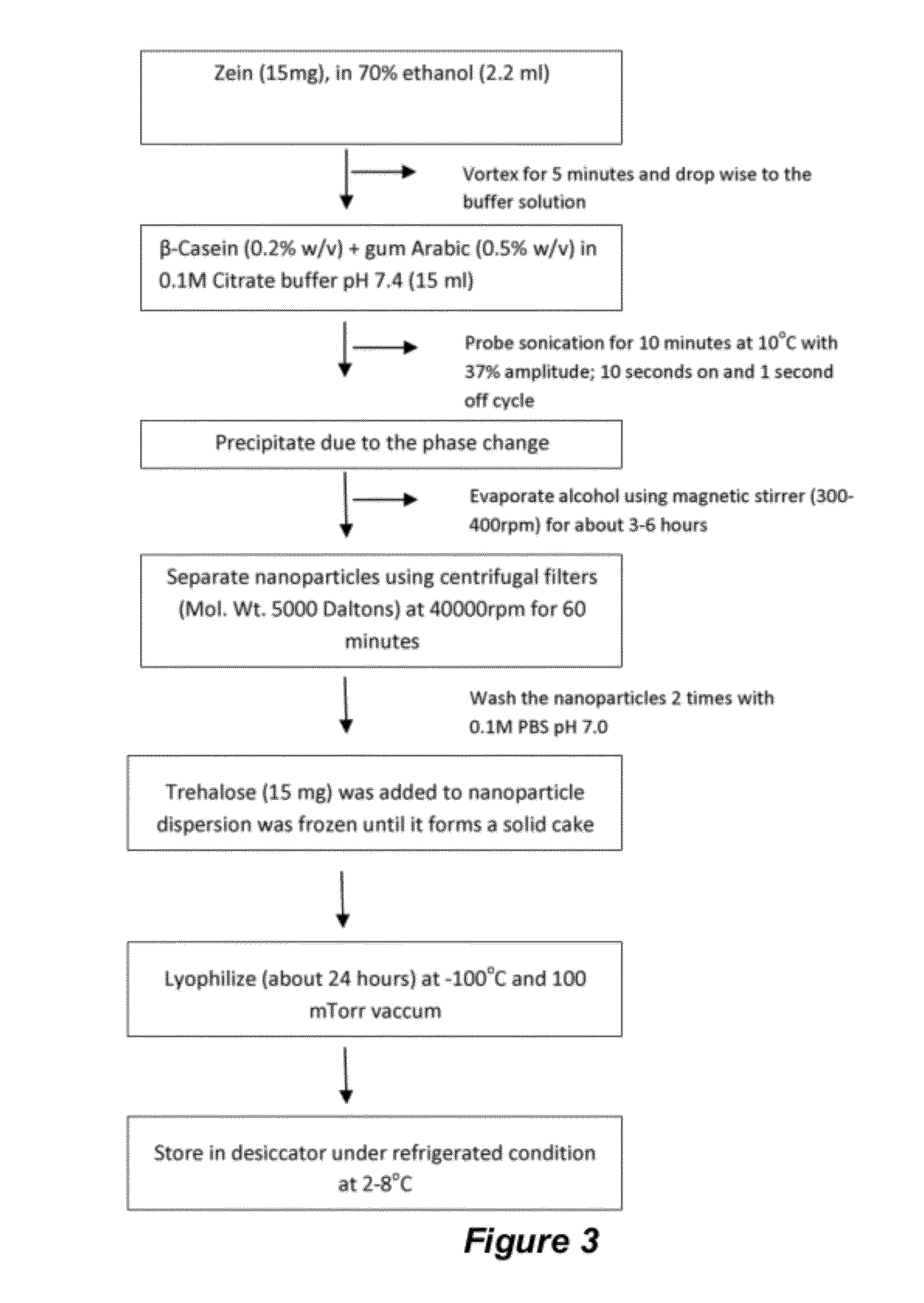
Figure 3
Abstract
Description
CROSS REFERENCE TO RELATED APPLICATION
[0001] This application is a continuation-in-part of U.S. application Ser. No. 12 / 991,872, filed Dec. 13, 2010, which is a national phase entry of PCT / US2009 / 002935, filed May 11, 2009, which claims the benefit of U.S. Provisional Application No. 61 / 127,134, filed May 9, 2008; this application also claims benefit of U.S. Provisional Application No. 61 / 446,934, filed Feb. 25, 2011. The disclosures of each of these applications are incorporated by reference herein in their entireties.FIELD OF THE INVENTION
[0002] The present invention relates generally to drug delivery technologies, and more specifically to a nanoparticle drug delivery system, including methods for preparing such a system using a hydrophobic water insoluble protein, which nanoparticles may include prolamine to generate a topical drug delivery system.BACKGROUND INFORMATION
[0003] Zein, a plant protein that can be isolated from corn or maize, belongs to a family of prolamines that are co...
Examples
example 1
Zein Nanoparticle Preparation
[0183]In a first aqueous phase, 13.5 mg of white zein was dissolved in a mixture of 3 mL of ethanol and 0.25 mL of water. The concentration of zein or solvent combination used was optimal; however, nanoparticles in the desired different size range can be produced by modifying the zein concentration or solvent composition. Dissolution of the zein was aided by the application of probe sonication for about 20 seconds. The resulting solution of the first aqueous phase was then added drop-wise into a 15 mL solution of citrate buffer, with a pH 7.4, and a combination of lecithin (0.45% w / v) and PLURONIC® F68 (0.9% w / v) under constant application of ultrasonic energy (1.39 kW / h, 37% amplitude) for 10 minutes with a pulse on time of 10 seconds and off time of 1 second. During the ultrasonic shearing process, the dispersion was kept in an ice bath to maintain the temperature at about 10° C. The dispersion was then placed on a magnetic stirrer at between 300 to 50...
example 2
Zein Nanoparticle Preparation Using a High Pressure Homogenizer
[0186]An amount of 0.65% w / v white zein was dissolved in a mixture of 6 mL of ethanol and 0.50 mL of water. The composition of the resulting solution of the first aqueous phase was altered to obtain a desired pH of about pH 6 to about pH 7. Dissolution of the zein was aided by the application of probe sonication for about 20 seconds. The resulting solution of the first aqueous phase was then added drop-wise into a 30 mL solution of citrate buffer, having a pH 7.4, and a combination of lecithin (0.45% w / v) and PLURONIC® F68 (0.9% w / v) under Constant application of ultrasonic energy (1.39 kW / h, 37% amplitude) for 2 minutes with a pulse on time of 10 seconds and off time of 1 second. During the ultrasonic shearing process, the dispersion was kept in an ice bath to maintain the temperature at about 10° C. The resulting coarse suspension was then passed through a high pressure homogenizer (NANO DEBEE®, USA) having an orifice ...
example 3
Preparation of Agent Encapsulating Zein Nanoparticles
[0192]An example of a method for forming a molecule-encapsulated nanoparticle is as follows. White zein in the amount of 13.5 mg was dissolved in a mixture of 3 mL ethanol and 0.25 mL of 0.01N NaOH to adjust the pH between 6 and 7. To the solution was added 6.6 mg of 6,7 hydroxycoumarin and the mixture was subjected to probe sonication for 20 seconds to assure dissolution. In various embodiments, the 6,7-hydroxycoumarin can be replaced with about 0.03 mmol to about 0.05 mmol of a different agent described herein, such as retinol or a derivative thereof. In some embodiments, about 0.1% w / w to about 2% w / w, or about 0.3% w / w to about 1% w / w of an active agent, such as retinol, can be employed. The resulting solution was added drop-wise into 15 mL of citrate buffer (pH 7.4) containing 67.5 mg of lecithin and 135 mg of PLURONIC® F68 under constant ultrasonic energy at 1.39 kW / h and 37% amplitude for 10 minutes, with a pulse on-time of...