
Wall Mounted Ironing Board Cabinet
a wall-mounted and ironing board technology, applied in the field of wall-mounted ironing board cabinets, can solve the problems of limited use of the presently known ironing board cabinet, difficult in limited space, and difficulty in folding and carrying the boards
Patent Information
- Authority / Receiving Office
- US · United States
- Patent Type
- Applications(United States)
- Current Assignee / Owner
- Publication Date
- 2013-06-20
- Estimated Expiration
- Not applicable · inactive patent
Smart Images
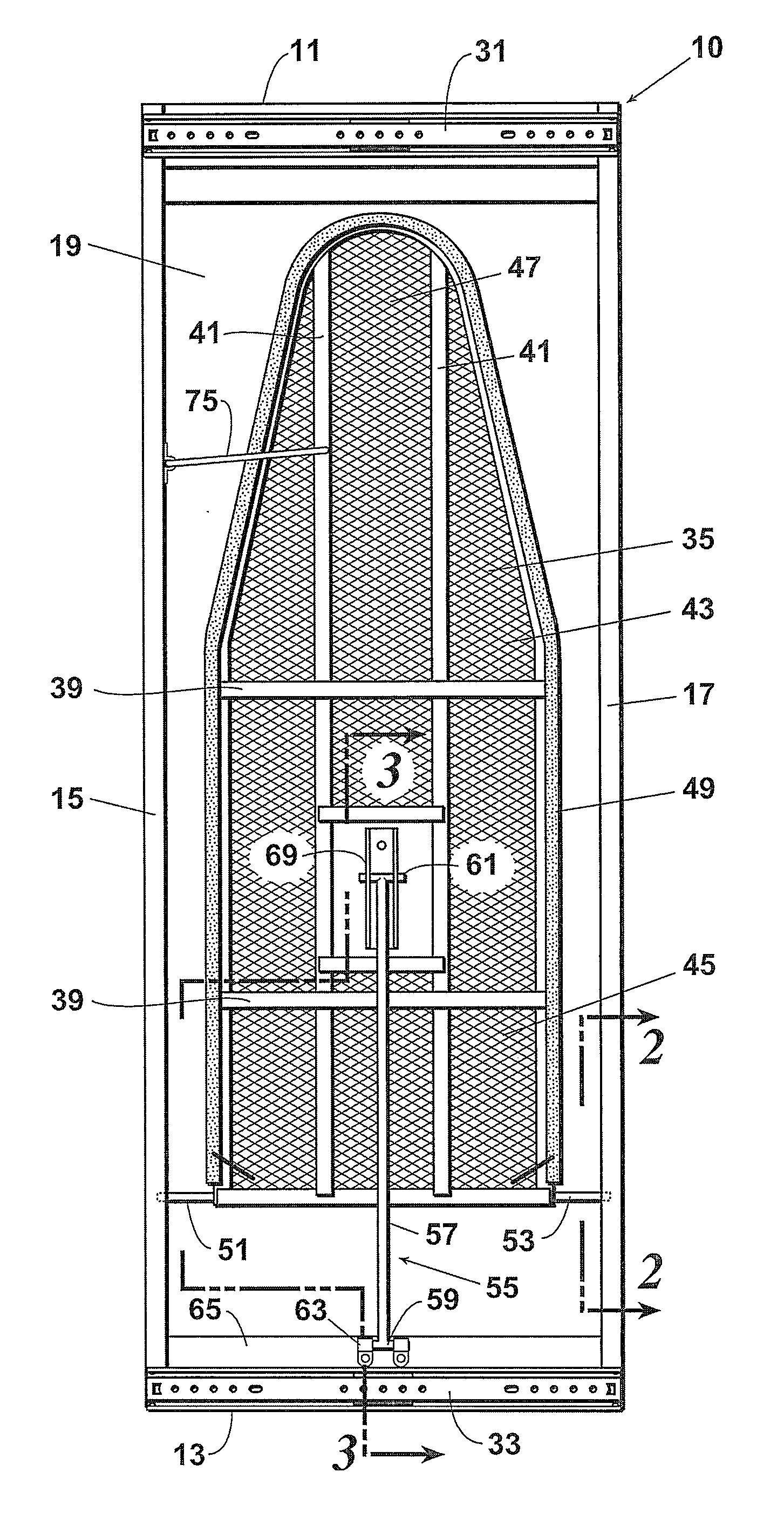
Figure 1 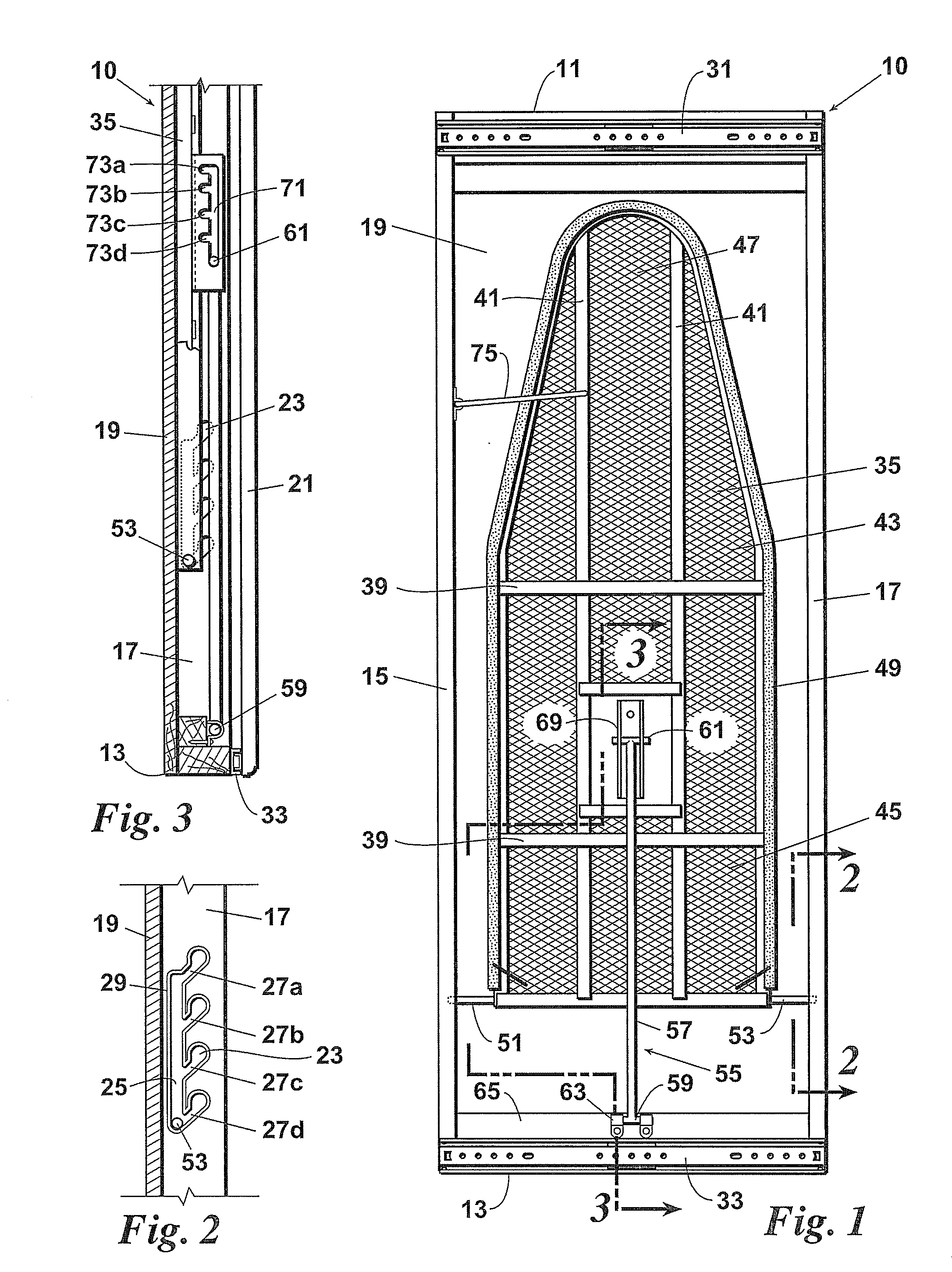
Figure 2 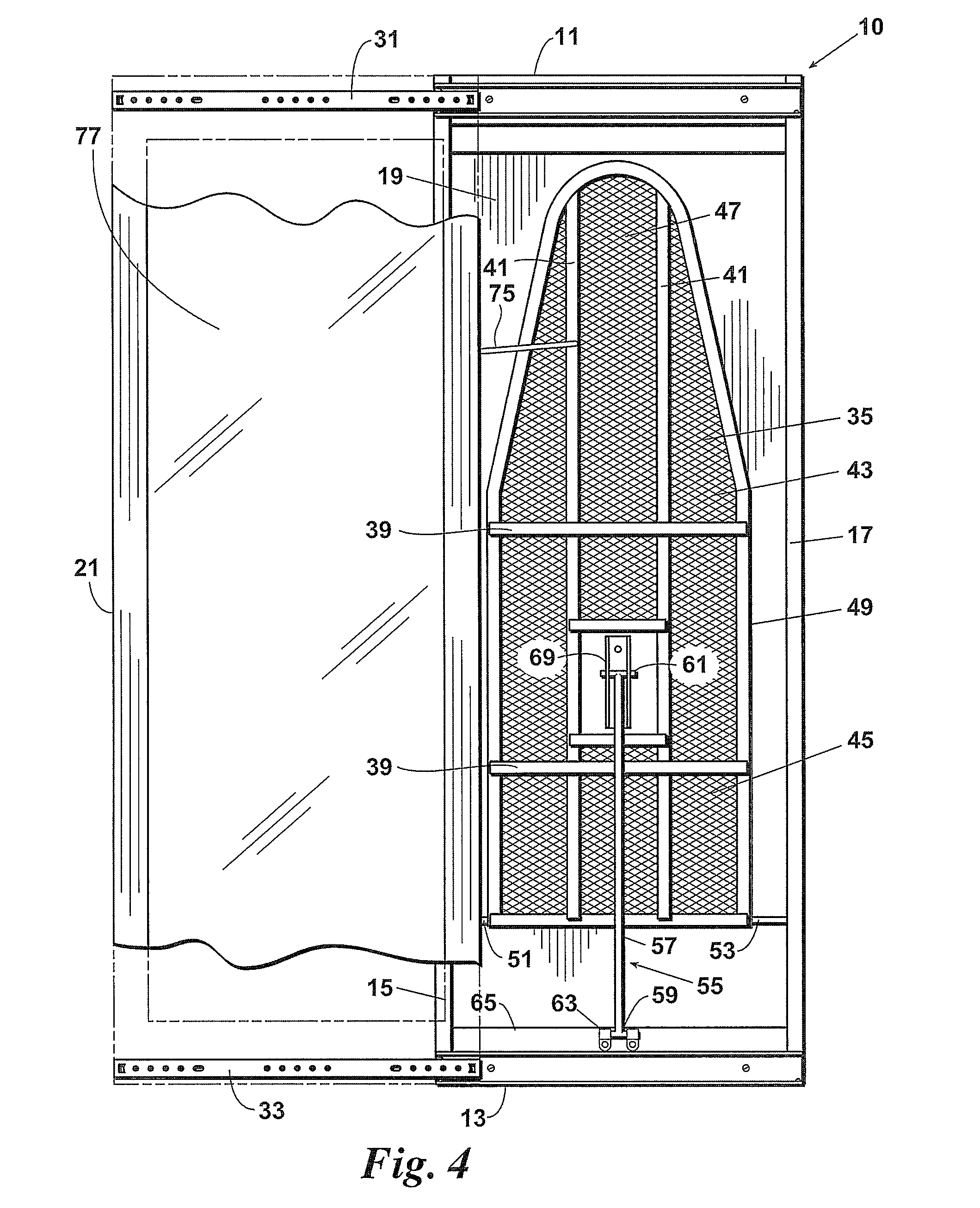
Figure 3
Abstract
Description
BACKGROUND OF THE INVENTION
[0001] This invention relates generally to ironing board cabinets and more particularly relates to wall mounted cabinets for concealing ironing boards in a vertical “storage” orientation and supporting them in a horizontal “use” orientation.
[0002] Earlier ironing boards had leg supports that could be folded. If sufficient space were available, a board might, for convenience sake, be left free-standing in an ironing area. More commonly, for space and / or aesthetic reasons, the legs would be folded after each use and the board leaned against a wall or stored in a closet. For older folks or for folks with physical debilitations, folding and carrying the boards can be problematic.
[0003] For some time now, ironing boards have been marketed which are self-contained in wall mounted cabinets with hinged doors. The doors conceal their presence when stored and the cabinets support them while they are in use. Wall mounted cabinets, which may be either surface mounted on ...
Examples
Embodiment Construction
[0025]Turning first to FIGS. 1-4, a shallow, wall mounted ironing board cabinet 10 is illustrated. The cabinet 10 has orthogonal top 11, bottom 13, side 15 and 17 and back 19 walls and a door 21 covering the open front of the cabinet 10.
[0026]As seen in FIGS. 2, 3 and 10, a pair of mirror-image channels 23 are routed in the opposed lower inside surfaces of their respective cabinet side walls 15 and 17. Each of the channels 23 has a vertical passage 25 spaced from the cabinet back wall 19 with an array of lateral passages 27a, 27b, 27c and 27d which extend forwardly and upwardly from their respective vertical passage 25. Preferably, the walls of the vertical 25 and lateral 27 passages of each channel 23 will be protected by a thin plastic insert 29.
[0027]Looking at FIGS. 1 and 3, the door 21 is attached to the front faces of the top 11 and bottom 13 walls of the cabinet 10 by upper 31 and lower 33 two-way sliders. The sliders 31 and 33 permit the door 21 to slide laterally across the...