
Beamforming techniques for single-stream communications
a single-stream communication and beamforming technology, applied in the field of wireless communications systems, can solve the problems that conventional single-antenna tx devices may not be able to take advantage of existing beamforming techniques, and single-antenna tx devices may be incapable of transmitting via multiple spatial channels, so as to improve the quality and/or performance of single-stream transmission, reduce and increase the per-tone power load of one or more identified subcarrier
Patent Information
- Authority / Receiving Office
- US · United States
- Patent Type
- Applications(United States)
- Current Assignee / Owner
- Publication Date
- 2017-08-03
- Estimated Expiration
- Not applicable · inactive patent
Smart Images
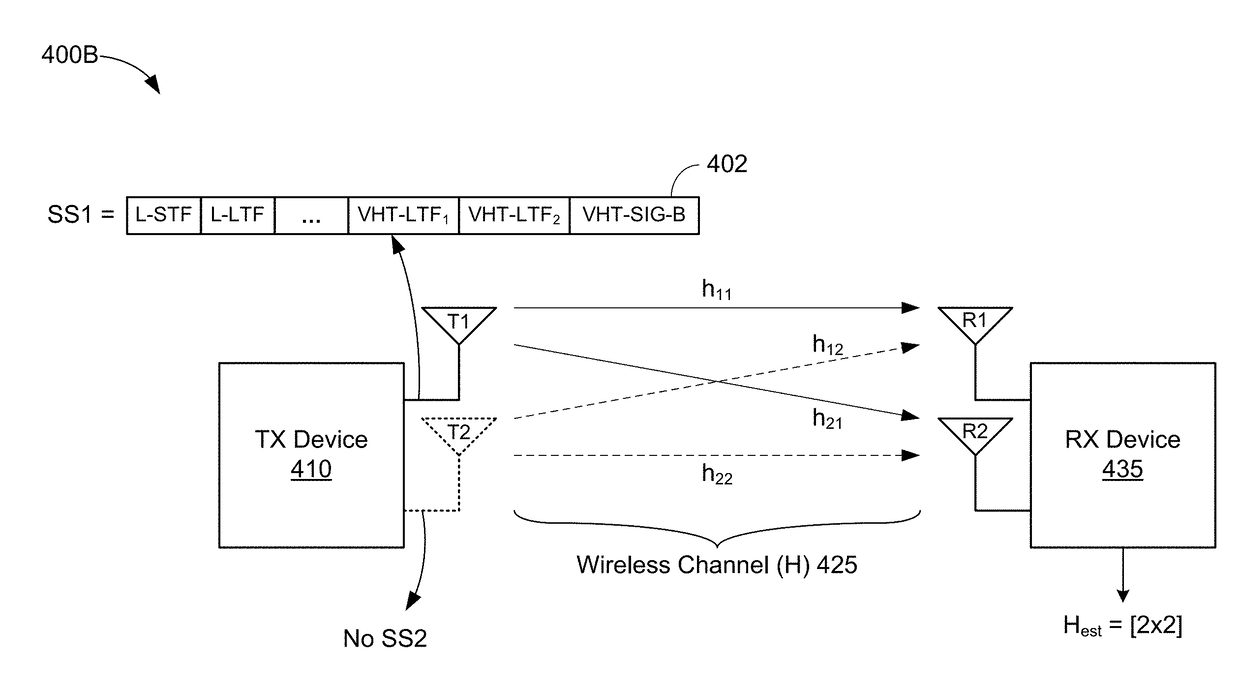
Figure 1 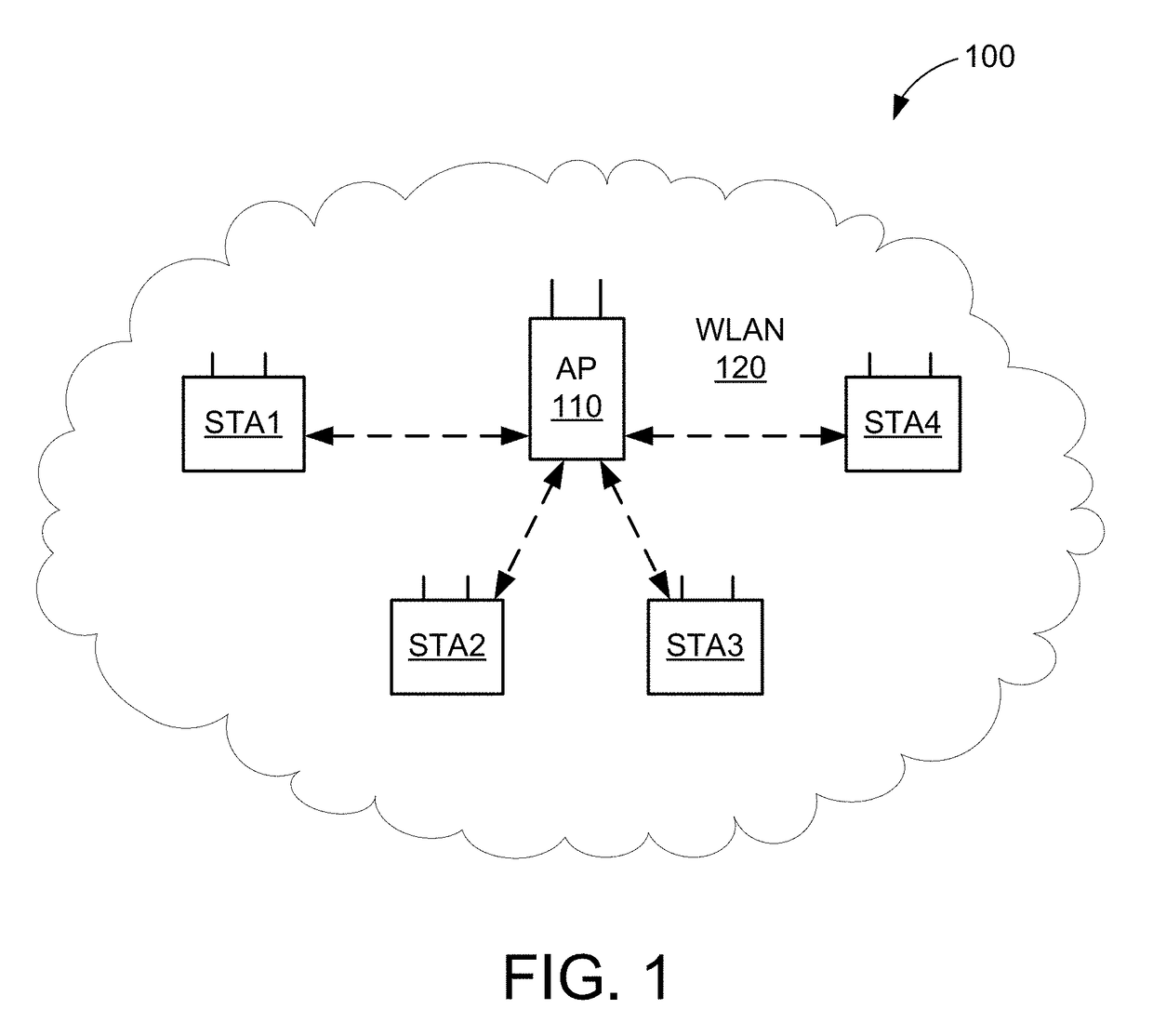
Figure 2 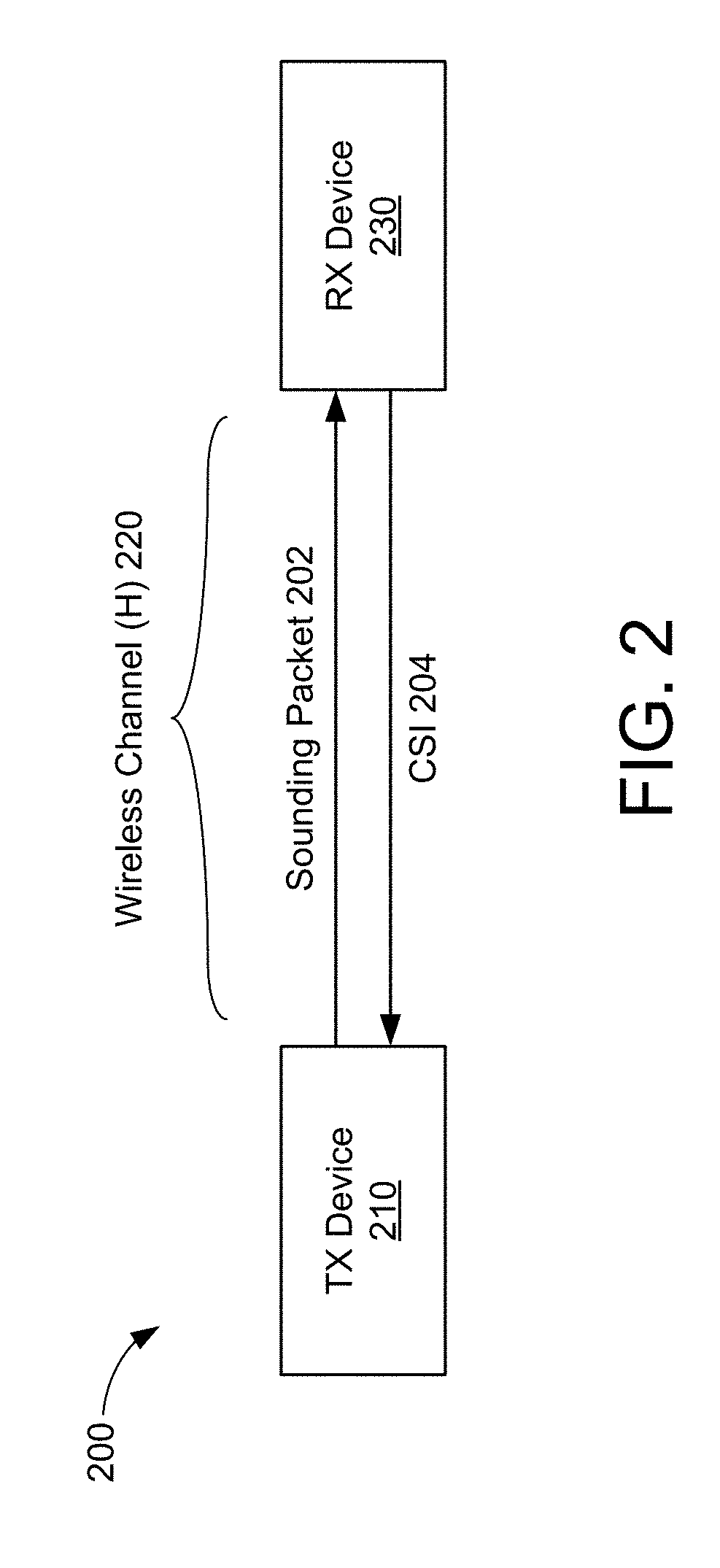
Figure 3
Abstract
Description
TECHNICAL FIELD
[0001] The present embodiments relate generally to wireless communications systems, and specifically to methods of improving single-stream communications using beamforming techniques.BACKGROUND OF RELATED ART
[0002] Transmit beamforming is a technique for improving wireless communications between a transmitting (TX) device and a receiving (RX) device by leveraging known properties of the wireless channel (e.g., channel state information (CSI)). In conventional beamforming, the TX device utilizes multiple antennas to focus energy (e.g., data signals) toward the RX device. For example, each of the antennas of the TX device may transmit the same wireless signal with different phase offsets to “steer” the signal in the direction of the RX device (e.g., as determined from the CSI). Beamformed signals converge (e.g., combine) along the steered path and interfere with (e.g., cancel) one another outside of the steered path. Thus, the effectiveness of beamforming may depend on th...
Examples
Embodiment Construction
[0022]The example embodiments are described below in the context of WLAN systems for simplicity only. It is to be understood that the example embodiments are equally applicable to other wireless networks (e.g., cellular networks, pico networks, femto networks, satellite networks), as well as for systems using signals of one or more wired standards or protocols (e.g., Ethernet and / or HomePlug / PLC standards). As used herein, the terms “WLAN” and “Wi-Fi®” may include communications governed by the IEEE 802.11 family of standards, BLUETOOTH® (Bluetooth), HiperLAN (a set of wireless standards, comparable to the IEEE 802.11 standards, used primarily in Europe), and other technologies having relatively short radio propagation range. Thus, the terms “WLAN” and “Wi-Fi” may be used interchangeably herein.
[0023]In addition, although described below in terms of an infrastructure WLAN system including one or more APs and a number of STAs, the example embodiments are equally applicable to other W...