
Lighting protection system
Patent Information
- Authority / Receiving Office
- US · United States
- Current Assignee / Owner
- Publication Date
- 2017-12-14
Smart Images
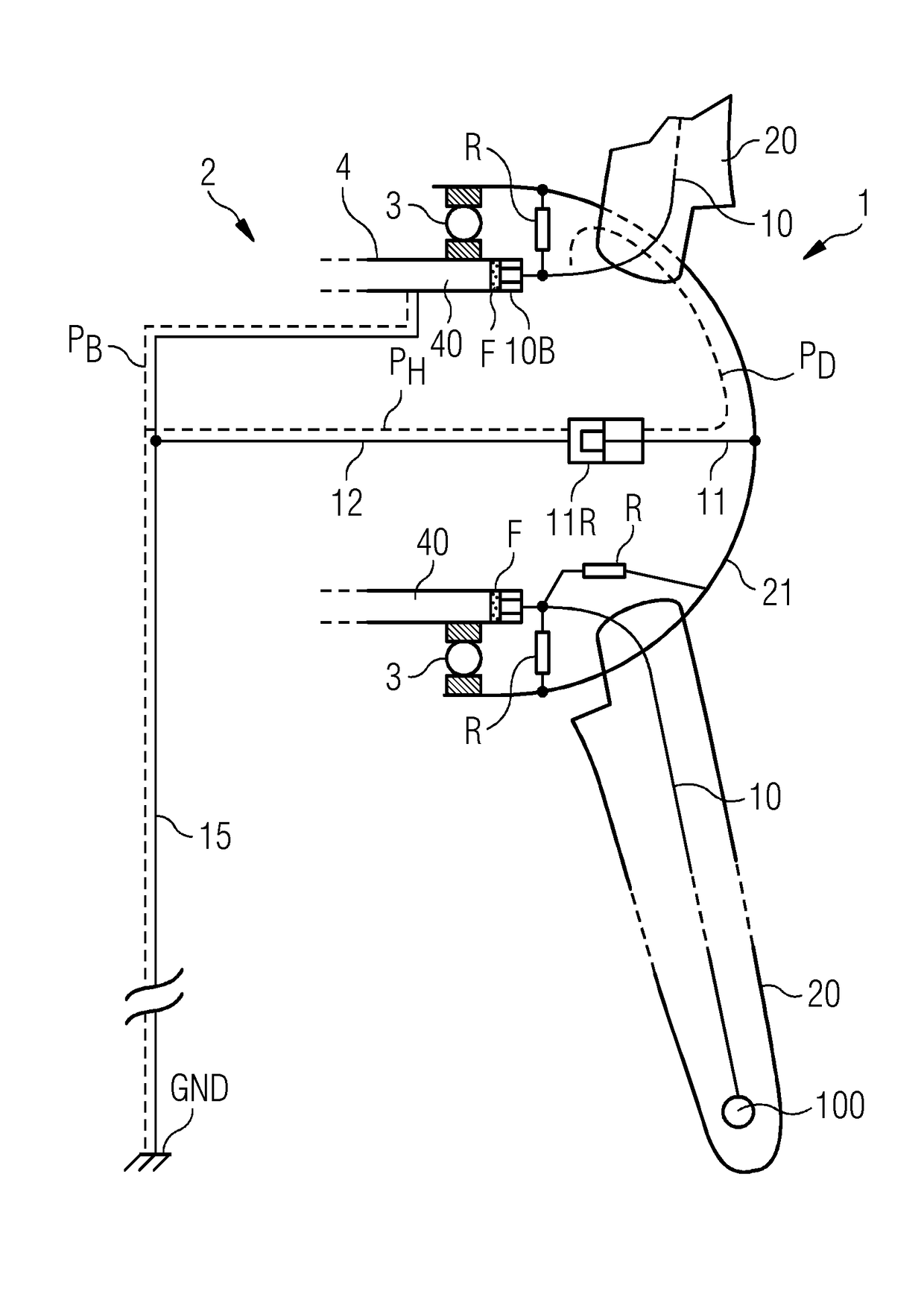
Figure 1 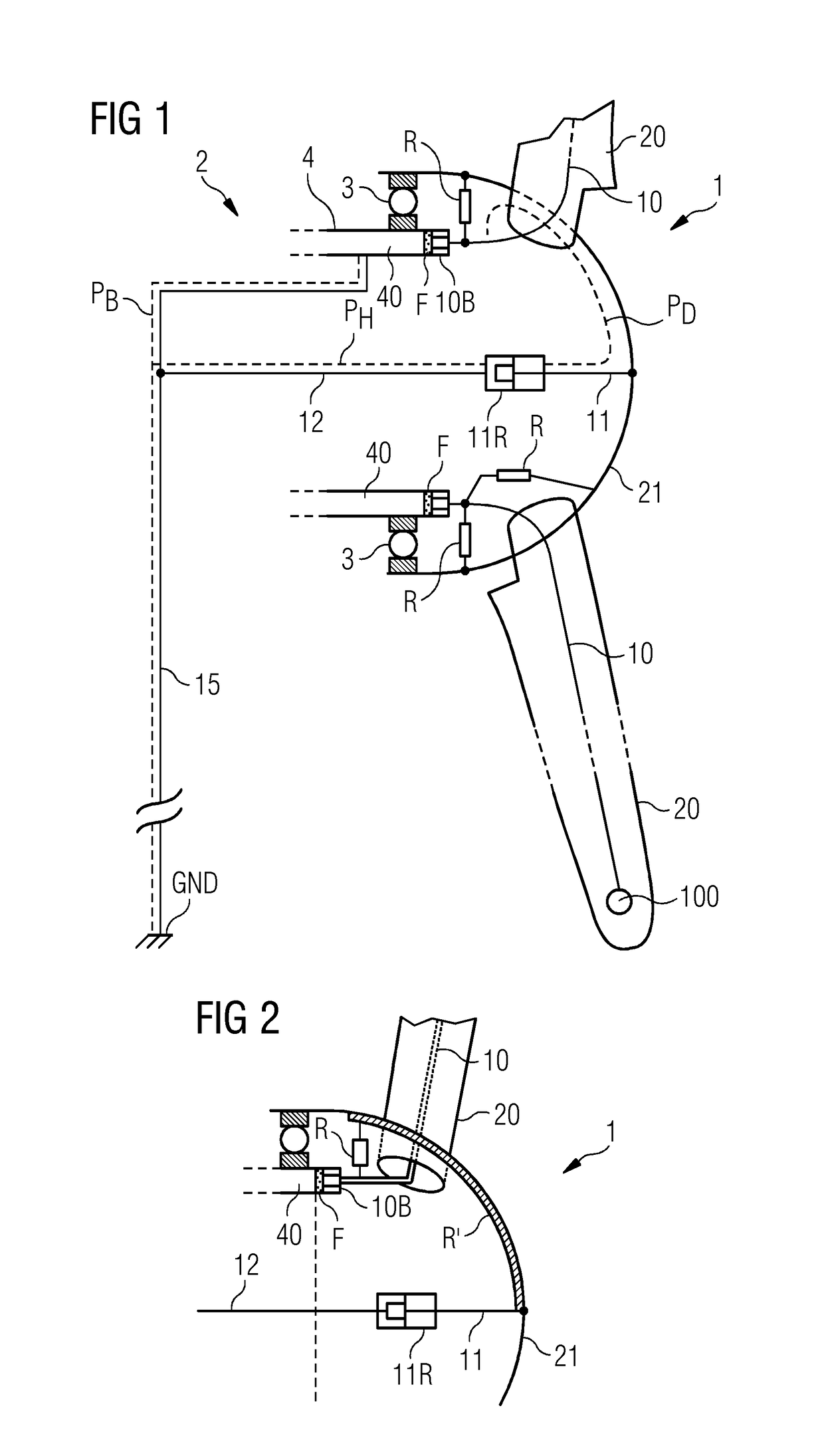
Figure 2 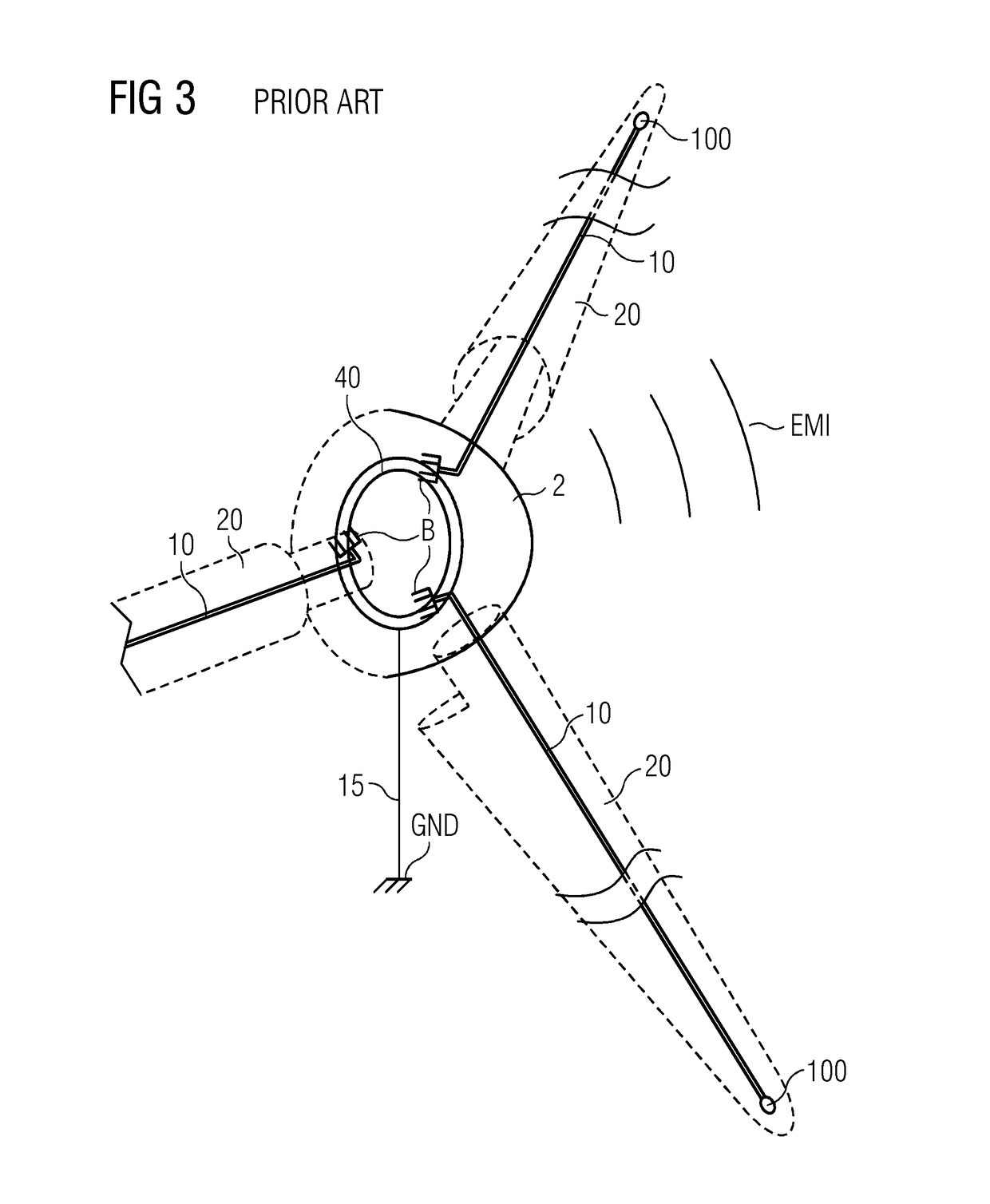
Figure 3
Abstract
Description
CROSS-REFERENCE TO RELATED APPLICATIONS
[0001] This application claims priority to European application No. EP 16173684.8 having a filing date of Jun. 9, 2016, the entire contents of which are hereby incorporated by reference.FIELD OF TECHNOLOGY
[0002] The following relates to a lighting protection system of a wind turbine, and a wind turbine comprising such a lightning protection system.BACKGROUND
[0003] A tall structure such as a wind turbine is equipped with a lightning protection system (LPS) which serves to receive a stroke at one or more specific sites or receptors, and to divert the ensuing electrical current to ground during a lightning strike. The blades of a wind turbine are particularly vulnerable to lightning strikes on account of their length. The LPS of a wind turbine therefore generally includes a lightning conductor for each blade, arranged in the interior of the blade and extending along its length from base to tip. The blades are generally mounted to a hub or spinner, an...
Examples
Embodiment Construction
[0026]FIG. 1 shows a lightning protection system 1 according to embodiments of the invention. The diagram is a very simplified schematic representation showing only the relevant aspects of the inventive LPS 1 installed in a wind turbine. A wind turbine hub 21 is indicated. The hub 21 is mounted to a nacelle 4 of the wind turbine by means of a bearing 3. The hub 21, which can also be hit by a lightning strike, is provided with a hub lightning conductor 11. Since the hub 21 rotates relative to the nacelle, a sealed rotary joint 11R connects the rotating hub lightning conductor 11 to a stationary conductor 12, which in turn leads to ground GND. Several blades 20 are mounted to the hub 21. A lightning conductor 10 extends along the length of each blade 20, terminating at the outer blade end in a receptor 100 which ensures that a lightning strike is received in a controlled manner. The other ends of each lightning conductor 10 terminate at a brush 10B, which is in contact with a stationa...