
Culinary chipping, slicing and dicing tool
Patent Information
- Authority / Receiving Office
- US · United States
- Current Assignee / Owner
- Publication Date
- 2019-08-22
Smart Images
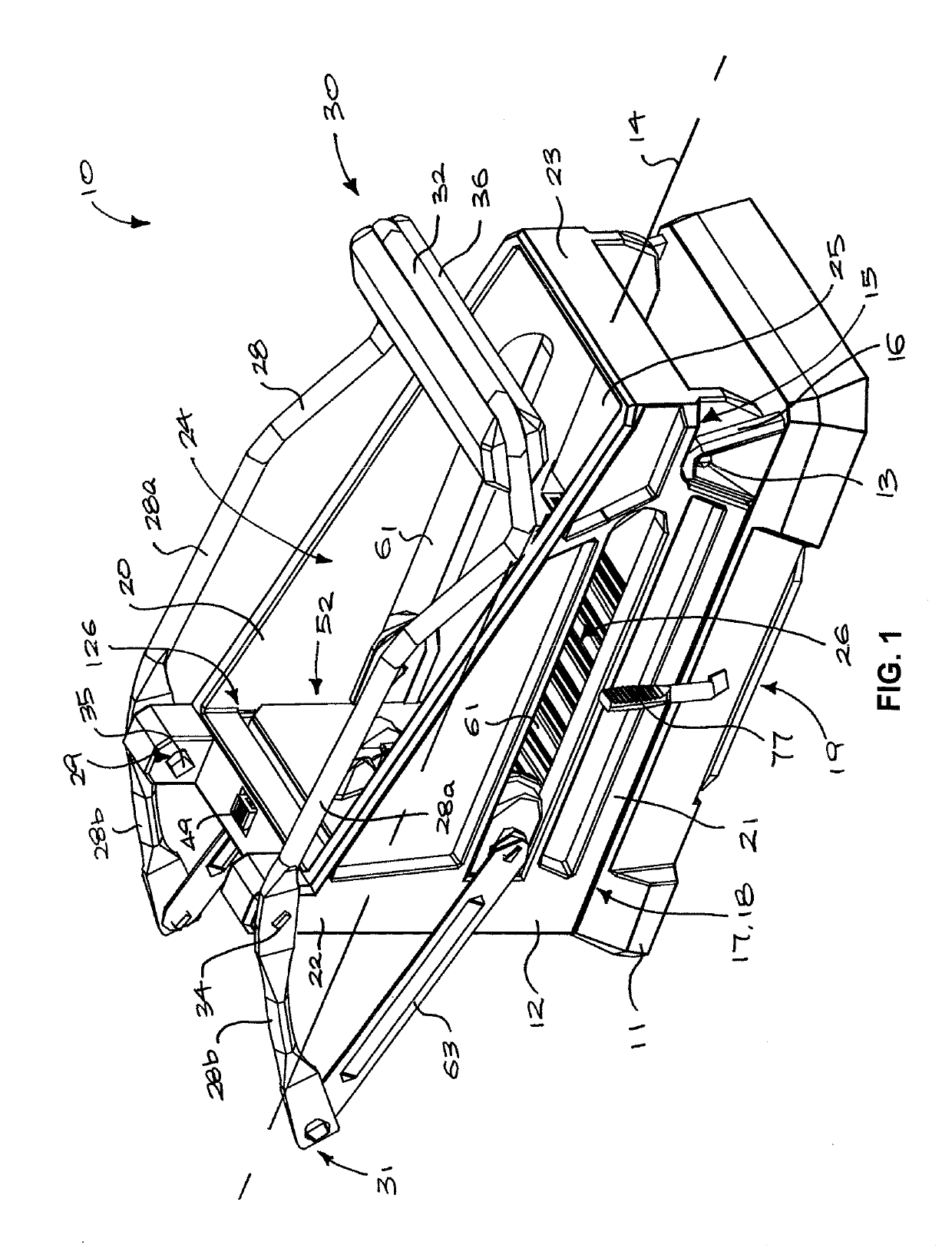
Figure 1 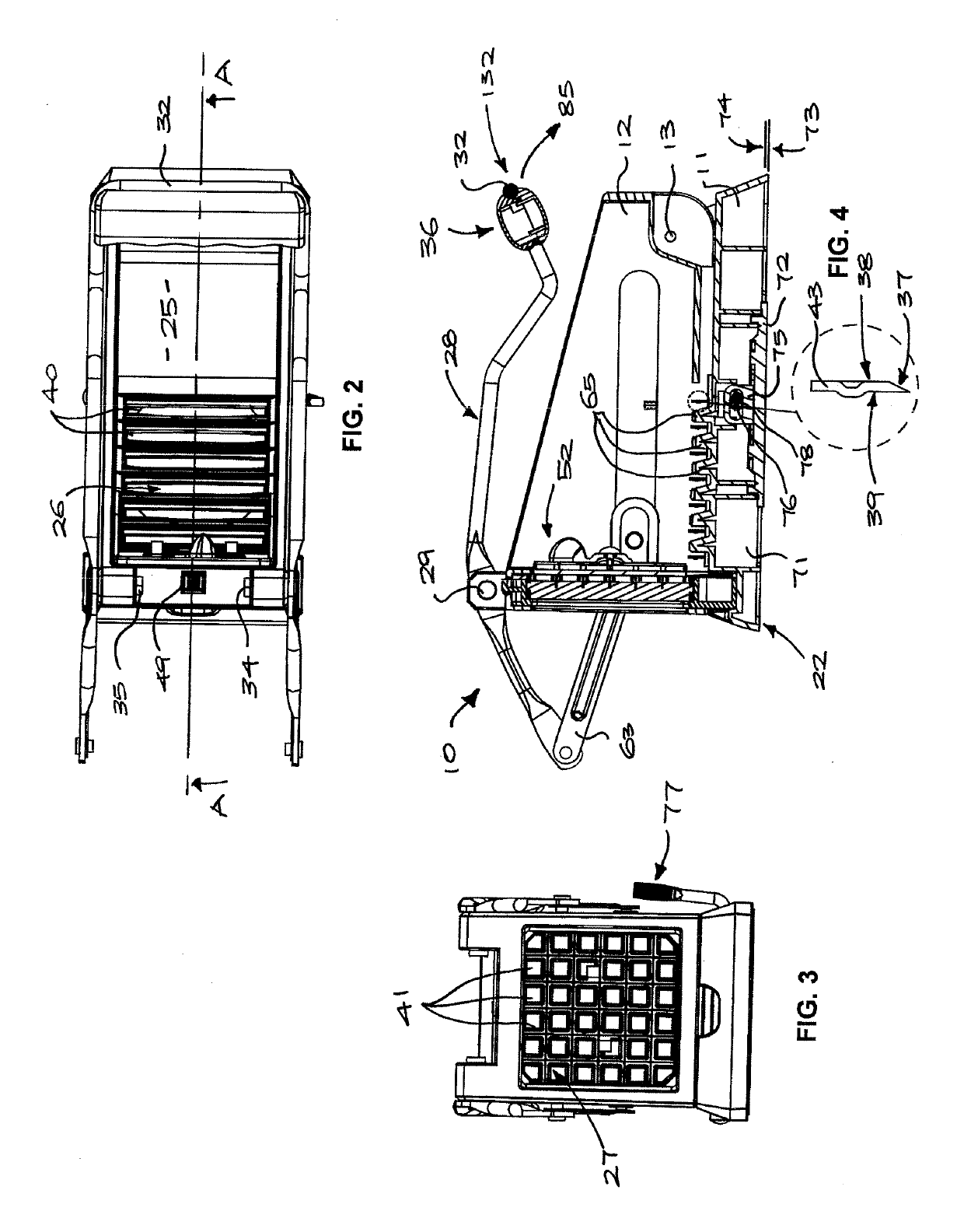
Figure 2 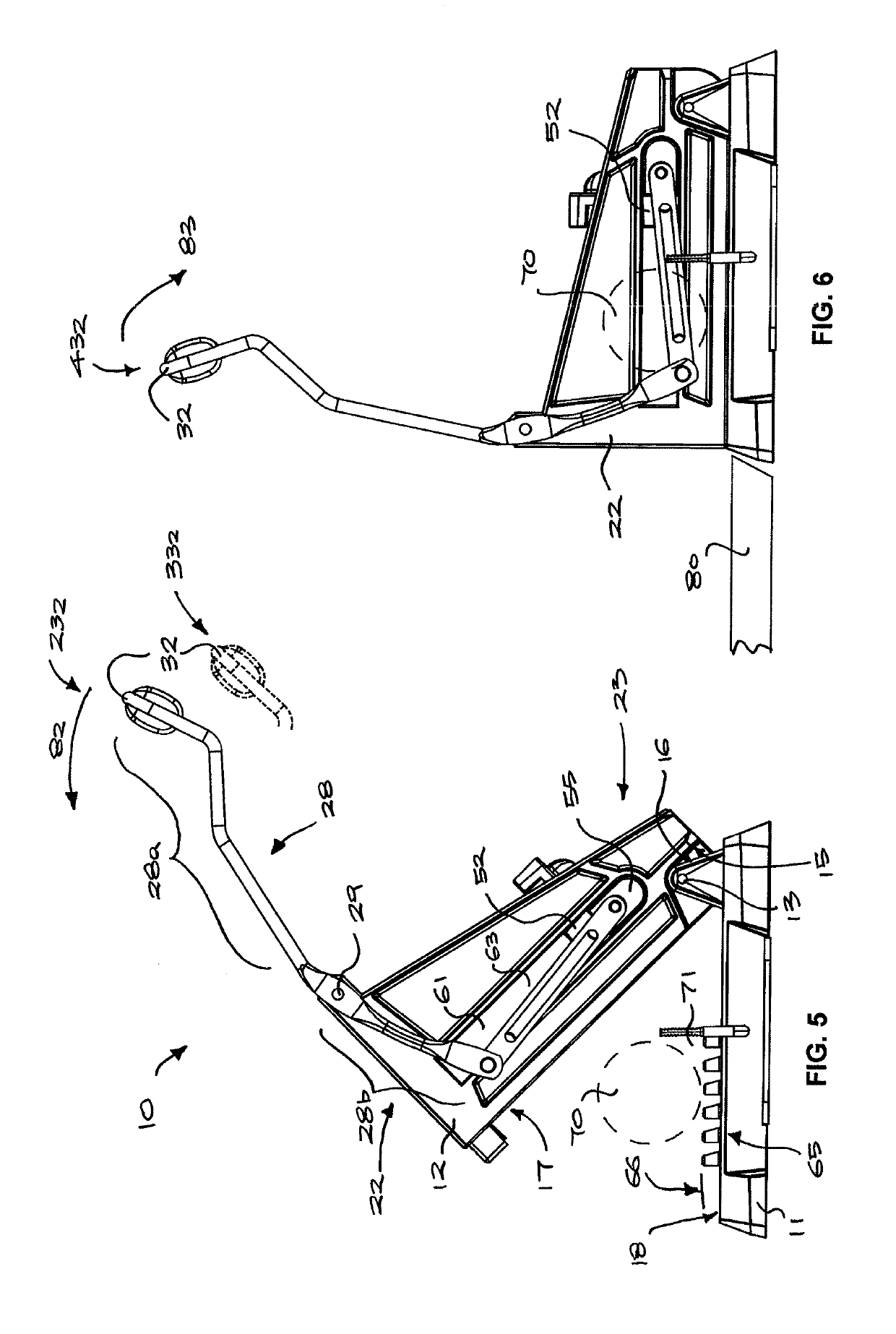
Figure 3
Abstract
Description
TECHNICAL FIELD
[0001] The present invention relates to a culinary tool that both slices and dices food, such as vegetables, fruit, and cheese.BACKGROUND OF THE INVENTION
[0002] Dicing manually involves making parallel cuts in three sets, the cutting directions of each set being orthogonal. To produce cubes, the spacing of cuts must be even and, if using a knife, the item to be cut must be turned at least once, so culinary hand tools continue to maintain a place in many kitchens, despite the proliferation of electrically powered food processors, because of their capacity to perform tasks such as dicing.
[0003] U.S. Pat. No. 7,587,968 describes a culinary hand tool including two orthogonal cutting grids through which an item is pressed sequentially to dice it into cubes: a first cutting grid that is upright and has square openings and a second that is horizontal with rectangular openings. A pivoting handle drives a horizontal pusher to press the item through the first grid and, with contin...
Examples
Embodiment Construction
[0035]Referring to FIGS. 1 and 5, a culinary tool 10 generally comprises a base 11 connected to a frame 12 by a hinge 13 to turn between an open position (FIG. 5) in which the frame 12 and base 11 are spaced apart, and a closed position (FIG. 1) in which the frame 12 rests on the base 11.
[0036]The frame 12 may have a generally rectangular prismatic form, with a long axis 14 orthogonal to the transverse axis of the hinge 13, the hinge 13 being disposed near one longitudinal end of the frame 12 and base 11. Stop surfaces 15, 16 on the frame and base, respectively, may abut to limit the relative angle of rotation about the hinge 13 in the direction of opening and provide a stable inclined position for the frame 12. Complementary surfaces 17, 18 on the frame and base, respectively, may abut in the closed position, whereby the frame 12 is supported on the base 11 with the axis 14 horizontal. A suction cup assembly 19 may be mounted in a centrally located recess in the base 11 for securin...