
Dielectric waveguide line, connection structure and method for producing dielectric waveguide line
a dielectric waveguide and connection structure technology, applied in waveguides, electrical devices, coupling devices, etc., can solve problems such as loss of transmission efficiency, and achieve the effects of reducing rapid change of impedance, reducing permittivity, and being easy to connect to each other
Patent Information
- Authority / Receiving Office
- US · United States
- Patent Type
- Applications(United States)
- Current Assignee / Owner
- Publication Date
- 2020-01-30
Smart Images
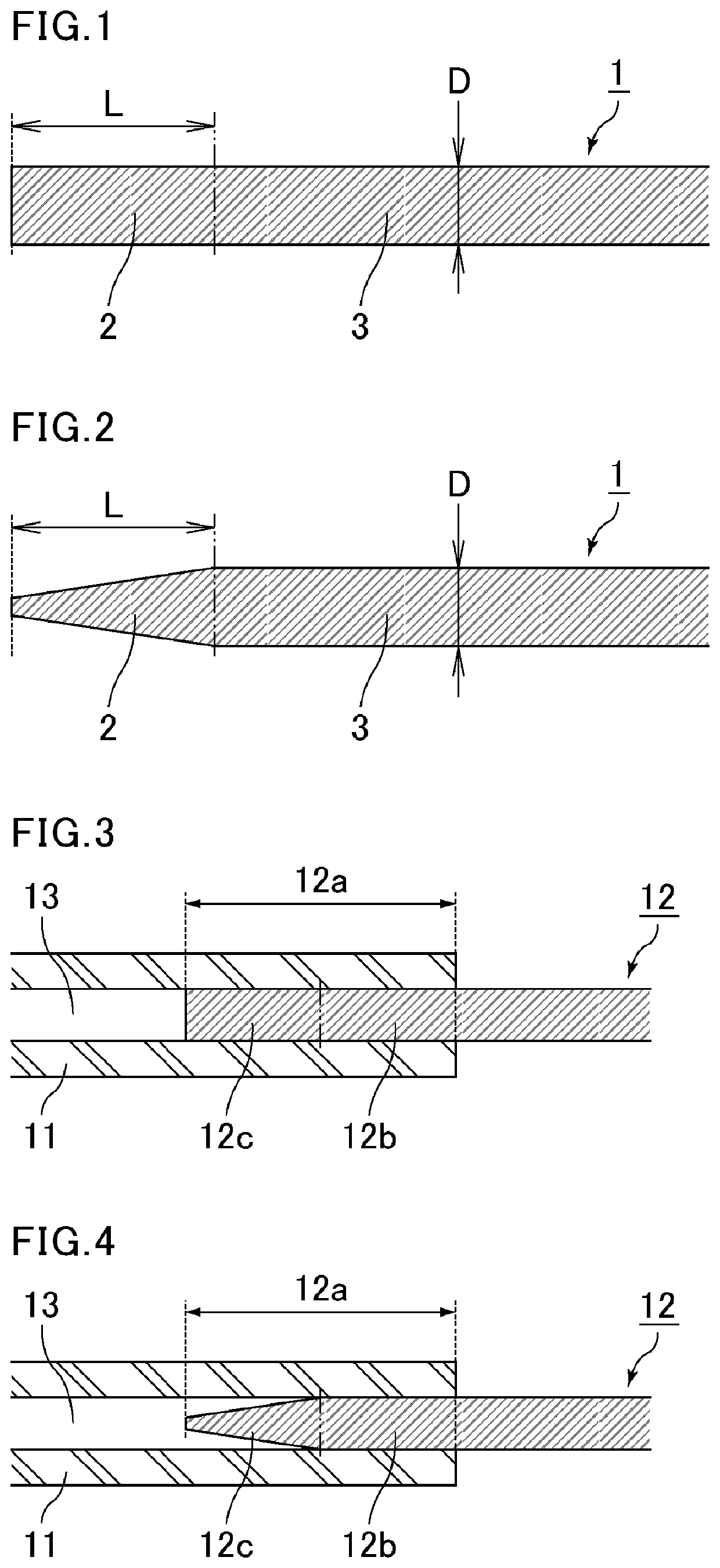
Figure 1 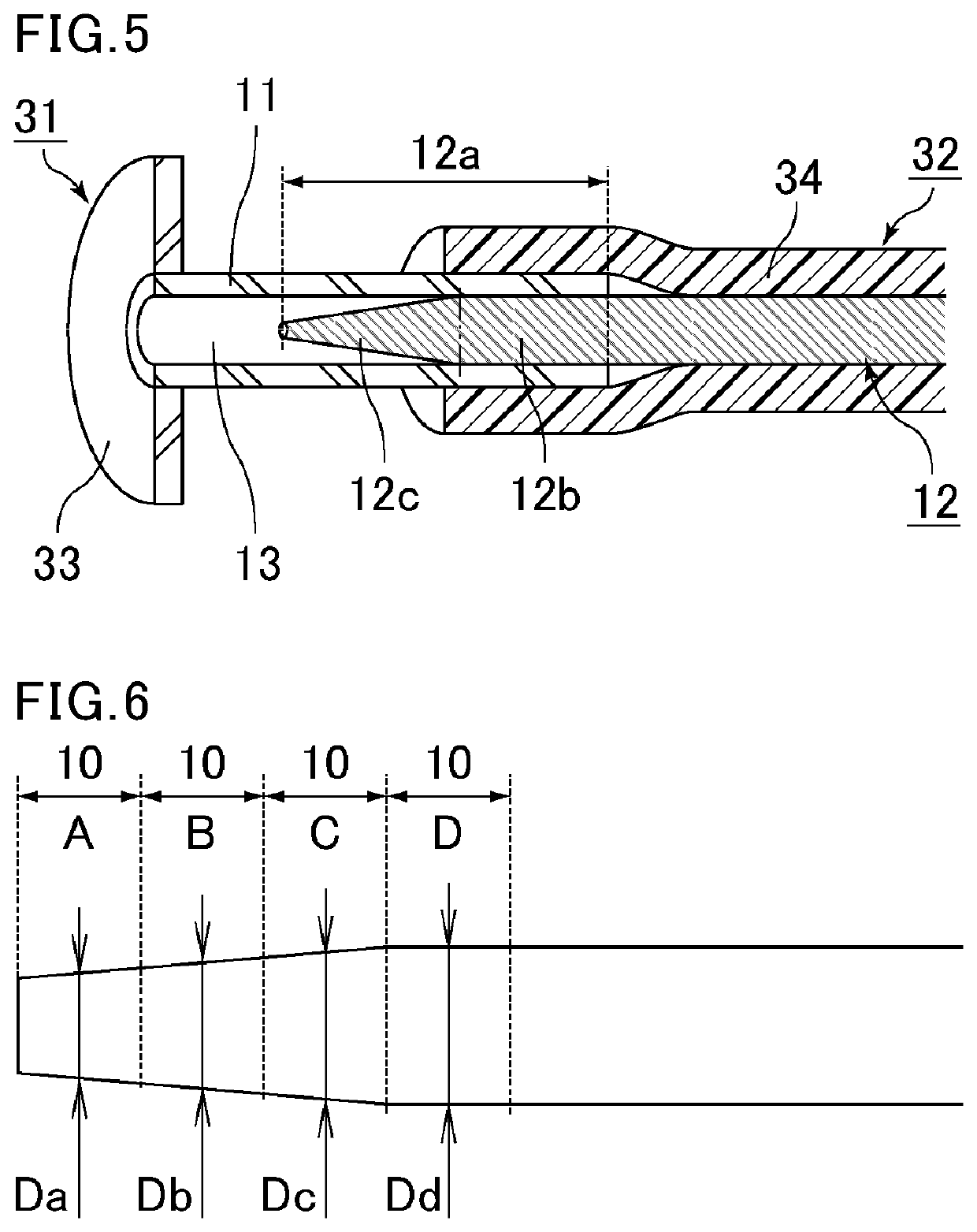
Figure 2 
Figure 3
Abstract
Description
TECHNICAL FIELD
[0001] The invention relates to dielectric waveguides, connection structures, and methods for producing a dielectric waveguide.BACKGROUND ART
[0002] Dielectric waveguides, waveguides, coaxial cables, and similar devices are used to transmit high frequency signals such as microwaves and millimeter waves. In particular, dielectric waveguides and waveguides are used as transmission lines for high frequency band electromagnetic waves such as millimeter waves. A common dielectric waveguide is composed of an inner layer and an outer layer and it utilizes the difference in permittivity between the layers to transmit electromagnetic waves by side reflection. The outer layer may be the air. Still, in order to stabilize the permittivity and to achieve easy handling, the outer layer is usually a soft structure made of, for example, resin foam having low tan δ and low permittivity. In practical implementation, transmission lines of different kinds are often coupled with each other. ...
Examples
examples
[0126]The invention is described with reference to examples. These examples are not intended to limit the invention.
experimental example
[0127]PTFE fine powder (SSG: 2.175) in an amount of 100 parts by mass was mixed with 20.5 parts by mass of Isopar G available from Exxon Mobil Corp. serving as an extrusion aid, and the mixture was aged at room temperature for 12 hours. Thereby, extrusion aid-mixed powder was obtained. This extrusion aid-mixed powder was put into a pre-molding machine and pressurized at 3 MPa for 30 minutes. Thereby, a cylindrical pre-molded article was obtained.
[0128]This pre-molded article was paste-extruded using a paste extruder, and then heated at 200° C. for one hour so that the extrusion aid was evaporated. Thereby, a resin line having a diameter of 3.51 mm was obtained.
[0129]This resin line was cut so as to have a total length of 660 mm.
Outer layer:
[0130]PTFE fine powder was mixed with Isopar G available from Exxon Mobil Corp. serving as an extrusion aid, and the mixture was aged at room temperature for 12 hours. Thereby, extrusion aid-mixed powder was obtained. This extrusion aid-mixed powd...
example 1
[0133]The resin line obtained in the experimental example was heated at 330° C. for 70 minutes. A portion (end) 20 mm or less apart from a tip of the resin line was heated at 260° C. A portion 5 mm or less apart from the tip was then held and the end was stretched at a stretch ratio of two times and at a stretching speed of 200% / sec in the longitudinal direction. Thereby, the end was stretched to 40 mm. After the stretching, a portion 10 mm or less apart from the tip held in the stretching was cut off. Thereby, a dielectric waveguide was obtained.
[0134]This dielectric waveguide was inserted into the outer layer obtained in the experimental example. Thereby, a dielectric waveguide including an outer layer was obtained.