
Escapement for a timepiece with optimized torque transmission
a technology of torque transmission and escapement, which is applied in the field of escapement with optimized torque transmission, can solve the problems of not being optimized at all, compromising and affecting the performance of the escapemen
Patent Information
- Authority / Receiving Office
- US · United States
- Patent Type
- Applications(United States)
- Current Assignee / Owner
- Publication Date
- 2020-02-27
Smart Images
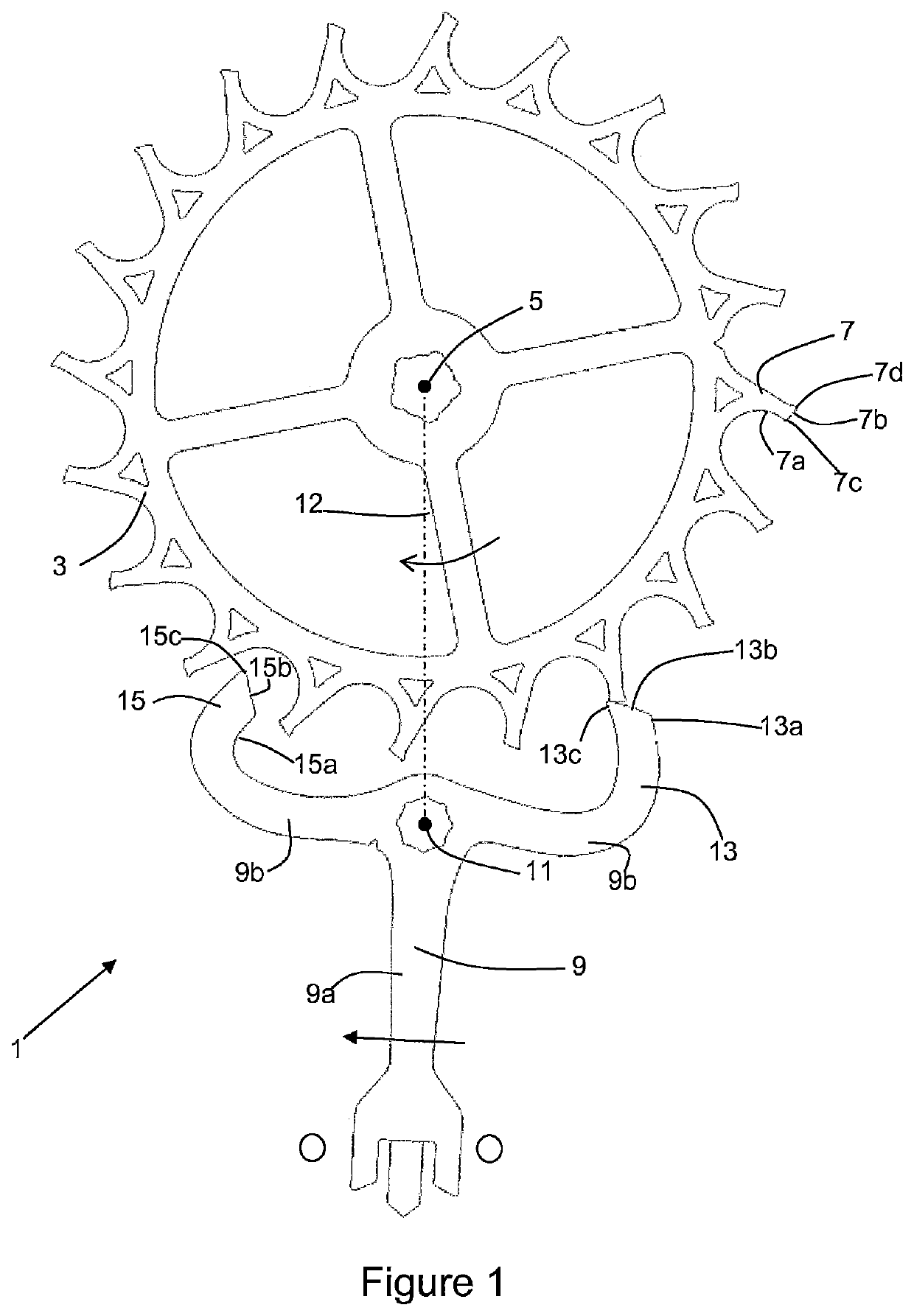
Figure 1 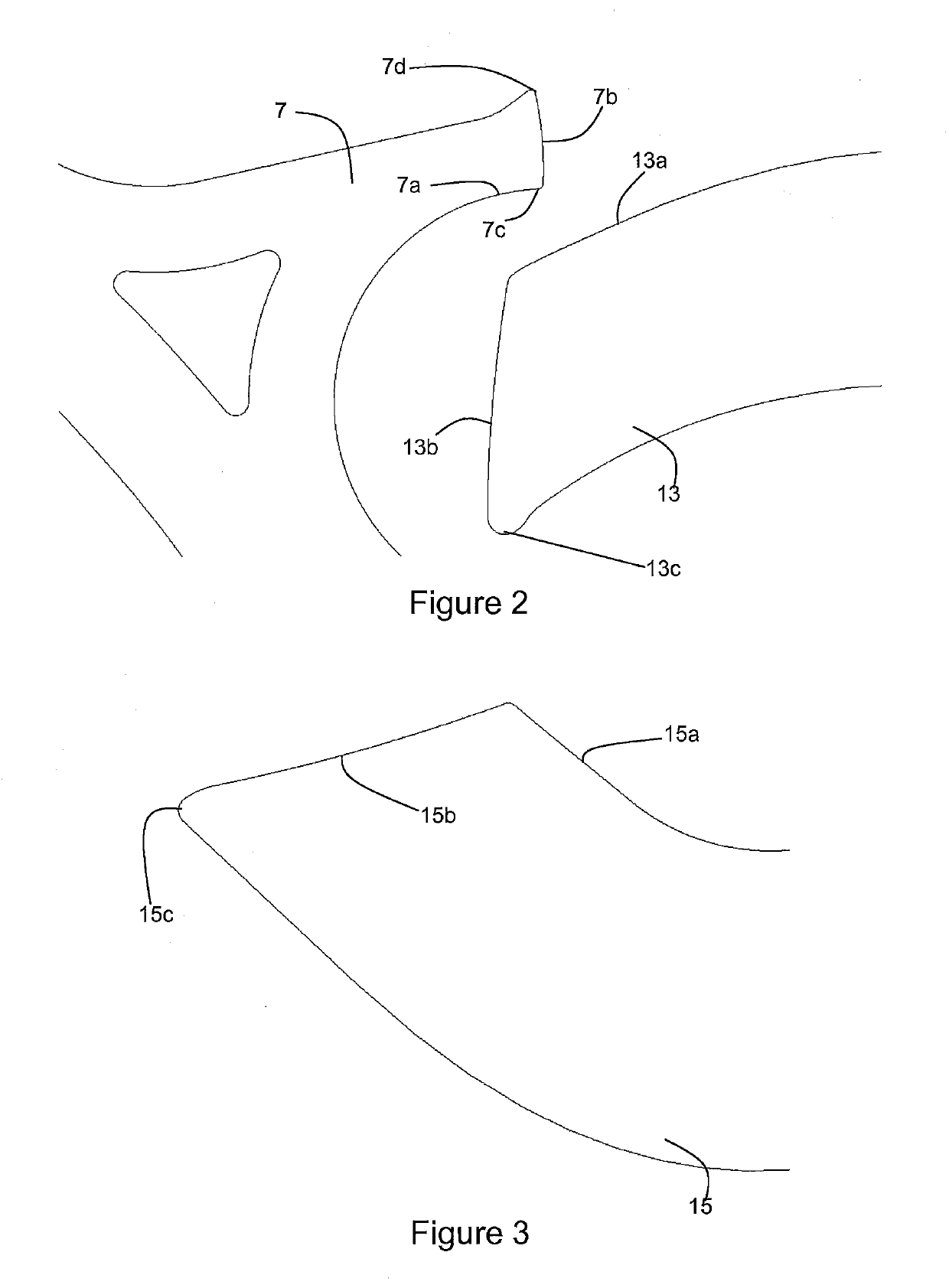
Figure 2 
Figure 3
Abstract
Description
TECHNICAL FIELD
[0001] The present invention relates to the field of watchmaking. It concerns, more particularly, an escapement with optimized torque transmission.BACKGROUND ART
[0002] A traditional escapement, such as a Swiss anchor escapement, an English anchor escapement, a Daniels escapement or similar, includes an anchor which blocks an escapement wheel in an intermittent manner and transmits energy from the going train to the regulating member when the wheel is released. Oscillations of the regulating member, such as a balance wheel and hairspring, actuate the anchor lever in order to perform this periodic release of the escapement wheel and to supply an impulsion once more to the regulating member in order to maintain its oscillations.
[0003] To this end, the anchor includes at least two pallets, one of which—the entry pallet—being situated upstream in relation to the direction of rotation of the escapement wheel, and the other—the exit pallet—being situated downstream. On each hal...
Examples
Embodiment Construction
[0048]FIG. 1 depicts an escapement 1 according to the invention. This escapement 1 embodies the overall form of a Swiss anchor escapement, in which each pallet participates in providing an impulsion to the regulating member.
[0049]As generally known, the escapement comprises an escapement wheel 3, arranged to be driven by a power source, not depicted here. This power source may be a mainspring or an electric motor, for example, which is kinematically linked with the escapement wheel 3 by means of a going train (likewise not depicted).
[0050]The escapement wheel 3 is mounted in a pivotable manner on an arbor (not depicted), of which the theoretical axis is indicated by the reference sign 5. In the variant depicted here, the teeth of the escapement wheel 7 each include an upstream surface 7a, which interacts with the pallets when the escapement wheel 3 is blocked, and an impulsion surface. However, the invention is applicable to other forms of escapement wheel, for example to pointed te...