
Compact head-mounted display system having uniform image
a display system and compact technology, applied in the field of substrateguided optical devices, can solve the problems of direct display with poor image viewing quality, limiting factor of display quality within the device of the end-user, etc., and achieves the effect of convenient incorporation, large eye-motion box values, and convenient design and fabrication
Patent Information
- Authority / Receiving Office
- US · United States
- Patent Type
- Applications(United States)
- Current Assignee / Owner
- Publication Date
- 2021-01-21
Smart Images
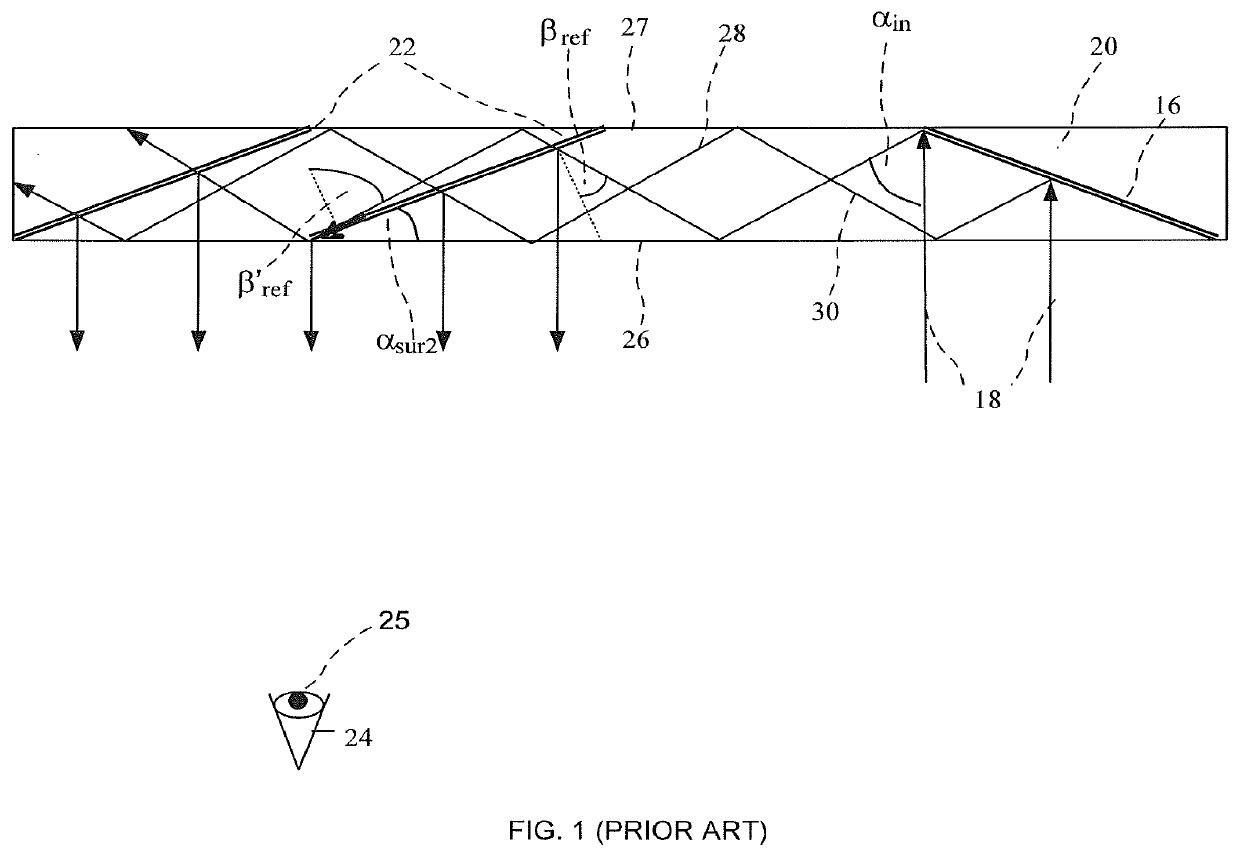
Figure 1 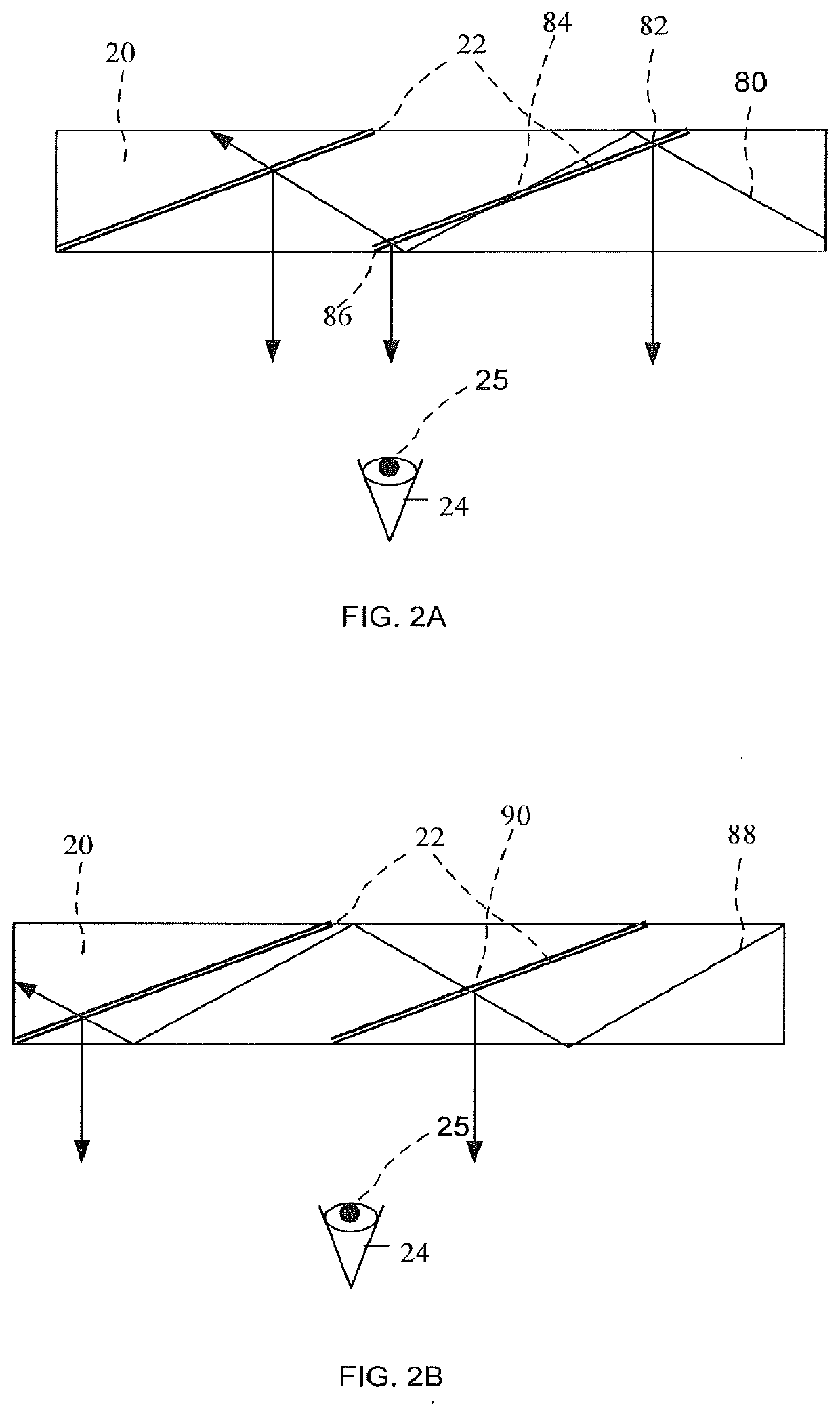
Figure 2 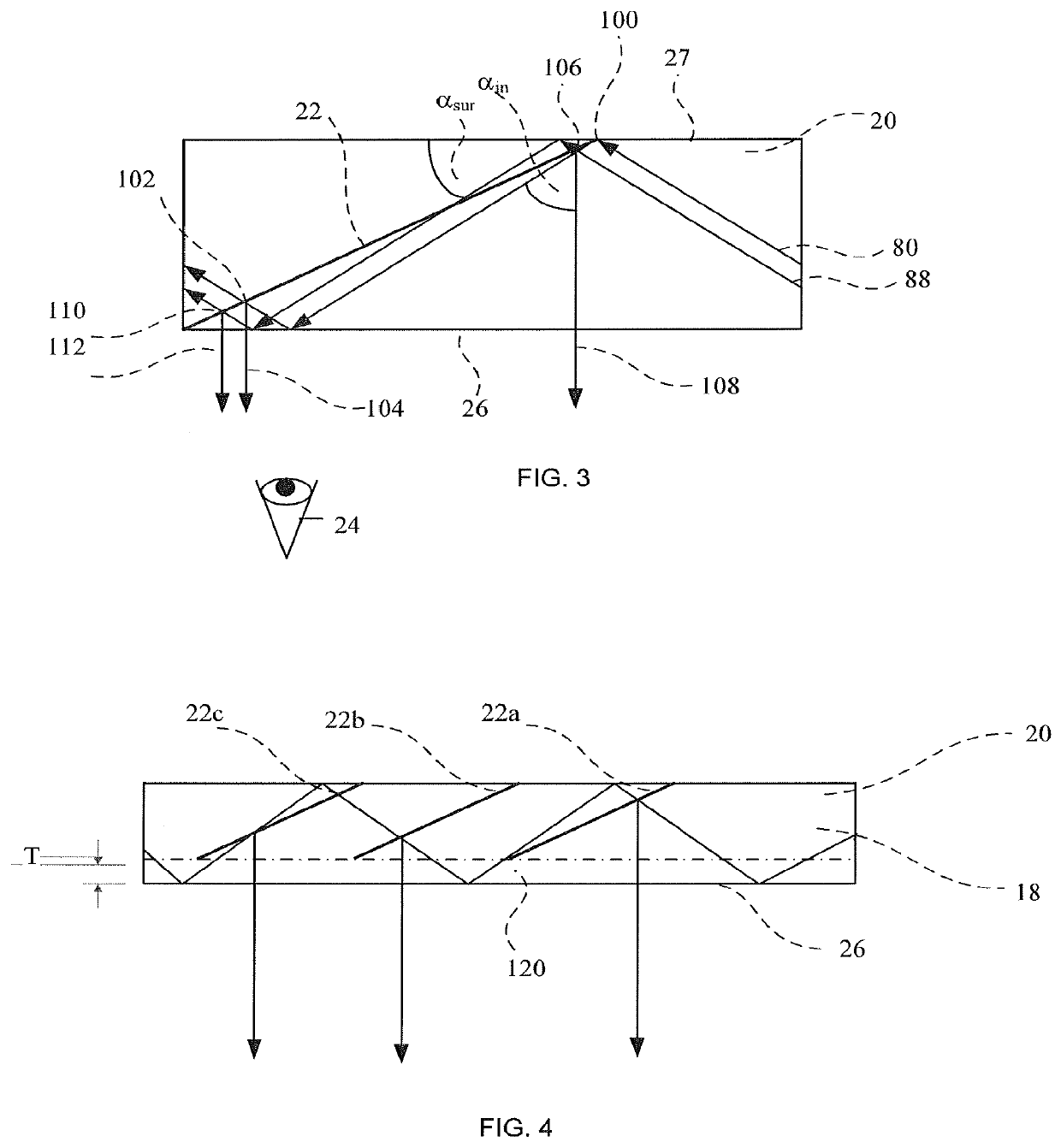
Figure 3
Abstract
Description
FIELD OF THE INVENTION
[0001] The present invention relates to substrate-guided optical devices, and particularly to devices which include a plurality of reflecting surfaces carried by a common light-transmissive substrate, also referred to as a light-guide optical element (LOE).
[0002] The invention can be implemented to advantage in a large number of imaging applications, such as, for example, head-mounted and head-up displays, cellular phones, compact displays, 3-D displays, compact beam expanders as well as non-imaging applications such as flat-panel indicators, compact illuminators and scanners.BACKGROUND OF THE INVENTION
[0003] One of the important applications for compact optical elements is in head-mounted displays, wherein an optical module serves both as an imaging lens and a combiner, in which a two-dimensional display is imaged to infinity and reflected into the eye of an observer. The display can be obtained directly from either a spatial light modulator (SLM) such as a catho...
Examples
Embodiment Construction
[0031]FIG. 1 illustrates a sectional view of a light-guide optical element (LOE), according to the present invention. The first reflecting surface 16 is illuminated by a collimated display 18 emanating from a light source (not shown) located behind the device. The reflecting surface 16 reflects the incident light from the source such that the light is trapped inside a planar substrate 20 by total internal reflection. After several reflections off the surfaces 26, 27 of the substrate, the trapped light waves reach an array of partially reflecting surfaces 22, which couple the light out of the substrate into the eye 24, having a pupil 25, of a viewer. Herein, the input surface of the LOE will be defined as the surface through which the input light waves enter the LOE and the output surface of the LOE will be defined as the surface through which the trapped light waves exit the LOE. In addition, the input aperture of the LOE will be referred to as the part of the input surface through ...