
Aluminum alloy sheet
Patent Information
- Authority / Receiving Office
- US · United States
- Current Assignee / Owner
- Publication Date
- 2021-10-21
Smart Images
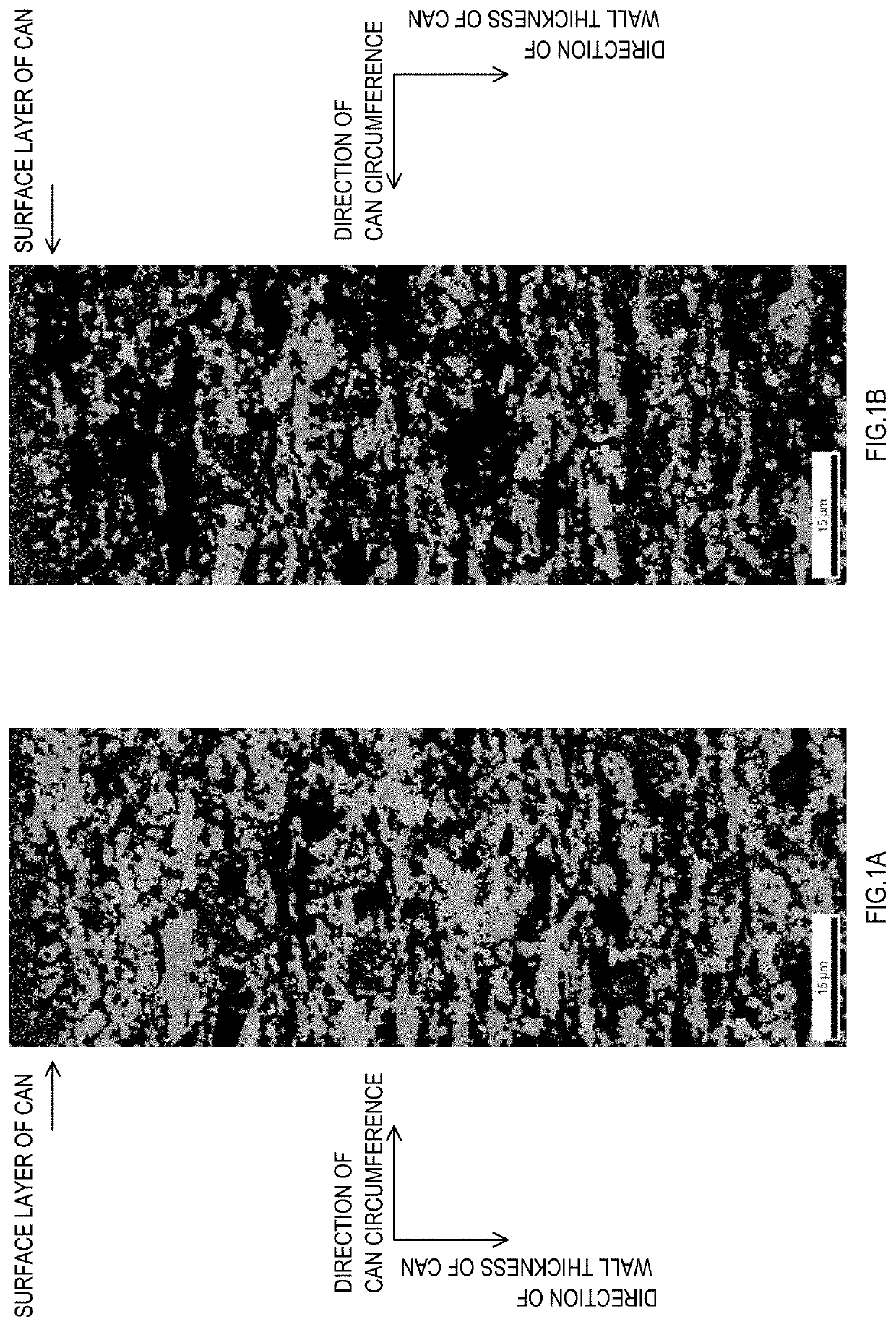
Figure 1
Abstract
Description
CROSS-REFERENCE TO RELATED APPLICATION
[0001] This international application claims the benefit of Japanese Patent Application No. 2018-163486 filed on Aug. 31, 2018 with the Japan Patent Office, the entire disclosure of which is incorporated herein by reference.TECHNICAL FIELD
[0002] The present disclosure relates to an aluminum alloy sheet.BACKGROUND ART
[0003] In recent years, a bottle can that is a type of aluminum can is commercially available. The bottle can comprises a body portion and a neck portion. The neck portion is thin compared to the body portion. The bottle can comprises a thread portion near an end of the neck portion. The bottle can is capable of being resealed using the thread portion and a cap.
[0004] The bottle can is manufactured as follows. First, a drawing is performed on a circular blank to form a cup. Then a redrawing is performed on the cup using a body maker. Further, an ironing is performed after the redrawing to form a can body.
[0005] Subsequently, an opening po...
Examples
embodiment
6. Embodiment
(6-1) Producing Aluminum Alloy Sheet
[0062]Aluminum alloy sheets numbered S1 to S8 in Table 1 were produced. The production method was as follows.
TABLE 1Rough Finish Cold RollingAreal Ratio Tensile Component (mass %)RollingRollingReduction RateDegree of Integrationof α-phaseStrengthCurl SampleSiFeCuMnMglogZlogZ(%)CuGoss(%)(MPa)FormabilityS10.340.540.201.01.111.614.884.26.42.02.9301XS20.350.550.201.01.111.614.882.36.02.12.8295◯S30.300.410.211.01.111.314.883.16.92.02.4301XS40.320.530.201.01.111.114.883.96.42.32.7295XS50.310.420.201.01.111.114.584.46.52.32.6307XS60.330.510.191.01.111.114.584.46.12.22.8297◯S70.330.510.191.01.111.215.071.95.21.82.7273◯S80.330.510.191.01.111.214.971.94.91.82.6233◯
[0063]First, an ingot was produced through a semi-continuous casting method. A composition of the ingot is shown in Table 1. A thickness of the ingot was 700 mm. The ingot contained 0.03% by mass of inevitable impurity elements. Subsequently, four surfaces of the ingot were ground. Th...