
Method and system for sharing over-allocated bandwidth between different classes of service in a wireless network
a wireless network and over-allocation technology, applied in the field of wireless communication, can solve problems such as delay and/or retransmission, and achieve the effect of reducing or eliminating problems and disadvantages
Patent Information
- Authority / Receiving Office
- US · United States
- Current Assignee / Owner
- Publication Date
- 2005-12-06
- Estimated Expiration
- Not applicable · inactive patent
Smart Images
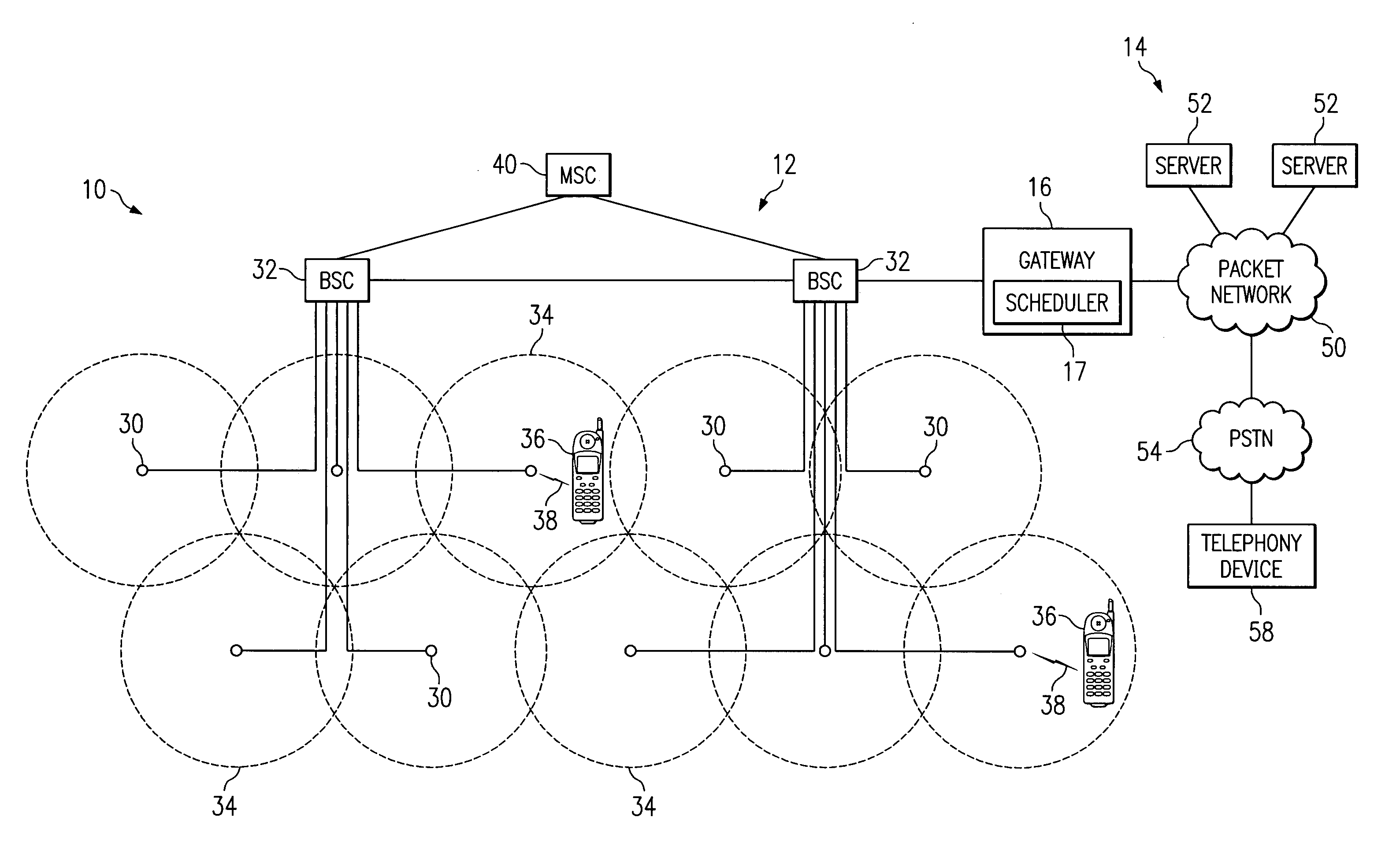
Figure 1 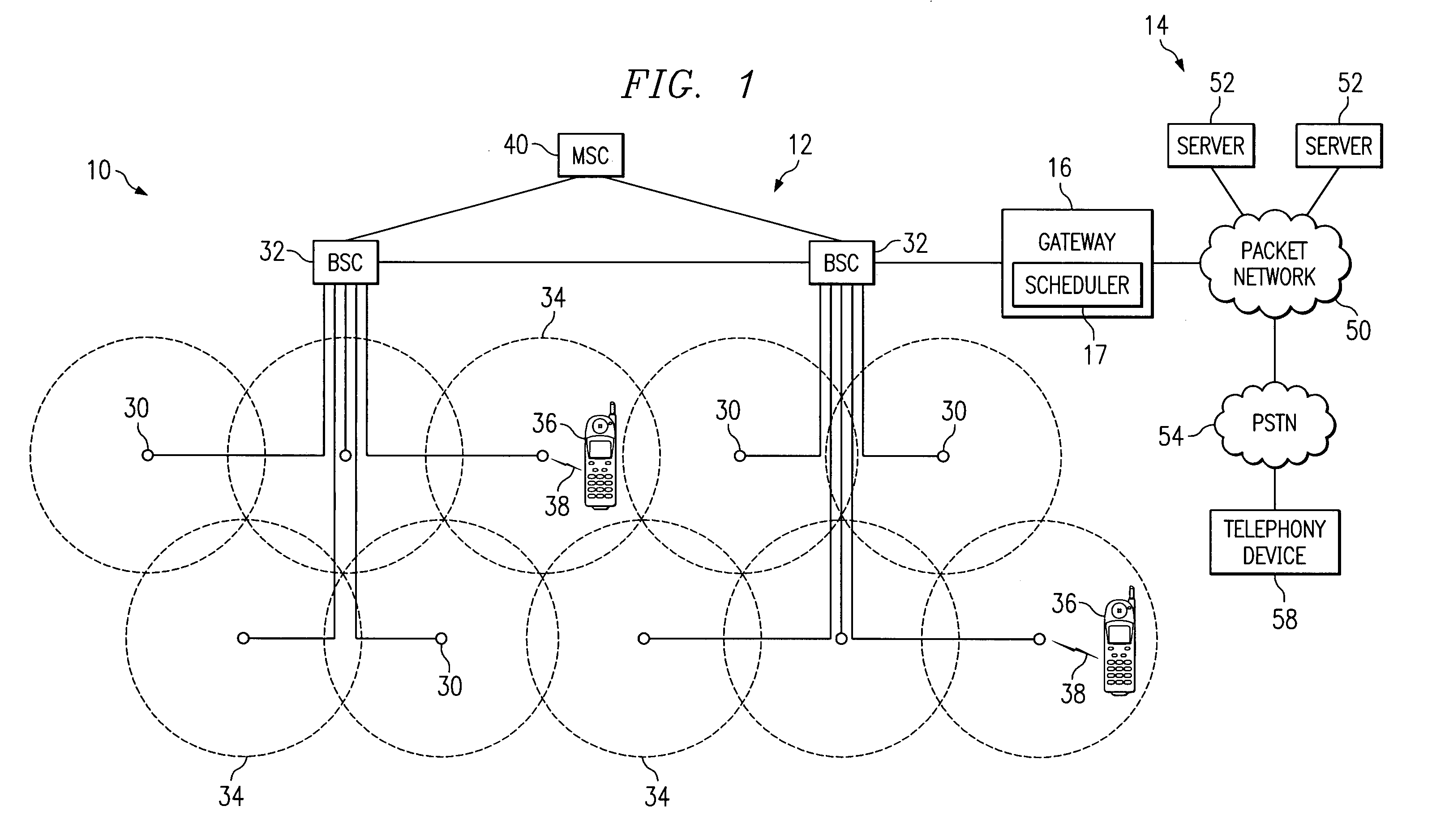
Figure 2 
Figure 3
Abstract
Description
TECHNICAL FIELD OF THE INVENTION
[0001] This invention relates in general to the field of wireless communications, and more particularly to a method and system for sharing over-allocated bandwidth between different classes of service in a wireless network.BACKGROUND OF THE INVENTION
[0002] Wireline and wireless Internet protocol (IP) networks have traditionally supported a best effort delivery of all traffic. To support enhanced services, multiple types, or classes, of services have been established and assigned certain class of service (CoS) parameters that help engineer queues for each service type.
[0003] The CoS parameters include delay, jitter, error rates, and throughput. The CoS parameters can be provisioned on a per IP connection or per flow basis through mechanisms such as resource reservation protocol (RSVP) or can be provisioned on aggregate flows which are classified into service classes. Internet service providers (ISPs) can utilize the service classes, their associated CoS b...
Examples
Embodiment Construction
[0013]Referring to FIG. 1, the communications system 10 includes a wireless network 12 connected to a wireline network 14 through a gateway 16.
[0014]The wireless network 12 includes a number of base stations (BTSs) 30 connected to base station controllers (BSCs) 32. The BTSs 30 each cover a geographic region or cell or sector 34 of the wireless network 12 and communicate with mobile devices 36 in the cell 34. The mobile devices 36 may be cell phones, data phones, portable data devices, portable computers, handheld devices, handsets, portable network appliances or other suitable devices capable of communicating information over a wireless link 38.
[0015]The BSCs 32 are connected to each other in some way, to the Gateway 16 and to a mobile switching center (MSC) 40. The BSCs 32 and the MSC 40 cooperate to provide switch and handoff functionality for the wireless network 12. In this way, voice, video, data and other information is routed to and from the mobile devices 36 and connections...