
Polyphenylene ether oligomer compound, derivatives thereof and use thereof
a technology of phenylene ether and oligomer compound, which is applied in the direction of metallic pattern materials, synthetic resin layered products, metal layered products, etc., can solve the problems of resin and molding processability compatibility, large decrease in humidity resistance, and inability to solve molding processability and heat resistance problems, etc., to achieve high compatibility, easy preparation, and low dielectric characteristics
Patent Information
- Authority / Receiving Office
- US · United States
- Patent Type
- Patents(United States)
- Current Assignee / Owner
- Publication Date
- 2007-10-02
Smart Images
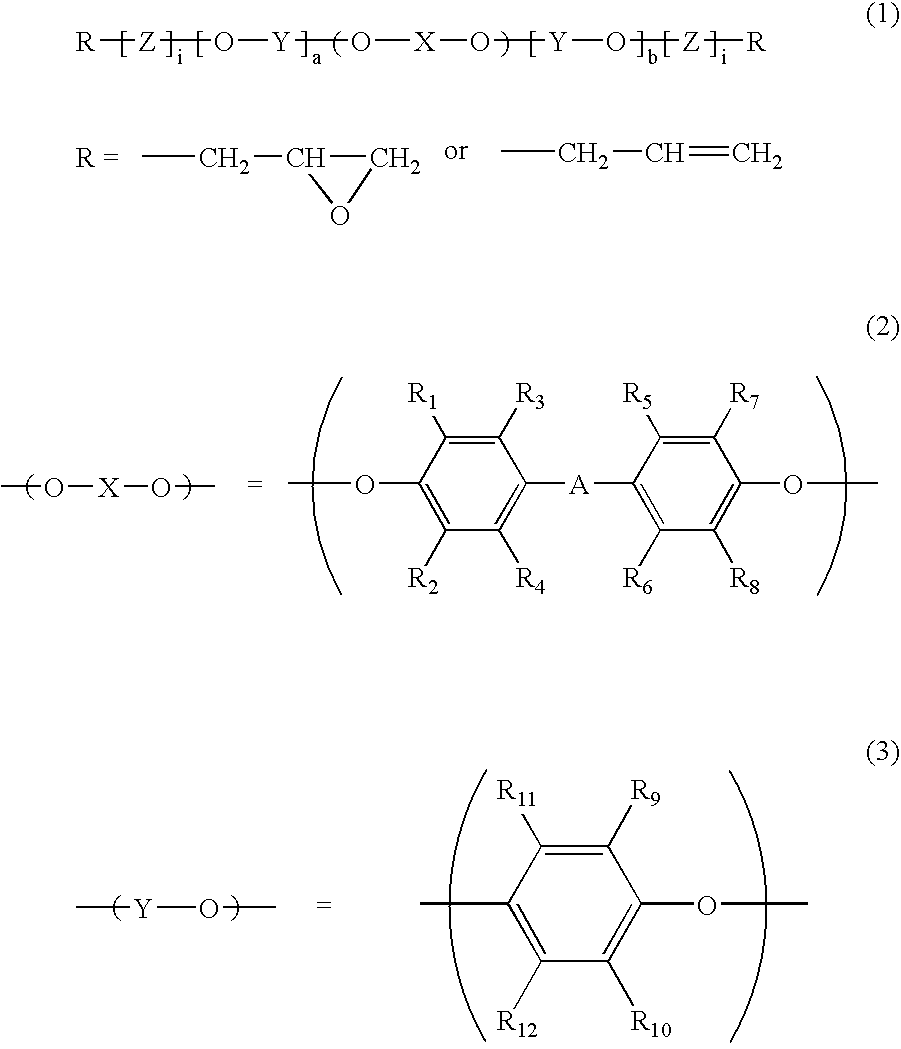
Figure 1 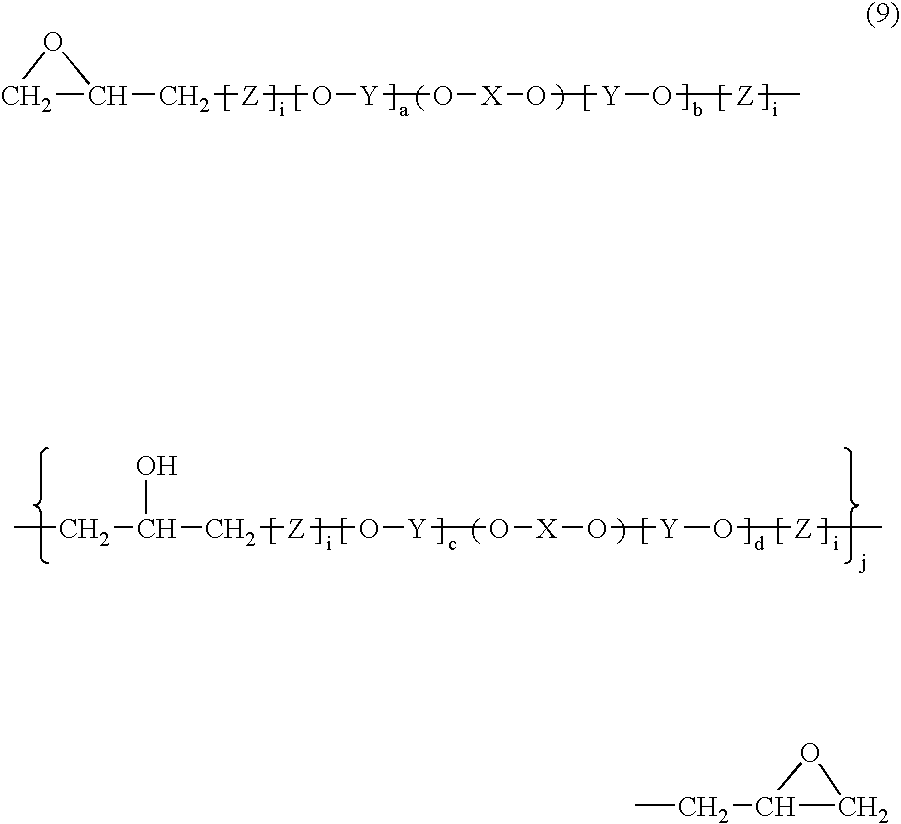
Figure 2 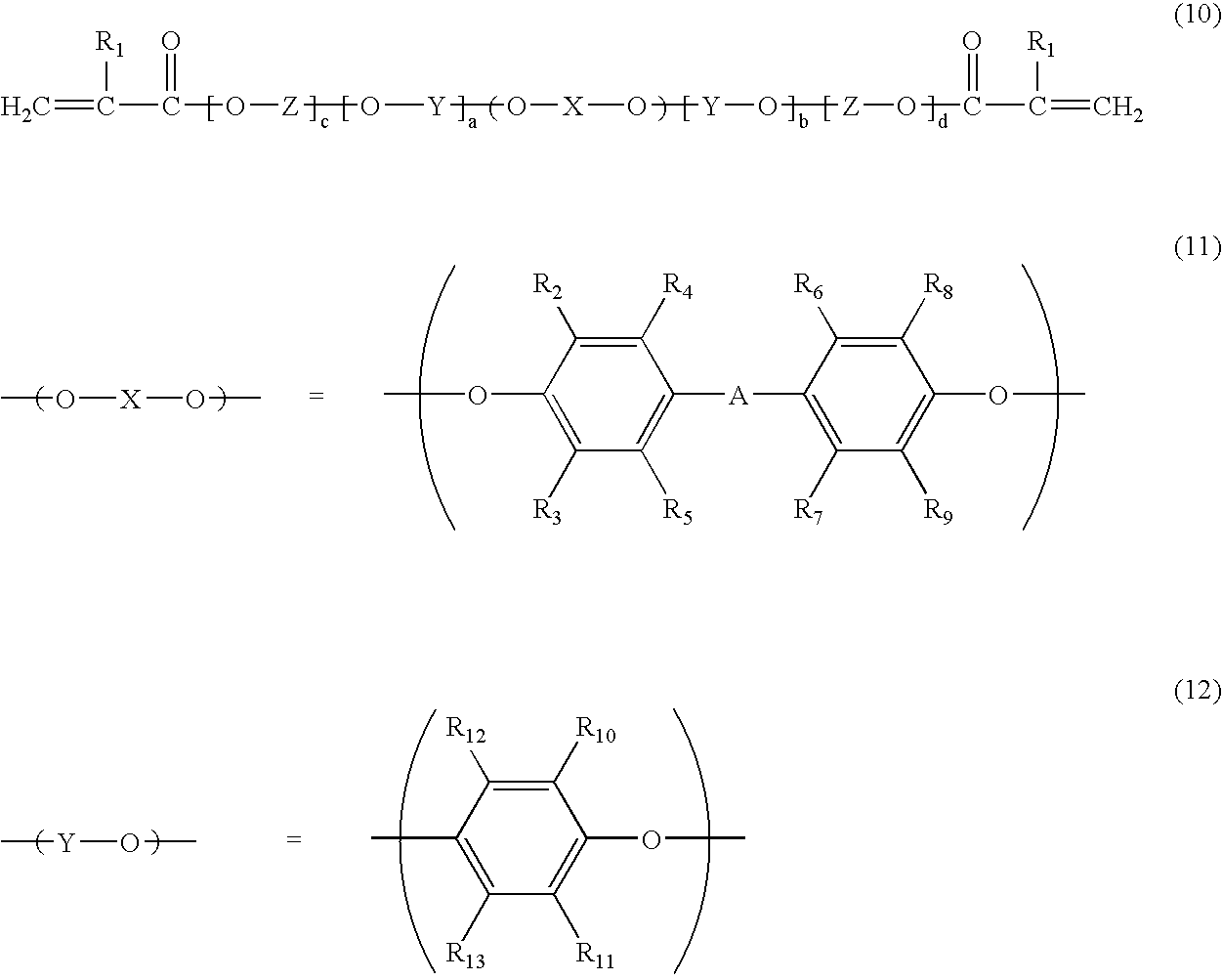
Figure 3
Abstract
Description
[0001] This is a divisional application of Ser. No. 10 / 352,232 filed Jan. 28, 2003 now U.S. Pat. No. 6,835,785.FIELD OF THE INVENTION
[0002] The present invention relates to a bifunctional phenylene ether oligomer compound having a thermosetting functional group at each terminal, an epoxy resin containing the above oligomer compound and a use thereof. More specifically, it relates to a sealing epoxy resin composition for sealing an electric part, an epoxy resin composition for laminates, a laminate, a printed wiring board, a curable resin composition and a photosensitive resin composition. The resins and resin compositions of the present invention are used in electronics fields in which a low dielectric constant, a low dielectric loss tangent and high toughness are required and also used for various uses such as coating, bonding and molding.BACKGROUND OF THE INVENTION
[0003] As for materials for use in an electric or electronic field, as the speed of transmission signal increases, a low ...
Examples
example 2
Production Process of Bifunctional PPE Oligmer Compound
[0198]A longitudinally long reactor having a volume of 2 litters and equipped with a stirrer, a thermometer, an air-introducing tube and baffleplates was charged with 2.7 g (0.012 mol) of CuBr2, 70.7 g (0.55 mol) of di-n-butylamine and 600 g of toluene. The coponents were stirred at a reaction temperature of 40° C. A mixed solution (bivalent phenol of the forumla (7):monovalent phenols of the formula (8) in a molar ratio=1:2) obtained by dissolving 68.0 g (0.21 mol) of a bivalent phenol 4,4′-cyclohexylidenebis[2,6-dimethylphenol], 25.6 g (0.21 mol) of 2,6-dimethylphenol and 28.6 g (0.21 mol) of 2,3,6-trimethyiphenol in 600 g of methyl ethyl ketone was dropwise added to the reactor over 120 minutes while carrying out bubbling with 2 L / min of air. After the completion of the addition, stirring was carried out for 30 minutes while continuing the bubbling with 2 L / min of air. A disodium dihydrogen ethylenediamine tetraacetate aqueou...
example 3
Production Process of Bifunctional PPE Oligomer Compound
[0202]A longitudinally long reactor having a volume of 2 liters and equipped with a stirrer, a thermometer, an air-introducing tube and baffleplates was charged with 1.3 g (0.013 mol) of CuCl, 79.5 g (0.62 mol) of di-n-butylamine and 400 g of methyl ethyl ketone. The components were stirred at a reaction temperature of 40° C. A mixed solution (bivalent phenol of the formula (7):monovalent phenol of the formula (8) in a molar ratio=1:4) obtained by dissolving 42.6 g (0.15 mol) of a bivalent phenol 4,4′-methylenebis(2,3,6-trimethylphenol), 56.7 g (0.46 mol) of 2,6-dimethylphenol and 21.1 g (0.16 mol) of 2,3,6-trimethylphenol in 400 g of methyl ethyl ketone and 400 g of tetrahydrofliran was dropwise added to the reactor over 120 minutes while carrying out bubbling with 2 L / min of air. After the completion of the addition, stirring was carried out for 60 minutes while continuing the bubbling with 2 L / min of air. A disodium dihydrog...
example 4
Production Process of Bifunctional PPE Oligomer Compound
[0206]A longitudinally long reactor having a volume of 2 liters and equipped with a stirrer, a thermometer, an air-introducing tube and baffleplates was charged with 1.1 g (0.11 mol) of CuCl, 66.3 g (0.51 mol) of di-n-butylamine and 400 g of toluene. The components were stirred at a reaction temperature of 40° C. A mixed solution (bivalent phenol of the formula (7):monovalent phenol of the formula (8) in a molar ratio=1:8) obtained by dissolving 33.1 g (0.077 mol) of a bivalent phenol 4,4′-[1,4-phenylenebis( 1-methylethylidene)]bis(2,3,6-trimethylphenol) and 75.6 g (0.62 mol) of 2,6-dimethylphenol in 400 g of methyl ethyl ketone and 400 g of tetrahydrofuran was dropwise added to the reactor over 120 minutes while carrying out bubbling with 2 L / min of air. After the completion of the addition, stirring was carried out for 30 minutes while continuing the bubbling with 2 L / min of air. A disodium dihydrogen ethylenediamine tetraace...