
Mixed superscalar and VLIW instruction issuing and processing method and system
a superscalar and instruction technology, applied in the field of data communication, can solve problems such as resource conflicts, data dependencies, and procedural dependencies, and achieve the effect of reducing dependencies and rapid identification and issuan
Patent Information
- Authority / Receiving Office
- US · United States
- Patent Type
- Patents(United States)
- Current Assignee / Owner
- Publication Date
- 2009-09-15
Smart Images
Figure 1 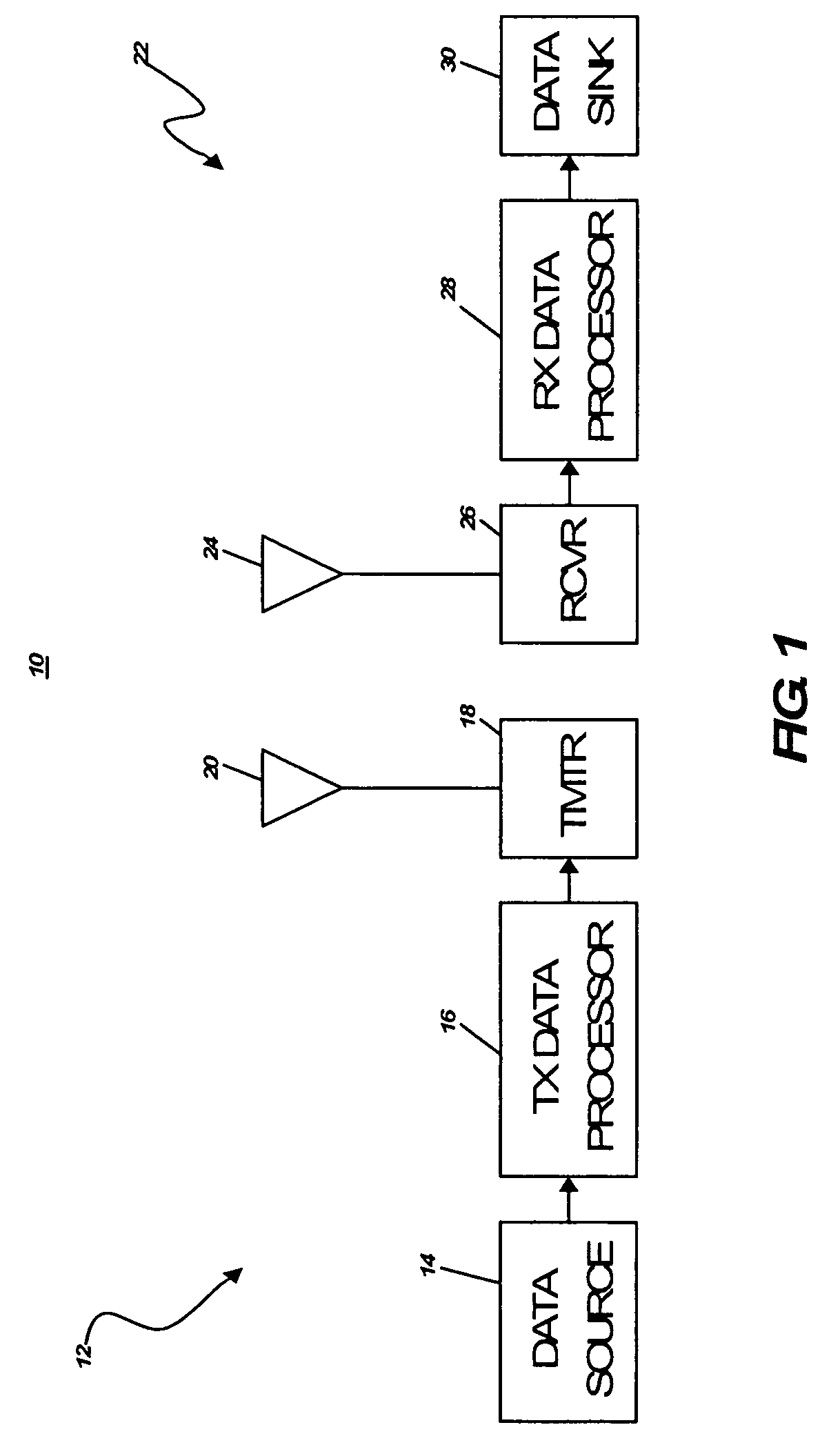
Figure 2 
Figure 3
Abstract
Description
FIELD
[0001] The disclosed subject matter relates to data communications. More particularly, this disclosure relates to a novel and improved method and system for mixed superscalar and VLIW instruction issuing and processing in a digital signal processor.DESCRIPTION OF THE RELATED ART
[0002] A modern day communications system must support a variety of applications. One such communications system is a code division multiple access (CDMA) system that supports voice and data communication between users over a satellite or terrestrial link. The use of CDMA techniques in a multiple access communication system is disclosed in U.S. Pat. Nos. 4,901,307, entitled “SPREAD SPECTRUM MULTIPLE ACCESS COMMUNICATION SYSTEM USING SATELLITE OR TERRESTRIAL REPEATERS,” and 5,103,459, entitled “SYSTEM AND METHOD FOR GENERATING WAVEFORMS IN A CDMA CELLULAR TELEHANDSET SYSTEM,” both assigned to the assignee of the claimed subject matter.
[0003] A CDMA system is typically designed to conform to one or more stand...
Examples
Embodiment Construction
[0023]FIG. 1 is a simplified block diagram of a communications system 10 that can implement the presented embodiments. At a transmitter unit 12, data is sent, typically in blocks, from a data source 14 to a transmit (TX) data processor 16 that formats, codes, and processes the data to generate one or more analog signals. The analog signals are then provided to a transmitter (TMTR) 18 that modulates, filters, amplifies, and up converts the baseband signals to generate a modulated signal. The modulated signal is then transmitted via an antenna 20 to one or more receiver units.
[0024]At a receiver unit 22, the transmitted signal is received by an antenna 24 and provided to a receiver (RCVR) 26. Within receiver 26, the received signal is amplified, filtered, down converted, demodulated, and digitized to generate in phase (I) and (Q) samples. The samples are then decoded and processed by a receive (RX) data processor 28 to recover the transmitted data. The decoding and processing at recei...