
Pneumatic run flat tire
a pneumatic run and tire technology, applied in the field of pneumatic run flat tires, can solve the problems of increasing rolling resistance and worsening riding comfort, and achieve the effects of reducing tire weight, optimizing tread profile, and maintaining run-flat durability
Patent Information
- Authority / Receiving Office
- US · United States
- Patent Type
- Patents(United States)
- Current Assignee / Owner
- Publication Date
- 2013-08-06
Smart Images
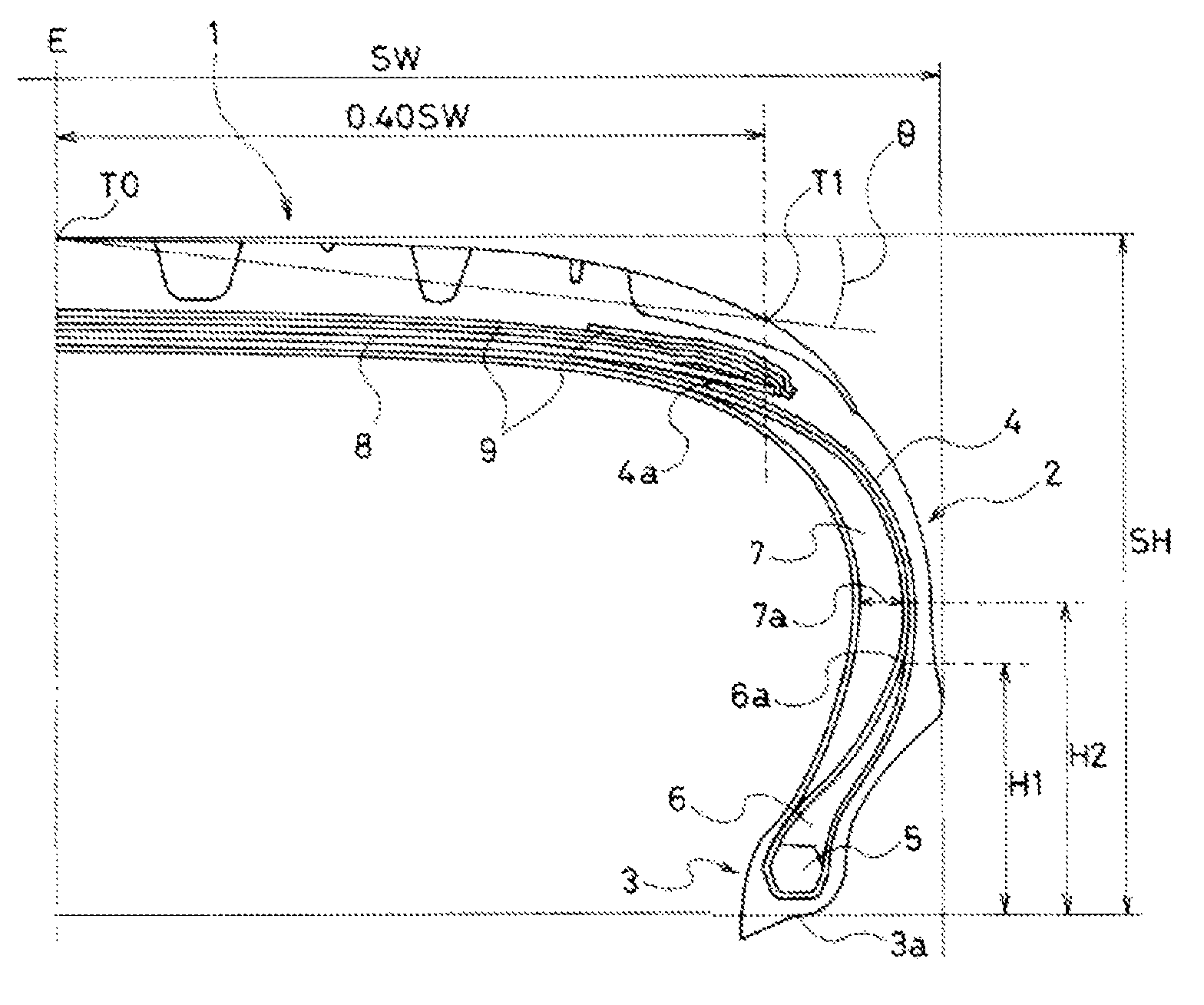
Figure 1 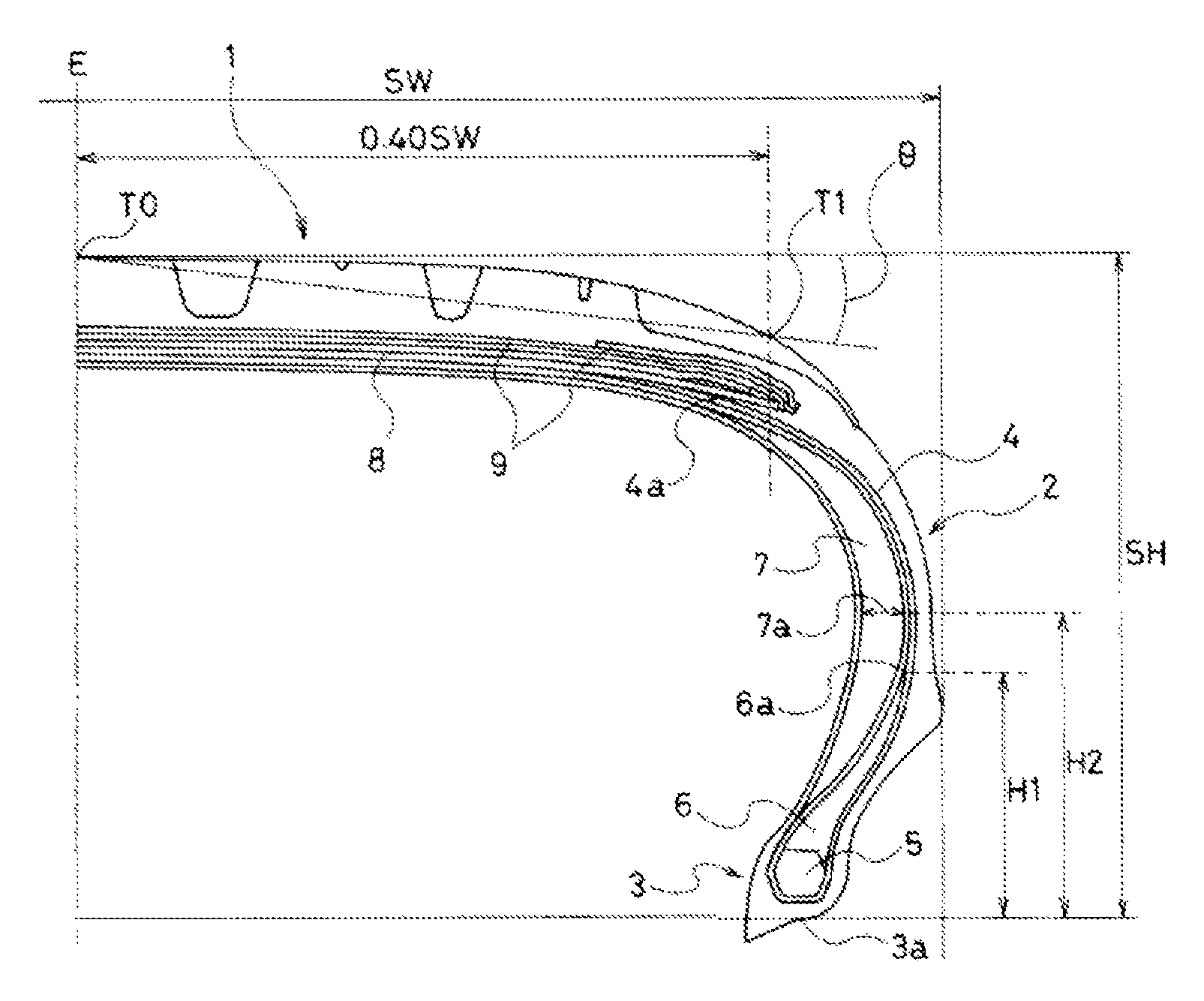
Figure 2 
Figure 3
Abstract
Description
PRIORITY CLAIM
[0001] Priority is claimed to Japan Patent Application Serial No. 2010-245963 filed on Nov. 2, 2010.BACKGROUND
[0002] 1. Technical Field
[0003] The present technology relates to a pneumatic run flat tire, and particularly Relates to a pneumatic run flat tire in which tire weight can be reduced while maintaining run-flat durability, and which is configured so that riding comfort when regular traveling is enhanced.
[0004] 2. Related Art
[0005] Conventionally, in run flat tires provided with a reinforcing rubber layer having a falcated cross-section on an inner surface side of a side wall portion, methods such as increasing a thickness of the reinforcing rubber layer and using a rubber with a higher hardness for the reinforcing rubber layer have been used in order to ensure durability when run-flat traveling. However, there are problems with tires having run-flat durability enhanced in this way such as increased rolling resistance caused by increased weight, and worsening of ridin...
Examples
examples
[0033]Ten types of tires were made for a Conventional Example, Comparative Examples 1 to 4, and Working Examples 1 to 5 with a common tire size of 255 / 40RF19. Shapes of the tire cross-section, and specifications of the bead filler and the reinforcing rubber layer were configured as shown in Table 1.
[0034]The Conventional Example is an example wherein the angle θ and the bead filler height are less, and the reinforcing rubber layer height is greater than the ranges specified in the present technology. Comparative Examples 1 and 2 are examples wherein the bead filler height is outside the range of the present technology. Comparative Example 3 is an example wherein the reinforcing rubber layer height is outside the range of the present technology. Comparative Example 4 is an example wherein the angle θ is outside the range of the present technology.
[0035]Working Examples 1 to 5 are all examples in which the tire cross-sectional shape was within the range specified in the present techno...