
Pneumatic Tire
a pneumatic tire and tire body technology, applied in the field of pneumatic tires, can solve the problems of preventing affecting the manufacturability of tires, and difficult to maintain air permeation, so as to reduce tire weight, prevent performance and steering stability, and reduce tire weight. the effect of sufficient weigh
Patent Information
- Authority / Receiving Office
- US · United States
- Patent Type
- Applications(United States)
- Current Assignee / Owner
- Publication Date
- 2019-11-21
Smart Images
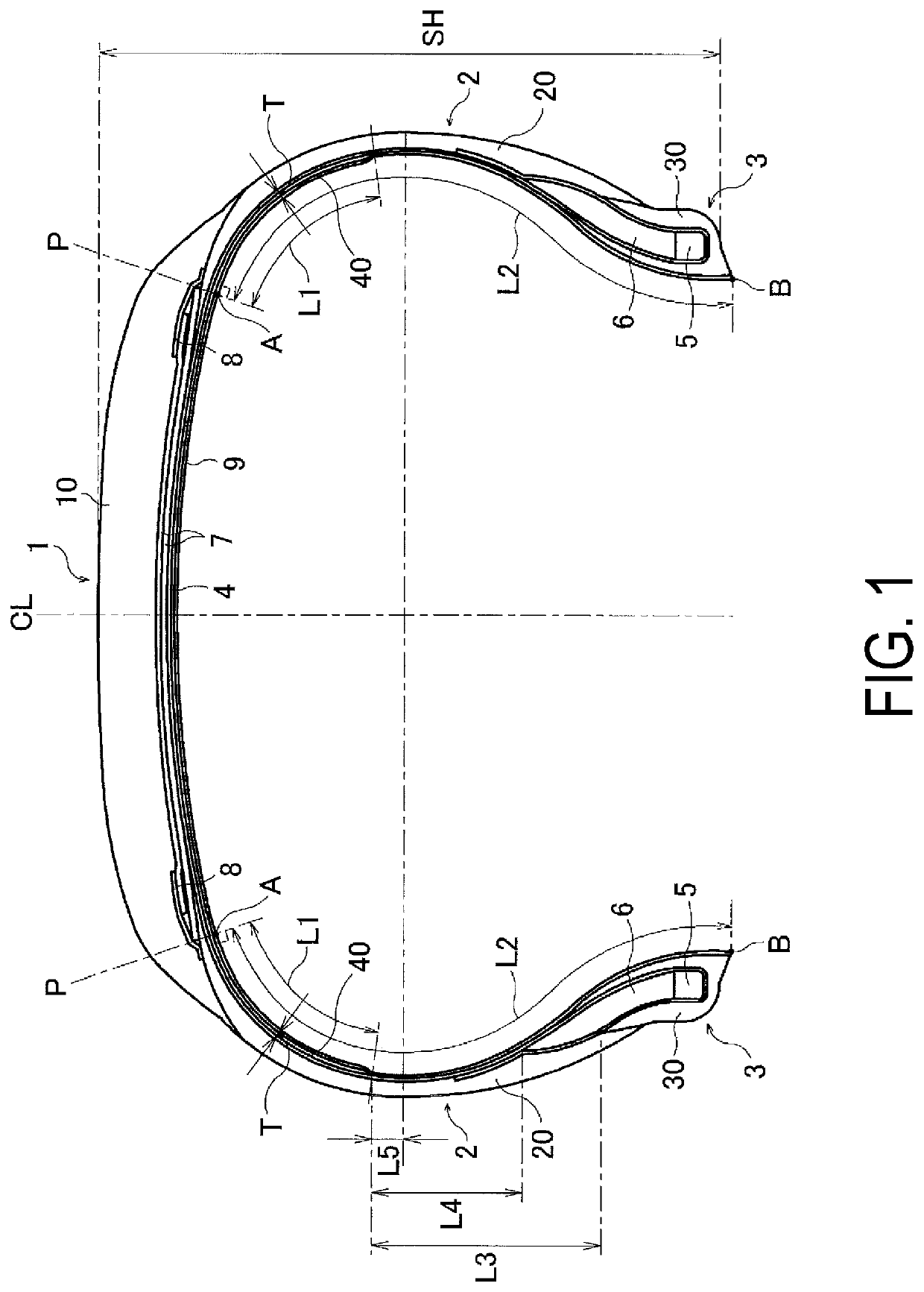
Figure 1
Abstract
Description
TECHNICAL FIELD
[0001] The present technology relates to a pneumatic tire provided with a partial tie rubber layer limitedly disposed between a portion between a carcass layer and an innerliner layer, and particularly relates to a pneumatic tire that achieves further reduction in tire weight while maintaining air permeation preventing performance and steering stability in a well-balanced manner.BACKGROUND ART
[0002] In a pneumatic tire, a tie rubber layer is disposed between a carcass layer and an innerliner layer in order to prevent carcass cords from biting into the innerliner layer when an unvulcanized tire is inflated at the time of manufacturing the tire. In recent years, in order to reduce tire weight and rolling resistance, with regard to such tie rubber layer, it has been proposed to employ a partial tie rubber layer that is selectively disposed in right and left shoulder regions instead of all the region between the carcass layer and the innerliner layer (for example, see Japan...
Examples
examples
[0025]25 types of pneumatic tires including Conventional Example 1, Comparative Examples 1 to 4, and Examples 1 to 20 were manufactured. Each of the tires had a tire size of 195 / 65R15 and a basic structure illustrated in FIG. 1, and was set to have the following conditions as shown in Table 1 or 2: a structure of a tie rubber layer; a protruding amount L1 of the partial tie rubber layer toward a bead portion with respect to a perpendicular line P, which is drawn from an outermost end portion of the belt layer in the tire lateral direction toward an innerliner layer; a periphery length L2 along a tire inner surface from an intersection point A of the perpendicular line P and a tire inner surface to a tip point B of a bead toe; a ratio of a separation distance L3 between the end portion of the partial tie rubber layer and an end portion of a rim cushion rubber layer on an outer side in the tire radial direction with respect to a tire cross-sectional height SH (L3 / SH); a ratio of a sep...