

Process for the preparation of alogliptin
a technology of alogliptin and alogliptin, which is applied in the field of process for the preparation of alogliptin, can solve the problems of uncontrolled diabetes, poor adsorption of alogliptin, and difficulty in separating and purifying mixtures of solvents with high boiling points
Patent Information
- Authority / Receiving Office
- US · United States
- Patent Type
- Patents(United States)
- Current Assignee / Owner
- Publication Date
- 2014-09-23
- Estimated Expiration
- Not applicable · inactive patent
Smart Images
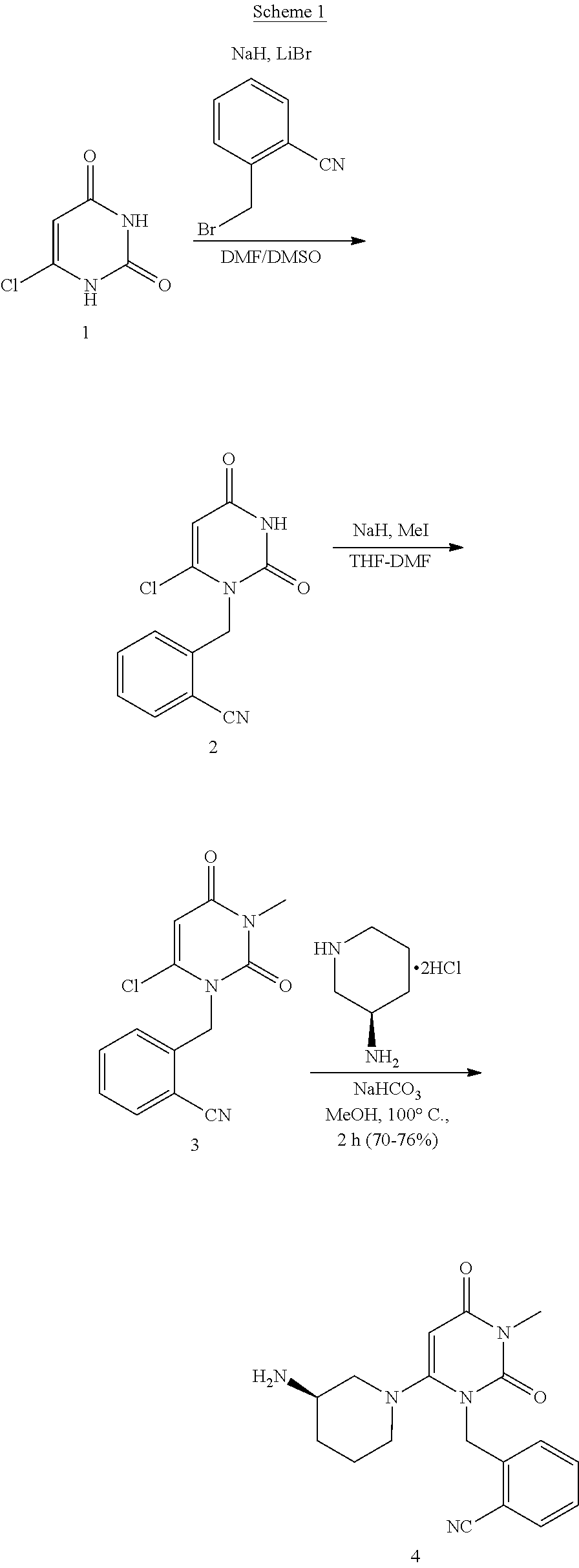
Figure 1 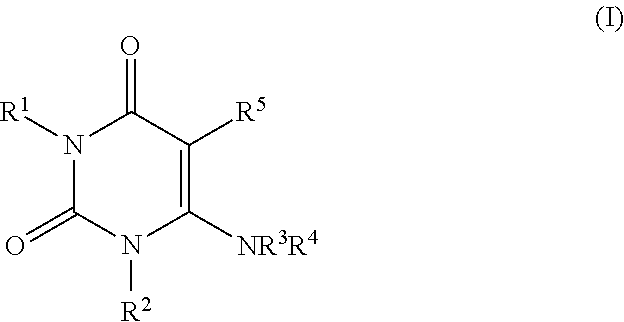
Figure 2 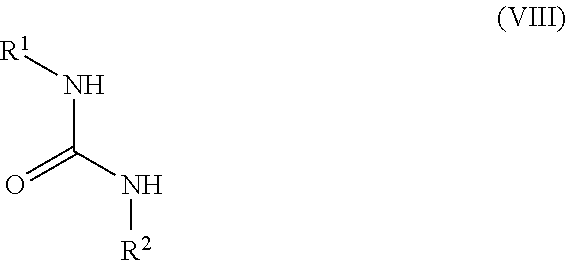
Figure 3
Abstract
Description
CROSS REFERENCE TO RELATED APPLICATIONS
[0001] This application is a 35 U.S.C. §371 National Phase Entry Application from PCT / IL2010 / 000260, filed Mar. 25, 2010, and designating the United States, which claims the benefit of U.S. Provisional Application No. 61 / 163,481, filed on Mar. 26, 2009, which are incorporated herein in their entireties.FIELD OF THE INVENTION
[0002] The present invention relates to a process for the preparation of alogliptin and its analogs, inhibitors of dipeptidyl peptidase-4 (DPP-4) that are useful for the treatment of type 2 diabetes.BACKGROUND OF THE INVENTION
[0003] Diabetes affects millions of people worldwide and is considered one of the main threats to human health in the 21st century. In 2006, the World Health Organization (WHO) estimated that over 180 million people worldwide had diabetes, and the number is projected to double by 2030. Over time, uncontrolled diabetes can damage body systems, including the heart, blood vessels, eyes, kidneys and nerves. Ac...
Examples
example 1
Preparation of (R)-2-((6-(3-aminopiperidin-1-yl)-3-methyl-2,4-dioxo-3,4-dihydropyrimidin-1 (2H)-yl)methyl)benzonitrile (alogliptin) via 6-chloro-1-(2-isocyanobenzyl)-3-methylpyrimidine-2,4(1H,3H)-dione (Scheme 3)
[0126]
Preparation of 1-(2-isocyanobenzyl)-3-methylurea
[0127]2-cyanobenzylamine hydrochloride (90 g) and Dichloromethane (800 ml) were taken into a round bottomed (RB) flask. Methyl isocyanate (45.6 g) was added at 5° C. Triethylamine (81 g) in Dichloromethane (300 ml) was added at the same temperature and stirred at room temperature for 16 h. Water (1 L) was added and stirred for 30 min. The obtained solid was collected by filtration and dried in oven at 50° C. for 12 h. The yield is 85% and the purity 99.8%.
Preparation of 1-(2-isocyanobenzyl)-3-methylpyrimidine-2,4,6(1H,3H,5H)-trione
[0128]a). To a stirred solution of 0.11 mol of sodium ethanolate in 80 ml of ethanol abs. was added 0.1 mol of 1-(2-isocyanobenzyl)-3-methylurea and 0.1 mol diethyl malonate. The mixture was ref...
example 2
Preparation of (R)-2-((6-(3-aminopiperidin-1-yl)-3-methyl-2,4-dioxo-3,4-dihydropyrimidin-1(2H)-yl)methyl)benzonitrile (alogliptin) via 6-amino-1-(2-isocyanobenzyl)-3-methylpyrimidine-2,4(1H,3H)-dione (Scheme 4)
[0139]
Preparation of 6-amino-1-(2-isocyanobenzyl)-3-methylpyrimidine-2,4(1H,3H)-dione
[0140]a). 1-(2-isocyanobenzyl)-3-methylurea (0.2 mol) and cyanoacetic acid (0.22 mol) were dissolved in acetic anhydride (400 ml), and the mixture was heated at 80° C. for 2 hours. Acetic anhydride was distilled off under reduced pressure and water (200 ml) was added. The mixture was cooled to 0-5° C. and 2N NaOH solution (220 ml) was added and stirring was continued for 2 hours. The obtained solids were filtered off, washed with cold methanol and dried under vacuum. The yield of 6-amino-1-(2-isocyanobenzyl)-3-methylpyrimidine-2,4(1H,3H)-dione was 72%.
[0141]b). Under nitrogen atmosphere, 1-(2-isocyanobenzyl)-3-methylurea (98.4 g) and cyanoacetic acid (80.0 g) was added to N,N-dimethylformamide...