
Catheter with serially connected sensing structures and methods of calibration and detection
a sensing structure and serial connection technology, applied in the field of catheters, can solve the problems of occupying space in the space-constrained catheter tip, affecting the calibration and detection of catheters, so as to reduce the number of sensing coil leads, minimize lead breakage and failure, the effect of reducing the number of coil leads
Patent Information
- Authority / Receiving Office
- US · United States
- Patent Type
- Patents(United States)
- Current Assignee / Owner
- Publication Date
- 2015-12-08
Smart Images
Figure 1 
Figure 2 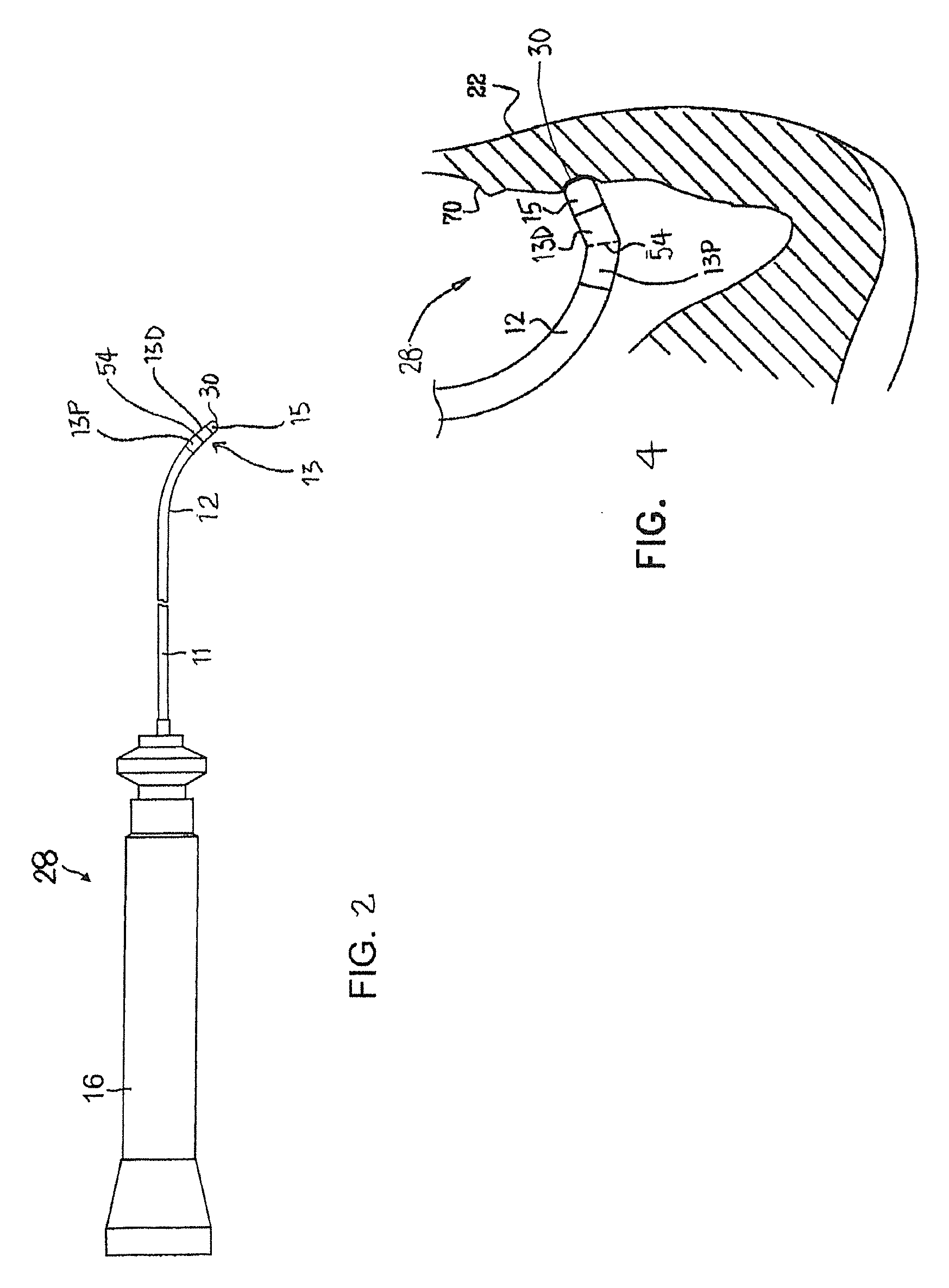
Figure 3
Abstract
Description
FIELD OF INVENTION
[0001] The present invention relates to catheters, particularly catheters with location / orientation and pressure sensing capabilities.BACKGROUND OF INVENTION
[0002] In some diagnostic and therapeutic techniques, a catheter is inserted into a chamber of the heart and brought into contact with the inner heart wall. For example, in intracardiac radio-frequency (RF) ablation, a catheter having an electrode at its distal tip is inserted through the patient's vascular system into a chamber of the heart. The electrode is brought into contact with a site (or sites) on the endocardium, and electrical activity in the heart chamber is detected by the electrode. Moreover, RF energy may be applied through the catheter to the electrode in order to ablate the heart tissue at the site.
[0003] Catheters for mapping and / or ablation typically carry one or more magnetic position sensors for generating signals that are used to determine position coordinates of a distal portion of catheter. ...
Examples
Embodiment Construction
[0023]The present invention is directed to a system and catheter for cardiac catheterization, where the catheter has a sensing assembly that provides signals representative of both position of the catheter and pressure exerted on a distal section of the catheter when it engages tissue. Compared to conventional position sensing assemblies and pressure sensing assemblies, sensing assemblies of the catheter are advantageously configured with serially-wired sensing structures to reduce the number of leads and / or their lengths for a simplified catheter structure that minimizes the risk of damaged or broken leads.
[0024]FIG. 1 is a schematic, pictorial illustration of a conventional system 20 for cardiac catheterization as known in the art. System 20 may be based, for example, on the CARTO™ system, produced by Biosense Webster Inc. (Diamond Bar, Calif.). This system comprises an invasive probe in the form of a catheter 28 and a control console 34. In the embodiment described hereinbelow, i...