Benchmark Hall Effect Sensor Performance for Renewable Energy Systems
SEP 22, 20259 MIN READ
Generate Your Research Report Instantly with AI Agent
PatSnap Eureka helps you evaluate technical feasibility & market potential.
Hall Effect Sensor Technology Background and Objectives
Hall Effect sensors have evolved significantly since Edwin Hall's discovery of the Hall Effect in 1879. Initially limited to laboratory applications, these sensors have transformed into versatile components essential for modern electronic systems. The technology operates on the fundamental principle that when a current-carrying conductor is placed in a magnetic field, a voltage is generated perpendicular to both the current and magnetic field. This simple yet powerful principle enables precise measurement of magnetic field strength, position, and proximity.
In renewable energy systems, particularly wind turbines and solar tracking systems, Hall Effect sensors play a critical role in ensuring optimal performance and efficiency. The evolution of these sensors has been marked by continuous improvements in sensitivity, temperature stability, and integration capabilities, making them increasingly suitable for demanding renewable energy applications.
The global push towards sustainable energy solutions has accelerated the development of Hall Effect sensor technology. Modern sensors now offer enhanced precision, reliability, and durability—qualities essential for renewable energy systems that operate in variable environmental conditions. Recent advancements include the development of programmable Hall Effect sensors with digital outputs, integrated temperature compensation, and improved signal-to-noise ratios, addressing previous limitations in harsh operating environments.
The primary technical objective in benchmarking Hall Effect sensor performance for renewable energy systems is to establish standardized evaluation metrics that accurately reflect real-world operational requirements. These metrics must account for the unique challenges faced in renewable energy applications, including wide temperature variations, exposure to elements, and the need for long-term stability without maintenance.
Another critical objective is to identify the optimal sensor specifications for different types of renewable energy systems. Wind turbines require sensors capable of high-speed rotational measurements with minimal drift, while solar tracking systems demand precise positional accuracy with low power consumption. Understanding these differentiated requirements is essential for effective benchmarking.
Furthermore, the benchmarking process aims to evaluate emerging Hall Effect sensor technologies against traditional solutions, quantifying improvements in energy efficiency, system reliability, and overall performance. This comparative analysis will guide future development efforts and investment decisions in sensor technology for renewable energy applications.
The ultimate goal of this technical research is to accelerate the adoption of optimized Hall Effect sensors in renewable energy systems, thereby enhancing energy production efficiency, reducing maintenance costs, and extending system operational lifespans. By establishing clear performance benchmarks, the industry can drive innovation toward sensors specifically designed for the unique demands of sustainable energy generation.
In renewable energy systems, particularly wind turbines and solar tracking systems, Hall Effect sensors play a critical role in ensuring optimal performance and efficiency. The evolution of these sensors has been marked by continuous improvements in sensitivity, temperature stability, and integration capabilities, making them increasingly suitable for demanding renewable energy applications.
The global push towards sustainable energy solutions has accelerated the development of Hall Effect sensor technology. Modern sensors now offer enhanced precision, reliability, and durability—qualities essential for renewable energy systems that operate in variable environmental conditions. Recent advancements include the development of programmable Hall Effect sensors with digital outputs, integrated temperature compensation, and improved signal-to-noise ratios, addressing previous limitations in harsh operating environments.
The primary technical objective in benchmarking Hall Effect sensor performance for renewable energy systems is to establish standardized evaluation metrics that accurately reflect real-world operational requirements. These metrics must account for the unique challenges faced in renewable energy applications, including wide temperature variations, exposure to elements, and the need for long-term stability without maintenance.
Another critical objective is to identify the optimal sensor specifications for different types of renewable energy systems. Wind turbines require sensors capable of high-speed rotational measurements with minimal drift, while solar tracking systems demand precise positional accuracy with low power consumption. Understanding these differentiated requirements is essential for effective benchmarking.
Furthermore, the benchmarking process aims to evaluate emerging Hall Effect sensor technologies against traditional solutions, quantifying improvements in energy efficiency, system reliability, and overall performance. This comparative analysis will guide future development efforts and investment decisions in sensor technology for renewable energy applications.
The ultimate goal of this technical research is to accelerate the adoption of optimized Hall Effect sensors in renewable energy systems, thereby enhancing energy production efficiency, reducing maintenance costs, and extending system operational lifespans. By establishing clear performance benchmarks, the industry can drive innovation toward sensors specifically designed for the unique demands of sustainable energy generation.
Market Analysis for Hall Sensors in Renewable Energy
The global market for Hall effect sensors in renewable energy applications is experiencing robust growth, driven by the increasing adoption of clean energy technologies worldwide. As of 2023, the market valuation stands at approximately 1.2 billion USD, with projections indicating a compound annual growth rate (CAGR) of 7.8% through 2030. This growth trajectory is primarily fueled by the expanding solar and wind energy sectors, which together account for over 65% of Hall sensor applications in renewable energy systems.
Wind energy represents the largest application segment, where Hall sensors are critical components in turbine control systems, position sensing, and current monitoring. The market demand in this sector has seen a 12% year-over-year increase, reflecting the global push toward offshore wind farm development and the upgrading of existing installations with more sophisticated monitoring capabilities.
Solar energy applications follow closely, with Hall sensors being integral to inverter systems, tracking mechanisms, and power management. This segment has witnessed a 9.5% growth rate, driven by the decreasing cost of photovoltaic installations and increasing grid integration requirements that necessitate precise current and position sensing.
Regionally, Asia-Pacific dominates the market with a 42% share, led by China's aggressive renewable energy expansion and manufacturing capabilities. Europe follows at 28%, where stringent environmental regulations and ambitious renewable energy targets have accelerated adoption. North America accounts for 21% of the market, with significant growth potential as renewable infrastructure investments increase.
The customer landscape is diverse, encompassing renewable energy equipment manufacturers, system integrators, and maintenance service providers. Large-scale utility companies represent the highest-value customers, demanding high-precision sensors with enhanced reliability for critical infrastructure applications.
Price sensitivity varies significantly across market segments. While utility-scale projects prioritize performance and reliability over cost, smaller residential and commercial installations remain highly price-sensitive, creating distinct market tiers with different value propositions.
Future market expansion is expected in emerging applications such as energy storage systems, where Hall sensors play crucial roles in battery management and safety systems. This segment is projected to grow at 14.3% annually, potentially becoming a significant market driver by 2028.
Customer requirements are evolving toward sensors with higher temperature stability, improved accuracy in harsh environments, and enhanced digital integration capabilities. The ability to provide comprehensive data for predictive maintenance and system optimization is increasingly becoming a key differentiator in the market.
Wind energy represents the largest application segment, where Hall sensors are critical components in turbine control systems, position sensing, and current monitoring. The market demand in this sector has seen a 12% year-over-year increase, reflecting the global push toward offshore wind farm development and the upgrading of existing installations with more sophisticated monitoring capabilities.
Solar energy applications follow closely, with Hall sensors being integral to inverter systems, tracking mechanisms, and power management. This segment has witnessed a 9.5% growth rate, driven by the decreasing cost of photovoltaic installations and increasing grid integration requirements that necessitate precise current and position sensing.
Regionally, Asia-Pacific dominates the market with a 42% share, led by China's aggressive renewable energy expansion and manufacturing capabilities. Europe follows at 28%, where stringent environmental regulations and ambitious renewable energy targets have accelerated adoption. North America accounts for 21% of the market, with significant growth potential as renewable infrastructure investments increase.
The customer landscape is diverse, encompassing renewable energy equipment manufacturers, system integrators, and maintenance service providers. Large-scale utility companies represent the highest-value customers, demanding high-precision sensors with enhanced reliability for critical infrastructure applications.
Price sensitivity varies significantly across market segments. While utility-scale projects prioritize performance and reliability over cost, smaller residential and commercial installations remain highly price-sensitive, creating distinct market tiers with different value propositions.
Future market expansion is expected in emerging applications such as energy storage systems, where Hall sensors play crucial roles in battery management and safety systems. This segment is projected to grow at 14.3% annually, potentially becoming a significant market driver by 2028.
Customer requirements are evolving toward sensors with higher temperature stability, improved accuracy in harsh environments, and enhanced digital integration capabilities. The ability to provide comprehensive data for predictive maintenance and system optimization is increasingly becoming a key differentiator in the market.
Current Challenges in Hall Effect Sensing Technology
Despite significant advancements in Hall effect sensing technology, several critical challenges persist that limit optimal performance in renewable energy applications. Temperature drift remains one of the most significant issues, with sensor accuracy typically degrading by 0.1% to 0.5% per degree Celsius outside calibrated ranges. This is particularly problematic in renewable energy systems where operating environments can range from -40°C in wind turbines to over 85°C in solar inverters, requiring complex compensation algorithms that increase computational overhead.
Signal-to-noise ratio (SNR) degradation presents another substantial challenge, especially in high-power renewable applications where electromagnetic interference (EMI) from power conversion circuits can overwhelm the relatively weak Hall voltage signals. Current sensors in utility-scale solar inverters and wind power converters often require extensive shielding and filtering, adding cost and complexity while still achieving only 65-75dB SNR in practical implementations.
Linearity issues become increasingly apparent at the extremes of measurement ranges, with typical non-linearity errors of 0.5% to 2% of full scale. This creates particular difficulties in renewable energy systems that experience wide dynamic ranges—from low-power generation conditions to sudden peak outputs during optimal weather conditions. The non-linear response requires sophisticated calibration procedures that must be maintained throughout the sensor's operational lifetime.
Long-term stability and drift characteristics pose significant reliability concerns for renewable energy installations designed for 20+ year lifespans. Current Hall effect sensors exhibit drift rates of approximately 0.1% to 0.3% annually, potentially leading to cumulative measurement errors exceeding 5% over the system lifetime without periodic recalibration—a costly maintenance requirement for remote installations.
Power consumption remains problematic for distributed sensing applications, particularly in self-powered monitoring systems for renewable energy. While improvements have reduced consumption to the 5-20mW range, this still exceeds the power budget for energy-harvesting sensor nodes that might monitor distributed solar arrays or remote wind installations.
Integration challenges persist when incorporating Hall sensors into increasingly compact and cost-sensitive renewable energy electronics. The need for magnetic concentrators, temperature compensation circuits, and signal conditioning components increases both physical footprint and bill of materials, conflicting with industry trends toward miniaturization and cost reduction. Current integrated solutions still require 30-50% more PCB area than theoretical minimums.
Response time limitations affect dynamic performance in grid-connected renewable systems, where rapid current transient detection is essential for fault protection. While specialized Hall sensors achieve response times of 3-5μs, this remains insufficient for detecting ultra-fast fault conditions that require sub-microsecond response to prevent cascade failures in large renewable installations.
Signal-to-noise ratio (SNR) degradation presents another substantial challenge, especially in high-power renewable applications where electromagnetic interference (EMI) from power conversion circuits can overwhelm the relatively weak Hall voltage signals. Current sensors in utility-scale solar inverters and wind power converters often require extensive shielding and filtering, adding cost and complexity while still achieving only 65-75dB SNR in practical implementations.
Linearity issues become increasingly apparent at the extremes of measurement ranges, with typical non-linearity errors of 0.5% to 2% of full scale. This creates particular difficulties in renewable energy systems that experience wide dynamic ranges—from low-power generation conditions to sudden peak outputs during optimal weather conditions. The non-linear response requires sophisticated calibration procedures that must be maintained throughout the sensor's operational lifetime.
Long-term stability and drift characteristics pose significant reliability concerns for renewable energy installations designed for 20+ year lifespans. Current Hall effect sensors exhibit drift rates of approximately 0.1% to 0.3% annually, potentially leading to cumulative measurement errors exceeding 5% over the system lifetime without periodic recalibration—a costly maintenance requirement for remote installations.
Power consumption remains problematic for distributed sensing applications, particularly in self-powered monitoring systems for renewable energy. While improvements have reduced consumption to the 5-20mW range, this still exceeds the power budget for energy-harvesting sensor nodes that might monitor distributed solar arrays or remote wind installations.
Integration challenges persist when incorporating Hall sensors into increasingly compact and cost-sensitive renewable energy electronics. The need for magnetic concentrators, temperature compensation circuits, and signal conditioning components increases both physical footprint and bill of materials, conflicting with industry trends toward miniaturization and cost reduction. Current integrated solutions still require 30-50% more PCB area than theoretical minimums.
Response time limitations affect dynamic performance in grid-connected renewable systems, where rapid current transient detection is essential for fault protection. While specialized Hall sensors achieve response times of 3-5μs, this remains insufficient for detecting ultra-fast fault conditions that require sub-microsecond response to prevent cascade failures in large renewable installations.
Benchmark Methodologies for Hall Effect Sensors
01 Hall Effect Sensor Design and Structure
The design and structure of Hall effect sensors significantly impact their performance. Various structural configurations, including integrated circuit designs, semiconductor material choices, and packaging techniques, can enhance sensitivity, reduce noise, and improve overall reliability. Optimized sensor structures can minimize temperature drift and increase magnetic field detection capabilities.- Hall sensor design and structure optimization: The performance of Hall effect sensors can be improved through optimized design and structure. This includes the development of specialized semiconductor materials, geometric configurations, and integration techniques that enhance sensitivity and reduce noise. Advanced fabrication methods can create sensors with better magnetic field detection capabilities and improved signal-to-noise ratios, resulting in more accurate measurements and higher reliability in various applications.
- Signal processing and conditioning techniques: Various signal processing and conditioning techniques can significantly enhance Hall effect sensor performance. These include amplification circuits, filtering methods, and digital signal processing algorithms that improve the quality of the output signal. Advanced compensation techniques can address issues such as temperature drift, offset voltage, and non-linearity, resulting in more stable and accurate sensor readings across different operating conditions.
- Temperature compensation and environmental stability: Hall effect sensor performance can be significantly affected by temperature variations and environmental factors. Implementing temperature compensation techniques, such as integrated temperature sensors and calibration algorithms, helps maintain measurement accuracy across wide temperature ranges. Protective packaging and specialized materials can also improve sensor stability in harsh environments, including high humidity, vibration, and electromagnetic interference conditions.
- Power efficiency and miniaturization: Improving power efficiency and reducing the size of Hall effect sensors are critical aspects of performance enhancement. Low-power design techniques, including optimized biasing circuits and power management systems, extend battery life in portable applications. Advanced manufacturing processes enable the creation of smaller sensors without compromising sensitivity, allowing for integration into space-constrained devices and enabling new applications in fields such as medical implants and IoT devices.
- Specialized applications and measurement techniques: Hall effect sensors can be optimized for specific applications through specialized measurement techniques. This includes sensors designed for high-speed rotation detection, precise current measurement, position sensing, and contactless switching. By tailoring the sensor design to specific use cases, performance characteristics such as response time, detection range, and accuracy can be significantly improved, enabling more effective solutions in automotive, industrial, consumer electronics, and medical applications.
02 Sensitivity and Accuracy Improvements
Techniques to enhance the sensitivity and accuracy of Hall effect sensors include signal amplification, noise reduction circuits, and advanced calibration methods. These improvements allow for detection of smaller magnetic field changes and more precise measurements. Enhanced sensitivity is particularly important in applications requiring high-resolution position sensing or low magnetic field detection.Expand Specific Solutions03 Temperature Compensation and Environmental Stability
Hall effect sensors are susceptible to performance variations due to temperature changes and environmental factors. Implementing temperature compensation techniques, such as integrated temperature sensors, offset correction circuits, and specialized materials with lower temperature coefficients, can significantly improve stability across wide operating temperature ranges and harsh environments.Expand Specific Solutions04 Power Efficiency and Consumption Optimization
Reducing power consumption while maintaining performance is crucial for Hall effect sensors, especially in battery-powered applications. Power optimization techniques include low-power operating modes, sleep functionality, efficient biasing circuits, and improved semiconductor materials that require less current to operate effectively while maintaining high sensitivity to magnetic fields.Expand Specific Solutions05 Integration with Signal Processing and Interface Technologies
Advanced signal processing techniques and interface technologies enhance Hall effect sensor performance by improving signal-to-noise ratio, enabling digital output capabilities, and facilitating integration with microcontrollers and other systems. These include on-chip analog-to-digital converters, digital signal processors, programmable gain amplifiers, and various communication interfaces that allow for more sophisticated sensor applications.Expand Specific Solutions
Major Manufacturers and Competitive Landscape
The Hall Effect sensor market for renewable energy systems is in a growth phase, driven by increasing adoption of clean energy technologies. The market is expanding rapidly with a projected size of several billion dollars by 2030. Technologically, the field shows varying maturity levels across applications. Industry leaders like Honeywell, Infineon, and Texas Instruments have established robust commercial solutions with advanced sensing capabilities, while research institutions such as CNRS and Chinese universities are developing next-generation technologies. State Grid Corporation of China and other power utilities are implementing these sensors in grid infrastructure. The competitive landscape features both established semiconductor manufacturers and specialized sensor companies like Lake Shore Cryotronics, with increasing collaboration between academic institutions and industry players to enhance performance metrics for renewable energy applications.
Honeywell International Technologies Ltd.
Technical Solution: Honeywell has developed advanced Hall effect sensor solutions specifically optimized for renewable energy applications. Their SS360/SS460 series high-sensitivity latching Hall effect sensors feature industry-leading sensitivity (7 Gauss typical operate point), enabling them to operate in the presence of relatively weak magnetic fields in solar tracking systems. The sensors incorporate Honeywell's proprietary integrated circuit and packaging techniques, resulting in superior temperature stability (±30 Gauss over -40°C to +125°C) critical for outdoor renewable installations. For wind turbine applications, Honeywell's SMART position sensors provide non-contact measurement with high accuracy (0.1% linearity) and long-distance sensing capabilities (up to 180mm) to monitor blade pitch and yaw positioning, enhancing energy capture efficiency while withstanding harsh environmental conditions.
Strengths: Superior temperature stability across extreme conditions; high sensitivity enabling operation with weaker magnetic fields; proven reliability in harsh environments. Weaknesses: Higher cost compared to standard Hall sensors; requires specialized integration knowledge; some models have higher power consumption requirements.
Infineon Technologies AG
Technical Solution: Infineon has pioneered the TLE4966V/TLE4966-3K double Hall-effect sensors specifically engineered for renewable energy applications. These sensors utilize Infineon's patented Triaxis® technology that enables 3D magnetic field sensing with a single chip, providing precise measurement of both speed and direction in wind turbine generators. The TLE4966 series features integrated signal processing with differential field measurement capability, achieving exceptional stray field compensation and an operating temperature range of -40°C to +170°C. For solar tracking systems, Infineon's TLI4970 current sensors with integrated Hall elements deliver high accuracy (±1%) measurements with galvanic isolation up to 3kV, enabling precise monitoring of photovoltaic array performance. Their sensors incorporate advanced chopper stabilization techniques that minimize temperature drift to less than 1% over the full operating range, ensuring consistent performance in variable outdoor conditions.
Strengths: Superior stray field immunity through differential sensing; extended temperature range ideal for harsh environments; integrated protection features against overvoltage and reverse polarity. Weaknesses: Higher power consumption compared to some competitors; more complex implementation requiring specialized design knowledge; premium pricing structure.
Key Patents and Technical Innovations
Magnetic sensor with thin-walled magnetic core and methods of manufacture
PatentActiveUS20150285841A1
Innovation
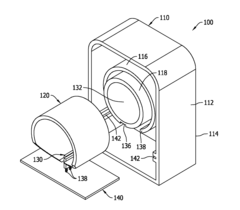
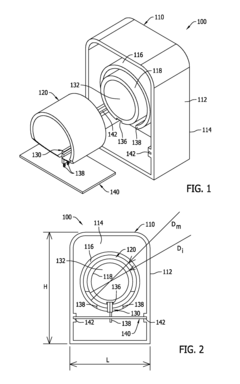
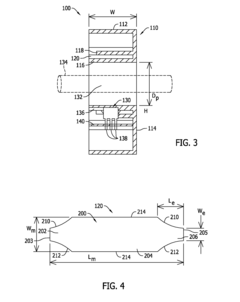
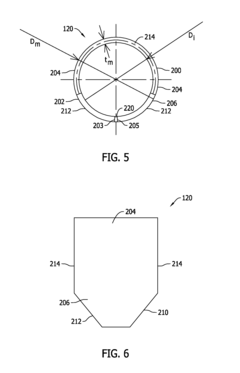
- The development of thin-walled magnetic core elements with a thickness ratio of inner diameter to thickness greater than 10:1, fabricated from materials like unoriented nickel molybdenum alloys, allowing for compact Hall effect current sensor designs with reduced dimensions while maintaining performance.
Hall effect sensor
PatentInactiveEP0572298A1
Innovation
- A Hall effect semiconductor sensor with a quantum well structure comprising III-V semiconductor materials, including a carrier supply layer and a burial layer, is designed to minimize temperature sensitivity and offset voltage, featuring a buffer layer for crystalline quality and a specific layer configuration to confine carriers and reduce thermal drift.


Environmental Impact and Sustainability Considerations
The integration of Hall Effect sensors in renewable energy systems presents significant environmental and sustainability implications that extend beyond mere technical performance. These sensors contribute to the optimization of renewable energy generation by enabling precise monitoring and control, thereby enhancing overall system efficiency. When renewable energy systems operate at peak efficiency through accurate sensing technologies, they maximize clean energy production while minimizing resource consumption, directly contributing to reduced greenhouse gas emissions and fossil fuel dependency.
From a lifecycle perspective, Hall Effect sensors demonstrate favorable environmental characteristics compared to alternative sensing technologies. Their solid-state construction typically requires fewer raw materials and generates less manufacturing waste than mechanical alternatives. Additionally, these sensors contain no mercury or other hazardous substances commonly found in older switch technologies, aligning with global initiatives like RoHS (Restriction of Hazardous Substances) and REACH (Registration, Evaluation, Authorization and Restriction of Chemicals) regulations.
The durability and reliability of Hall Effect sensors further enhance their sustainability profile. With no moving parts to wear out, these sensors typically offer operational lifespans exceeding 20 years when properly implemented, matching or exceeding the expected service life of many renewable energy installations. This longevity reduces replacement frequency and associated environmental impacts from manufacturing and disposal of replacement components.
Energy consumption of the sensors themselves represents another critical sustainability consideration. Modern Hall Effect sensors typically operate with power requirements in the milliwatt range, representing minimal parasitic load on renewable energy systems. Advanced low-power variants can further reduce energy consumption through intelligent power management features, operating in sleep modes when measurements are not actively required.
End-of-life considerations reveal both challenges and opportunities. While Hall Effect sensors contain semiconductor materials that require specialized recycling processes, their compact size minimizes waste volume. Industry initiatives are emerging to establish closed-loop recycling systems for electronic components in renewable energy applications, though implementation remains inconsistent across global markets.
When benchmarking Hall Effect sensor performance for renewable energy applications, environmental certification standards provide valuable frameworks for assessment. Sensors meeting ISO 14001 environmental management standards or carrying Environmental Product Declarations (EPDs) offer quantifiable sustainability metrics that can be incorporated into comprehensive performance evaluations alongside technical specifications.
From a lifecycle perspective, Hall Effect sensors demonstrate favorable environmental characteristics compared to alternative sensing technologies. Their solid-state construction typically requires fewer raw materials and generates less manufacturing waste than mechanical alternatives. Additionally, these sensors contain no mercury or other hazardous substances commonly found in older switch technologies, aligning with global initiatives like RoHS (Restriction of Hazardous Substances) and REACH (Registration, Evaluation, Authorization and Restriction of Chemicals) regulations.
The durability and reliability of Hall Effect sensors further enhance their sustainability profile. With no moving parts to wear out, these sensors typically offer operational lifespans exceeding 20 years when properly implemented, matching or exceeding the expected service life of many renewable energy installations. This longevity reduces replacement frequency and associated environmental impacts from manufacturing and disposal of replacement components.
Energy consumption of the sensors themselves represents another critical sustainability consideration. Modern Hall Effect sensors typically operate with power requirements in the milliwatt range, representing minimal parasitic load on renewable energy systems. Advanced low-power variants can further reduce energy consumption through intelligent power management features, operating in sleep modes when measurements are not actively required.
End-of-life considerations reveal both challenges and opportunities. While Hall Effect sensors contain semiconductor materials that require specialized recycling processes, their compact size minimizes waste volume. Industry initiatives are emerging to establish closed-loop recycling systems for electronic components in renewable energy applications, though implementation remains inconsistent across global markets.
When benchmarking Hall Effect sensor performance for renewable energy applications, environmental certification standards provide valuable frameworks for assessment. Sensors meeting ISO 14001 environmental management standards or carrying Environmental Product Declarations (EPDs) offer quantifiable sustainability metrics that can be incorporated into comprehensive performance evaluations alongside technical specifications.
Reliability Testing Standards for Renewable Applications
Reliability testing standards for Hall Effect sensors in renewable energy applications must adhere to rigorous protocols that ensure consistent performance under extreme environmental conditions. The International Electrotechnical Commission (IEC) has established several standards specifically for sensors used in renewable energy systems, including IEC 61000-4-2 for electrostatic discharge immunity and IEC 60068-2-1 for cold temperature testing.
For solar energy applications, Hall Effect sensors must undergo accelerated aging tests that simulate 25+ years of operational life. These tests typically include thermal cycling between -40°C and +125°C for at least 1,000 cycles, with performance parameters measured at regular intervals. The IEC 61215 standard, though primarily for photovoltaic modules, provides valuable testing frameworks that have been adapted for sensor components within these systems.
Wind turbine applications demand additional vibration and mechanical shock testing according to IEC 61400-1. Hall Effect sensors deployed in these environments must withstand continuous vibration frequencies of 5-2000 Hz with acceleration up to 10g. Humidity cycling tests following IEC 60068-2-30 are also critical, exposing sensors to relative humidity levels of 95% at varying temperatures to assess moisture resistance.
The JEDEC JESD22-A104 standard has been widely adopted for temperature cycling reliability assessment of Hall Effect sensors. This standard defines specific test conditions that correlate with different application environments, with Condition G (-40°C to +125°C) being particularly relevant for renewable energy applications.
Salt fog testing according to ASTM B117 is essential for offshore wind installations, where sensors must demonstrate corrosion resistance after exposure to salt spray for 96-1000 hours. Additionally, IP67/IP68 ingress protection testing verifies the sensor's ability to withstand dust and water immersion.
Electromagnetic compatibility (EMC) testing following IEC 61000-4-3 and IEC 61000-4-6 ensures Hall Effect sensors maintain accuracy in the electromagnetically noisy environments typical of power generation systems. These standards specify minimum immunity levels to radiated and conducted electromagnetic disturbances.
For reliability qualification, manufacturers typically employ statistical methods such as Highly Accelerated Life Testing (HALT) and Highly Accelerated Stress Screening (HASS) to identify potential failure modes. The Weibull distribution analysis is commonly used to predict failure rates and establish Mean Time Between Failures (MTBF) metrics, with renewable energy applications typically requiring MTBF values exceeding 100,000 hours.
For solar energy applications, Hall Effect sensors must undergo accelerated aging tests that simulate 25+ years of operational life. These tests typically include thermal cycling between -40°C and +125°C for at least 1,000 cycles, with performance parameters measured at regular intervals. The IEC 61215 standard, though primarily for photovoltaic modules, provides valuable testing frameworks that have been adapted for sensor components within these systems.
Wind turbine applications demand additional vibration and mechanical shock testing according to IEC 61400-1. Hall Effect sensors deployed in these environments must withstand continuous vibration frequencies of 5-2000 Hz with acceleration up to 10g. Humidity cycling tests following IEC 60068-2-30 are also critical, exposing sensors to relative humidity levels of 95% at varying temperatures to assess moisture resistance.
The JEDEC JESD22-A104 standard has been widely adopted for temperature cycling reliability assessment of Hall Effect sensors. This standard defines specific test conditions that correlate with different application environments, with Condition G (-40°C to +125°C) being particularly relevant for renewable energy applications.
Salt fog testing according to ASTM B117 is essential for offshore wind installations, where sensors must demonstrate corrosion resistance after exposure to salt spray for 96-1000 hours. Additionally, IP67/IP68 ingress protection testing verifies the sensor's ability to withstand dust and water immersion.
Electromagnetic compatibility (EMC) testing following IEC 61000-4-3 and IEC 61000-4-6 ensures Hall Effect sensors maintain accuracy in the electromagnetically noisy environments typical of power generation systems. These standards specify minimum immunity levels to radiated and conducted electromagnetic disturbances.
For reliability qualification, manufacturers typically employ statistical methods such as Highly Accelerated Life Testing (HALT) and Highly Accelerated Stress Screening (HASS) to identify potential failure modes. The Weibull distribution analysis is commonly used to predict failure rates and establish Mean Time Between Failures (MTBF) metrics, with renewable energy applications typically requiring MTBF values exceeding 100,000 hours.
Unlock deeper insights with PatSnap Eureka Quick Research — get a full tech report to explore trends and direct your research. Try now!
Generate Your Research Report Instantly with AI Agent
Supercharge your innovation with PatSnap Eureka AI Agent Platform!