Benchmarking Hall Effect Sensor Performance in Aerospace
SEP 22, 20259 MIN READ
Generate Your Research Report Instantly with AI Agent
PatSnap Eureka helps you evaluate technical feasibility & market potential.
Hall Effect Sensor Evolution in Aerospace Applications
Hall Effect sensors have undergone significant evolution in aerospace applications since their introduction in the 1950s. Initially, these sensors were primarily used for simple position detection with limited accuracy and reliability under extreme conditions. The first generation of aerospace Hall sensors featured basic semiconductor materials with relatively high power consumption and limited temperature ranges, typically operating between -40°C and +85°C.
The 1970s marked a turning point with the integration of silicon-based Hall Effect sensors into aircraft systems, offering improved stability and reduced size. These second-generation sensors incorporated basic compensation circuits to mitigate temperature drift issues, a critical advancement for aerospace applications where environmental conditions vary dramatically.
By the 1990s, the third generation emerged with the development of integrated Hall Effect sensor systems featuring built-in signal conditioning, amplification, and temperature compensation. These innovations significantly enhanced measurement accuracy from approximately ±5% to ±1% full-scale output, while expanding operating temperature ranges to -55°C to +150°C, meeting the stringent requirements of military and commercial aerospace standards.
The early 2000s witnessed the introduction of digital Hall Effect sensors with integrated analog-to-digital converters and microprocessors, enabling self-calibration capabilities and digital output formats compatible with modern avionics systems. This generation reduced susceptibility to electromagnetic interference, a persistent challenge in aircraft environments filled with various electronic systems.
Current state-of-the-art Hall Effect sensors for aerospace applications feature advanced materials such as gallium arsenide (GaAs) and indium antimonide (InSb), offering superior sensitivity and temperature stability. Modern sensors achieve measurement accuracies of ±0.1% with operating temperatures extending from -65°C to +200°C, making them suitable for engine monitoring and control systems where extreme conditions prevail.
Recent innovations include 3D Hall Effect sensors capable of measuring magnetic fields in three dimensions simultaneously, providing comprehensive position and rotation data for flight control systems. Additionally, radiation-hardened variants have been developed specifically for satellite and space applications, withstanding cosmic radiation exposure while maintaining measurement integrity.
The miniaturization trend has resulted in Hall Effect sensor packages less than 1mm² in size, enabling integration into increasingly compact aerospace components while reducing weight—a critical factor in aircraft design. Power efficiency has also improved dramatically, with modern sensors consuming less than 10% of the power required by their predecessors from the 1980s.
The 1970s marked a turning point with the integration of silicon-based Hall Effect sensors into aircraft systems, offering improved stability and reduced size. These second-generation sensors incorporated basic compensation circuits to mitigate temperature drift issues, a critical advancement for aerospace applications where environmental conditions vary dramatically.
By the 1990s, the third generation emerged with the development of integrated Hall Effect sensor systems featuring built-in signal conditioning, amplification, and temperature compensation. These innovations significantly enhanced measurement accuracy from approximately ±5% to ±1% full-scale output, while expanding operating temperature ranges to -55°C to +150°C, meeting the stringent requirements of military and commercial aerospace standards.
The early 2000s witnessed the introduction of digital Hall Effect sensors with integrated analog-to-digital converters and microprocessors, enabling self-calibration capabilities and digital output formats compatible with modern avionics systems. This generation reduced susceptibility to electromagnetic interference, a persistent challenge in aircraft environments filled with various electronic systems.
Current state-of-the-art Hall Effect sensors for aerospace applications feature advanced materials such as gallium arsenide (GaAs) and indium antimonide (InSb), offering superior sensitivity and temperature stability. Modern sensors achieve measurement accuracies of ±0.1% with operating temperatures extending from -65°C to +200°C, making them suitable for engine monitoring and control systems where extreme conditions prevail.
Recent innovations include 3D Hall Effect sensors capable of measuring magnetic fields in three dimensions simultaneously, providing comprehensive position and rotation data for flight control systems. Additionally, radiation-hardened variants have been developed specifically for satellite and space applications, withstanding cosmic radiation exposure while maintaining measurement integrity.
The miniaturization trend has resulted in Hall Effect sensor packages less than 1mm² in size, enabling integration into increasingly compact aerospace components while reducing weight—a critical factor in aircraft design. Power efficiency has also improved dramatically, with modern sensors consuming less than 10% of the power required by their predecessors from the 1980s.
Aerospace Market Requirements for Hall Effect Sensors
The aerospace industry demands exceptional performance from Hall effect sensors due to the critical nature of flight systems and the harsh operating environments. Primary requirements include extreme temperature tolerance, with sensors needing to function reliably from -65°C to +150°C to accommodate both high-altitude cold and engine proximity heat. Vibration and shock resistance are equally crucial, as aerospace sensors must withstand continuous vibration levels of 20G or more and shock impacts exceeding 100G during takeoff, landing, and turbulence events.
Accuracy and precision requirements in aerospace applications typically demand measurement errors below 0.1% across the full operating range, with excellent repeatability between measurement cycles. This level of precision is essential for flight control systems, where even minor deviations can significantly impact aircraft performance and safety. Long-term stability is another critical factor, with aerospace-grade Hall sensors expected to maintain calibration and performance specifications for 20,000+ operating hours without drift.
Reliability metrics for aerospace Hall effect sensors are exceptionally stringent, with failure rates typically required to be less than 10 FIT (failures in time, or failures per billion hours of operation). This translates to a mean time between failures (MTBF) exceeding 100 million hours for critical applications. Redundancy features are often mandatory, with sensors incorporating self-diagnostic capabilities and fail-safe modes to ensure system integrity.
Power efficiency considerations are particularly important for satellite and unmanned aerial vehicle (UAV) applications, where sensors must operate with minimal power consumption, typically below 5mW in active mode and under 100μW in standby mode. Size and weight constraints are equally pressing, with the aerospace industry continuously pushing for miniaturization while maintaining performance.
Electromagnetic compatibility (EMC) requirements are especially demanding, as sensors must function accurately in environments with high electromagnetic interference from radar systems, communication equipment, and power distribution networks. Certification standards including DO-160 for environmental conditions and DO-254 for hardware design assurance must be met, requiring extensive documentation and testing protocols.
The aerospace market increasingly demands sensors with digital interfaces (SPI, I²C) that support advanced diagnostics and integration with flight management systems. Additionally, there is growing interest in sensors capable of measuring multiple parameters simultaneously, such as combining magnetic field detection with temperature sensing or position monitoring, to reduce overall system complexity and weight.
Accuracy and precision requirements in aerospace applications typically demand measurement errors below 0.1% across the full operating range, with excellent repeatability between measurement cycles. This level of precision is essential for flight control systems, where even minor deviations can significantly impact aircraft performance and safety. Long-term stability is another critical factor, with aerospace-grade Hall sensors expected to maintain calibration and performance specifications for 20,000+ operating hours without drift.
Reliability metrics for aerospace Hall effect sensors are exceptionally stringent, with failure rates typically required to be less than 10 FIT (failures in time, or failures per billion hours of operation). This translates to a mean time between failures (MTBF) exceeding 100 million hours for critical applications. Redundancy features are often mandatory, with sensors incorporating self-diagnostic capabilities and fail-safe modes to ensure system integrity.
Power efficiency considerations are particularly important for satellite and unmanned aerial vehicle (UAV) applications, where sensors must operate with minimal power consumption, typically below 5mW in active mode and under 100μW in standby mode. Size and weight constraints are equally pressing, with the aerospace industry continuously pushing for miniaturization while maintaining performance.
Electromagnetic compatibility (EMC) requirements are especially demanding, as sensors must function accurately in environments with high electromagnetic interference from radar systems, communication equipment, and power distribution networks. Certification standards including DO-160 for environmental conditions and DO-254 for hardware design assurance must be met, requiring extensive documentation and testing protocols.
The aerospace market increasingly demands sensors with digital interfaces (SPI, I²C) that support advanced diagnostics and integration with flight management systems. Additionally, there is growing interest in sensors capable of measuring multiple parameters simultaneously, such as combining magnetic field detection with temperature sensing or position monitoring, to reduce overall system complexity and weight.
Current Limitations and Technical Challenges
Despite significant advancements in Hall effect sensor technology, several critical limitations persist when applied to aerospace environments. The extreme operating conditions of aerospace applications—including temperature ranges from -65°C to over 300°C in engine compartments—push commercial Hall sensors beyond their typical operating range of -40°C to 150°C. This temperature limitation significantly impacts measurement accuracy and sensor longevity, with sensitivity drift exceeding 15% at extreme temperatures.
Vibration and mechanical stress present another substantial challenge, as aerospace platforms experience continuous vibration profiles up to 20g and shock events exceeding 50g. Current Hall sensor packaging technologies struggle to maintain consistent performance under these conditions, with mechanical stress inducing up to 8% measurement error through piezoelectric effects on semiconductor materials.
Electromagnetic interference (EMI) from aircraft power systems, radar equipment, and communication systems creates a particularly hostile environment for Hall sensors. Modern aircraft electrical systems operating at 270VDC or 230VAC/400Hz generate significant electromagnetic noise that can overwhelm the relatively small Hall voltage signals (typically in the microvolt range). Current shielding techniques add substantial weight and complexity, contradicting aerospace design principles of minimizing size, weight, and power (SWaP).
Power consumption remains problematic for battery or limited-power applications in aerospace. While recent low-power Hall sensors have improved, drawing 5-15mA during operation, this still presents challenges for long-duration unmanned aerial vehicles (UAVs) and satellite applications where power budgets are extremely constrained.
Reliability and longevity concerns are paramount in aerospace, where components must function flawlessly for thousands of flight hours. Current Hall sensor mean time between failures (MTBF) ratings of 50,000-100,000 hours fall short of aerospace requirements exceeding 150,000 hours. Radiation hardening presents additional challenges in high-altitude and space applications, where cosmic radiation can cause single-event upsets in the sensor's electronic components.
Calibration drift over time represents another significant technical hurdle. Field data indicates that Hall sensors in aerospace applications can experience sensitivity drift of 2-5% annually, necessitating recalibration procedures that increase maintenance costs and downtime. This drift is exacerbated by thermal cycling and vibration exposure typical in aerospace operations.
Integration challenges with existing aerospace systems also persist. Legacy aircraft systems using different voltage standards (5V, 12V, 28V) require complex interface circuits for modern Hall sensors, adding points of failure and increasing certification complexity under DO-254 and other aerospace standards.
Vibration and mechanical stress present another substantial challenge, as aerospace platforms experience continuous vibration profiles up to 20g and shock events exceeding 50g. Current Hall sensor packaging technologies struggle to maintain consistent performance under these conditions, with mechanical stress inducing up to 8% measurement error through piezoelectric effects on semiconductor materials.
Electromagnetic interference (EMI) from aircraft power systems, radar equipment, and communication systems creates a particularly hostile environment for Hall sensors. Modern aircraft electrical systems operating at 270VDC or 230VAC/400Hz generate significant electromagnetic noise that can overwhelm the relatively small Hall voltage signals (typically in the microvolt range). Current shielding techniques add substantial weight and complexity, contradicting aerospace design principles of minimizing size, weight, and power (SWaP).
Power consumption remains problematic for battery or limited-power applications in aerospace. While recent low-power Hall sensors have improved, drawing 5-15mA during operation, this still presents challenges for long-duration unmanned aerial vehicles (UAVs) and satellite applications where power budgets are extremely constrained.
Reliability and longevity concerns are paramount in aerospace, where components must function flawlessly for thousands of flight hours. Current Hall sensor mean time between failures (MTBF) ratings of 50,000-100,000 hours fall short of aerospace requirements exceeding 150,000 hours. Radiation hardening presents additional challenges in high-altitude and space applications, where cosmic radiation can cause single-event upsets in the sensor's electronic components.
Calibration drift over time represents another significant technical hurdle. Field data indicates that Hall sensors in aerospace applications can experience sensitivity drift of 2-5% annually, necessitating recalibration procedures that increase maintenance costs and downtime. This drift is exacerbated by thermal cycling and vibration exposure typical in aerospace operations.
Integration challenges with existing aerospace systems also persist. Legacy aircraft systems using different voltage standards (5V, 12V, 28V) require complex interface circuits for modern Hall sensors, adding points of failure and increasing certification complexity under DO-254 and other aerospace standards.
Benchmark Methodologies and Performance Metrics
01 Enhancing sensitivity and accuracy of Hall effect sensors
Various techniques can be employed to improve the sensitivity and accuracy of Hall effect sensors. These include optimizing the semiconductor materials used in the sensor, implementing signal conditioning circuits, and utilizing advanced calibration methods. Enhanced sensitivity allows for detection of weaker magnetic fields, while improved accuracy ensures reliable measurements across varying operating conditions.- Design and structure of Hall effect sensors: The physical design and structure of Hall effect sensors significantly impact their performance. Various structural configurations, including the use of specific materials and geometries, can enhance sensitivity and reduce noise. Innovations in sensor design focus on optimizing the Hall element shape, contact placement, and integration with other semiconductor components to improve overall performance metrics.
- Sensitivity and accuracy enhancement techniques: Various techniques can be employed to enhance the sensitivity and accuracy of Hall effect sensors. These include signal conditioning circuits, differential sensing arrangements, and specialized amplification methods. Advanced calibration techniques and compensation algorithms help minimize measurement errors caused by temperature variations and other environmental factors, resulting in more precise magnetic field detection.
- Noise reduction and interference management: Managing noise and interference is crucial for Hall effect sensor performance. Techniques include implementing shielding structures, utilizing specialized filtering circuits, and employing differential sensing architectures. Advanced signal processing algorithms can further reduce noise effects, while proper sensor placement and orientation help minimize interference from external magnetic fields, improving the signal-to-noise ratio.
- Temperature compensation and environmental stability: Hall effect sensors are susceptible to performance variations due to temperature changes and environmental factors. Implementing temperature compensation techniques, such as integrated temperature sensors and adaptive calibration algorithms, helps maintain consistent performance across varying conditions. Specialized packaging and protective coatings can also enhance environmental stability, ensuring reliable operation in harsh environments.
- Integration with other systems and applications: The integration of Hall effect sensors with other electronic systems affects their overall performance in specific applications. Considerations include interface circuitry, power management, and communication protocols. Advanced integration techniques enable Hall sensors to function effectively in automotive systems, industrial equipment, consumer electronics, and other specialized applications, with optimized performance for each use case.
02 Temperature compensation in Hall effect sensors
Temperature variations can significantly affect Hall effect sensor performance. Temperature compensation techniques involve implementing circuits or algorithms that adjust sensor output based on temperature changes. These methods may include using temperature sensors, differential amplifiers, or specialized materials with lower temperature coefficients to maintain consistent sensor performance across a wide temperature range.Expand Specific Solutions03 Structural design improvements for Hall effect sensors
The physical structure and packaging of Hall effect sensors significantly impact their performance. Design improvements include optimizing the geometry of the sensing element, implementing protective layers against environmental factors, and developing compact packaging solutions. Advanced fabrication techniques can reduce size while improving durability and reliability in harsh operating environments.Expand Specific Solutions04 Power efficiency and noise reduction in Hall sensors
Enhancing power efficiency while reducing noise is crucial for Hall effect sensor performance. This involves implementing low-power circuit designs, optimizing biasing currents, and incorporating noise filtering techniques. Advanced signal processing algorithms can further improve signal-to-noise ratio, enabling more reliable operation in electromagnetically noisy environments while extending battery life in portable applications.Expand Specific Solutions05 Integration with other systems and measurement techniques
Hall effect sensors can be integrated with other sensing technologies and systems to enhance overall performance. This includes combining Hall sensors with magnetoresistive elements, integrating them with microprocessors for smart sensing capabilities, or implementing them in arrays for spatial magnetic field mapping. Such integration enables more comprehensive measurement capabilities and adaptability to various applications.Expand Specific Solutions
Leading Manufacturers and Aerospace Integrators
The Hall Effect sensor market in aerospace is currently in a growth phase, characterized by increasing demand for high-precision sensing solutions in critical flight systems. The market size is expanding steadily, driven by the aerospace industry's focus on safety, efficiency, and automation. Technologically, the field shows varying maturity levels, with established players like Honeywell International, Infineon Technologies, and Safran Electronics & Defense leading innovation through advanced sensor designs offering enhanced reliability and performance in extreme conditions. Boeing and Airbus are driving adoption through integration requirements, while specialized manufacturers like GlobalFoundries and Beijing Smartchip are developing customized solutions. University partnerships, particularly with institutions like South China University of Technology and University of Electronic Science & Technology of China, are accelerating technological advancements in miniaturization and sensitivity improvements.
Infineon Technologies AG
Technical Solution: Infineon has developed advanced Hall effect sensors specifically designed for aerospace applications, featuring their proprietary XENSIV™ technology. These sensors utilize thin-film ferromagnetic materials to enhance sensitivity while maintaining stability across extreme temperature ranges (-55°C to +175°C). Their TLE4999I3 series implements integrated digital signal processing with 16-bit resolution and programmable transfer functions, allowing for precise magnetic field measurements in the microtesla range. Infineon's aerospace Hall sensors incorporate redundant sensing elements with independent signal paths and built-in self-test capabilities that continuously monitor sensor health during operation. The company has also implemented radiation-hardened designs with specialized shielding to protect against cosmic radiation effects common at high altitudes. Their sensors achieve a remarkable 0.5% total error over the full temperature range, with response times under 2μs for critical flight control applications.
Strengths: Industry-leading temperature stability with minimal drift characteristics; integrated diagnostics and redundancy features specifically designed for aerospace safety requirements; high radiation tolerance. Weaknesses: Higher power consumption compared to some competitors; larger package sizes for fully-featured aerospace variants; premium pricing structure that may limit adoption in cost-sensitive applications.
Honeywell International Technologies Ltd.
Technical Solution: Honeywell has pioneered Hall effect sensor technology for aerospace with their HMC series magnetoresistive sensors specifically benchmarked for flight-critical systems. Their approach combines traditional Hall elements with proprietary flux concentrators that amplify magnetic fields, achieving sensitivity below 40 μT while maintaining linearity within 0.1%. Honeywell's aerospace Hall sensors feature dual-die architecture with separate power supplies and signal conditioning circuits, providing true redundancy for safety-critical applications. Their SS39ET series incorporates temperature compensation algorithms that dynamically adjust output based on ambient conditions, maintaining accuracy across the full aerospace operating envelope (-65°C to +150°C). The company has developed specialized packaging with hermetic sealing that achieves MIL-STD-883 compliance for resistance to moisture, salt fog, and vibration up to 20G. Honeywell's sensors demonstrate mean time between failures (MTBF) exceeding 500,000 hours in aerospace environments, with documented performance in over 50,000 aircraft worldwide.
Strengths: Extensive aerospace certification portfolio including DO-254 and DO-160 compliance; proven reliability record in flight-critical applications; comprehensive technical support and documentation for aerospace integration. Weaknesses: Less competitive pricing compared to newer market entrants; longer lead times for specialized aerospace variants; larger form factors than some newer semiconductor-based alternatives.
Critical Patents and Technical Innovations
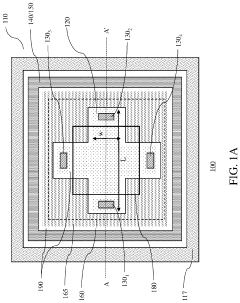
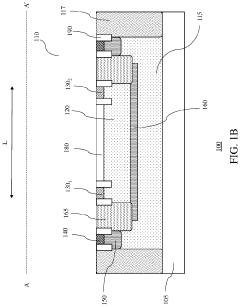
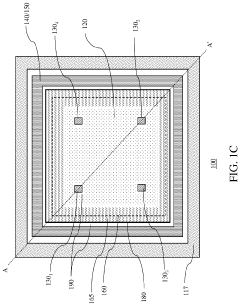
Hall effect sensor with enhanced sensitivity and method for producing the same
PatentActiveUS10707408B2
Innovation
- A Hall effect sensor is formed with a thin Hall plate and optional front and back gates, and reduced or omitted doping to enhance sensitivity, using a silicon-on-insulator (SOI) substrate with shallow trench isolation (STI) structures and N+ dopant ion implantation to create N+ implantation regions.
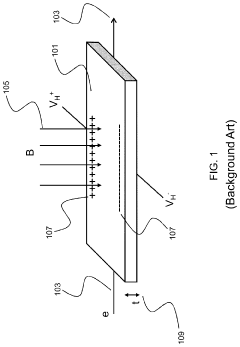
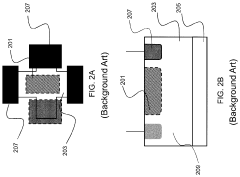
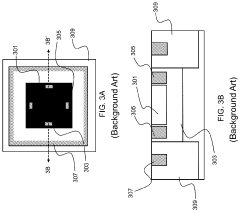
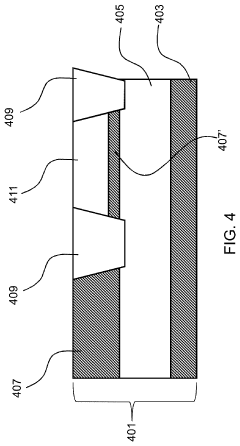
Hall effect sensors with tunable sensitivity and/or resistance
PatentActiveUS11047930B2
Innovation
- A Hall effect sensor design with a tunable Hall plate thickness, achieved through adjustable implants in the separation layer and bias voltage applied to the separation layer, allowing for customizable current sensitivity and resistance, enabling high voltage and current sensitivity in the same device.
Certification Standards and Compliance Requirements
Hall Effect sensors deployed in aerospace applications must adhere to stringent certification standards and compliance requirements to ensure reliability, safety, and performance under extreme conditions. The aerospace industry is governed by multiple regulatory bodies, with the Federal Aviation Administration (FAA) in the United States, the European Union Aviation Safety Agency (EASA), and the International Civil Aviation Organization (ICAO) being the primary authorities establishing certification frameworks.
DO-160 Environmental Conditions and Test Procedures for Airborne Equipment represents one of the most critical standards for Hall Effect sensors. This standard defines test conditions for various environmental factors including temperature variation, humidity, vibration, shock, and electromagnetic interference. Hall Effect sensors must demonstrate compliance with Category A through H requirements depending on their specific installation location within aircraft systems.
For military aerospace applications, MIL-STD-810 provides additional environmental testing protocols, while MIL-STD-461 addresses electromagnetic compatibility requirements. These standards ensure sensors can withstand the harsh electromagnetic environment present in modern aircraft without performance degradation or false readings.
The AS9100 quality management system standard, derived from ISO 9001 but with additional aerospace-specific requirements, governs the manufacturing processes for Hall Effect sensors. Manufacturers must maintain certification to this standard, implementing rigorous quality control procedures and documentation throughout the production lifecycle.
Functional safety certification is increasingly important, with ARP4754A and DO-178C/DO-254 standards applying to Hall Effect sensors used in critical systems. These standards define development assurance levels (DALs) from E (least critical) to A (most critical), with corresponding verification and validation requirements increasing with criticality.
RTCA/DO-254 specifically addresses hardware considerations for airborne electronic hardware, requiring manufacturers to implement design assurance processes proportional to the failure consequence severity. For Hall Effect sensors in flight-critical applications, this typically means compliance with DAL A or B requirements.
Material compliance represents another significant aspect, with sensors needing to meet RoHS (Restriction of Hazardous Substances) and REACH (Registration, Evaluation, Authorization and Restriction of Chemicals) requirements, albeit with aerospace-specific exemptions where alternatives do not exist or cannot meet performance requirements.
Traceability requirements are particularly stringent, with each sensor requiring complete documentation of its manufacturing history, test results, and component sourcing to facilitate potential failure investigations and ensure counterfeit part prevention.
DO-160 Environmental Conditions and Test Procedures for Airborne Equipment represents one of the most critical standards for Hall Effect sensors. This standard defines test conditions for various environmental factors including temperature variation, humidity, vibration, shock, and electromagnetic interference. Hall Effect sensors must demonstrate compliance with Category A through H requirements depending on their specific installation location within aircraft systems.
For military aerospace applications, MIL-STD-810 provides additional environmental testing protocols, while MIL-STD-461 addresses electromagnetic compatibility requirements. These standards ensure sensors can withstand the harsh electromagnetic environment present in modern aircraft without performance degradation or false readings.
The AS9100 quality management system standard, derived from ISO 9001 but with additional aerospace-specific requirements, governs the manufacturing processes for Hall Effect sensors. Manufacturers must maintain certification to this standard, implementing rigorous quality control procedures and documentation throughout the production lifecycle.
Functional safety certification is increasingly important, with ARP4754A and DO-178C/DO-254 standards applying to Hall Effect sensors used in critical systems. These standards define development assurance levels (DALs) from E (least critical) to A (most critical), with corresponding verification and validation requirements increasing with criticality.
RTCA/DO-254 specifically addresses hardware considerations for airborne electronic hardware, requiring manufacturers to implement design assurance processes proportional to the failure consequence severity. For Hall Effect sensors in flight-critical applications, this typically means compliance with DAL A or B requirements.
Material compliance represents another significant aspect, with sensors needing to meet RoHS (Restriction of Hazardous Substances) and REACH (Registration, Evaluation, Authorization and Restriction of Chemicals) requirements, albeit with aerospace-specific exemptions where alternatives do not exist or cannot meet performance requirements.
Traceability requirements are particularly stringent, with each sensor requiring complete documentation of its manufacturing history, test results, and component sourcing to facilitate potential failure investigations and ensure counterfeit part prevention.
Reliability Testing Protocols for Aerospace Sensors
Reliability testing protocols for aerospace Hall Effect sensors must adhere to stringent standards that exceed conventional industrial applications due to the extreme operating conditions encountered in aerospace environments. These protocols typically follow established frameworks such as DO-160 (Environmental Conditions and Test Procedures for Airborne Equipment) and MIL-STD-810 (Environmental Engineering Considerations and Laboratory Tests), which provide comprehensive guidelines for evaluating sensor performance under various stressors.
The testing regimen begins with baseline performance characterization, establishing key parameters including sensitivity, linearity, hysteresis, and temperature coefficient across the sensor's intended operating range. This initial benchmarking serves as the reference point against which degradation is measured throughout subsequent reliability tests.
Environmental stress testing forms the core of aerospace sensor reliability protocols, subjecting Hall Effect sensors to temperature cycling between extremes (-65°C to +150°C), thermal shock, and extended high-temperature operation to evaluate performance stability. Humidity testing in conditions ranging from 5% to 95% relative humidity assesses susceptibility to moisture-induced failures, while altitude testing in hypobaric chambers simulates operation at elevations up to 70,000 feet.
Mechanical durability testing includes vibration analysis across multiple frequency spectra (particularly 10Hz-2000Hz), random vibration profiles mimicking actual flight conditions, mechanical shock testing up to 100g, and acceleration testing to 20g sustained forces. These tests identify potential failure modes related to wire bond integrity, package sealing, and substrate attachment.
Radiation hardness testing is particularly critical for aerospace applications, with protocols evaluating Total Ionizing Dose (TID) effects, Single Event Effects (SEE), and displacement damage. Hall Effect sensors must demonstrate specified performance parameters after exposure to radiation levels typical of their intended operational altitude and mission duration.
Long-term reliability assessment incorporates accelerated life testing using elevated temperatures and voltages to induce failure mechanisms that might occur over years of normal operation. Mean Time Between Failure (MTBF) calculations derived from these tests typically target 100,000+ hours for critical aerospace applications.
Electromagnetic compatibility testing verifies sensor operation in the presence of EMI/RFI environments encountered in modern aircraft, with particular attention to susceptibility and emissions across the 10kHz to 18GHz frequency range. This ensures Hall Effect sensors maintain accuracy when integrated with complex avionics systems.
The final protocol component involves statistical analysis of test results across multiple production lots, establishing confidence intervals for reliability metrics and identifying potential manufacturing variations that could impact field performance. This data-driven approach enables quantitative reliability predictions essential for aerospace certification processes.
The testing regimen begins with baseline performance characterization, establishing key parameters including sensitivity, linearity, hysteresis, and temperature coefficient across the sensor's intended operating range. This initial benchmarking serves as the reference point against which degradation is measured throughout subsequent reliability tests.
Environmental stress testing forms the core of aerospace sensor reliability protocols, subjecting Hall Effect sensors to temperature cycling between extremes (-65°C to +150°C), thermal shock, and extended high-temperature operation to evaluate performance stability. Humidity testing in conditions ranging from 5% to 95% relative humidity assesses susceptibility to moisture-induced failures, while altitude testing in hypobaric chambers simulates operation at elevations up to 70,000 feet.
Mechanical durability testing includes vibration analysis across multiple frequency spectra (particularly 10Hz-2000Hz), random vibration profiles mimicking actual flight conditions, mechanical shock testing up to 100g, and acceleration testing to 20g sustained forces. These tests identify potential failure modes related to wire bond integrity, package sealing, and substrate attachment.
Radiation hardness testing is particularly critical for aerospace applications, with protocols evaluating Total Ionizing Dose (TID) effects, Single Event Effects (SEE), and displacement damage. Hall Effect sensors must demonstrate specified performance parameters after exposure to radiation levels typical of their intended operational altitude and mission duration.
Long-term reliability assessment incorporates accelerated life testing using elevated temperatures and voltages to induce failure mechanisms that might occur over years of normal operation. Mean Time Between Failure (MTBF) calculations derived from these tests typically target 100,000+ hours for critical aerospace applications.
Electromagnetic compatibility testing verifies sensor operation in the presence of EMI/RFI environments encountered in modern aircraft, with particular attention to susceptibility and emissions across the 10kHz to 18GHz frequency range. This ensures Hall Effect sensors maintain accuracy when integrated with complex avionics systems.
The final protocol component involves statistical analysis of test results across multiple production lots, establishing confidence intervals for reliability metrics and identifying potential manufacturing variations that could impact field performance. This data-driven approach enables quantitative reliability predictions essential for aerospace certification processes.
Unlock deeper insights with PatSnap Eureka Quick Research — get a full tech report to explore trends and direct your research. Try now!
Generate Your Research Report Instantly with AI Agent
Supercharge your innovation with PatSnap Eureka AI Agent Platform!