What are the Challenges Facing Carbon-negative Concrete Uptake
OCT 11, 20259 MIN READ
Generate Your Research Report Instantly with AI Agent
Patsnap Eureka helps you evaluate technical feasibility & market potential.
Carbon-negative Concrete Background and Objectives
Concrete, as the most widely used building material globally, has a significant carbon footprint, accounting for approximately 8% of global CO2 emissions. The concept of carbon-negative concrete represents a paradigm shift in construction materials, aiming not only to reduce emissions but to actively remove carbon dioxide from the atmosphere during its lifecycle. This revolutionary approach has emerged over the past decade as a response to increasing climate concerns and regulatory pressures on the construction industry.
The evolution of concrete technology has progressed from traditional high-emission Portland cement to low-carbon alternatives, and now to carbon-negative formulations. This progression reflects the industry's adaptation to environmental challenges and technological innovations in material science. Carbon-negative concrete incorporates various technologies including carbon capture during production, alternative cementitious materials, and novel aggregates capable of sequestering CO2.
The primary objective of carbon-negative concrete development is to transform a major source of greenhouse gas emissions into a carbon sink while maintaining or improving upon the mechanical properties and durability of conventional concrete. This dual goal presents significant technical challenges that require interdisciplinary solutions spanning chemistry, materials science, and civil engineering.
Recent technological breakthroughs have enabled the creation of concrete formulations that can absorb more CO2 during their lifetime than is emitted during their production. These innovations include the use of supplementary cementitious materials like fly ash and slag, alternative binding agents such as geopolymers, and the incorporation of CO2-absorbing aggregates or admixtures.
The development trajectory of carbon-negative concrete has been accelerated by increasing global commitments to carbon neutrality, with major economies pledging significant emissions reductions by mid-century. This has created both regulatory pressure and market opportunities for sustainable construction materials, driving research and investment in the field.
Current technical objectives focus on scaling production capabilities, reducing costs, optimizing carbon sequestration efficiency, and ensuring long-term performance under various environmental conditions. Additionally, there is significant emphasis on developing standardized testing and certification protocols to validate carbon-negative claims and facilitate market adoption.
The ultimate goal extends beyond creating a sustainable building material to establishing a circular carbon economy within the construction sector, where buildings and infrastructure serve as carbon repositories rather than sources of emissions. This vision requires overcoming numerous technical, economic, and regulatory hurdles, but represents a critical pathway toward mitigating climate change impacts from the built environment.
The evolution of concrete technology has progressed from traditional high-emission Portland cement to low-carbon alternatives, and now to carbon-negative formulations. This progression reflects the industry's adaptation to environmental challenges and technological innovations in material science. Carbon-negative concrete incorporates various technologies including carbon capture during production, alternative cementitious materials, and novel aggregates capable of sequestering CO2.
The primary objective of carbon-negative concrete development is to transform a major source of greenhouse gas emissions into a carbon sink while maintaining or improving upon the mechanical properties and durability of conventional concrete. This dual goal presents significant technical challenges that require interdisciplinary solutions spanning chemistry, materials science, and civil engineering.
Recent technological breakthroughs have enabled the creation of concrete formulations that can absorb more CO2 during their lifetime than is emitted during their production. These innovations include the use of supplementary cementitious materials like fly ash and slag, alternative binding agents such as geopolymers, and the incorporation of CO2-absorbing aggregates or admixtures.
The development trajectory of carbon-negative concrete has been accelerated by increasing global commitments to carbon neutrality, with major economies pledging significant emissions reductions by mid-century. This has created both regulatory pressure and market opportunities for sustainable construction materials, driving research and investment in the field.
Current technical objectives focus on scaling production capabilities, reducing costs, optimizing carbon sequestration efficiency, and ensuring long-term performance under various environmental conditions. Additionally, there is significant emphasis on developing standardized testing and certification protocols to validate carbon-negative claims and facilitate market adoption.
The ultimate goal extends beyond creating a sustainable building material to establishing a circular carbon economy within the construction sector, where buildings and infrastructure serve as carbon repositories rather than sources of emissions. This vision requires overcoming numerous technical, economic, and regulatory hurdles, but represents a critical pathway toward mitigating climate change impacts from the built environment.
Market Analysis for Sustainable Construction Materials
The global construction materials market is undergoing a significant transformation driven by increasing environmental concerns and regulatory pressures. The sustainable construction materials sector, valued at approximately $254 billion in 2022, is projected to reach $432 billion by 2030, growing at a CAGR of 11.2%. Within this segment, carbon-negative concrete represents an emerging category with substantial growth potential, though currently occupying less than 5% of the overall concrete market.
Demand for carbon-negative concrete is primarily driven by three key factors: stringent environmental regulations, corporate sustainability commitments, and green building certification requirements. The European Union's Carbon Border Adjustment Mechanism and various national net-zero targets are creating regulatory frameworks that favor low-carbon building materials. Additionally, over 300 major construction and real estate companies have committed to science-based emissions reduction targets, creating a substantial potential customer base.
Regional market analysis reveals varying adoption rates and market readiness. Northern Europe leads in carbon-negative concrete implementation, with Scandinavian countries showing adoption rates of 15-20% in new public infrastructure projects. North America follows with growing interest, particularly in coastal urban centers where climate resilience is prioritized. The Asia-Pacific region represents the largest potential market by volume, though current adoption remains limited primarily to showcase projects in Singapore, Japan, and Australia.
Market segmentation indicates that public infrastructure projects currently constitute approximately 60% of carbon-negative concrete applications, followed by commercial buildings (25%) and residential construction (15%). This distribution reflects government procurement policies that increasingly incorporate carbon footprint considerations and the willingness of commercial developers to absorb premium costs for sustainability marketing advantages.
Price sensitivity remains a significant market barrier. Current carbon-negative concrete solutions command a premium of 25-40% over conventional concrete, though this gap is narrowing as production scales and technologies mature. Market research indicates that commercial viability threshold lies at a premium of approximately 15%, which industry analysts project could be achieved within 3-5 years through technological improvements and economies of scale.
Customer awareness and technical confidence represent additional market challenges. Surveys of construction professionals indicate that while 78% are aware of carbon-negative concrete options, only 32% express confidence in their long-term performance characteristics. This perception gap highlights the need for demonstration projects, performance data, and industry education to accelerate market acceptance.
Demand for carbon-negative concrete is primarily driven by three key factors: stringent environmental regulations, corporate sustainability commitments, and green building certification requirements. The European Union's Carbon Border Adjustment Mechanism and various national net-zero targets are creating regulatory frameworks that favor low-carbon building materials. Additionally, over 300 major construction and real estate companies have committed to science-based emissions reduction targets, creating a substantial potential customer base.
Regional market analysis reveals varying adoption rates and market readiness. Northern Europe leads in carbon-negative concrete implementation, with Scandinavian countries showing adoption rates of 15-20% in new public infrastructure projects. North America follows with growing interest, particularly in coastal urban centers where climate resilience is prioritized. The Asia-Pacific region represents the largest potential market by volume, though current adoption remains limited primarily to showcase projects in Singapore, Japan, and Australia.
Market segmentation indicates that public infrastructure projects currently constitute approximately 60% of carbon-negative concrete applications, followed by commercial buildings (25%) and residential construction (15%). This distribution reflects government procurement policies that increasingly incorporate carbon footprint considerations and the willingness of commercial developers to absorb premium costs for sustainability marketing advantages.
Price sensitivity remains a significant market barrier. Current carbon-negative concrete solutions command a premium of 25-40% over conventional concrete, though this gap is narrowing as production scales and technologies mature. Market research indicates that commercial viability threshold lies at a premium of approximately 15%, which industry analysts project could be achieved within 3-5 years through technological improvements and economies of scale.
Customer awareness and technical confidence represent additional market challenges. Surveys of construction professionals indicate that while 78% are aware of carbon-negative concrete options, only 32% express confidence in their long-term performance characteristics. This perception gap highlights the need for demonstration projects, performance data, and industry education to accelerate market acceptance.
Current Limitations and Technical Barriers
Despite the promising potential of carbon-negative concrete technologies, several significant limitations and technical barriers currently impede widespread adoption. The production of traditional cement, a key component in concrete, remains highly carbon-intensive, accounting for approximately 8% of global CO2 emissions. While carbon-negative alternatives exist, they face substantial scaling challenges due to the massive volume of concrete produced globally—over 30 billion tons annually.
Material performance inconsistency represents a critical technical barrier. Carbon-negative concrete formulations often exhibit variable strength development, durability characteristics, and setting times compared to conventional Portland cement concrete. This inconsistency creates hesitation among structural engineers and contractors who require predictable material behavior for safety-critical applications.
The carbonation process, essential for carbon sequestration in many negative-carbon concrete technologies, faces significant rate limitations. Current carbonation methods require specific environmental conditions and extended curing times, which conflict with construction industry demands for rapid project completion. Additionally, the depth of carbonation remains limited in many applications, reducing the overall carbon sequestration potential.
Raw material availability presents another substantial challenge. Many carbon-negative concrete technologies rely on industrial byproducts such as fly ash, slag, or silica fume, which have geographically constrained availability and fluctuating supply chains. The limited production capacity of novel binders like magnesium oxide-based cements further restricts scaling potential.
Quality control and standardization deficiencies significantly hinder market acceptance. Current building codes and standards were developed primarily for traditional Portland cement concrete, creating regulatory barriers for innovative carbon-negative alternatives. The absence of long-term performance data and standardized testing protocols increases perceived risk among stakeholders.
Cost competitiveness remains problematic, with many carbon-negative concrete solutions currently 15-40% more expensive than conventional alternatives. This premium stems from specialized production processes, additional material processing requirements, and the relatively small scale of production operations. Without carbon pricing mechanisms or regulatory mandates, the economic incentive for adoption remains weak.
Technical knowledge gaps further complicate implementation. The construction industry's workforce lacks familiarity with handling, placing, and curing carbon-negative concrete products. Additionally, limited understanding of long-term performance characteristics, including freeze-thaw resistance, chemical attack resilience, and reinforcement corrosion protection, creates uncertainty among potential adopters.
Material performance inconsistency represents a critical technical barrier. Carbon-negative concrete formulations often exhibit variable strength development, durability characteristics, and setting times compared to conventional Portland cement concrete. This inconsistency creates hesitation among structural engineers and contractors who require predictable material behavior for safety-critical applications.
The carbonation process, essential for carbon sequestration in many negative-carbon concrete technologies, faces significant rate limitations. Current carbonation methods require specific environmental conditions and extended curing times, which conflict with construction industry demands for rapid project completion. Additionally, the depth of carbonation remains limited in many applications, reducing the overall carbon sequestration potential.
Raw material availability presents another substantial challenge. Many carbon-negative concrete technologies rely on industrial byproducts such as fly ash, slag, or silica fume, which have geographically constrained availability and fluctuating supply chains. The limited production capacity of novel binders like magnesium oxide-based cements further restricts scaling potential.
Quality control and standardization deficiencies significantly hinder market acceptance. Current building codes and standards were developed primarily for traditional Portland cement concrete, creating regulatory barriers for innovative carbon-negative alternatives. The absence of long-term performance data and standardized testing protocols increases perceived risk among stakeholders.
Cost competitiveness remains problematic, with many carbon-negative concrete solutions currently 15-40% more expensive than conventional alternatives. This premium stems from specialized production processes, additional material processing requirements, and the relatively small scale of production operations. Without carbon pricing mechanisms or regulatory mandates, the economic incentive for adoption remains weak.
Technical knowledge gaps further complicate implementation. The construction industry's workforce lacks familiarity with handling, placing, and curing carbon-negative concrete products. Additionally, limited understanding of long-term performance characteristics, including freeze-thaw resistance, chemical attack resilience, and reinforcement corrosion protection, creates uncertainty among potential adopters.
Existing Carbon-negative Concrete Solutions
01 CO2 capture and sequestration in concrete
Carbon-negative concrete technologies that actively capture and sequester CO2 during the curing process. These methods involve exposing concrete to CO2-rich environments, allowing the material to absorb carbon dioxide and convert it into stable carbonate minerals. This process not only reduces the carbon footprint of concrete production but can potentially make concrete a carbon sink, effectively removing CO2 from the atmosphere while strengthening the material.- CO2 Capture and Sequestration in Concrete: Carbon-negative concrete technologies that actively capture and sequester CO2 during the curing process. These methods involve the deliberate exposure of concrete to CO2 gas, which reacts with calcium compounds to form stable carbonate minerals. This process not only reduces the carbon footprint of concrete production but also can improve concrete properties such as strength and durability while permanently storing atmospheric carbon dioxide.
- Alternative Cementitious Materials for Carbon Reduction: The use of alternative cementitious materials to replace traditional Portland cement, which is responsible for significant CO2 emissions. These alternatives include supplementary cementitious materials (SCMs) like fly ash, slag, and natural pozzolans, as well as novel binders that require less energy to produce. These materials can significantly reduce the carbon footprint of concrete while maintaining or even enhancing performance characteristics.
- Enhanced Carbonation Techniques for Concrete: Advanced techniques to enhance the natural carbonation process in concrete, accelerating CO2 uptake. These methods include optimizing concrete mix designs, controlling curing conditions, and developing specialized additives that promote carbonation. The techniques focus on maximizing the concrete's capacity to absorb CO2 throughout its lifecycle, from production through use and even during recycling phases.
- Biomass and Waste Incorporation for Carbon Negativity: Integration of biomass and waste materials into concrete formulations to achieve carbon negativity. These approaches involve incorporating materials that have already sequestered carbon (such as agricultural waste, wood products, or biochar) into concrete mixes. The embedded biomass effectively stores carbon while potentially improving certain concrete properties like thermal insulation or weight reduction.
- Monitoring and Quantification of Carbon Uptake: Methods and systems for accurately monitoring and quantifying carbon uptake in concrete structures. These technologies include sensors, testing protocols, and analytical models that can measure the amount of CO2 sequestered in concrete over time. Such quantification is essential for carbon accounting, regulatory compliance, and verification of carbon credits or other incentives for carbon-negative concrete applications.
02 Alternative binders and supplementary cementitious materials
The use of alternative binders and supplementary cementitious materials to replace traditional Portland cement, which is responsible for significant CO2 emissions. These alternatives include geopolymers, alkali-activated materials, and industrial byproducts such as fly ash and slag. By reducing the amount of Portland cement needed, these materials can significantly lower the carbon footprint of concrete while maintaining or even improving performance characteristics.Expand Specific Solutions03 Enhanced carbonation techniques
Advanced methods to accelerate and enhance the natural carbonation process in concrete. These techniques include pressurized carbonation, carbonation curing, and the use of catalysts to increase CO2 uptake rates. By optimizing the conditions for carbonation, these methods can maximize the amount of CO2 sequestered in concrete while improving material properties such as strength and durability.Expand Specific Solutions04 Carbon-negative aggregates and fillers
The development and use of specialized aggregates and fillers that have inherent carbon-capturing properties. These materials can be engineered to absorb CO2 throughout the concrete lifecycle, not just during curing. Examples include mineral wastes treated to enhance carbonation potential, biomass-derived materials, and synthetic aggregates designed specifically for carbon sequestration. When incorporated into concrete mixtures, these aggregates contribute to the overall carbon-negative profile of the final product.Expand Specific Solutions05 Monitoring and quantification of CO2 uptake
Methods and systems for accurately measuring and verifying the amount of CO2 captured by carbon-negative concrete. These technologies include embedded sensors, spectroscopic techniques, and computational models that can track carbonation progress and quantify carbon sequestration in real-time. Such monitoring systems are crucial for validating carbon credits, ensuring quality control, and optimizing the carbon-capturing potential of concrete structures throughout their service life.Expand Specific Solutions
Key Industry Stakeholders and Competitors
The carbon-negative concrete market is in an early growth phase, characterized by significant technological innovation but limited commercial-scale implementation. The global market is projected to expand rapidly as sustainability regulations tighten, potentially reaching several billion dollars by 2030. Technologically, solutions vary in maturity, with companies at different development stages. Established players like Huaxin Cement and China West Construction are integrating carbon capture into traditional concrete production, while innovative startups like Carbon Limit Co. are developing specialized carbon-capturing concrete technologies. Academic institutions (Southeast University, Arizona State University) are advancing fundamental research, and technology companies (X Development) are exploring disruptive approaches. The industry faces challenges in scaling production, reducing costs, and standardizing carbon measurement methodologies, creating a competitive landscape where collaboration between industry incumbents and technology innovators is increasingly vital.
Carbon Limit Co.
Technical Solution: Carbon Limit Co. has developed a groundbreaking carbon-negative concrete solution called CarbonX that utilizes biomass-derived additives and enhanced carbonation processes. Their technology incorporates modified biochar from agricultural waste into concrete mixtures, which serves both as a partial cement replacement and as a carbon sequestration mechanism. The biochar is specially treated to enhance its reactivity with cement minerals and improve its carbon stability. Carbon Limit's process also includes a post-casting CO2 curing chamber that accelerates carbonation, allowing their concrete products to absorb significant amounts of CO2 during the curing phase. Independent testing has verified that their concrete products can sequester up to 200 kg of CO2 per cubic meter, while maintaining structural properties that meet or exceed industry standards. The company has successfully deployed this technology in commercial projects across North America, demonstrating its viability in real-world applications and various climate conditions.
Strengths: Achieves among the highest carbon sequestration rates in the industry; creates additional value for agricultural waste streams; maintains excellent mechanical properties. Weaknesses: Requires specialized curing facilities; biochar supply chains may be limited in some regions; higher initial production costs compared to conventional concrete.
Taiheiyo Cement Corp.
Technical Solution: Taiheiyo Cement has developed an innovative carbon-negative concrete solution that incorporates CO2 mineralization technology. Their approach involves capturing CO2 emissions from their cement production facilities and injecting it into concrete during the mixing process, where it chemically reacts with calcium compounds to form stable calcium carbonate. This process not only sequesters carbon permanently but also improves the concrete's strength and durability. Taiheiyo has implemented a closed-loop carbon capture system at several production facilities, reducing their carbon footprint by approximately 15-20%. Their proprietary CO2-SUICOM technology allows concrete to absorb more CO2 than is emitted during its production, achieving carbon-negative status through innovative material engineering and optimized curing conditions.
Strengths: Advanced CO2 mineralization technology that permanently sequesters carbon while improving concrete properties; established industrial-scale implementation with proven carbon reduction metrics. Weaknesses: Higher production costs compared to conventional concrete; requires specialized equipment for CO2 injection; limited geographical availability of their solution outside Japan.
Critical Patents and Research Breakthroughs
Cementitious materials and methods of making and using same
PatentPendingUS20250042811A1
Innovation
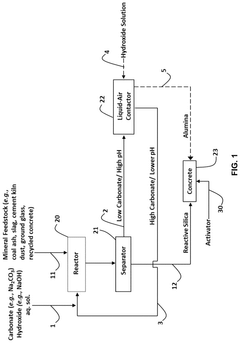
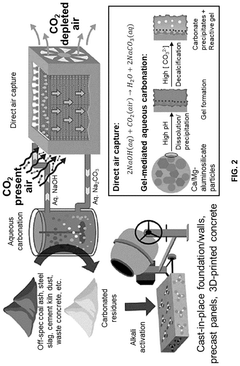
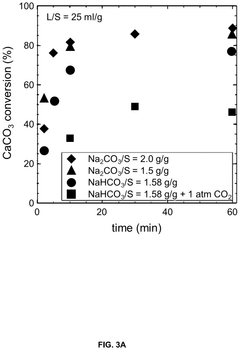
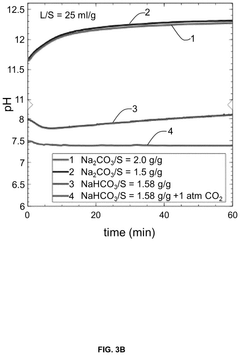
- A carbon mineralization-based direct-air capture process is used to produce carbon-negative cementitious materials by capturing CO2 from the air through an aqueous carbonation cycle, enhancing the pozzolanic reactivity of industrial mineral wastes, and incorporating the captured CO2 as solid carbonate in the concrete.
Carbon dioxide-capturing cement compositions and related methods
PatentPendingUS20230271134A1
Innovation
- Development of cement compositions comprising porous inorganic materials, silica, and metal oxides that can capture and mineralize carbon dioxide, forming carbonate compounds, thereby reducing atmospheric CO2 levels and enhancing the mechanical strength of concrete.


Regulatory Framework and Policy Incentives
The regulatory landscape for carbon-negative concrete represents a critical factor in market adoption and industry transformation. Current building codes and construction standards in most countries were developed for traditional concrete formulations, creating significant barriers for innovative carbon-negative alternatives. These regulations often specify minimum cement content or particular strength development profiles that carbon-negative formulations may struggle to meet, despite their overall performance adequacy for intended applications.
Policy frameworks across different regions show varying degrees of support for low-carbon construction materials. The European Union has taken a leading position through its Green Deal and Circular Economy Action Plan, which include specific provisions for sustainable construction materials. The EU Emissions Trading System (ETS) provides economic incentives for carbon reduction in cement production, while the Construction Products Regulation is being revised to better accommodate innovative materials with environmental benefits.
In North America, regulatory approaches remain fragmented. California has implemented procurement policies requiring Environmental Product Declarations (EPDs) for construction materials in public projects, effectively creating market pull for lower-carbon alternatives. However, federal-level policies remain limited, with most initiatives operating as voluntary programs rather than mandatory requirements.
Financial incentives represent another crucial regulatory tool. Tax credits for carbon sequestration, such as the 45Q tax credit in the United States, can significantly improve the economic viability of carbon-negative concrete technologies. Green public procurement policies that prioritize low-carbon materials in government construction projects have demonstrated effectiveness in creating initial market demand in regions like Scandinavia and parts of Canada.
Performance-based standards rather than prescriptive specifications are emerging as a regulatory solution. These standards focus on the functional requirements of concrete rather than its composition, allowing innovative formulations to compete on equal footing. Countries including the Netherlands and Singapore have pioneered this approach, resulting in measurable increases in sustainable concrete adoption.
The development of standardized carbon accounting methodologies for construction materials represents another regulatory frontier. Without consistent measurement protocols, claims of carbon negativity remain difficult to verify and compare. Organizations including the World Business Council for Sustainable Development and the International Organization for Standardization are working to establish these frameworks, which will be essential for effective carbon pricing mechanisms and procurement policies.
Policy frameworks across different regions show varying degrees of support for low-carbon construction materials. The European Union has taken a leading position through its Green Deal and Circular Economy Action Plan, which include specific provisions for sustainable construction materials. The EU Emissions Trading System (ETS) provides economic incentives for carbon reduction in cement production, while the Construction Products Regulation is being revised to better accommodate innovative materials with environmental benefits.
In North America, regulatory approaches remain fragmented. California has implemented procurement policies requiring Environmental Product Declarations (EPDs) for construction materials in public projects, effectively creating market pull for lower-carbon alternatives. However, federal-level policies remain limited, with most initiatives operating as voluntary programs rather than mandatory requirements.
Financial incentives represent another crucial regulatory tool. Tax credits for carbon sequestration, such as the 45Q tax credit in the United States, can significantly improve the economic viability of carbon-negative concrete technologies. Green public procurement policies that prioritize low-carbon materials in government construction projects have demonstrated effectiveness in creating initial market demand in regions like Scandinavia and parts of Canada.
Performance-based standards rather than prescriptive specifications are emerging as a regulatory solution. These standards focus on the functional requirements of concrete rather than its composition, allowing innovative formulations to compete on equal footing. Countries including the Netherlands and Singapore have pioneered this approach, resulting in measurable increases in sustainable concrete adoption.
The development of standardized carbon accounting methodologies for construction materials represents another regulatory frontier. Without consistent measurement protocols, claims of carbon negativity remain difficult to verify and compare. Organizations including the World Business Council for Sustainable Development and the International Organization for Standardization are working to establish these frameworks, which will be essential for effective carbon pricing mechanisms and procurement policies.
Life Cycle Assessment and Environmental Impact
Life Cycle Assessment (LCA) represents a critical framework for evaluating the environmental impacts of carbon-negative concrete throughout its entire lifecycle. Traditional concrete production accounts for approximately 8% of global CO2 emissions, primarily from cement manufacturing. Carbon-negative alternatives aim to sequester more carbon than they emit, but comprehensive LCA studies are essential to validate these claims and identify potential environmental trade-offs.
Current LCA methodologies for carbon-negative concrete face significant challenges in boundary definition and allocation methods. Many assessments focus exclusively on operational carbon, neglecting embodied carbon from raw material extraction, processing, and transportation. This partial analysis can lead to misleading conclusions about the true environmental benefits of these innovative materials.
The temporal dimension presents another analytical challenge, as carbon sequestration occurs over different timeframes than emissions. While conventional concrete continues to slowly absorb CO2 through carbonation over decades, carbon-negative formulations may sequester carbon more rapidly but require verification of long-term stability. LCA practitioners must develop standardized approaches to account for these temporal differences.
Environmental impact categories beyond carbon footprint reveal important considerations. Water usage in carbon-negative concrete production, particularly for mineral carbonation processes, can be substantial in water-stressed regions. Similarly, land use changes associated with sourcing alternative materials like agricultural waste or sustainable timber must be carefully evaluated to prevent unintended ecological consequences.
Comparative LCAs between conventional and carbon-negative concrete demonstrate varying results depending on regional factors such as electricity grid carbon intensity, transportation distances, and local material availability. Studies indicate potential reductions of 30-110% in global warming potential compared to Portland cement concrete, though these benefits may come with trade-offs in other impact categories.
The lack of standardized Environmental Product Declarations (EPDs) specifically designed for carbon-negative concrete hinders market adoption and regulatory acceptance. Industry stakeholders are working to develop consistent methodologies that account for carbon sequestration while maintaining scientific rigor and transparency.
Future LCA research must address data gaps regarding long-term performance, durability, and end-of-life scenarios for carbon-negative concrete. As these materials evolve from laboratory experiments to commercial applications, continuous environmental assessment will be essential to guide innovation toward truly sustainable construction solutions.
Current LCA methodologies for carbon-negative concrete face significant challenges in boundary definition and allocation methods. Many assessments focus exclusively on operational carbon, neglecting embodied carbon from raw material extraction, processing, and transportation. This partial analysis can lead to misleading conclusions about the true environmental benefits of these innovative materials.
The temporal dimension presents another analytical challenge, as carbon sequestration occurs over different timeframes than emissions. While conventional concrete continues to slowly absorb CO2 through carbonation over decades, carbon-negative formulations may sequester carbon more rapidly but require verification of long-term stability. LCA practitioners must develop standardized approaches to account for these temporal differences.
Environmental impact categories beyond carbon footprint reveal important considerations. Water usage in carbon-negative concrete production, particularly for mineral carbonation processes, can be substantial in water-stressed regions. Similarly, land use changes associated with sourcing alternative materials like agricultural waste or sustainable timber must be carefully evaluated to prevent unintended ecological consequences.
Comparative LCAs between conventional and carbon-negative concrete demonstrate varying results depending on regional factors such as electricity grid carbon intensity, transportation distances, and local material availability. Studies indicate potential reductions of 30-110% in global warming potential compared to Portland cement concrete, though these benefits may come with trade-offs in other impact categories.
The lack of standardized Environmental Product Declarations (EPDs) specifically designed for carbon-negative concrete hinders market adoption and regulatory acceptance. Industry stakeholders are working to develop consistent methodologies that account for carbon sequestration while maintaining scientific rigor and transparency.
Future LCA research must address data gaps regarding long-term performance, durability, and end-of-life scenarios for carbon-negative concrete. As these materials evolve from laboratory experiments to commercial applications, continuous environmental assessment will be essential to guide innovation toward truly sustainable construction solutions.
Unlock deeper insights with Patsnap Eureka Quick Research — get a full tech report to explore trends and direct your research. Try now!
Generate Your Research Report Instantly with AI Agent
Supercharge your innovation with Patsnap Eureka AI Agent Platform!