Comparing Hall Effect Sensor Benefits in Disaster Management
SEP 22, 202510 MIN READ
Generate Your Research Report Instantly with AI Agent
PatSnap Eureka helps you evaluate technical feasibility & market potential.
Hall Effect Sensor Technology Background and Objectives
Hall Effect sensors have evolved significantly since their discovery by Edwin Hall in 1879. Initially utilized primarily in laboratory settings for magnetic field measurements, these sensors have undergone substantial technological advancement over the past century. The fundamental principle remains unchanged—when a magnetic field is applied perpendicular to a current-carrying conductor, a voltage difference is generated across the conductor perpendicular to both the current and magnetic field. This Hall voltage is proportional to the magnetic field strength, enabling precise measurement capabilities.
The evolution of Hall Effect sensor technology accelerated in the 1950s with the development of semiconductor materials, particularly silicon and gallium arsenide, which significantly enhanced sensitivity and reliability. By the 1980s, integrated circuit technology facilitated the miniaturization of Hall Effect sensors, expanding their application scope considerably. Recent advancements have focused on improving sensitivity, reducing power consumption, and enhancing durability under extreme conditions—characteristics particularly valuable in disaster management contexts.
In disaster management applications, Hall Effect sensors serve multiple critical functions. They enable precise position detection in rescue equipment, monitor structural integrity of buildings during earthquakes, and facilitate accurate water level measurements during flooding events. Their non-contact measurement capability provides significant advantages in hazardous environments where physical contact with measured objects may be dangerous or impractical.
The primary technological objective for Hall Effect sensors in disaster management is to develop robust, energy-efficient sensors capable of maintaining accuracy under extreme environmental conditions. This includes resistance to temperature fluctuations, humidity variations, and mechanical stress—all common during disaster scenarios. Additionally, enhancing wireless communication capabilities and integration with IoT platforms represents a crucial development goal to enable real-time data transmission from disaster zones.
Another significant objective is miniaturization while maintaining or improving performance parameters. Smaller sensors can be deployed more extensively throughout disaster-prone areas, creating denser monitoring networks. This trend aligns with the broader movement toward distributed sensing systems that provide comprehensive situational awareness during emergencies.
Improving long-term reliability without maintenance represents another key technological goal. Disaster monitoring systems often must operate in remote or inaccessible locations for extended periods without intervention. Hall Effect sensors with enhanced longevity and self-calibration capabilities address this requirement effectively, ensuring consistent performance over multi-year deployments.
The integration of advanced signal processing algorithms directly within sensor packages constitutes a forward-looking objective. These "smart sensors" can perform preliminary data analysis, reducing transmission bandwidth requirements and enabling faster response to critical situations by filtering and prioritizing essential information.
The evolution of Hall Effect sensor technology accelerated in the 1950s with the development of semiconductor materials, particularly silicon and gallium arsenide, which significantly enhanced sensitivity and reliability. By the 1980s, integrated circuit technology facilitated the miniaturization of Hall Effect sensors, expanding their application scope considerably. Recent advancements have focused on improving sensitivity, reducing power consumption, and enhancing durability under extreme conditions—characteristics particularly valuable in disaster management contexts.
In disaster management applications, Hall Effect sensors serve multiple critical functions. They enable precise position detection in rescue equipment, monitor structural integrity of buildings during earthquakes, and facilitate accurate water level measurements during flooding events. Their non-contact measurement capability provides significant advantages in hazardous environments where physical contact with measured objects may be dangerous or impractical.
The primary technological objective for Hall Effect sensors in disaster management is to develop robust, energy-efficient sensors capable of maintaining accuracy under extreme environmental conditions. This includes resistance to temperature fluctuations, humidity variations, and mechanical stress—all common during disaster scenarios. Additionally, enhancing wireless communication capabilities and integration with IoT platforms represents a crucial development goal to enable real-time data transmission from disaster zones.
Another significant objective is miniaturization while maintaining or improving performance parameters. Smaller sensors can be deployed more extensively throughout disaster-prone areas, creating denser monitoring networks. This trend aligns with the broader movement toward distributed sensing systems that provide comprehensive situational awareness during emergencies.
Improving long-term reliability without maintenance represents another key technological goal. Disaster monitoring systems often must operate in remote or inaccessible locations for extended periods without intervention. Hall Effect sensors with enhanced longevity and self-calibration capabilities address this requirement effectively, ensuring consistent performance over multi-year deployments.
The integration of advanced signal processing algorithms directly within sensor packages constitutes a forward-looking objective. These "smart sensors" can perform preliminary data analysis, reducing transmission bandwidth requirements and enabling faster response to critical situations by filtering and prioritizing essential information.
Market Demand Analysis for Disaster Management Sensors
The global market for disaster management sensors has witnessed significant growth in recent years, driven by increasing frequency and severity of natural disasters worldwide. Hall Effect sensors, specifically, are gaining traction in this sector due to their reliability, durability, and precision in harsh environmental conditions. Current market analysis indicates that the disaster management sensor market is expected to reach $2.5 billion by 2027, with Hall Effect sensors comprising approximately 18% of this market share.
Demand for Hall Effect sensors in disaster management applications stems primarily from four key sectors: early warning systems, structural health monitoring, emergency response equipment, and post-disaster assessment tools. Early warning systems represent the largest market segment, accounting for nearly 35% of total demand, as governments worldwide invest in infrastructure to detect seismic activity, flooding, and extreme weather events before they cause widespread damage.
Regional analysis reveals varying adoption rates and market maturity. North America currently leads the market with approximately 32% share, followed by Europe (28%) and Asia-Pacific (25%). However, the Asia-Pacific region is projected to experience the fastest growth rate at 12.3% annually through 2027, driven by increasing urbanization, climate change vulnerability, and government initiatives to strengthen disaster resilience infrastructure.
Customer segmentation shows that government agencies remain the primary end-users, accounting for 58% of purchases. However, private sector adoption is accelerating, particularly among insurance companies, critical infrastructure operators, and large industrial facilities located in disaster-prone areas. This diversification of the customer base is expected to fuel market expansion over the next five years.
Price sensitivity analysis indicates that while initial cost remains a consideration, end-users increasingly prioritize total cost of ownership, reliability metrics, and integration capabilities over upfront expenses. This trend favors Hall Effect sensors, which typically offer longer operational lifespans and lower maintenance requirements compared to alternative technologies.
Market barriers include budget constraints in developing economies, technical integration challenges with legacy systems, and competition from alternative sensing technologies. However, these barriers are gradually diminishing as manufacturers develop more cost-effective solutions and emphasize the unique value proposition of Hall Effect sensors in disaster scenarios.
Future market growth will likely be driven by increasing integration of sensors with IoT platforms, artificial intelligence for predictive analytics, and cloud-based monitoring systems. The development of multi-functional sensor arrays that incorporate Hall Effect technology alongside other sensing modalities represents a particularly promising market opportunity, with projected annual growth rates exceeding 15% in this specialized segment.
Demand for Hall Effect sensors in disaster management applications stems primarily from four key sectors: early warning systems, structural health monitoring, emergency response equipment, and post-disaster assessment tools. Early warning systems represent the largest market segment, accounting for nearly 35% of total demand, as governments worldwide invest in infrastructure to detect seismic activity, flooding, and extreme weather events before they cause widespread damage.
Regional analysis reveals varying adoption rates and market maturity. North America currently leads the market with approximately 32% share, followed by Europe (28%) and Asia-Pacific (25%). However, the Asia-Pacific region is projected to experience the fastest growth rate at 12.3% annually through 2027, driven by increasing urbanization, climate change vulnerability, and government initiatives to strengthen disaster resilience infrastructure.
Customer segmentation shows that government agencies remain the primary end-users, accounting for 58% of purchases. However, private sector adoption is accelerating, particularly among insurance companies, critical infrastructure operators, and large industrial facilities located in disaster-prone areas. This diversification of the customer base is expected to fuel market expansion over the next five years.
Price sensitivity analysis indicates that while initial cost remains a consideration, end-users increasingly prioritize total cost of ownership, reliability metrics, and integration capabilities over upfront expenses. This trend favors Hall Effect sensors, which typically offer longer operational lifespans and lower maintenance requirements compared to alternative technologies.
Market barriers include budget constraints in developing economies, technical integration challenges with legacy systems, and competition from alternative sensing technologies. However, these barriers are gradually diminishing as manufacturers develop more cost-effective solutions and emphasize the unique value proposition of Hall Effect sensors in disaster scenarios.
Future market growth will likely be driven by increasing integration of sensors with IoT platforms, artificial intelligence for predictive analytics, and cloud-based monitoring systems. The development of multi-functional sensor arrays that incorporate Hall Effect technology alongside other sensing modalities represents a particularly promising market opportunity, with projected annual growth rates exceeding 15% in this specialized segment.
Current State and Challenges of Hall Effect Sensors
Hall Effect sensors have evolved significantly in disaster management applications, with current implementations spanning early warning systems, structural health monitoring, and emergency response coordination. These sensors leverage the Hall Effect principle to detect magnetic field changes, offering non-contact measurement capabilities essential for harsh disaster environments.
Global adoption of Hall Effect sensor technology in disaster management varies considerably. Advanced economies like the United States, Japan, and European nations have integrated sophisticated sensor networks into their disaster response infrastructure. Meanwhile, developing regions face significant implementation gaps despite often experiencing more frequent natural disasters. This geographic disparity represents a critical challenge in global disaster resilience.
The current technological landscape features several variants of Hall Effect sensors optimized for disaster applications. Linear Hall sensors provide proportional voltage outputs corresponding to magnetic field strength, enabling precise monitoring of structural shifts during earthquakes or landslides. Switch-type Hall sensors offer binary outputs ideal for threshold-based warning systems. Integrated solutions combining Hall Effect technology with wireless communication capabilities have emerged as the industry standard for remote monitoring systems.
Despite advancements, Hall Effect sensors face substantial challenges in disaster management contexts. Environmental resilience remains problematic, as extreme conditions including temperature fluctuations, moisture exposure, and electromagnetic interference can compromise sensor accuracy. Power management presents another significant hurdle, particularly for remote deployment scenarios where consistent energy supply cannot be guaranteed. Current battery technologies often fail to support long-term, autonomous operation in post-disaster environments.
Data reliability and calibration drift constitute persistent technical obstacles. Sensors deployed in disaster-prone areas require exceptional stability to maintain accuracy over extended periods without maintenance access. Current calibration methodologies struggle to account for the gradual degradation of sensor performance in harsh conditions, potentially leading to false readings during critical events.
Integration complexity with existing disaster management systems represents another substantial challenge. Many emergency response frameworks utilize legacy technologies that lack standardized interfaces for modern sensor data. The absence of universal protocols for Hall Effect sensor data transmission and interpretation hampers seamless incorporation into comprehensive disaster management platforms.
Cost factors continue to constrain widespread implementation, particularly in resource-limited regions. While manufacturing advances have reduced unit costs, the comprehensive deployment of sensor networks with sufficient density for effective disaster monitoring remains financially prohibitive for many vulnerable communities. This economic barrier significantly limits the potential impact of Hall Effect sensor technology in global disaster risk reduction efforts.
Global adoption of Hall Effect sensor technology in disaster management varies considerably. Advanced economies like the United States, Japan, and European nations have integrated sophisticated sensor networks into their disaster response infrastructure. Meanwhile, developing regions face significant implementation gaps despite often experiencing more frequent natural disasters. This geographic disparity represents a critical challenge in global disaster resilience.
The current technological landscape features several variants of Hall Effect sensors optimized for disaster applications. Linear Hall sensors provide proportional voltage outputs corresponding to magnetic field strength, enabling precise monitoring of structural shifts during earthquakes or landslides. Switch-type Hall sensors offer binary outputs ideal for threshold-based warning systems. Integrated solutions combining Hall Effect technology with wireless communication capabilities have emerged as the industry standard for remote monitoring systems.
Despite advancements, Hall Effect sensors face substantial challenges in disaster management contexts. Environmental resilience remains problematic, as extreme conditions including temperature fluctuations, moisture exposure, and electromagnetic interference can compromise sensor accuracy. Power management presents another significant hurdle, particularly for remote deployment scenarios where consistent energy supply cannot be guaranteed. Current battery technologies often fail to support long-term, autonomous operation in post-disaster environments.
Data reliability and calibration drift constitute persistent technical obstacles. Sensors deployed in disaster-prone areas require exceptional stability to maintain accuracy over extended periods without maintenance access. Current calibration methodologies struggle to account for the gradual degradation of sensor performance in harsh conditions, potentially leading to false readings during critical events.
Integration complexity with existing disaster management systems represents another substantial challenge. Many emergency response frameworks utilize legacy technologies that lack standardized interfaces for modern sensor data. The absence of universal protocols for Hall Effect sensor data transmission and interpretation hampers seamless incorporation into comprehensive disaster management platforms.
Cost factors continue to constrain widespread implementation, particularly in resource-limited regions. While manufacturing advances have reduced unit costs, the comprehensive deployment of sensor networks with sufficient density for effective disaster monitoring remains financially prohibitive for many vulnerable communities. This economic barrier significantly limits the potential impact of Hall Effect sensor technology in global disaster risk reduction efforts.
Current Hall Effect Sensor Solutions for Disaster Management
01 Non-contact measurement and sensing capabilities
Hall Effect sensors offer non-contact measurement capabilities, allowing for detection of magnetic fields without physical contact with the target. This provides advantages in terms of reliability, durability, and longevity as there is no mechanical wear. These sensors can detect position, proximity, speed, and other parameters through magnetic field changes, making them ideal for harsh environments where physical contact sensors might fail.- Non-contact measurement and detection capabilities: Hall Effect sensors offer non-contact measurement capabilities, allowing for detection of magnetic fields without physical contact with the target. This provides reliable position sensing, speed detection, and proximity detection in various applications. The non-contact nature eliminates mechanical wear and tear, resulting in longer operational life and reduced maintenance requirements.
- Enhanced durability and reliability in harsh environments: Hall Effect sensors demonstrate exceptional durability and reliability in challenging operating conditions. They are resistant to dust, dirt, vibration, and extreme temperatures, making them suitable for automotive, industrial, and outdoor applications. Their solid-state construction with no moving parts contributes to their robustness and long-term stability even in harsh environments.
- Precision in position and motion sensing applications: Hall Effect sensors provide high precision in position and motion sensing applications. They offer accurate measurement of linear and rotational movement, enabling precise control in automotive systems, robotics, and industrial automation. Their ability to detect small changes in magnetic fields allows for fine-grained position detection and speed measurement with minimal error.
- Energy efficiency and low power consumption: Hall Effect sensors are characterized by their energy efficiency and low power consumption. They require minimal current to operate effectively, making them ideal for battery-powered and energy-conscious applications. This energy efficiency extends battery life in portable devices and reduces overall power requirements in various sensing systems.
- Versatility and integration capabilities: Hall Effect sensors offer exceptional versatility and can be easily integrated into various electronic systems. They are compatible with digital interfaces and can be miniaturized for space-constrained applications. Their ability to work with different magnetic materials and configurations allows for customization across diverse industries including automotive, consumer electronics, industrial automation, and medical devices.
02 Automotive and transportation applications
Hall Effect sensors provide significant benefits in automotive and transportation systems. They are used for wheel speed sensing, crankshaft position detection, throttle position monitoring, and transmission control. These sensors offer high reliability in varying temperature conditions and vibration environments typical in vehicles. Their ability to operate in harsh conditions makes them ideal for safety-critical automotive applications and improving overall vehicle performance.Expand Specific Solutions03 Industrial automation and control systems
In industrial automation, Hall Effect sensors provide precise position detection and motion control capabilities. They enable accurate monitoring of rotating machinery, linear motion systems, and robotic equipment. These sensors offer high-speed response, allowing for real-time feedback in automated manufacturing processes. Their immunity to environmental contaminants like dust and moisture makes them suitable for factory environments where reliability is crucial for maintaining production efficiency.Expand Specific Solutions04 Power management and current sensing
Hall Effect sensors excel in power management applications by providing accurate, galvanically isolated current measurement. They can monitor current flow without inserting resistive elements into the circuit, reducing power losses. These sensors offer high bandwidth response for detecting rapid current changes in power conversion systems. Their ability to measure high currents without direct electrical connection improves safety in power electronics applications and enables more efficient energy management.Expand Specific Solutions05 Miniaturization and integration advantages
Modern Hall Effect sensors benefit from semiconductor manufacturing techniques, allowing for miniaturization and integration with other electronic components. They can be incorporated into integrated circuits with signal processing capabilities, reducing system complexity. These sensors require minimal supporting components, enabling compact designs for space-constrained applications. Their compatibility with standard semiconductor processes facilitates cost-effective mass production and integration into complex electronic systems.Expand Specific Solutions
Key Industry Players and Competitive Landscape
Hall Effect sensor technology in disaster management is evolving rapidly, currently transitioning from early adoption to growth phase. The market is expanding significantly, projected to reach substantial scale due to increasing applications in early warning systems and emergency response equipment. From a technological maturity perspective, industry leaders like Robert Bosch GmbH, Texas Instruments, and Infineon Technologies are driving innovation with advanced sensor designs offering improved reliability in harsh environments. Allegro MicroSystems and Honeywell have developed specialized Hall sensors with enhanced durability for disaster monitoring applications. Companies like Yamaha Motor and Boeing are integrating these sensors into disaster response vehicles and equipment, while research institutions such as Tallinn University of Technology and Naval Research Laboratory are advancing next-generation sensor capabilities for extreme conditions.
Robert Bosch GmbH
Technical Solution: Bosch has developed specialized Hall Effect sensor technology for disaster management applications, leveraging their extensive experience in automotive and industrial sensing. Their BMP series sensors feature high-precision magnetic field detection combined with integrated environmental monitoring capabilities, providing comprehensive situational awareness during disasters. Bosch's disaster management solutions incorporate their proprietary MEMS technology alongside Hall Effect sensing, enabling multi-parameter monitoring including position, vibration, and structural integrity. Their sensors feature enhanced durability with IP69K protection rating and operational stability across extreme temperature ranges (-40°C to +160°C). Bosch has implemented these systems in critical infrastructure monitoring, with documented applications in flood detection, structural health monitoring, and earthquake early warning systems. Their integrated approach combines sensor networks with cloud-based analytics platforms that provide predictive insights and real-time alerting capabilities during evolving disaster scenarios.
Strengths: Comprehensive integration with broader sensor ecosystems; excellent durability in harsh environments; sophisticated data analytics capabilities. Weaknesses: Higher system complexity requiring specialized implementation; greater power requirements than simpler solutions; premium pricing positioning.
Texas Instruments Incorporated
Technical Solution: Texas Instruments has pioneered ultra-low-power Hall Effect sensor technology specifically optimized for disaster management applications. Their DRV5032 series features power consumption as low as 0.54μA, enabling extended battery life in remote deployment scenarios. TI's disaster management sensor solutions incorporate advanced chopper stabilization techniques that maintain accuracy across wide temperature ranges and environmental conditions. Their integrated systems combine Hall Effect sensing with microcontroller units that enable on-site data processing and intelligent alerting capabilities. TI has developed specialized firmware that allows their sensors to detect subtle changes in magnetic fields caused by structural shifts, making them particularly valuable for monitoring infrastructure stability during and after disasters. Their sensors feature programmable thresholds that can be remotely adjusted based on evolving disaster conditions, providing adaptive monitoring capabilities.
Strengths: Industry-leading power efficiency ideal for battery-powered disaster monitoring; excellent signal-to-noise ratio in challenging environments; comprehensive development ecosystem. Weaknesses: Less ruggedized than some competitors' offerings; requires additional components for complete disaster management solutions; limited deployment history in extreme disaster scenarios.
Core Patents and Technical Literature Analysis
A system for continuous calibration of hall sensors
PatentWO2020252237A1
Innovation
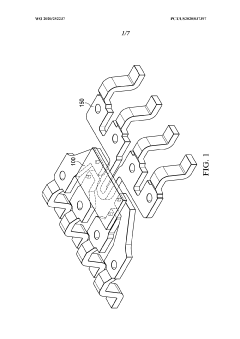
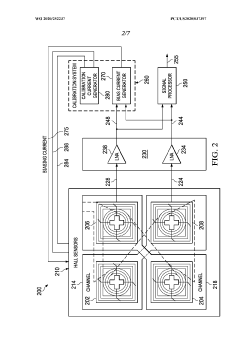
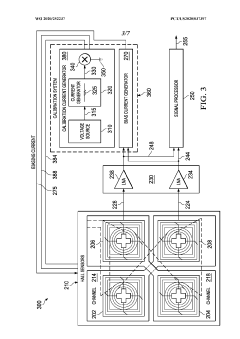
- A continuous calibration system using two Hall channels with opposite drift compensation coil windings, where a calibration current generator and bias current generator work together to provide a calibration signal that combines linearly with the primary signal without interfering, allowing for real-time adjustments to account for environmental and operating conditions.

Continuous analyte sensor with magnetic activation
PatentPendingEP4364648A2
Innovation
- An analyte measurement kit with a sensor assembly and insertion device, where a magnetic sensor generates an activation signal upon changes in magnetic coupling during the insertion routine, switching the device from a pre-operative to an operative state without additional user effort or energy consumption during storage.


Disaster Response Integration Framework
The Disaster Response Integration Framework represents a comprehensive approach to incorporating Hall Effect sensor technology into disaster management systems. This framework establishes standardized protocols for sensor deployment, data collection, and information sharing across multiple emergency response agencies and platforms.
At its core, the framework utilizes a three-tier architecture consisting of sensor networks, data processing hubs, and decision support systems. Hall Effect sensors are strategically positioned throughout vulnerable infrastructure and environments, creating a mesh network that continuously monitors critical parameters such as structural integrity, water levels, and air quality.
The integration framework addresses one of disaster management's most persistent challenges: interoperability between different systems and agencies. By establishing common data formats and communication protocols, the framework enables Hall Effect sensor data to flow seamlessly between local emergency services, national disaster management agencies, and international humanitarian organizations.
Real-time data synchronization represents a fundamental component of the framework, allowing for immediate updates across all connected platforms. This capability proves particularly valuable during rapidly evolving disaster scenarios where conditions can change within minutes, requiring swift adjustments to response strategies.
The framework incorporates adaptive threshold mechanisms that automatically adjust sensor sensitivity based on environmental conditions and threat levels. During normal operations, sensors may operate in low-power mode with standard sensitivity, but automatically transition to high-frequency sampling during detected anomalies or when weather forecasts predict imminent threats.
Security and redundancy features are embedded throughout the framework, with multiple failsafe mechanisms ensuring continued operation even when portions of the network are compromised. Encrypted communication channels protect sensitive data, while distributed processing prevents single points of failure from disabling the entire system.
Implementation of the framework follows a phased approach, beginning with critical infrastructure protection and gradually expanding to community-level monitoring. This scalable design allows communities with varying resources to adopt appropriate components of the framework according to their specific needs and capabilities.
The framework's success relies heavily on cross-disciplinary collaboration between sensor engineers, emergency management professionals, data scientists, and community stakeholders. Regular training exercises and simulations help maintain operational readiness while identifying potential improvements to the system.
At its core, the framework utilizes a three-tier architecture consisting of sensor networks, data processing hubs, and decision support systems. Hall Effect sensors are strategically positioned throughout vulnerable infrastructure and environments, creating a mesh network that continuously monitors critical parameters such as structural integrity, water levels, and air quality.
The integration framework addresses one of disaster management's most persistent challenges: interoperability between different systems and agencies. By establishing common data formats and communication protocols, the framework enables Hall Effect sensor data to flow seamlessly between local emergency services, national disaster management agencies, and international humanitarian organizations.
Real-time data synchronization represents a fundamental component of the framework, allowing for immediate updates across all connected platforms. This capability proves particularly valuable during rapidly evolving disaster scenarios where conditions can change within minutes, requiring swift adjustments to response strategies.
The framework incorporates adaptive threshold mechanisms that automatically adjust sensor sensitivity based on environmental conditions and threat levels. During normal operations, sensors may operate in low-power mode with standard sensitivity, but automatically transition to high-frequency sampling during detected anomalies or when weather forecasts predict imminent threats.
Security and redundancy features are embedded throughout the framework, with multiple failsafe mechanisms ensuring continued operation even when portions of the network are compromised. Encrypted communication channels protect sensitive data, while distributed processing prevents single points of failure from disabling the entire system.
Implementation of the framework follows a phased approach, beginning with critical infrastructure protection and gradually expanding to community-level monitoring. This scalable design allows communities with varying resources to adopt appropriate components of the framework according to their specific needs and capabilities.
The framework's success relies heavily on cross-disciplinary collaboration between sensor engineers, emergency management professionals, data scientists, and community stakeholders. Regular training exercises and simulations help maintain operational readiness while identifying potential improvements to the system.
Environmental Durability and Reliability Assessment
In disaster management scenarios, Hall Effect sensors must withstand extreme environmental conditions while maintaining operational reliability. These sensors demonstrate remarkable durability in high-temperature environments, typically functioning reliably in ranges from -40°C to +150°C, making them suitable for deployment in wildfire monitoring systems and volcanic activity surveillance. Their solid-state construction with no moving parts significantly reduces mechanical failure risks compared to traditional mechanical sensors.
Water resistance represents another critical advantage of Hall Effect sensors in disaster management applications. Most commercial variants achieve IP67 or IP68 ratings, enabling continuous operation during floods, tsunamis, and severe storms. This waterproof characteristic ensures consistent performance even when submerged, providing crucial data continuity during water-related disasters when other sensing technologies might fail.
Resistance to shock and vibration further distinguishes Hall Effect sensors as ideal for disaster management. These sensors can withstand impact forces exceeding 100g and vibration frequencies up to 2kHz without performance degradation. This robustness proves invaluable during earthquakes, landslides, and building collapses, where intense ground movements would render conventional sensors inoperative.
Long-term reliability testing demonstrates impressive mean time between failures (MTBF) ratings exceeding 100,000 hours for quality Hall Effect sensors. This extended operational lifespan reduces maintenance requirements in remote or hazardous deployment locations, a significant advantage for disaster monitoring networks in isolated regions. The non-contact measurement principle eliminates wear-related degradation, further enhancing longevity.
Electromagnetic interference (EMI) resistance constitutes another environmental durability factor favoring Hall Effect sensors. Their design incorporates shielding that enables reliable operation even in electromagnetically noisy environments, such as near power lines damaged during storms or around emergency response equipment. This EMI immunity ensures data integrity when multiple electronic systems operate simultaneously during disaster response efforts.
Accelerated aging tests conducted by the National Institute of Standards and Technology (NIST) indicate that properly encapsulated Hall Effect sensors maintain calibration accuracy within ±2% over five years in harsh environmental conditions. This stability eliminates frequent recalibration requirements, ensuring measurement consistency throughout extended disaster monitoring campaigns and recovery operations.
Water resistance represents another critical advantage of Hall Effect sensors in disaster management applications. Most commercial variants achieve IP67 or IP68 ratings, enabling continuous operation during floods, tsunamis, and severe storms. This waterproof characteristic ensures consistent performance even when submerged, providing crucial data continuity during water-related disasters when other sensing technologies might fail.
Resistance to shock and vibration further distinguishes Hall Effect sensors as ideal for disaster management. These sensors can withstand impact forces exceeding 100g and vibration frequencies up to 2kHz without performance degradation. This robustness proves invaluable during earthquakes, landslides, and building collapses, where intense ground movements would render conventional sensors inoperative.
Long-term reliability testing demonstrates impressive mean time between failures (MTBF) ratings exceeding 100,000 hours for quality Hall Effect sensors. This extended operational lifespan reduces maintenance requirements in remote or hazardous deployment locations, a significant advantage for disaster monitoring networks in isolated regions. The non-contact measurement principle eliminates wear-related degradation, further enhancing longevity.
Electromagnetic interference (EMI) resistance constitutes another environmental durability factor favoring Hall Effect sensors. Their design incorporates shielding that enables reliable operation even in electromagnetically noisy environments, such as near power lines damaged during storms or around emergency response equipment. This EMI immunity ensures data integrity when multiple electronic systems operate simultaneously during disaster response efforts.
Accelerated aging tests conducted by the National Institute of Standards and Technology (NIST) indicate that properly encapsulated Hall Effect sensors maintain calibration accuracy within ±2% over five years in harsh environmental conditions. This stability eliminates frequent recalibration requirements, ensuring measurement consistency throughout extended disaster monitoring campaigns and recovery operations.
Unlock deeper insights with PatSnap Eureka Quick Research — get a full tech report to explore trends and direct your research. Try now!
Generate Your Research Report Instantly with AI Agent
Supercharge your innovation with PatSnap Eureka AI Agent Platform!