

Comparing Hall Effect Sensors vs Inductive Sensors: Sensitivity
SEP 22, 20259 MIN READ
Generate Your Research Report Instantly with AI Agent
Patsnap Eureka helps you evaluate technical feasibility & market potential.
Sensor Technology Background and Objectives
Sensor technology has evolved significantly over the past decades, with position and proximity sensing becoming increasingly critical in various industrial applications. Hall Effect and inductive sensors represent two distinct approaches to non-contact sensing that have gained prominence in automation, automotive systems, and industrial control applications. The evolution of these technologies traces back to the 1879 discovery of the Hall Effect by Edwin Hall, while inductive sensing principles emerged from electromagnetic induction theories established by Michael Faraday in the 1830s.
The technological trajectory of these sensing methodologies has been shaped by increasing demands for precision, reliability, and adaptability across diverse operating environments. Hall Effect sensors have progressed from simple switches to sophisticated linear and programmable devices capable of detecting minute magnetic field variations. Concurrently, inductive sensors have advanced from basic proximity detectors to high-precision position measurement tools with enhanced immunity to environmental interference.
Current market trends indicate a growing preference for sensors with superior sensitivity characteristics, particularly in applications requiring precise position control and detection capabilities in challenging environments. The sensitivity parameter—defined as the minimum detectable change in the measured variable—has become a critical differentiator between competing sensor technologies.
The primary technical objective of this research is to conduct a comprehensive comparative analysis of Hall Effect and inductive sensors specifically focusing on their sensitivity characteristics. This includes examining their respective detection thresholds, signal-to-noise ratios, and response to environmental variables such as temperature fluctuations, electromagnetic interference, and mechanical vibrations.
Additionally, this investigation aims to identify the fundamental physical principles that determine sensitivity limitations in both technologies, exploring how recent innovations have addressed these constraints. The research will evaluate how semiconductor advancements have enhanced Hall Effect sensor performance and how improvements in coil design and signal processing have elevated inductive sensor capabilities.
Understanding these sensitivity parameters is essential for optimizing sensor selection across various applications, from automotive wheel speed detection to industrial automation and robotics. The findings will provide valuable insights for engineers seeking to match sensor characteristics with specific application requirements, particularly in scenarios where detection precision directly impacts system performance and reliability.
This research also seeks to anticipate future technological developments that may further enhance sensitivity in both sensor types, including emerging materials, novel circuit designs, and advanced signal processing techniques that could potentially overcome current limitations.
The technological trajectory of these sensing methodologies has been shaped by increasing demands for precision, reliability, and adaptability across diverse operating environments. Hall Effect sensors have progressed from simple switches to sophisticated linear and programmable devices capable of detecting minute magnetic field variations. Concurrently, inductive sensors have advanced from basic proximity detectors to high-precision position measurement tools with enhanced immunity to environmental interference.
Current market trends indicate a growing preference for sensors with superior sensitivity characteristics, particularly in applications requiring precise position control and detection capabilities in challenging environments. The sensitivity parameter—defined as the minimum detectable change in the measured variable—has become a critical differentiator between competing sensor technologies.
The primary technical objective of this research is to conduct a comprehensive comparative analysis of Hall Effect and inductive sensors specifically focusing on their sensitivity characteristics. This includes examining their respective detection thresholds, signal-to-noise ratios, and response to environmental variables such as temperature fluctuations, electromagnetic interference, and mechanical vibrations.
Additionally, this investigation aims to identify the fundamental physical principles that determine sensitivity limitations in both technologies, exploring how recent innovations have addressed these constraints. The research will evaluate how semiconductor advancements have enhanced Hall Effect sensor performance and how improvements in coil design and signal processing have elevated inductive sensor capabilities.
Understanding these sensitivity parameters is essential for optimizing sensor selection across various applications, from automotive wheel speed detection to industrial automation and robotics. The findings will provide valuable insights for engineers seeking to match sensor characteristics with specific application requirements, particularly in scenarios where detection precision directly impacts system performance and reliability.
This research also seeks to anticipate future technological developments that may further enhance sensitivity in both sensor types, including emerging materials, novel circuit designs, and advanced signal processing techniques that could potentially overcome current limitations.
Market Demand Analysis for Proximity Sensing Solutions
The global proximity sensing solutions market is experiencing robust growth, driven by increasing automation across multiple industries. The market was valued at approximately 3.8 billion USD in 2022 and is projected to reach 6.2 billion USD by 2028, representing a compound annual growth rate of 8.5%. This growth is particularly evident in automotive manufacturing, industrial automation, consumer electronics, and aerospace applications where precise non-contact detection capabilities are essential.
Hall Effect and inductive sensors represent two significant segments within this market, with distinct demand characteristics based on their sensitivity profiles. The automotive sector remains the largest consumer of proximity sensing solutions, accounting for nearly 35% of the total market share. In this sector, demand is increasingly focused on sensors with higher sensitivity for applications such as wheel speed detection, position monitoring, and advanced driver assistance systems (ADAS).
Industrial automation represents the fastest-growing segment with a 10.2% growth rate, where the need for sensors capable of operating in harsh environments with consistent sensitivity is paramount. Manufacturing facilities are increasingly adopting Industry 4.0 principles, creating substantial demand for sensors that can provide reliable data for predictive maintenance and process optimization.
Consumer electronics manufacturers are seeking miniaturized sensing solutions with enhanced sensitivity for applications in smartphones, wearables, and home appliances. This segment values power efficiency alongside sensitivity, creating specific market requirements that influence sensor selection between Hall Effect and inductive technologies.
Regional analysis indicates that Asia-Pacific dominates the market with 42% share, followed by North America (28%) and Europe (22%). China and South Korea are experiencing the highest growth rates due to their expanding manufacturing sectors and automotive production facilities.
Market research indicates that end-users are increasingly prioritizing sensitivity specifications when selecting proximity sensing solutions. Approximately 68% of procurement specialists cite sensitivity as a "very important" or "critical" factor in sensor selection processes. This trend is particularly pronounced in precision manufacturing and medical device applications where detection accuracy directly impacts product quality and safety.
The market is also witnessing growing demand for sensors with programmable sensitivity thresholds, allowing for application-specific customization. This requirement is creating new opportunities for sensor manufacturers who can deliver flexible solutions that maintain sensitivity performance across varying environmental conditions and installation scenarios.
Hall Effect and inductive sensors represent two significant segments within this market, with distinct demand characteristics based on their sensitivity profiles. The automotive sector remains the largest consumer of proximity sensing solutions, accounting for nearly 35% of the total market share. In this sector, demand is increasingly focused on sensors with higher sensitivity for applications such as wheel speed detection, position monitoring, and advanced driver assistance systems (ADAS).
Industrial automation represents the fastest-growing segment with a 10.2% growth rate, where the need for sensors capable of operating in harsh environments with consistent sensitivity is paramount. Manufacturing facilities are increasingly adopting Industry 4.0 principles, creating substantial demand for sensors that can provide reliable data for predictive maintenance and process optimization.
Consumer electronics manufacturers are seeking miniaturized sensing solutions with enhanced sensitivity for applications in smartphones, wearables, and home appliances. This segment values power efficiency alongside sensitivity, creating specific market requirements that influence sensor selection between Hall Effect and inductive technologies.
Regional analysis indicates that Asia-Pacific dominates the market with 42% share, followed by North America (28%) and Europe (22%). China and South Korea are experiencing the highest growth rates due to their expanding manufacturing sectors and automotive production facilities.
Market research indicates that end-users are increasingly prioritizing sensitivity specifications when selecting proximity sensing solutions. Approximately 68% of procurement specialists cite sensitivity as a "very important" or "critical" factor in sensor selection processes. This trend is particularly pronounced in precision manufacturing and medical device applications where detection accuracy directly impacts product quality and safety.
The market is also witnessing growing demand for sensors with programmable sensitivity thresholds, allowing for application-specific customization. This requirement is creating new opportunities for sensor manufacturers who can deliver flexible solutions that maintain sensitivity performance across varying environmental conditions and installation scenarios.
Current State and Challenges in Sensor Sensitivity
The global sensor market has witnessed significant growth in recent years, with Hall Effect and inductive sensors playing crucial roles in various industrial applications. Current sensitivity levels for Hall Effect sensors typically range from 0.5 to 5 mV/G (millivolts per Gauss), while advanced models can achieve sensitivities up to 10 mV/G. In contrast, inductive sensors demonstrate sensitivity measured in terms of displacement detection, commonly ranging from 0.2 to 2 mm depending on the target material and sensor design.
The sensitivity of Hall Effect sensors has improved substantially through technological advancements in semiconductor materials and integrated circuit design. Modern Hall sensors incorporate signal amplification and temperature compensation circuits directly on-chip, enhancing their performance in varying environmental conditions. However, they continue to face challenges related to temperature drift, which can cause up to 0.1% sensitivity variation per degree Celsius, potentially affecting measurement accuracy in applications with wide temperature fluctuations.
Inductive sensors have evolved with improvements in coil design and signal processing techniques. Current state-of-the-art inductive sensors utilize advanced materials for core construction and sophisticated electronics for signal conditioning. Despite these advancements, they still struggle with limitations in detection range, typically restricted to 1-2 times the sensor diameter, which constrains their application in scenarios requiring longer-range detection.
A significant challenge for both sensor types is achieving high sensitivity while maintaining signal stability. Hall Effect sensors are particularly susceptible to external magnetic interference, which can compromise measurement accuracy in environments with varying magnetic fields. Manufacturers have implemented magnetic shielding techniques and differential sensing architectures to mitigate these effects, but complete isolation remains challenging in complex industrial settings.
Inductive sensors face challenges related to target material dependency, with ferrous materials providing optimal response while non-ferrous metals like aluminum or copper yielding reduced sensitivity (typically 30-60% lower than with ferrous targets). This material-dependent performance variation necessitates careful calibration and compensation in applications involving diverse target materials.
Power consumption represents another critical challenge, particularly for battery-operated or energy-efficient systems. Current Hall Effect sensors typically consume 1-5 mA during operation, while inductive sensors generally require 10-20 mA, making power optimization a priority for next-generation sensor development. Recent research has focused on reducing this consumption through improved circuit design and power management techniques.
Miniaturization trends across industries have pushed sensor manufacturers to develop smaller form factors without compromising sensitivity. This has led to innovative packaging solutions and integration techniques, though reduced sensor size often correlates with decreased sensitivity, creating a design trade-off that engineers must carefully navigate when selecting sensors for specific applications.
The sensitivity of Hall Effect sensors has improved substantially through technological advancements in semiconductor materials and integrated circuit design. Modern Hall sensors incorporate signal amplification and temperature compensation circuits directly on-chip, enhancing their performance in varying environmental conditions. However, they continue to face challenges related to temperature drift, which can cause up to 0.1% sensitivity variation per degree Celsius, potentially affecting measurement accuracy in applications with wide temperature fluctuations.
Inductive sensors have evolved with improvements in coil design and signal processing techniques. Current state-of-the-art inductive sensors utilize advanced materials for core construction and sophisticated electronics for signal conditioning. Despite these advancements, they still struggle with limitations in detection range, typically restricted to 1-2 times the sensor diameter, which constrains their application in scenarios requiring longer-range detection.
A significant challenge for both sensor types is achieving high sensitivity while maintaining signal stability. Hall Effect sensors are particularly susceptible to external magnetic interference, which can compromise measurement accuracy in environments with varying magnetic fields. Manufacturers have implemented magnetic shielding techniques and differential sensing architectures to mitigate these effects, but complete isolation remains challenging in complex industrial settings.
Inductive sensors face challenges related to target material dependency, with ferrous materials providing optimal response while non-ferrous metals like aluminum or copper yielding reduced sensitivity (typically 30-60% lower than with ferrous targets). This material-dependent performance variation necessitates careful calibration and compensation in applications involving diverse target materials.
Power consumption represents another critical challenge, particularly for battery-operated or energy-efficient systems. Current Hall Effect sensors typically consume 1-5 mA during operation, while inductive sensors generally require 10-20 mA, making power optimization a priority for next-generation sensor development. Recent research has focused on reducing this consumption through improved circuit design and power management techniques.
Miniaturization trends across industries have pushed sensor manufacturers to develop smaller form factors without compromising sensitivity. This has led to innovative packaging solutions and integration techniques, though reduced sensor size often correlates with decreased sensitivity, creating a design trade-off that engineers must carefully navigate when selecting sensors for specific applications.
Comparative Analysis of Hall Effect vs Inductive Sensing Solutions
01 Hall Effect Sensor Sensitivity Enhancement Techniques
Various techniques can be employed to enhance the sensitivity of Hall effect sensors, including optimizing the semiconductor material, implementing flux concentrators, and utilizing advanced signal processing algorithms. These enhancements allow for more accurate detection of magnetic fields, even in challenging environments with weak magnetic signals or high noise levels. Improved sensitivity enables applications in automotive systems, industrial automation, and consumer electronics where precise magnetic field measurement is critical.- Hall Effect Sensor Sensitivity Enhancement Techniques: Various techniques can be employed to enhance the sensitivity of Hall effect sensors, including optimizing the semiconductor material, adjusting the geometry of the sensing element, and implementing signal conditioning circuits. These enhancements allow for more accurate detection of magnetic fields, even in low-field environments. Advanced semiconductor materials like gallium arsenide or indium antimonide can provide higher sensitivity compared to traditional silicon-based sensors.
- Inductive Sensor Sensitivity Improvement Methods: Inductive sensors' sensitivity can be improved through coil design optimization, core material selection, and advanced signal processing techniques. By increasing the number of coil turns, using high-permeability core materials, and implementing noise reduction algorithms, the detection range and accuracy of inductive sensors can be significantly enhanced. These improvements enable inductive sensors to detect smaller changes in the magnetic field and operate more effectively in challenging environments.
- Comparative Analysis of Hall Effect and Inductive Sensor Sensitivity: Hall effect sensors generally offer higher sensitivity at lower frequencies and static magnetic fields, while inductive sensors perform better at higher frequencies with changing magnetic fields. Hall sensors provide direct voltage output proportional to magnetic field strength, whereas inductive sensors respond to the rate of change of magnetic fields. Understanding these differences is crucial for selecting the appropriate sensor technology based on specific application requirements such as operating frequency, detection range, and environmental conditions.
- Temperature Compensation and Environmental Stability: Both Hall effect and inductive sensors are affected by temperature variations, which can impact their sensitivity and accuracy. Various compensation techniques, including integrated temperature sensors, calibration algorithms, and specialized materials with lower temperature coefficients, can be implemented to maintain consistent sensitivity across a wide temperature range. Environmental protection methods such as encapsulation and shielding further enhance sensor stability in harsh operating conditions.
- Miniaturization and Integration Technologies: Advanced manufacturing techniques enable the miniaturization and integration of both Hall effect and inductive sensors while maintaining or improving sensitivity. MEMS technology allows for smaller Hall sensors with enhanced sensitivity through optimized geometry and reduced noise. Similarly, planar and micro-fabricated inductive sensors can achieve higher sensitivity in compact form factors. These miniaturized sensors can be integrated with signal processing circuits on the same substrate, reducing noise and improving overall performance.
02 Inductive Sensor Sensitivity Optimization
Inductive sensors can achieve higher sensitivity through coil design optimization, core material selection, and advanced excitation methods. By carefully selecting ferromagnetic materials, optimizing coil geometry, and implementing resonant circuit designs, the detection range and accuracy of inductive sensors can be significantly improved. These optimizations enable more precise position sensing, metal detection, and proximity applications in industrial environments.Expand Specific Solutions03 Comparative Performance Between Hall Effect and Inductive Sensors
Hall effect and inductive sensors exhibit different sensitivity characteristics based on their operating principles. Hall sensors offer advantages in detecting static magnetic fields and providing absolute position measurements, while inductive sensors excel in dynamic environments and are less susceptible to temperature variations. The selection between these sensor types depends on application requirements such as detection range, response time, temperature stability, and immunity to environmental interference.Expand Specific Solutions04 Integrated Circuit Designs for Enhanced Sensor Sensitivity
Advanced integrated circuit designs incorporate specialized amplification stages, noise reduction techniques, and temperature compensation to enhance sensor sensitivity. These ICs may include chopper stabilization, auto-calibration features, and digital signal processing capabilities that significantly improve the signal-to-noise ratio of both Hall effect and inductive sensors. Such integration enables miniaturization while maintaining or improving sensitivity performance in demanding applications.Expand Specific Solutions05 Environmental Factors Affecting Sensor Sensitivity
Environmental conditions such as temperature fluctuations, electromagnetic interference, and mechanical stress can significantly impact the sensitivity of both Hall effect and inductive sensors. Compensation techniques including differential sensing arrangements, shielding designs, and adaptive calibration algorithms help maintain consistent sensitivity across varying operating conditions. These approaches ensure reliable sensor performance in automotive, industrial, and outdoor applications where environmental factors are constantly changing.Expand Specific Solutions
Key Manufacturers and Competitive Landscape
The Hall Effect vs Inductive Sensors market is currently in a growth phase, with increasing demand across automotive, industrial, and consumer electronics sectors. The global market size for these sensing technologies is projected to reach several billion dollars by 2025, driven by automation trends and IoT applications. In terms of technological maturity, Hall Effect sensors have achieved greater standardization, with Allegro MicroSystems, Texas Instruments, and Infineon Technologies leading innovation in sensitivity improvements and miniaturization. Inductive sensing technology, championed by TDK-Micronas, STMicroelectronics, and Honeywell International, is evolving rapidly with advances in signal processing and noise immunity. The competitive landscape shows established semiconductor manufacturers investing heavily in R&D to address sensitivity challenges while maintaining cost-effectiveness, with emerging players like SigmaSense introducing disruptive approaches to capacitive imaging that may influence both sensing technologies.
Allegro MicroSystems LLC
Technical Solution: Allegro MicroSystems has developed advanced Hall Effect sensor technology with their proprietary BiCMOS process that integrates both Hall elements and high-performance signal processing circuitry on a single die. Their Hall-Effect sensors feature programmable sensitivity ranges from 1 mV/G to 14 mV/G, allowing for precise magnetic field detection across various applications. The company's sensors incorporate chopper stabilization techniques that significantly reduce temperature drift and offset errors, achieving sensitivity stability of less than 3% across their operating temperature range (-40°C to 150°C). Allegro's integrated signal conditioning includes amplification, filtering, and temperature compensation, resulting in high signal-to-noise ratios even in electrically noisy environments. Their latest generation sensors can detect magnetic fields as low as 1 gauss with response times under 3 microseconds, making them suitable for high-speed applications.
Strengths: Superior sensitivity and temperature stability through chopper stabilization; integrated signal processing reduces external component requirements; programmable sensitivity ranges provide application flexibility. Weaknesses: Generally higher power consumption than passive inductive sensors; more susceptible to electromagnetic interference in certain industrial environments; typically higher cost per unit than simpler sensing technologies.
Melexis Technologies SA
Technical Solution: Melexis has developed Triaxis® Hall Effect sensor technology that utilizes a unique planar Hall element configuration to measure magnetic fields in three dimensions from a single silicon die. Their sensors achieve sensitivity ratings of 25-50 mV/mT with programmable gain settings to optimize performance for specific applications. The company's proprietary IMC-Hall® (Integrated Magneto-Concentrator) technology enhances sensitivity by incorporating ferromagnetic structures directly into the semiconductor manufacturing process, effectively amplifying the magnetic field at the sensing element. This approach enables detection of magnetic fields below 10 μT with high accuracy. Melexis sensors feature 16-bit signal processing with advanced filtering algorithms that reduce noise to less than 0.5 μT RMS, allowing for precise position sensing even in challenging environments. Their SENT and ASIL-compliant interfaces provide robust communication suitable for safety-critical automotive applications, with response times under 100 microseconds.
Strengths: Unique Triaxis® technology enables three-dimensional sensing from a single die; IMC-Hall® technology provides enhanced sensitivity without external concentrators; excellent noise immunity through advanced signal processing; automotive-grade qualification with ASIL compliance. Weaknesses: More complex manufacturing process increases unit cost; higher power consumption compared to basic Hall sensors; requires specialized calibration equipment; limited high-temperature performance compared to some inductive alternatives.
Technical Deep Dive: Sensitivity Enhancement Innovations
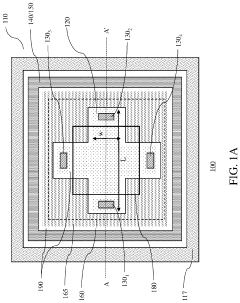
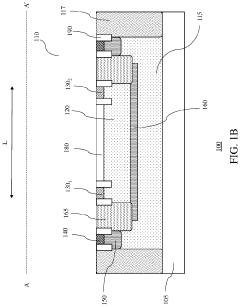
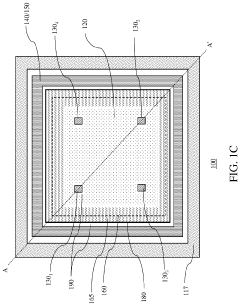
Hall effect sensors with tunable sensitivity and/or resistance
PatentActiveUS11047930B2
Innovation
- A Hall effect sensor design with a tunable Hall plate thickness, achieved through adjustable implants in the separation layer and bias voltage applied to the separation layer, allowing for customizable current sensitivity and resistance, enabling high voltage and current sensitivity in the same device.
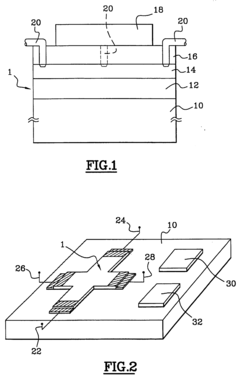
Hall-effect sensor and integrated circuit comprising such a sensor
PatentInactiveEP1091425A2
Innovation
- A Hall effect sensor structure with a thin active Si layer (less than 100 nm) and a SiO2 insulation layer, along with an insulating dielectric layer, which reduces temperature dependence and enhances magnetic field sensitivity, utilizing a quasi-two-dimensional electron gas and a guard electrode to minimize thermal effects.
Environmental Factors Affecting Sensor Performance
Environmental factors significantly impact the performance of both Hall Effect and inductive sensors, with each technology exhibiting distinct responses to various conditions. Temperature variations represent one of the most critical environmental challenges. Hall Effect sensors demonstrate notable sensitivity to temperature fluctuations, with their output typically shifting by 0.1% to 0.5% per degree Celsius without compensation. This temperature dependency necessitates additional circuitry for applications requiring high precision across wide temperature ranges. Conversely, inductive sensors generally offer superior temperature stability, maintaining consistent performance between -25°C and +70°C in standard configurations, with specialized variants extending this range to -40°C to +120°C.
Electromagnetic interference (EMI) affects these sensor technologies differently. Hall Effect sensors, being semiconductor devices that respond to magnetic fields, can be susceptible to external electromagnetic noise, potentially resulting in signal distortion or false readings in environments with high electromagnetic activity. Inductive sensors, while operating on electromagnetic principles themselves, typically demonstrate better immunity to external EMI due to their self-contained oscillating magnetic field and robust shielding techniques.
Humidity and moisture exposure present varying challenges to sensor reliability. Hall Effect sensors, when properly encapsulated, can achieve IP67 or IP68 ratings, enabling operation in wet environments. However, prolonged exposure to moisture may compromise their long-term stability. Inductive sensors inherently offer excellent moisture resistance, with many models designed specifically for washdown environments in food processing and marine applications.
Mechanical stress and vibration can significantly impact sensor longevity and accuracy. Hall Effect sensors, having no moving parts, demonstrate excellent vibration resistance but may experience drift if subjected to mechanical deformation affecting the semiconductor element. Inductive sensors similarly withstand vibration well but may experience sensitivity changes if coil geometry is altered through extreme mechanical stress.
Dust, dirt, and airborne contaminants affect optical and capacitive sensing technologies severely but have minimal impact on both Hall Effect and inductive sensors. This environmental resilience represents a significant advantage for both technologies in industrial applications. However, ferromagnetic particles can potentially interfere with Hall Effect sensors by altering the local magnetic field, while metallic debris may influence the detection range of inductive sensors by affecting their electromagnetic field.
Electromagnetic interference (EMI) affects these sensor technologies differently. Hall Effect sensors, being semiconductor devices that respond to magnetic fields, can be susceptible to external electromagnetic noise, potentially resulting in signal distortion or false readings in environments with high electromagnetic activity. Inductive sensors, while operating on electromagnetic principles themselves, typically demonstrate better immunity to external EMI due to their self-contained oscillating magnetic field and robust shielding techniques.
Humidity and moisture exposure present varying challenges to sensor reliability. Hall Effect sensors, when properly encapsulated, can achieve IP67 or IP68 ratings, enabling operation in wet environments. However, prolonged exposure to moisture may compromise their long-term stability. Inductive sensors inherently offer excellent moisture resistance, with many models designed specifically for washdown environments in food processing and marine applications.
Mechanical stress and vibration can significantly impact sensor longevity and accuracy. Hall Effect sensors, having no moving parts, demonstrate excellent vibration resistance but may experience drift if subjected to mechanical deformation affecting the semiconductor element. Inductive sensors similarly withstand vibration well but may experience sensitivity changes if coil geometry is altered through extreme mechanical stress.
Dust, dirt, and airborne contaminants affect optical and capacitive sensing technologies severely but have minimal impact on both Hall Effect and inductive sensors. This environmental resilience represents a significant advantage for both technologies in industrial applications. However, ferromagnetic particles can potentially interfere with Hall Effect sensors by altering the local magnetic field, while metallic debris may influence the detection range of inductive sensors by affecting their electromagnetic field.
Cost-Benefit Analysis of Sensor Implementation
When implementing sensor technology in industrial applications, a comprehensive cost-benefit analysis is essential to determine the most suitable option between Hall Effect and Inductive sensors, particularly regarding sensitivity considerations.
The initial acquisition costs reveal significant differences between these sensor types. Hall Effect sensors typically range from $5-30 per unit for standard industrial models, while Inductive sensors generally cost between $20-100 depending on specifications. However, this price differential must be evaluated against long-term operational expenses and performance benefits.
Installation costs also vary considerably between these technologies. Hall Effect sensors generally require simpler mounting arrangements and less precise positioning, resulting in lower installation labor costs. Conversely, Inductive sensors often demand more precise installation parameters and potentially more complex wiring configurations, increasing initial setup expenses by approximately 15-30%.
Maintenance requirements present another critical cost factor. Hall Effect sensors, with their solid-state construction and no moving parts, typically demonstrate longer mean time between failures (MTBF) of 100,000+ hours and require minimal maintenance. Inductive sensors, while also reliable, may require more frequent inspection and calibration in environments with metallic debris or electromagnetic interference.
Energy consumption patterns differ as well. Hall Effect sensors generally operate with lower power requirements (typically 5-25mA), contributing to reduced operational costs in large-scale implementations. Inductive sensors often consume more power (20-200mA depending on model and application), which can impact long-term energy expenditures in systems with numerous sensing points.
The sensitivity advantages of each sensor type translate directly to economic benefits. Hall Effect sensors' superior sensitivity to small magnetic field changes enables earlier detection of potential issues in machinery, potentially reducing downtime costs by 5-15% compared to less sensitive alternatives. Meanwhile, Inductive sensors' immunity to non-metallic interference can reduce false positives in certain industrial environments, decreasing unnecessary maintenance interventions by up to 20%.
Return on investment (ROI) calculations indicate that while Hall Effect sensors may offer lower initial costs and energy consumption, Inductive sensors often provide superior performance in harsh industrial environments with high electromagnetic interference, potentially justifying their higher acquisition costs through extended operational lifespans and reduced replacement frequency.
The initial acquisition costs reveal significant differences between these sensor types. Hall Effect sensors typically range from $5-30 per unit for standard industrial models, while Inductive sensors generally cost between $20-100 depending on specifications. However, this price differential must be evaluated against long-term operational expenses and performance benefits.
Installation costs also vary considerably between these technologies. Hall Effect sensors generally require simpler mounting arrangements and less precise positioning, resulting in lower installation labor costs. Conversely, Inductive sensors often demand more precise installation parameters and potentially more complex wiring configurations, increasing initial setup expenses by approximately 15-30%.
Maintenance requirements present another critical cost factor. Hall Effect sensors, with their solid-state construction and no moving parts, typically demonstrate longer mean time between failures (MTBF) of 100,000+ hours and require minimal maintenance. Inductive sensors, while also reliable, may require more frequent inspection and calibration in environments with metallic debris or electromagnetic interference.
Energy consumption patterns differ as well. Hall Effect sensors generally operate with lower power requirements (typically 5-25mA), contributing to reduced operational costs in large-scale implementations. Inductive sensors often consume more power (20-200mA depending on model and application), which can impact long-term energy expenditures in systems with numerous sensing points.
The sensitivity advantages of each sensor type translate directly to economic benefits. Hall Effect sensors' superior sensitivity to small magnetic field changes enables earlier detection of potential issues in machinery, potentially reducing downtime costs by 5-15% compared to less sensitive alternatives. Meanwhile, Inductive sensors' immunity to non-metallic interference can reduce false positives in certain industrial environments, decreasing unnecessary maintenance interventions by up to 20%.
Return on investment (ROI) calculations indicate that while Hall Effect sensors may offer lower initial costs and energy consumption, Inductive sensors often provide superior performance in harsh industrial environments with high electromagnetic interference, potentially justifying their higher acquisition costs through extended operational lifespans and reduced replacement frequency.
Unlock deeper insights with Patsnap Eureka Quick Research — get a full tech report to explore trends and direct your research. Try now!
Generate Your Research Report Instantly with AI Agent
Supercharge your innovation with Patsnap Eureka AI Agent Platform!