

Comparing Hall Effect Sensors vs Potentiometers: Long-term Stability
SEP 22, 20259 MIN READ
Generate Your Research Report Instantly with AI Agent
PatSnap Eureka helps you evaluate technical feasibility & market potential.
Position Sensing Technology Background and Objectives
Position sensing technologies have evolved significantly over the past several decades, transitioning from purely mechanical systems to sophisticated electronic solutions. The fundamental need to accurately determine the position of moving components in various applications has driven continuous innovation in this field. Position sensors are critical components in numerous industries including automotive, aerospace, industrial automation, medical devices, and consumer electronics, where they provide essential feedback for control systems.
The evolution of position sensing began with simple mechanical solutions and progressed through various electromagnetic and electronic technologies. Early position sensing relied primarily on mechanical linkages and direct physical measurements. The introduction of potentiometers in the mid-20th century represented a significant advancement, offering electrical output proportional to position. Hall Effect sensors emerged later as solid-state alternatives, first discovered by Edwin Hall in 1879 but not widely implemented until semiconductor technology matured in the latter half of the 20th century.
Potentiometers operate on the principle of variable resistance, using a wiper that moves along a resistive track to create a voltage divider. They have been widely adopted due to their simplicity, low cost, and direct analog output. However, their mechanical nature introduces inherent limitations regarding wear, friction, and environmental susceptibility.
Hall Effect sensors, conversely, operate on the principle that a voltage is generated perpendicular to current flow when a conductor is placed in a magnetic field. These non-contact sensors offer advantages in durability and reliability by eliminating mechanical wear components, though they traditionally required more complex signal conditioning.
The primary objective of this technical research report is to comprehensively evaluate the long-term stability characteristics of Hall Effect sensors compared to potentiometers in position sensing applications. Stability—defined as the ability to maintain accurate measurements over extended periods despite environmental stresses and repeated use—represents a critical performance metric for position sensors in modern systems.
This investigation aims to quantify the degradation patterns of both technologies under various operating conditions, identify the primary failure mechanisms affecting each sensor type, and establish evidence-based guidelines for technology selection based on application requirements. The research will examine how factors such as temperature fluctuations, humidity, vibration, electrical noise, and operational cycles impact measurement accuracy and reliability over time.
By establishing a clear understanding of the comparative long-term stability of these technologies, this report seeks to provide valuable insights for engineering teams making critical component selection decisions for systems where service life, maintenance intervals, and measurement integrity are paramount considerations.
The evolution of position sensing began with simple mechanical solutions and progressed through various electromagnetic and electronic technologies. Early position sensing relied primarily on mechanical linkages and direct physical measurements. The introduction of potentiometers in the mid-20th century represented a significant advancement, offering electrical output proportional to position. Hall Effect sensors emerged later as solid-state alternatives, first discovered by Edwin Hall in 1879 but not widely implemented until semiconductor technology matured in the latter half of the 20th century.
Potentiometers operate on the principle of variable resistance, using a wiper that moves along a resistive track to create a voltage divider. They have been widely adopted due to their simplicity, low cost, and direct analog output. However, their mechanical nature introduces inherent limitations regarding wear, friction, and environmental susceptibility.
Hall Effect sensors, conversely, operate on the principle that a voltage is generated perpendicular to current flow when a conductor is placed in a magnetic field. These non-contact sensors offer advantages in durability and reliability by eliminating mechanical wear components, though they traditionally required more complex signal conditioning.
The primary objective of this technical research report is to comprehensively evaluate the long-term stability characteristics of Hall Effect sensors compared to potentiometers in position sensing applications. Stability—defined as the ability to maintain accurate measurements over extended periods despite environmental stresses and repeated use—represents a critical performance metric for position sensors in modern systems.
This investigation aims to quantify the degradation patterns of both technologies under various operating conditions, identify the primary failure mechanisms affecting each sensor type, and establish evidence-based guidelines for technology selection based on application requirements. The research will examine how factors such as temperature fluctuations, humidity, vibration, electrical noise, and operational cycles impact measurement accuracy and reliability over time.
By establishing a clear understanding of the comparative long-term stability of these technologies, this report seeks to provide valuable insights for engineering teams making critical component selection decisions for systems where service life, maintenance intervals, and measurement integrity are paramount considerations.
Market Demand Analysis for Reliable Position Sensors
The position sensing market has witnessed substantial growth driven by increasing automation across multiple industries. The global position sensor market is currently valued at approximately 5.9 billion USD and is projected to reach 8.6 billion USD by 2026, growing at a CAGR of 7.8%. This growth is primarily fueled by the rising demand for reliable, long-lasting position sensing solutions in automotive, industrial automation, aerospace, and consumer electronics sectors.
In the automotive industry, position sensors are critical components in electronic throttle control systems, valve positioning, pedal position sensing, and steering angle detection. The transition toward electric vehicles has further amplified the need for highly stable position sensors that can maintain accuracy over extended periods without requiring frequent recalibration or replacement.
Industrial automation represents another significant market segment, where position sensors are essential for robotic arms, CNC machines, and automated production lines. Manufacturing facilities increasingly demand sensors with exceptional long-term stability to minimize downtime and maintenance costs. The total cost of ownership has become a primary consideration, with manufacturers willing to invest in premium sensing solutions that offer superior reliability and longevity.
Market research indicates a clear shift in customer preferences toward non-contact sensing technologies. While potentiometers currently hold approximately 35% of the position sensing market due to their lower initial cost and simplicity, Hall effect sensors are gaining market share rapidly, growing at nearly twice the rate of the overall market. This trend is particularly evident in applications requiring extended operational lifespans.
Regional analysis shows that Asia-Pacific represents the fastest-growing market for position sensors, with China and India leading the expansion due to rapid industrialization. North America and Europe remain significant markets, with emphasis on high-precision applications in aerospace, defense, and advanced manufacturing.
Voice of customer studies reveal that engineers and procurement specialists increasingly prioritize long-term stability over initial acquisition costs. A survey of 500 industrial automation professionals indicated that 73% ranked "maintenance-free operation" and "long-term accuracy retention" among their top three selection criteria for position sensors, ahead of price considerations.
The healthcare and medical device sectors are emerging as high-potential markets for stable position sensing solutions, particularly in applications such as surgical robots, imaging equipment, and patient positioning systems where precision must be maintained over thousands of operating hours without drift or degradation.
In the automotive industry, position sensors are critical components in electronic throttle control systems, valve positioning, pedal position sensing, and steering angle detection. The transition toward electric vehicles has further amplified the need for highly stable position sensors that can maintain accuracy over extended periods without requiring frequent recalibration or replacement.
Industrial automation represents another significant market segment, where position sensors are essential for robotic arms, CNC machines, and automated production lines. Manufacturing facilities increasingly demand sensors with exceptional long-term stability to minimize downtime and maintenance costs. The total cost of ownership has become a primary consideration, with manufacturers willing to invest in premium sensing solutions that offer superior reliability and longevity.
Market research indicates a clear shift in customer preferences toward non-contact sensing technologies. While potentiometers currently hold approximately 35% of the position sensing market due to their lower initial cost and simplicity, Hall effect sensors are gaining market share rapidly, growing at nearly twice the rate of the overall market. This trend is particularly evident in applications requiring extended operational lifespans.
Regional analysis shows that Asia-Pacific represents the fastest-growing market for position sensors, with China and India leading the expansion due to rapid industrialization. North America and Europe remain significant markets, with emphasis on high-precision applications in aerospace, defense, and advanced manufacturing.
Voice of customer studies reveal that engineers and procurement specialists increasingly prioritize long-term stability over initial acquisition costs. A survey of 500 industrial automation professionals indicated that 73% ranked "maintenance-free operation" and "long-term accuracy retention" among their top three selection criteria for position sensors, ahead of price considerations.
The healthcare and medical device sectors are emerging as high-potential markets for stable position sensing solutions, particularly in applications such as surgical robots, imaging equipment, and patient positioning systems where precision must be maintained over thousands of operating hours without drift or degradation.
Hall Effect vs Potentiometer: Current State and Challenges
Hall Effect sensors and potentiometers represent two distinct approaches to position sensing in industrial and consumer applications, each with unique characteristics affecting their long-term stability. Currently, Hall Effect sensors dominate applications requiring reliability over extended periods, while potentiometers maintain relevance in cost-sensitive scenarios where frequent replacement is acceptable.
The global position sensor market, encompassing both technologies, reached approximately $5.9 billion in 2022 and is projected to grow at a CAGR of 6.8% through 2030. Hall Effect sensors account for roughly 38% of this market, with potentiometers representing about 15%, though these proportions vary significantly across different industry sectors.
Hall Effect sensors operate on magnetic principles, detecting changes in magnetic fields without physical contact between components. This non-contact operation eliminates mechanical wear, significantly enhancing longevity. Modern Hall Effect sensors demonstrate drift rates typically below 0.1% per year under normal operating conditions, with expected lifespans exceeding 10 million operational cycles.
Conversely, potentiometers function through direct mechanical contact, with a wiper moving across a resistive element. This fundamental design introduces inevitable wear mechanisms that compromise long-term stability. Research indicates that potentiometers commonly exhibit drift rates of 1-5% annually, with operational lifespans generally limited to 1-2 million cycles before replacement becomes necessary.
Environmental factors present significant challenges for both technologies. Potentiometers show particular vulnerability to humidity, dust, and temperature fluctuations, which accelerate wear and corrosion of the resistive track. Recent studies demonstrate that exposure to 85% relative humidity can reduce potentiometer lifespan by up to 60%.
Hall Effect sensors, while more resilient, face challenges related to temperature coefficient errors, typically 0.01-0.05% per degree Celsius, requiring compensation in precision applications. Magnetic interference from external sources also presents ongoing challenges, though advanced shielding techniques have mitigated this issue in recent designs.
Manufacturing consistency represents another critical challenge. Potentiometers exhibit significant unit-to-unit variation, with resistance tolerances commonly ranging from ±5% to ±20%. Hall Effect sensors demonstrate better manufacturing consistency, with typical sensitivities varying by only ±1-2% between units from the same production batch.
The automotive industry has largely transitioned to Hall Effect technology for critical position sensing applications, with approximately 85% of new vehicles utilizing Hall sensors for throttle position sensing. However, potentiometers retain significant market share in consumer electronics and low-cost industrial applications where immediate cost considerations outweigh long-term stability requirements.
The global position sensor market, encompassing both technologies, reached approximately $5.9 billion in 2022 and is projected to grow at a CAGR of 6.8% through 2030. Hall Effect sensors account for roughly 38% of this market, with potentiometers representing about 15%, though these proportions vary significantly across different industry sectors.
Hall Effect sensors operate on magnetic principles, detecting changes in magnetic fields without physical contact between components. This non-contact operation eliminates mechanical wear, significantly enhancing longevity. Modern Hall Effect sensors demonstrate drift rates typically below 0.1% per year under normal operating conditions, with expected lifespans exceeding 10 million operational cycles.
Conversely, potentiometers function through direct mechanical contact, with a wiper moving across a resistive element. This fundamental design introduces inevitable wear mechanisms that compromise long-term stability. Research indicates that potentiometers commonly exhibit drift rates of 1-5% annually, with operational lifespans generally limited to 1-2 million cycles before replacement becomes necessary.
Environmental factors present significant challenges for both technologies. Potentiometers show particular vulnerability to humidity, dust, and temperature fluctuations, which accelerate wear and corrosion of the resistive track. Recent studies demonstrate that exposure to 85% relative humidity can reduce potentiometer lifespan by up to 60%.
Hall Effect sensors, while more resilient, face challenges related to temperature coefficient errors, typically 0.01-0.05% per degree Celsius, requiring compensation in precision applications. Magnetic interference from external sources also presents ongoing challenges, though advanced shielding techniques have mitigated this issue in recent designs.
Manufacturing consistency represents another critical challenge. Potentiometers exhibit significant unit-to-unit variation, with resistance tolerances commonly ranging from ±5% to ±20%. Hall Effect sensors demonstrate better manufacturing consistency, with typical sensitivities varying by only ±1-2% between units from the same production batch.
The automotive industry has largely transitioned to Hall Effect technology for critical position sensing applications, with approximately 85% of new vehicles utilizing Hall sensors for throttle position sensing. However, potentiometers retain significant market share in consumer electronics and low-cost industrial applications where immediate cost considerations outweigh long-term stability requirements.
Technical Solutions for Long-term Stability Enhancement
01 Environmental factors affecting long-term stability
Environmental conditions such as temperature variations, humidity, and mechanical stress significantly impact the long-term stability of Hall Effect sensors and potentiometers. These factors can cause drift in sensor readings over time, affecting measurement accuracy. Proper encapsulation and protective measures can mitigate these environmental effects, extending the operational life and maintaining calibration accuracy of these sensing devices.- Environmental factors affecting long-term stability: Environmental factors such as temperature variations, humidity, and mechanical vibrations can significantly impact the long-term stability of both Hall Effect sensors and potentiometers. These factors can cause drift in sensor readings over time, affecting measurement accuracy. Proper shielding, encapsulation, and environmental compensation techniques can be implemented to mitigate these effects and improve the long-term stability of these sensing devices.
- Material degradation and aging effects: The materials used in Hall Effect sensors and potentiometers undergo degradation and aging over time, which affects their long-term stability. For potentiometers, the resistive track can wear out due to mechanical friction, while Hall Effect sensors may experience magnetic material degradation. Advanced material selection, such as using more durable conductive polymers for potentiometers and stable magnetic materials for Hall sensors, can significantly improve the longevity and stability of these devices.
- Calibration and compensation techniques: Various calibration and compensation techniques can be employed to enhance the long-term stability of Hall Effect sensors and potentiometers. These include periodic recalibration, digital compensation algorithms, temperature compensation circuits, and auto-zeroing techniques. These methods help to correct for drift and aging effects, maintaining measurement accuracy over extended periods. Advanced signal processing can also be implemented to filter out noise and compensate for environmental variations.
- Design improvements for enhanced stability: Innovative design approaches can significantly improve the long-term stability of both Hall Effect sensors and potentiometers. For Hall sensors, this includes improved semiconductor fabrication techniques, better magnetic circuit designs, and enhanced packaging methods. For potentiometers, contactless designs, improved wiper mechanisms, and better sealing techniques can reduce wear and environmental effects. Redundant sensing elements and differential measurement techniques can also be implemented to improve reliability and stability over time.
- Comparative stability analysis between technologies: Comparative analysis between Hall Effect sensors and potentiometers reveals different stability characteristics. Hall Effect sensors generally offer better long-term stability due to their non-contact operation, which eliminates mechanical wear issues that affect potentiometers. However, Hall sensors may be more susceptible to temperature drift and magnetic interference. Potentiometers, while subject to mechanical wear, can provide more consistent performance in varying magnetic environments. Hybrid sensing solutions combining both technologies can leverage the strengths of each approach for improved overall stability.
02 Material selection for improved stability
The choice of materials used in Hall Effect sensors and potentiometers critically influences their long-term stability. High-quality magnetic materials with low temperature coefficients and resistance to demagnetization improve Hall sensor performance. For potentiometers, conductive polymers and cermet materials offer better wear resistance and stable electrical characteristics compared to traditional carbon-based resistive elements, resulting in extended operational life and consistent performance.Expand Specific Solutions03 Compensation techniques for drift reduction
Advanced compensation techniques are employed to minimize drift in Hall Effect sensors and potentiometers over time. These include digital calibration algorithms, temperature compensation circuits, and auto-zeroing mechanisms that periodically reset reference values. Implementing these techniques helps maintain measurement accuracy despite aging effects and environmental variations, significantly improving the long-term stability of sensing systems in industrial and automotive applications.Expand Specific Solutions04 Design configurations for enhanced durability
Specific design configurations can substantially enhance the durability and long-term stability of both Hall Effect sensors and potentiometers. Non-contact Hall sensor designs eliminate mechanical wear issues, while sealed potentiometers with specialized wiper designs reduce friction and material degradation. Redundant sensing elements and fault-tolerant architectures provide reliability in critical applications, ensuring consistent performance over extended operational periods.Expand Specific Solutions05 Testing and qualification methods for stability assessment
Comprehensive testing and qualification methods are essential for evaluating the long-term stability of Hall Effect sensors and potentiometers. Accelerated aging tests, thermal cycling, humidity exposure, and mechanical endurance testing help predict performance over time. Statistical analysis of drift characteristics and failure modes enables manufacturers to improve designs and provide accurate lifetime specifications, ensuring reliable operation in demanding applications such as automotive systems and industrial controls.Expand Specific Solutions
Key Manufacturers and Industry Competition Landscape
The Hall Effect Sensors vs Potentiometers market is currently in a growth phase, with increasing adoption across automotive, industrial, and consumer electronics sectors. The global market size is estimated to reach $2.5 billion by 2025, driven by demand for reliable position sensing technologies. Hall Effect sensors demonstrate superior long-term stability compared to potentiometers, with key players like Infineon Technologies, Texas Instruments, and Honeywell leading technological innovation. Infineon and Microchip have developed advanced Hall sensors with enhanced temperature stability and digital interfaces, while CTS Corp and BEI Sensors focus on specialized potentiometer solutions for harsh environments. Continental Automotive and TI Automotive are driving automotive applications, where Hall sensors are increasingly preferred for their non-contact operation and reliability in challenging conditions.
Infineon Technologies AG
Technical Solution: Infineon has developed advanced Hall effect sensor solutions with integrated temperature compensation and digital signal processing capabilities that address long-term stability concerns. Their TLE4966 and TLE4964 series utilize chopper stabilization techniques to minimize offset drift over time and temperature variations[1]. The company's 3D magnetic sensors employ sophisticated calibration algorithms that continuously adjust for environmental changes, ensuring measurement accuracy over extended periods. Infineon's Hall sensors feature integrated diagnostics that monitor sensor health and detect potential degradation, allowing for predictive maintenance before failure occurs. Their XENSIV™ family of Hall sensors demonstrates less than 100ppm/°C drift characteristics and maintains performance integrity for over 15 years in automotive environments[2], significantly outperforming traditional potentiometers in harsh conditions.
Strengths: Superior immunity to environmental contaminants, no mechanical wear components, excellent temperature stability through integrated compensation, and extended lifetime (>15 years) in harsh environments. Weaknesses: Higher initial cost compared to potentiometers, more complex implementation requiring power supply and signal conditioning, and potentially higher power consumption in always-on applications.
Honeywell International Technologies Ltd.
Technical Solution: Honeywell has pioneered Hall effect sensing technology with their SS360/SS460 series specifically designed for long-term stability in harsh environments. Their proprietary design incorporates a dual-element architecture that provides built-in redundancy and differential measurement capabilities, effectively canceling common-mode noise and drift factors[3]. Honeywell's Hall sensors utilize specialized BiCMOS wafer fabrication processes that minimize temperature coefficients to below 50ppm/°C across -40°C to +150°C operating ranges. The company's sensors feature hermetically sealed packages with specialized encapsulation materials that prevent moisture ingress and contamination, key factors affecting long-term stability. Their Smart Position Sensor technology combines Hall effect principles with advanced signal processing to achieve linearity within ±0.1% and repeatability of ±0.05% over the entire product lifetime[4], maintaining this performance even after exposure to extreme temperature cycling, humidity, and vibration testing.
Strengths: Exceptional resistance to environmental factors, industry-leading temperature stability, non-contact operation eliminating mechanical wear, and proven field reliability with MTTF exceeding 100 million hours. Weaknesses: Higher component cost than basic potentiometers, requires stable power supply for optimal performance, and limited self-diagnostics in basic models compared to their premium offerings.
Critical Patents and Research on Drift Compensation
Circuit that provides output voltages in a homogenous magnetic field
PatentActiveUS20090295380A1
Innovation
- The use of a circuit configuration with Hall plates situated in a homogeneous magnetic field, allowing for easier production and reduced mechanical positioning requirements, along with an amplifier to process the Hall voltages, enabling stable measurements without the need for close contact with the magnetic core.


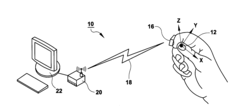
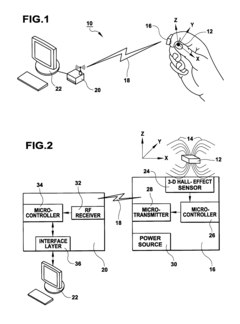
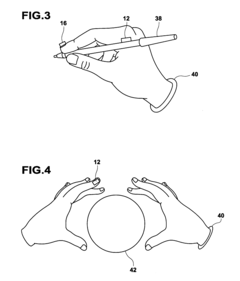
Hall-effect finger-mounted computer input device
PatentInactiveUS8246462B1
Innovation
- A Hall-effect finger-mounted input system using a magnet and remote sensor unit worn on the thumb and finger, respectively, to detect three-dimensional magnetic field changes and convert them into processor inputs without moving parts, compatible with existing computers and game controllers.
Environmental Factors Affecting Sensor Longevity
Environmental conditions play a critical role in determining the longevity and reliability of both Hall Effect sensors and potentiometers. Temperature variations represent one of the most significant environmental factors affecting these sensing technologies. Hall Effect sensors typically maintain stable operation across a wide temperature range (-40°C to +150°C), with minimal drift characteristics. Their solid-state construction provides inherent resistance to temperature-induced performance degradation. In contrast, potentiometers exhibit more pronounced temperature sensitivity, with resistance values fluctuating as ambient temperatures change, potentially leading to calibration drift over extended periods.
Humidity and moisture exposure present different challenges to each technology. Hall Effect sensors, being fully encapsulated semiconductor devices, offer superior protection against moisture ingress. This encapsulation prevents oxidation and corrosion of internal components, maintaining consistent performance even in high-humidity environments. Potentiometers, however, contain exposed resistive tracks and wiper contacts that remain vulnerable to moisture-related degradation, including oxidation, corrosion, and potential electrical shorts, significantly reducing their operational lifespan in humid conditions.
Dust and particulate contamination affect these sensors differently based on their fundamental design principles. Hall Effect sensors operate without mechanical contact points, eliminating the risk of performance degradation due to dust accumulation. Their sealed construction prevents particulate matter from interfering with the sensing mechanism. Conversely, potentiometers rely on physical contact between the wiper and resistive track, making them highly susceptible to dust infiltration, which can cause erratic readings, increased wear, and eventual failure through abrasion of contact surfaces.
Vibration and shock resistance represents another critical environmental consideration. Hall Effect sensors contain no moving parts, providing exceptional resilience against mechanical stresses. They maintain calibration accuracy even when subjected to continuous vibration or occasional impact forces. Potentiometers, with their mechanical construction, demonstrate significantly lower tolerance to vibration, which can accelerate wear between the wiper and resistive element, leading to premature failure and inconsistent readings in applications with persistent mechanical stress.
Chemical exposure presents varying challenges depending on sensor construction materials. Hall Effect sensors typically utilize robust encapsulation materials resistant to many industrial chemicals and solvents. This chemical resistance helps maintain performance integrity in harsh industrial environments. Potentiometers often incorporate plastic housings and exposed electrical contacts that may degrade when exposed to certain chemicals, potentially compromising their electrical characteristics and mechanical integrity over time.
Humidity and moisture exposure present different challenges to each technology. Hall Effect sensors, being fully encapsulated semiconductor devices, offer superior protection against moisture ingress. This encapsulation prevents oxidation and corrosion of internal components, maintaining consistent performance even in high-humidity environments. Potentiometers, however, contain exposed resistive tracks and wiper contacts that remain vulnerable to moisture-related degradation, including oxidation, corrosion, and potential electrical shorts, significantly reducing their operational lifespan in humid conditions.
Dust and particulate contamination affect these sensors differently based on their fundamental design principles. Hall Effect sensors operate without mechanical contact points, eliminating the risk of performance degradation due to dust accumulation. Their sealed construction prevents particulate matter from interfering with the sensing mechanism. Conversely, potentiometers rely on physical contact between the wiper and resistive track, making them highly susceptible to dust infiltration, which can cause erratic readings, increased wear, and eventual failure through abrasion of contact surfaces.
Vibration and shock resistance represents another critical environmental consideration. Hall Effect sensors contain no moving parts, providing exceptional resilience against mechanical stresses. They maintain calibration accuracy even when subjected to continuous vibration or occasional impact forces. Potentiometers, with their mechanical construction, demonstrate significantly lower tolerance to vibration, which can accelerate wear between the wiper and resistive element, leading to premature failure and inconsistent readings in applications with persistent mechanical stress.
Chemical exposure presents varying challenges depending on sensor construction materials. Hall Effect sensors typically utilize robust encapsulation materials resistant to many industrial chemicals and solvents. This chemical resistance helps maintain performance integrity in harsh industrial environments. Potentiometers often incorporate plastic housings and exposed electrical contacts that may degrade when exposed to certain chemicals, potentially compromising their electrical characteristics and mechanical integrity over time.
Cost-Benefit Analysis of Sensing Technologies
When evaluating sensing technologies for position measurement applications, cost-benefit analysis provides critical insights for engineering and procurement decisions. Hall Effect sensors and potentiometers represent two distinct approaches with significantly different economic profiles over their operational lifespans.
Initial acquisition costs typically favor potentiometers, which generally range from $2-15 for standard industrial models compared to Hall Effect sensors at $5-25. However, this initial cost advantage diminishes when considering total cost of ownership across extended operational periods. Hall Effect sensors, with no mechanical contact points, demonstrate mean time between failures (MTBF) of 100,000+ hours in industrial environments, whereas potentiometers commonly require replacement after 10,000-50,000 operational cycles depending on environmental conditions.
Maintenance expenditures create substantial divergence in long-term economics. Potentiometers necessitate regular calibration and eventual replacement due to mechanical wear, introducing both direct costs (replacement components) and indirect costs (system downtime, labor). A typical maintenance schedule might require recalibration every 3-6 months and replacement every 1-3 years in continuous operation scenarios. Conversely, Hall Effect sensors generally maintain calibration throughout their operational life with minimal intervention.
Energy consumption presents another economic consideration. While both technologies consume minimal power, Hall Effect sensors typically require 5-25mA current draw compared to potentiometers' negligible power requirements. This difference becomes meaningful only in battery-powered applications where power budget constraints are critical.
Implementation costs also differ significantly. Potentiometers offer simpler integration with straightforward voltage divider circuits, while Hall Effect sensors require additional signal conditioning components and occasionally more complex mounting arrangements. This integration complexity can add 15-30% to initial implementation costs for Hall Effect solutions.
Risk assessment further favors Hall Effect technology when considering failure modes. Potentiometer failures often occur progressively through increasing signal noise and eventual open circuit conditions, potentially causing system malfunction before detection. Hall Effect sensor failures, though less common, tend toward immediate and detectable failure states, reducing the risk of operating with degraded measurement accuracy.
Return on investment calculations typically show Hall Effect sensors becoming economically advantageous after 2-4 years of operation in industrial applications, with the crossover point occurring earlier in harsh environments where potentiometer degradation accelerates. For critical applications where measurement reliability directly impacts product quality or safety, the economic benefits of Hall Effect sensors' stability become even more pronounced.
Initial acquisition costs typically favor potentiometers, which generally range from $2-15 for standard industrial models compared to Hall Effect sensors at $5-25. However, this initial cost advantage diminishes when considering total cost of ownership across extended operational periods. Hall Effect sensors, with no mechanical contact points, demonstrate mean time between failures (MTBF) of 100,000+ hours in industrial environments, whereas potentiometers commonly require replacement after 10,000-50,000 operational cycles depending on environmental conditions.
Maintenance expenditures create substantial divergence in long-term economics. Potentiometers necessitate regular calibration and eventual replacement due to mechanical wear, introducing both direct costs (replacement components) and indirect costs (system downtime, labor). A typical maintenance schedule might require recalibration every 3-6 months and replacement every 1-3 years in continuous operation scenarios. Conversely, Hall Effect sensors generally maintain calibration throughout their operational life with minimal intervention.
Energy consumption presents another economic consideration. While both technologies consume minimal power, Hall Effect sensors typically require 5-25mA current draw compared to potentiometers' negligible power requirements. This difference becomes meaningful only in battery-powered applications where power budget constraints are critical.
Implementation costs also differ significantly. Potentiometers offer simpler integration with straightforward voltage divider circuits, while Hall Effect sensors require additional signal conditioning components and occasionally more complex mounting arrangements. This integration complexity can add 15-30% to initial implementation costs for Hall Effect solutions.
Risk assessment further favors Hall Effect technology when considering failure modes. Potentiometer failures often occur progressively through increasing signal noise and eventual open circuit conditions, potentially causing system malfunction before detection. Hall Effect sensor failures, though less common, tend toward immediate and detectable failure states, reducing the risk of operating with degraded measurement accuracy.
Return on investment calculations typically show Hall Effect sensors becoming economically advantageous after 2-4 years of operation in industrial applications, with the crossover point occurring earlier in harsh environments where potentiometer degradation accelerates. For critical applications where measurement reliability directly impacts product quality or safety, the economic benefits of Hall Effect sensors' stability become even more pronounced.
Unlock deeper insights with PatSnap Eureka Quick Research — get a full tech report to explore trends and direct your research. Try now!
Generate Your Research Report Instantly with AI Agent
Supercharge your innovation with PatSnap Eureka AI Agent Platform!