
Comparing Solid-State Relay vs Thyristor in Switching Applications
SEP 19, 20259 MIN READ
Generate Your Research Report Instantly with AI Agent
Patsnap Eureka helps you evaluate technical feasibility & market potential.
Solid-State and Thyristor Switching Technology Evolution
The evolution of switching technologies has witnessed significant advancements over the past several decades, transforming from mechanical relays to sophisticated solid-state solutions. The journey began in the 1950s with the invention of the thyristor (SCR - Silicon Controlled Rectifier), which marked the first major step toward electronic switching without moving parts. This innovation enabled higher switching speeds and reliability compared to mechanical alternatives.
During the 1960s and 1970s, thyristor technology matured with the development of various derivatives including TRIACs (Triode for Alternating Current) and GTO (Gate Turn-Off) thyristors, expanding application possibilities in power control systems. The fundamental limitation of thyristors—their inability to turn off without external commutation in DC applications—drove further innovation in the field.
The 1980s witnessed the emergence of early solid-state relays (SSRs) that incorporated semiconductor switching elements with integrated control circuitry. These devices began to challenge traditional electromechanical relays in industrial applications where frequent switching, reliability, and longevity were paramount concerns.
The 1990s brought significant miniaturization and integration capabilities, allowing SSRs to incorporate advanced features such as zero-crossing detection, which minimizes electromagnetic interference during switching operations. Concurrently, power MOSFETs and IGBTs (Insulated Gate Bipolar Transistors) emerged as alternatives to thyristors in many applications, offering improved controllability and efficiency.
By the early 2000s, solid-state relays had evolved to incorporate sophisticated protection features including overcurrent, overvoltage, and thermal protection mechanisms. This period also saw the development of hybrid solutions that combined the best aspects of different technologies to optimize performance for specific applications.
The 2010s marked the integration of digital control interfaces in advanced SSRs, enabling seamless incorporation into modern industrial automation systems and IoT frameworks. Enhanced thermal management techniques and packaging innovations further improved power density and reliability.
Most recently, wide bandgap semiconductors such as Silicon Carbide (SiC) and Gallium Nitride (GaN) have begun revolutionizing both thyristor and SSR technologies. These materials enable higher operating temperatures, faster switching speeds, and greater efficiency, pushing the performance boundaries of solid-state switching devices.
The evolution continues today with increasing focus on energy efficiency, miniaturization, and integration with smart systems. Modern solid-state switching technologies are increasingly designed with sustainability considerations, aiming to reduce energy losses and extend operational lifetimes while maintaining competitive costs and reliability advantages over their predecessors.
During the 1960s and 1970s, thyristor technology matured with the development of various derivatives including TRIACs (Triode for Alternating Current) and GTO (Gate Turn-Off) thyristors, expanding application possibilities in power control systems. The fundamental limitation of thyristors—their inability to turn off without external commutation in DC applications—drove further innovation in the field.
The 1980s witnessed the emergence of early solid-state relays (SSRs) that incorporated semiconductor switching elements with integrated control circuitry. These devices began to challenge traditional electromechanical relays in industrial applications where frequent switching, reliability, and longevity were paramount concerns.
The 1990s brought significant miniaturization and integration capabilities, allowing SSRs to incorporate advanced features such as zero-crossing detection, which minimizes electromagnetic interference during switching operations. Concurrently, power MOSFETs and IGBTs (Insulated Gate Bipolar Transistors) emerged as alternatives to thyristors in many applications, offering improved controllability and efficiency.
By the early 2000s, solid-state relays had evolved to incorporate sophisticated protection features including overcurrent, overvoltage, and thermal protection mechanisms. This period also saw the development of hybrid solutions that combined the best aspects of different technologies to optimize performance for specific applications.
The 2010s marked the integration of digital control interfaces in advanced SSRs, enabling seamless incorporation into modern industrial automation systems and IoT frameworks. Enhanced thermal management techniques and packaging innovations further improved power density and reliability.
Most recently, wide bandgap semiconductors such as Silicon Carbide (SiC) and Gallium Nitride (GaN) have begun revolutionizing both thyristor and SSR technologies. These materials enable higher operating temperatures, faster switching speeds, and greater efficiency, pushing the performance boundaries of solid-state switching devices.
The evolution continues today with increasing focus on energy efficiency, miniaturization, and integration with smart systems. Modern solid-state switching technologies are increasingly designed with sustainability considerations, aiming to reduce energy losses and extend operational lifetimes while maintaining competitive costs and reliability advantages over their predecessors.
Market Demand Analysis for Electronic Switching Solutions
The global electronic switching solutions market has witnessed substantial growth in recent years, driven by increasing automation across industrial, commercial, and residential sectors. Current market valuations place this segment at approximately $12.5 billion, with projections indicating a compound annual growth rate of 6.8% through 2028. This growth trajectory is particularly evident in regions with robust manufacturing bases such as East Asia, North America, and Western Europe.
Solid-state relays (SSRs) and thyristors represent two dominant technologies within this market, collectively accounting for over 60% of electronic switching applications. The demand for these components is increasingly segmented by application requirements, with distinct market preferences emerging across different sectors.
Industrial automation remains the largest consumer of electronic switching solutions, representing 42% of the total market. Within this segment, there is a clear shift toward SSRs in applications requiring frequent switching operations and longevity, while thyristors maintain dominance in high-power applications. The industrial Internet of Things (IIoT) expansion has further accelerated demand for intelligent switching solutions that offer remote monitoring capabilities and system integration.
The energy sector presents another significant market, particularly with the global transition toward renewable energy systems. Solar inverters and wind power systems heavily rely on efficient switching technologies, with thyristors historically dominating this space due to their high voltage and current handling capabilities. However, recent advancements in SSR technology have begun challenging this position, especially in medium-power applications where reliability and maintenance costs are primary concerns.
Consumer electronics represents the fastest-growing segment, with a 9.2% annual growth rate. This sector predominantly favors SSRs due to their compact size, silent operation, and compatibility with modern circuit designs. The proliferation of smart home devices has created substantial demand for miniaturized switching solutions that can be integrated into increasingly compact designs.
Market research indicates that customers across all segments are increasingly prioritizing energy efficiency, with 78% of procurement specialists citing power consumption as a critical factor in component selection. This trend has intensified competition between SSR and thyristor manufacturers to improve efficiency metrics, particularly in standby power consumption and switching losses.
Geographical analysis reveals emerging markets in Southeast Asia and South America showing accelerated adoption rates for electronic switching technologies, primarily driven by industrial modernization initiatives and infrastructure development projects. These regions present significant growth opportunities, with annual market expansion rates exceeding 10% in countries like Vietnam, Indonesia, and Brazil.
Solid-state relays (SSRs) and thyristors represent two dominant technologies within this market, collectively accounting for over 60% of electronic switching applications. The demand for these components is increasingly segmented by application requirements, with distinct market preferences emerging across different sectors.
Industrial automation remains the largest consumer of electronic switching solutions, representing 42% of the total market. Within this segment, there is a clear shift toward SSRs in applications requiring frequent switching operations and longevity, while thyristors maintain dominance in high-power applications. The industrial Internet of Things (IIoT) expansion has further accelerated demand for intelligent switching solutions that offer remote monitoring capabilities and system integration.
The energy sector presents another significant market, particularly with the global transition toward renewable energy systems. Solar inverters and wind power systems heavily rely on efficient switching technologies, with thyristors historically dominating this space due to their high voltage and current handling capabilities. However, recent advancements in SSR technology have begun challenging this position, especially in medium-power applications where reliability and maintenance costs are primary concerns.
Consumer electronics represents the fastest-growing segment, with a 9.2% annual growth rate. This sector predominantly favors SSRs due to their compact size, silent operation, and compatibility with modern circuit designs. The proliferation of smart home devices has created substantial demand for miniaturized switching solutions that can be integrated into increasingly compact designs.
Market research indicates that customers across all segments are increasingly prioritizing energy efficiency, with 78% of procurement specialists citing power consumption as a critical factor in component selection. This trend has intensified competition between SSR and thyristor manufacturers to improve efficiency metrics, particularly in standby power consumption and switching losses.
Geographical analysis reveals emerging markets in Southeast Asia and South America showing accelerated adoption rates for electronic switching technologies, primarily driven by industrial modernization initiatives and infrastructure development projects. These regions present significant growth opportunities, with annual market expansion rates exceeding 10% in countries like Vietnam, Indonesia, and Brazil.
Current Technological Landscape and Implementation Challenges
The current technological landscape of switching applications is witnessing a significant shift from traditional electromechanical relays to solid-state solutions. Solid-State Relays (SSRs) and Thyristors represent two prominent semiconductor-based switching technologies that have gained substantial market traction. SSRs have evolved considerably over the past decade, with improvements in integration density, thermal management, and isolation techniques. Modern SSRs typically incorporate MOSFETs or IGBTs as switching elements, offering enhanced performance characteristics compared to earlier generations.
Thyristor technology, despite being older, continues to maintain relevance in high-power applications. Recent advancements in thyristor design have focused on improving switching speeds and reducing conduction losses. Silicon Carbide (SiC) and Gallium Nitride (GaN) based thyristors are emerging as next-generation solutions, offering superior performance in high-temperature and high-frequency applications compared to traditional silicon-based devices.
The geographical distribution of these technologies shows interesting patterns. While research and development in advanced SSR technologies is concentrated in North America and Europe, mass production is predominantly based in East Asian countries, particularly China, Japan, and South Korea. Thyristor manufacturing remains more globally distributed, with significant production capacities in Europe, North America, and Asia.
Implementation challenges for both technologies persist across several dimensions. For SSRs, thermal management remains a critical concern, as heat dissipation directly impacts reliability and lifespan. The trade-off between on-state resistance and switching speed continues to challenge designers, particularly in applications requiring both high efficiency and fast response times. Additionally, SSRs face challenges in high-voltage isolation and surge protection in industrial environments.
Thyristors encounter different implementation hurdles, primarily related to their inherent latching behavior and limited gate control once turned on. This characteristic restricts their application in scenarios requiring precise control over turn-off timing. Furthermore, thyristors typically exhibit higher forward voltage drops compared to MOSFETs, resulting in greater power losses in high-current applications.
Both technologies face common challenges in EMI/EMC compliance, particularly as switching frequencies increase to meet demands for smaller form factors and higher efficiency. The absence of standardized testing methodologies specific to solid-state switching devices complicates qualification processes across different application domains.
Cost remains a significant barrier to wider adoption, especially for advanced SSRs incorporating newer semiconductor materials. While manufacturing processes have matured, the price premium over conventional electromechanical relays continues to limit penetration in cost-sensitive markets. Thyristors generally maintain a cost advantage in high-power applications, though this gap is gradually narrowing as SSR technology scales and production volumes increase.
Thyristor technology, despite being older, continues to maintain relevance in high-power applications. Recent advancements in thyristor design have focused on improving switching speeds and reducing conduction losses. Silicon Carbide (SiC) and Gallium Nitride (GaN) based thyristors are emerging as next-generation solutions, offering superior performance in high-temperature and high-frequency applications compared to traditional silicon-based devices.
The geographical distribution of these technologies shows interesting patterns. While research and development in advanced SSR technologies is concentrated in North America and Europe, mass production is predominantly based in East Asian countries, particularly China, Japan, and South Korea. Thyristor manufacturing remains more globally distributed, with significant production capacities in Europe, North America, and Asia.
Implementation challenges for both technologies persist across several dimensions. For SSRs, thermal management remains a critical concern, as heat dissipation directly impacts reliability and lifespan. The trade-off between on-state resistance and switching speed continues to challenge designers, particularly in applications requiring both high efficiency and fast response times. Additionally, SSRs face challenges in high-voltage isolation and surge protection in industrial environments.
Thyristors encounter different implementation hurdles, primarily related to their inherent latching behavior and limited gate control once turned on. This characteristic restricts their application in scenarios requiring precise control over turn-off timing. Furthermore, thyristors typically exhibit higher forward voltage drops compared to MOSFETs, resulting in greater power losses in high-current applications.
Both technologies face common challenges in EMI/EMC compliance, particularly as switching frequencies increase to meet demands for smaller form factors and higher efficiency. The absence of standardized testing methodologies specific to solid-state switching devices complicates qualification processes across different application domains.
Cost remains a significant barrier to wider adoption, especially for advanced SSRs incorporating newer semiconductor materials. While manufacturing processes have matured, the price premium over conventional electromechanical relays continues to limit penetration in cost-sensitive markets. Thyristors generally maintain a cost advantage in high-power applications, though this gap is gradually narrowing as SSR technology scales and production volumes increase.
Comparative Analysis of SSR and Thyristor Implementation Methods
01 Solid-state relay design and architecture
Solid-state relays (SSRs) utilize semiconductor components to perform switching operations without mechanical parts. These designs typically incorporate thyristors, triacs, or MOSFETs as the main switching elements. The architecture often includes input control circuitry, isolation mechanisms (typically optocouplers), and output switching stages. Advanced designs may feature integrated protection circuits for overvoltage, overcurrent, and thermal conditions to enhance reliability and performance in various applications.- Solid-state relay design and architecture: Solid-state relays (SSRs) utilize semiconductor components to perform switching operations without mechanical parts. Their design typically includes input control circuitry, isolation mechanisms, and output switching elements. These relays offer advantages such as fast switching speeds, no contact bounce, and longer operational life compared to mechanical relays. Various architectures are employed to optimize performance characteristics including response time, isolation quality, and heat dissipation.
- Thyristor switching characteristics and performance optimization: Thyristors are semiconductor devices used in power switching applications that can be optimized for various performance parameters. Key characteristics include turn-on/turn-off times, forward voltage drop, and blocking voltage capability. Performance optimization techniques involve gate drive circuit design, thermal management solutions, and snubber circuit implementation to control switching transients. Advanced thyristor designs incorporate features to improve switching speed and reduce losses during operation.
- Protection circuits and overvoltage management: Protection mechanisms are essential for solid-state relays and thyristor circuits to prevent damage from transient voltage spikes, overcurrent conditions, and thermal runaway. These protection circuits may include varistors, transient voltage suppressors, current-limiting components, and thermal shutdown features. Advanced designs incorporate integrated protection that responds quickly to fault conditions while maintaining normal operation under standard conditions, enhancing overall system reliability and longevity.
- Thermal management and heat dissipation techniques: Effective thermal management is critical for solid-state relays and thyristors as these devices generate significant heat during operation. Heat dissipation techniques include heatsink design optimization, thermal interface materials, forced air cooling, and improved package designs. Advanced thermal management solutions monitor device temperature and adjust operation to prevent overheating. Proper thermal design ensures reliable operation, extends device lifetime, and maintains switching performance within specification across varying load conditions.
- Control circuit integration and drive techniques: Control circuit integration for solid-state relays and thyristors focuses on optimizing gate drive characteristics to improve switching performance. Advanced drive techniques include precise timing control, variable gate current profiles, and feedback mechanisms to monitor switching states. Integration of control circuits with power devices reduces parasitic effects and improves response times. Modern designs incorporate digital control interfaces, programmable switching parameters, and diagnostic capabilities to enhance overall system performance and flexibility.
02 Thyristor switching characteristics and performance optimization
Thyristors exhibit specific switching characteristics that affect their performance in power control applications. Key parameters include turn-on time, turn-off time, di/dt (rate of current change) capability, and dv/dt (rate of voltage change) immunity. Performance optimization techniques involve gate drive circuit design, snubber networks for transient suppression, and thermal management solutions. Advanced thyristor designs incorporate specialized structures to improve switching speed and reduce switching losses, particularly important in high-frequency applications.Expand Specific Solutions03 Protection and reliability features in switching devices
Protection mechanisms are essential for ensuring reliable operation of solid-state relays and thyristor-based switches. These include overvoltage protection circuits, overcurrent detection and limitation, thermal shutdown capabilities, and EMI/RFI suppression techniques. Advanced designs incorporate fault detection algorithms, self-diagnostic features, and isolation barriers to prevent cascading failures. Reliability enhancements may include redundant components, specialized packaging for harsh environments, and integrated cooling solutions to maintain optimal operating temperatures.Expand Specific Solutions04 Control and triggering methods for improved switching
Various control and triggering methods are employed to optimize the switching performance of solid-state relays and thyristors. These include zero-crossing detection for reduced EMI, pulse-width modulation for precise power control, and phase-angle control techniques. Advanced triggering circuits may incorporate microcontroller-based adaptive algorithms that adjust gate signals based on load conditions. Optical isolation methods ensure signal integrity while maintaining electrical isolation between control and power circuits, enhancing both safety and noise immunity.Expand Specific Solutions05 Application-specific switching solutions and innovations
Specialized solid-state relay and thyristor switching solutions are developed for specific applications with unique requirements. These include high-voltage transmission systems, motor control circuits, heating element controllers, and automotive electronics. Innovations focus on miniaturization, increased power density, improved thermal management, and enhanced integration with digital control systems. Recent developments include hybrid switching technologies that combine the benefits of different semiconductor types to achieve optimal performance characteristics for particular operating conditions.Expand Specific Solutions
Key Manufacturers and Industry Competition Analysis
The solid-state relay (SSR) versus thyristor switching technology market is currently in a growth phase, with an expanding global market estimated at $1.5 billion and projected to reach $2.3 billion by 2027. The competitive landscape features established power electronics leaders like Siemens, ABB, and Schneider Electric alongside specialized manufacturers such as OMRON, TE Connectivity, and Xiamen Kudom Electronics. Technology maturity varies between applications - thyristors represent mature technology with decades of implementation, while solid-state relays continue evolving with semiconductor advancements. Companies like Texas Instruments, STMicroelectronics, and Nexperia are driving innovation in semiconductor-based switching solutions, while research institutions including China Electric Power Research Institute and Huazhong University of Science & Technology are developing next-generation technologies focusing on efficiency, miniaturization, and integration with smart grid systems.
OMRON Corp.
Technical Solution: OMRON Corporation has developed the G3PE and G3NA series of solid-state relays that represent their approach to modern industrial switching challenges. Their SSRs utilize advanced semiconductor designs with optimized heat dissipation structures, allowing for higher current densities in compact packages[1]. OMRON's solid-state relays feature zero-cross switching technology that minimizes electrical noise and reduces stress on connected loads, particularly important in sensitive electronic equipment applications. For applications requiring thyristor-based solutions, OMRON has developed the G3PH series that utilizes SCR technology with sophisticated gate control to handle high inrush currents while maintaining long operational life[2]. The company has also pioneered miniaturized SSR designs with their G3DZ series, which incorporates MOSFET switching elements for ultra-fast response times below 1ms while maintaining isolation ratings up to 4kV[3]. OMRON's hybrid approach in some product lines combines the benefits of both technologies, using thyristors for high-current handling capability and SSR technology for precise control and longevity.
Strengths: Exceptional miniaturization capabilities, high reliability in industrial environments, and excellent noise immunity characteristics. Their products offer superior longevity in high-cycle applications. Weaknesses: More limited current handling capability in some product lines compared to dedicated thyristor solutions, and higher cost for specialized high-performance models.
Siemens AG
Technical Solution: Siemens AG has developed the SIRIUS 3RF series of solid-state switching devices that represent their comprehensive approach to modern industrial switching applications. Their technology implements zero-crossing switching in their SSRs to minimize electromagnetic interference and reduce switching stress[1]. For high-power applications, Siemens utilizes thyristor-based solutions in their SINAMICS drive systems, featuring advanced gate driver circuits that optimize switching characteristics and reduce losses[2]. The company has also pioneered hybrid solutions that combine mechanical contactors with semiconductor switching elements, providing both isolation capabilities and arc-free switching. Siemens' 3RF24 series specifically addresses partial load applications with integrated current monitoring and diagnostics, allowing for predictive maintenance and enhanced system reliability[3]. Their PROFINET-compatible solid-state relays enable integration with industrial automation networks, providing real-time monitoring and control capabilities that traditional electromechanical relays cannot match.
Strengths: Excellent integration with industrial automation systems, comprehensive diagnostic capabilities, and robust design for harsh environments. Their solutions offer superior EMC performance. Weaknesses: Higher power consumption in the control circuit compared to some competitors, and limited options for extremely high-frequency switching applications.
Critical Patents and Technical Innovations in Switching Devices
Switch utilizing solid-state relay
PatentInactiveUS4742380A
Innovation
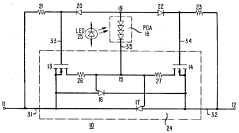
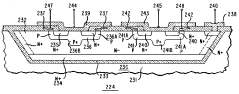
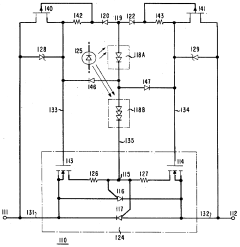
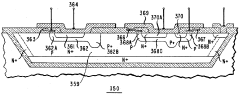
- A novel solid-state relay design utilizing an array of vertical DMOS transistors and unilateral thyristors, combined with a control circuit featuring voltage-controlled JFETs and zener diodes, to optimize switching characteristics and protect the gate oxide, allowing for reliable operation under high voltages and currents.
Quasi-resonant thyristor current interrupter
PatentWO2023141384A1
Innovation
- A quasi-resonant turn-off circuit is coupled with anti-parallel thyristors, featuring a resonant capacitor and energy recovery circuit to rapidly decrease turn-off time by supplying charge and recharging using parasitic inductances, enabling controlled current interruption.


Thermal Management Considerations in High-Power Applications
Thermal management represents a critical consideration when comparing solid-state relays (SSRs) and thyristors in high-power switching applications. Both technologies generate significant heat during operation, particularly when handling currents exceeding several amperes, necessitating effective thermal dissipation strategies to maintain reliability and performance.
SSRs typically incorporate semiconductor switching elements (MOSFETs or IGBTs) that exhibit higher on-state resistance compared to thyristors, resulting in greater power dissipation during conduction. This characteristic necessitates more robust heat sinking solutions for SSRs, especially in applications exceeding 10A. The compact packaging of modern SSRs, while beneficial for space-constrained installations, can exacerbate thermal challenges by concentrating heat generation in smaller volumes.
Thyristors generally demonstrate superior thermal efficiency with lower forward voltage drops (typically 1-1.5V versus 1.5-2V for SSRs), translating to reduced heat generation per ampere conducted. This inherent advantage makes thyristors particularly suitable for very high current applications where thermal management becomes paramount. However, thyristors still require adequate heat dissipation, especially in applications with high switching frequencies.
The thermal interface between the switching device and heat sink represents a critical consideration in both technologies. Thermal interface materials (TIMs) such as thermal greases, phase-change materials, or thermal pads are essential for minimizing thermal resistance. The selection of appropriate TIMs can significantly impact overall thermal performance, with differences in thermal conductivity ranging from 1 W/mK to over 10 W/mK depending on material quality.
Environmental factors also influence thermal management strategies. Ambient temperature, airflow conditions, and installation orientation all affect cooling efficiency. SSRs typically specify maximum junction temperatures of 125-150°C, while thyristors can often tolerate slightly higher temperatures, providing a marginal advantage in thermally challenging environments.
Advanced cooling techniques become necessary in extreme high-power applications. Forced-air cooling can improve heat dissipation by 30-50% compared to natural convection, while liquid cooling systems offer even greater thermal management capabilities, potentially increasing power handling capacity by 2-3 times. These advanced cooling methods are more commonly implemented with thyristor-based systems due to their prevalence in very high-power applications.
The thermal cycling endurance of both technologies warrants consideration in applications with frequent load variations. Repeated thermal expansion and contraction can lead to solder fatigue and eventual failure. SSRs with their more complex internal structure may exhibit greater susceptibility to thermal cycling stress compared to the relatively simpler construction of discrete thyristors.
SSRs typically incorporate semiconductor switching elements (MOSFETs or IGBTs) that exhibit higher on-state resistance compared to thyristors, resulting in greater power dissipation during conduction. This characteristic necessitates more robust heat sinking solutions for SSRs, especially in applications exceeding 10A. The compact packaging of modern SSRs, while beneficial for space-constrained installations, can exacerbate thermal challenges by concentrating heat generation in smaller volumes.
Thyristors generally demonstrate superior thermal efficiency with lower forward voltage drops (typically 1-1.5V versus 1.5-2V for SSRs), translating to reduced heat generation per ampere conducted. This inherent advantage makes thyristors particularly suitable for very high current applications where thermal management becomes paramount. However, thyristors still require adequate heat dissipation, especially in applications with high switching frequencies.
The thermal interface between the switching device and heat sink represents a critical consideration in both technologies. Thermal interface materials (TIMs) such as thermal greases, phase-change materials, or thermal pads are essential for minimizing thermal resistance. The selection of appropriate TIMs can significantly impact overall thermal performance, with differences in thermal conductivity ranging from 1 W/mK to over 10 W/mK depending on material quality.
Environmental factors also influence thermal management strategies. Ambient temperature, airflow conditions, and installation orientation all affect cooling efficiency. SSRs typically specify maximum junction temperatures of 125-150°C, while thyristors can often tolerate slightly higher temperatures, providing a marginal advantage in thermally challenging environments.
Advanced cooling techniques become necessary in extreme high-power applications. Forced-air cooling can improve heat dissipation by 30-50% compared to natural convection, while liquid cooling systems offer even greater thermal management capabilities, potentially increasing power handling capacity by 2-3 times. These advanced cooling methods are more commonly implemented with thyristor-based systems due to their prevalence in very high-power applications.
The thermal cycling endurance of both technologies warrants consideration in applications with frequent load variations. Repeated thermal expansion and contraction can lead to solder fatigue and eventual failure. SSRs with their more complex internal structure may exhibit greater susceptibility to thermal cycling stress compared to the relatively simpler construction of discrete thyristors.
Reliability and Lifetime Assessment Methodologies
Reliability assessment methodologies for solid-state relays (SSRs) and thyristors differ significantly due to their structural and operational characteristics. For SSRs, the Mean Time Between Failures (MTBF) calculation typically incorporates semiconductor junction degradation, optocoupler aging, and thermal cycling effects. Industry standards such as MIL-HDBK-217F and Telcordia SR-332 provide frameworks for predicting SSR reliability, with most manufacturers reporting MTBF values between 1-5 million hours under nominal conditions.
Thyristor reliability assessment, conversely, focuses on surge current capability, thermal cycling endurance, and gate trigger stability over time. The absence of optocouplers in thyristors simplifies certain reliability calculations, though their susceptibility to voltage transients introduces additional failure modes requiring specialized testing protocols such as those outlined in IEC 60747-6.
Accelerated life testing represents a critical methodology for both technologies. For SSRs, temperature cycling between -40°C and 125°C with dwell times of 15-30 minutes effectively reveals potential failure mechanisms in the isolation barrier and semiconductor junctions. Thyristors benefit from power cycling tests that alternate between maximum rated current and off-state to evaluate thermal fatigue resistance of internal bonding.
Environmental stress screening (ESS) protocols differ substantially between these technologies. SSRs typically undergo humidity bias testing (85°C/85% RH) for 1000 hours to evaluate moisture resistance of the encapsulation and isolation systems. Thyristors require additional high-temperature reverse bias (HTRB) testing to assess leakage current stability over time.
Field failure analysis data indicates distinct wear-out mechanisms. SSRs commonly fail due to optocoupler degradation or output semiconductor thermal fatigue, with typical useful life ranging from 7-12 years in industrial applications. Thyristors demonstrate longer operational lifespans (often 15-20 years) but exhibit more catastrophic failure modes, particularly in high-surge environments where thermal runaway can occur without warning.
Predictive maintenance strategies must account for these differences. SSR health monitoring typically employs on-state voltage drop measurement and switching time monitoring, with gradual increases in either parameter indicating impending failure. Thyristor condition monitoring focuses on gate trigger voltage stability and thermal impedance measurements, with specialized equipment required for accurate assessment in field conditions.
Thyristor reliability assessment, conversely, focuses on surge current capability, thermal cycling endurance, and gate trigger stability over time. The absence of optocouplers in thyristors simplifies certain reliability calculations, though their susceptibility to voltage transients introduces additional failure modes requiring specialized testing protocols such as those outlined in IEC 60747-6.
Accelerated life testing represents a critical methodology for both technologies. For SSRs, temperature cycling between -40°C and 125°C with dwell times of 15-30 minutes effectively reveals potential failure mechanisms in the isolation barrier and semiconductor junctions. Thyristors benefit from power cycling tests that alternate between maximum rated current and off-state to evaluate thermal fatigue resistance of internal bonding.
Environmental stress screening (ESS) protocols differ substantially between these technologies. SSRs typically undergo humidity bias testing (85°C/85% RH) for 1000 hours to evaluate moisture resistance of the encapsulation and isolation systems. Thyristors require additional high-temperature reverse bias (HTRB) testing to assess leakage current stability over time.
Field failure analysis data indicates distinct wear-out mechanisms. SSRs commonly fail due to optocoupler degradation or output semiconductor thermal fatigue, with typical useful life ranging from 7-12 years in industrial applications. Thyristors demonstrate longer operational lifespans (often 15-20 years) but exhibit more catastrophic failure modes, particularly in high-surge environments where thermal runaway can occur without warning.
Predictive maintenance strategies must account for these differences. SSR health monitoring typically employs on-state voltage drop measurement and switching time monitoring, with gradual increases in either parameter indicating impending failure. Thyristor condition monitoring focuses on gate trigger voltage stability and thermal impedance measurements, with specialized equipment required for accurate assessment in field conditions.
Unlock deeper insights with Patsnap Eureka Quick Research — get a full tech report to explore trends and direct your research. Try now!
Generate Your Research Report Instantly with AI Agent
Supercharge your innovation with Patsnap Eureka AI Agent Platform!