
Comparing Structural Flexibility: Topology Optimization vs Traditional Designs
SEP 16, 202510 MIN READ
Generate Your Research Report Instantly with AI Agent
Patsnap Eureka helps you evaluate technical feasibility & market potential.
Topology Optimization Background and Objectives
Topology optimization has emerged as a revolutionary approach in structural design, evolving from mathematical theories developed in the late 1980s by researchers like Martin Bendsøe and Noboru Kikuchi. This methodology represents a significant departure from traditional design paradigms by utilizing algorithms to determine optimal material distribution within a given design space, subject to specified constraints and loading conditions. The fundamental objective of topology optimization is to achieve maximum structural performance while minimizing material usage, a goal that aligns perfectly with modern engineering demands for efficiency and sustainability.
The evolution of topology optimization has been closely tied to advancements in computational capabilities. Early implementations were limited to simple 2D problems due to computational constraints, but modern high-performance computing has enabled the application of these techniques to complex 3D structures across various industries. This technological progression has transformed topology optimization from a theoretical concept to a practical design tool with widespread applications.
When comparing topology optimization with traditional design approaches, several key differences become apparent. Traditional design methodologies typically rely on intuition, experience, and iterative refinement of predetermined structural forms. These approaches often result in suboptimal designs that either use excessive material or fail to fully exploit the material's structural potential. In contrast, topology optimization employs mathematical algorithms to explore the entire design space, often yielding non-intuitive solutions that human designers might never conceive.
The primary objectives of topology optimization in modern engineering practice include weight reduction, performance enhancement, and material efficiency. By removing unnecessary material from areas that contribute minimally to structural integrity, topology optimization can produce components that are significantly lighter yet maintain or even improve mechanical performance. This capability is particularly valuable in industries where weight reduction translates directly to operational efficiency, such as aerospace, automotive, and medical device manufacturing.
Beyond immediate performance benefits, topology optimization aims to address broader engineering challenges. These include reducing environmental impact through material conservation, enabling novel functionalities through complex geometries, and accelerating the design process by automating structural optimization. As manufacturing technologies like additive manufacturing continue to advance, the practical implementation of topology-optimized designs becomes increasingly feasible, further driving adoption across industries.
The trajectory of topology optimization research indicates a growing convergence with other advanced technologies, including machine learning, multi-physics simulation, and generative design. This integration promises to expand the capabilities and applications of topology optimization, potentially revolutionizing how engineers approach structural design challenges across diverse fields and applications.
The evolution of topology optimization has been closely tied to advancements in computational capabilities. Early implementations were limited to simple 2D problems due to computational constraints, but modern high-performance computing has enabled the application of these techniques to complex 3D structures across various industries. This technological progression has transformed topology optimization from a theoretical concept to a practical design tool with widespread applications.
When comparing topology optimization with traditional design approaches, several key differences become apparent. Traditional design methodologies typically rely on intuition, experience, and iterative refinement of predetermined structural forms. These approaches often result in suboptimal designs that either use excessive material or fail to fully exploit the material's structural potential. In contrast, topology optimization employs mathematical algorithms to explore the entire design space, often yielding non-intuitive solutions that human designers might never conceive.
The primary objectives of topology optimization in modern engineering practice include weight reduction, performance enhancement, and material efficiency. By removing unnecessary material from areas that contribute minimally to structural integrity, topology optimization can produce components that are significantly lighter yet maintain or even improve mechanical performance. This capability is particularly valuable in industries where weight reduction translates directly to operational efficiency, such as aerospace, automotive, and medical device manufacturing.
Beyond immediate performance benefits, topology optimization aims to address broader engineering challenges. These include reducing environmental impact through material conservation, enabling novel functionalities through complex geometries, and accelerating the design process by automating structural optimization. As manufacturing technologies like additive manufacturing continue to advance, the practical implementation of topology-optimized designs becomes increasingly feasible, further driving adoption across industries.
The trajectory of topology optimization research indicates a growing convergence with other advanced technologies, including machine learning, multi-physics simulation, and generative design. This integration promises to expand the capabilities and applications of topology optimization, potentially revolutionizing how engineers approach structural design challenges across diverse fields and applications.
Market Demand Analysis for Lightweight Structural Solutions
The global market for lightweight structural solutions has experienced significant growth over the past decade, driven primarily by industries seeking to optimize performance while reducing material usage and environmental impact. According to recent market analyses, the lightweight structures market reached approximately $140 billion in 2022 and is projected to grow at a compound annual growth rate of 7.2% through 2030.
Automotive and aerospace sectors represent the largest demand segments, collectively accounting for over 60% of the total market share. In automotive manufacturing, stringent fuel efficiency regulations and the transition toward electric vehicles have intensified the need for weight reduction solutions. Each kilogram saved in vehicle weight translates to measurable improvements in range and performance, particularly critical for electric vehicle adoption.
The aerospace industry demonstrates even more compelling economics, with estimates suggesting that each kilogram of weight reduction in aircraft design yields fuel savings of $2,000-$3,000 over the operational lifetime of commercial aircraft. This has positioned topology optimization as a high-value technology for manufacturers seeking competitive advantages.
Construction and civil engineering applications are emerging as rapidly growing segments, with projected market expansion of 9.5% annually. The shift toward sustainable building practices and the need for resilient infrastructure in the face of climate change have accelerated adoption of advanced structural optimization techniques. Building information modeling (BIM) integration with topology optimization tools has created new workflows that enable architects and engineers to explore previously impossible design solutions.
Consumer electronics and medical device industries represent smaller but premium market segments, where miniaturization and material efficiency drive significant value creation. The ability to create complex internal structures through additive manufacturing, guided by topology optimization algorithms, has enabled breakthrough product designs that combine strength with minimal material usage.
Regional analysis reveals that North America and Europe currently lead in adoption of advanced structural optimization technologies, but Asia-Pacific markets are demonstrating the fastest growth rates, particularly in China, Japan, and South Korea. This growth correlates strongly with these regions' expanding manufacturing capabilities in high-value sectors and significant investments in digital design technologies.
Customer surveys indicate that key purchasing factors for lightweight structural solutions include performance improvements (cited by 78% of respondents), cost reduction potential (65%), and sustainability benefits (57%). The increasing emphasis on environmental considerations suggests that topology optimization's material efficiency advantages will likely become even more valuable as carbon pricing mechanisms expand globally.
Automotive and aerospace sectors represent the largest demand segments, collectively accounting for over 60% of the total market share. In automotive manufacturing, stringent fuel efficiency regulations and the transition toward electric vehicles have intensified the need for weight reduction solutions. Each kilogram saved in vehicle weight translates to measurable improvements in range and performance, particularly critical for electric vehicle adoption.
The aerospace industry demonstrates even more compelling economics, with estimates suggesting that each kilogram of weight reduction in aircraft design yields fuel savings of $2,000-$3,000 over the operational lifetime of commercial aircraft. This has positioned topology optimization as a high-value technology for manufacturers seeking competitive advantages.
Construction and civil engineering applications are emerging as rapidly growing segments, with projected market expansion of 9.5% annually. The shift toward sustainable building practices and the need for resilient infrastructure in the face of climate change have accelerated adoption of advanced structural optimization techniques. Building information modeling (BIM) integration with topology optimization tools has created new workflows that enable architects and engineers to explore previously impossible design solutions.
Consumer electronics and medical device industries represent smaller but premium market segments, where miniaturization and material efficiency drive significant value creation. The ability to create complex internal structures through additive manufacturing, guided by topology optimization algorithms, has enabled breakthrough product designs that combine strength with minimal material usage.
Regional analysis reveals that North America and Europe currently lead in adoption of advanced structural optimization technologies, but Asia-Pacific markets are demonstrating the fastest growth rates, particularly in China, Japan, and South Korea. This growth correlates strongly with these regions' expanding manufacturing capabilities in high-value sectors and significant investments in digital design technologies.
Customer surveys indicate that key purchasing factors for lightweight structural solutions include performance improvements (cited by 78% of respondents), cost reduction potential (65%), and sustainability benefits (57%). The increasing emphasis on environmental considerations suggests that topology optimization's material efficiency advantages will likely become even more valuable as carbon pricing mechanisms expand globally.
Current State and Challenges in Structural Design Methods
The field of structural design has evolved significantly over the past decades, with traditional design methodologies gradually giving way to more advanced computational approaches. Currently, structural design methods can be broadly categorized into two main paradigms: traditional design approaches and topology optimization techniques.
Traditional design methodologies rely heavily on established engineering principles, empirical knowledge, and iterative refinement processes. These approaches typically involve predefined structural forms based on historical precedents, standardized components, and rule-based design guidelines. While these methods have proven reliable over time, they often result in over-engineered structures with material redundancy and suboptimal performance characteristics.
In contrast, topology optimization represents a computational approach that has gained significant traction in recent years. This method determines the optimal material distribution within a design space to achieve specified performance criteria while satisfying given constraints. The current state of topology optimization includes various algorithms such as Solid Isotropic Material with Penalization (SIMP), level set methods, and evolutionary structural optimization techniques.
Despite the advancements, several challenges persist in both traditional and optimization-based design approaches. For traditional methods, the primary limitations include difficulty in handling complex loading conditions, inability to efficiently explore the full design space, and challenges in adapting to non-standard requirements. These methods also struggle with multi-objective optimization scenarios where competing performance criteria must be balanced.
Topology optimization faces its own set of challenges. Computational complexity remains a significant barrier, particularly for large-scale problems requiring high-resolution meshes. Manufacturing constraints often limit the practical implementation of optimized designs, as the organic, complex geometries produced may not be readily fabricable using conventional manufacturing techniques.
Another critical challenge is the integration of multi-physics considerations. Real-world structures rarely operate under purely mechanical loads; thermal, acoustic, and fluid-structure interaction effects frequently play important roles. Current topology optimization frameworks struggle to efficiently incorporate these multi-physics aspects into the design process.
The interpretability of optimization results presents another obstacle. Engineers often find it difficult to translate the abstract, organic forms generated by topology optimization into practical, manufacturable designs that comply with industry standards and regulations. This translation process frequently requires significant post-processing and manual intervention.
Bridging the gap between these two design paradigms represents one of the most pressing challenges in the field. While topology optimization offers tremendous potential for performance improvements and material savings, its integration with traditional design workflows, regulatory frameworks, and manufacturing processes remains incomplete.
Traditional design methodologies rely heavily on established engineering principles, empirical knowledge, and iterative refinement processes. These approaches typically involve predefined structural forms based on historical precedents, standardized components, and rule-based design guidelines. While these methods have proven reliable over time, they often result in over-engineered structures with material redundancy and suboptimal performance characteristics.
In contrast, topology optimization represents a computational approach that has gained significant traction in recent years. This method determines the optimal material distribution within a design space to achieve specified performance criteria while satisfying given constraints. The current state of topology optimization includes various algorithms such as Solid Isotropic Material with Penalization (SIMP), level set methods, and evolutionary structural optimization techniques.
Despite the advancements, several challenges persist in both traditional and optimization-based design approaches. For traditional methods, the primary limitations include difficulty in handling complex loading conditions, inability to efficiently explore the full design space, and challenges in adapting to non-standard requirements. These methods also struggle with multi-objective optimization scenarios where competing performance criteria must be balanced.
Topology optimization faces its own set of challenges. Computational complexity remains a significant barrier, particularly for large-scale problems requiring high-resolution meshes. Manufacturing constraints often limit the practical implementation of optimized designs, as the organic, complex geometries produced may not be readily fabricable using conventional manufacturing techniques.
Another critical challenge is the integration of multi-physics considerations. Real-world structures rarely operate under purely mechanical loads; thermal, acoustic, and fluid-structure interaction effects frequently play important roles. Current topology optimization frameworks struggle to efficiently incorporate these multi-physics aspects into the design process.
The interpretability of optimization results presents another obstacle. Engineers often find it difficult to translate the abstract, organic forms generated by topology optimization into practical, manufacturable designs that comply with industry standards and regulations. This translation process frequently requires significant post-processing and manual intervention.
Bridging the gap between these two design paradigms represents one of the most pressing challenges in the field. While topology optimization offers tremendous potential for performance improvements and material savings, its integration with traditional design workflows, regulatory frameworks, and manufacturing processes remains incomplete.
Comparative Analysis of Topology Optimization vs Traditional Approaches
01 Topology optimization methods for structural flexibility
Various computational methods are employed to optimize the topology of structures while considering flexibility requirements. These methods include mathematical algorithms that analyze stress distribution, material properties, and load conditions to determine optimal structural configurations. By balancing rigidity and flexibility, these approaches enable designers to create structures that can withstand specific loads while maintaining necessary flexibility characteristics.- Topology optimization methods for structural flexibility: Various computational methods are employed to optimize the topology of structures while considering flexibility requirements. These methods include mathematical algorithms that analyze stress distribution, material properties, and load conditions to determine optimal structural configurations. By balancing stiffness and flexibility, these approaches enable designers to create structures that can withstand specific loads while maintaining necessary flexibility characteristics.
- Multi-objective optimization balancing stiffness and flexibility: Multi-objective optimization techniques are used to simultaneously address competing structural requirements such as stiffness and flexibility. These approaches employ algorithms that can evaluate trade-offs between different performance criteria, allowing engineers to find optimal solutions that balance rigidity where needed with flexibility in specific regions. This enables the design of structures that can both support loads and accommodate controlled deformation.
- Lattice and cellular structure design for controlled flexibility: Lattice and cellular structures provide engineered flexibility through their geometric configuration. By optimizing the arrangement, size, and shape of cells or lattice elements, designers can create structures with precisely controlled flexible properties. These structures can be tailored to exhibit specific deformation behaviors under load, enabling applications that require both strength and flexibility in predetermined directions.
- Material distribution optimization for flexibility control: Material distribution optimization techniques focus on strategically allocating materials throughout a structure to achieve desired flexibility characteristics. By varying material density, composition, or properties in different regions, engineers can create structures with targeted flexibility profiles. This approach enables the development of components that exhibit specific deformation behaviors while maintaining overall structural integrity.
- Computational modeling and simulation for flexibility prediction: Advanced computational modeling and simulation tools are essential for predicting and optimizing structural flexibility. These tools employ finite element analysis, machine learning algorithms, and other computational methods to simulate how structures will deform under various loading conditions. By accurately predicting flexibility characteristics before physical prototyping, engineers can iteratively refine designs to achieve optimal performance.
02 Multi-objective optimization balancing stiffness and flexibility
Multi-objective optimization techniques are used to simultaneously address competing structural requirements such as stiffness and flexibility. These approaches employ algorithms that can identify Pareto-optimal solutions where neither stiffness nor flexibility can be improved without compromising the other. This enables engineers to design structures with optimal performance characteristics for applications requiring specific combinations of rigidity and compliance.Expand Specific Solutions03 Lattice and cellular structure optimization for controlled flexibility
Lattice and cellular structures provide engineered flexibility through carefully designed internal architectures. Optimization techniques determine the ideal arrangement, size, and shape of cells or lattice elements to achieve targeted flexibility characteristics. These structures can be tailored to exhibit specific deformation behaviors, energy absorption properties, or directional flexibility, making them valuable for applications ranging from medical implants to aerospace components.Expand Specific Solutions04 Material distribution optimization for flexibility control
Material distribution optimization techniques strategically allocate different materials or vary material densities throughout a structure to control flexibility characteristics. By placing more flexible materials in regions requiring compliance and stiffer materials in areas needing rigidity, these methods create structures with tailored mechanical responses. This approach is particularly valuable for designing components that must exhibit different flexibility behaviors in different regions.Expand Specific Solutions05 Computational tools and software for flexibility-focused topology optimization
Specialized computational tools and software platforms have been developed to facilitate topology optimization with a focus on structural flexibility. These tools incorporate advanced algorithms, finite element analysis, and machine learning techniques to efficiently explore design spaces and identify optimal solutions. They enable engineers to visualize, analyze, and refine designs that meet specific flexibility requirements while satisfying other constraints such as manufacturability and weight limitations.Expand Specific Solutions
Leading Companies and Research Institutions in Topology Optimization
The topology optimization market is currently in a growth phase, with increasing adoption across industries due to its superior structural efficiency compared to traditional designs. The global market size is expanding rapidly, estimated to reach several billion dollars by 2025, driven by automotive, aerospace, and manufacturing applications. From a technological maturity perspective, academic institutions like Huazhong University of Science & Technology, Zhejiang University, and Kyoto University are leading fundamental research, while commercial implementation is spearheaded by industrial players such as Siemens AG, ANSYS, Inc., and PTC. These companies have developed sophisticated software platforms that integrate topology optimization into mainstream design workflows. The technology is transitioning from specialized applications to broader industrial adoption, with automotive manufacturers like Honda and Toyota leveraging it for lightweight component design.
Honda Motor Co., Ltd.
Technical Solution: Honda has developed an innovative approach to structural flexibility optimization that balances traditional design methodologies with advanced topology optimization techniques. Their hybrid system combines parametric CAD-based design with non-parametric topology optimization to create vehicle structures that meet strict safety, NVH (Noise, Vibration, Harshness), and weight requirements. Honda's methodology incorporates multi-disciplinary optimization that simultaneously considers crash performance, vibration characteristics, and manufacturing constraints. Their platform includes specialized algorithms for optimizing thin-walled structures common in automotive applications, with particular attention to forming limitations and joining requirements. Honda has recently enhanced their approach with machine learning capabilities that can predict crash performance of topology-optimized structures without requiring full finite element simulations, significantly accelerating the design iteration process.
Strengths: Excellent balance between traditional and topology-optimized design approaches, strong focus on automotive manufacturing constraints, and advanced crash performance prediction. Weaknesses: Solutions heavily tailored to automotive applications, limited transferability to other industries, and requires significant computational resources.
Siemens AG
Technical Solution: Siemens has pioneered an integrated approach to topology optimization through their NX and Simcenter software suites. Their technology implements both density-based (SIMP) and level-set methods for topology optimization, allowing engineers to optimize structures while considering multiple load cases and manufacturing constraints simultaneously. Siemens' solution incorporates generative design principles that can automatically explore thousands of design alternatives based on specified performance criteria. Their platform enables seamless transition from conceptual topology-optimized designs to detailed CAD models ready for manufacturing. Siemens has also developed specialized algorithms for lattice structure optimization that can create biomimetic designs with superior strength-to-weight ratios compared to traditional solid structures, particularly beneficial for additive manufacturing applications.
Strengths: Comprehensive end-to-end workflow from concept to manufacturing, strong integration with CAD systems, and advanced lattice optimization capabilities. Weaknesses: Complex user interface with steep learning curve, high computational requirements for large-scale problems, and occasional convergence issues with highly constrained optimization scenarios.
Key Technical Innovations in Structural Flexibility Enhancement
Topology optimization with locally differentiable complement space connectivity
PatentPendingUS20240061965A1
Innovation
- The approach recasts connectivity constraints as locally differentiable violation measures using 'virtual' compliance, allowing for the enforcement of connectivity between arbitrary regions within the design loop, combining with physics-based performance criteria through weighted penalty schemes and sensitivity fields, enabling the optimization of part topologies that ensure connectivity while maintaining structural integrity.


Structural topology optimization design method
PatentInactiveUS20160140269A1
Innovation
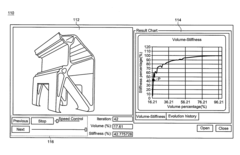
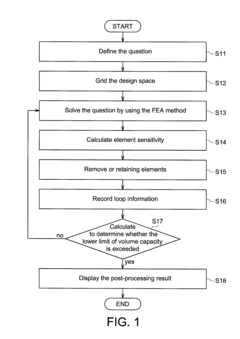
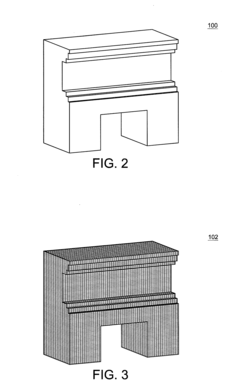
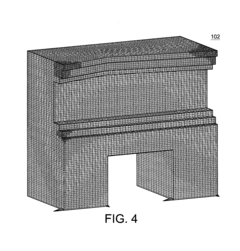
- A modified BESO method that omits the iteration process until the target volume capacity is reached, directly using structural profiles after each loop as optimization results, and utilizes a display interface to show the relationship between volume capacity and stiffness, allowing for easier determination of processing feasibility.
Implementation Costs and ROI Assessment
The implementation of topology optimization technologies requires significant initial investment compared to traditional design approaches. Organizations must consider both direct costs such as software acquisition (ranging from $10,000 to $100,000 for enterprise-level solutions) and hardware upgrades to handle complex computational demands. High-performance computing infrastructure may necessitate investments of $50,000 to $500,000 depending on organizational scale and optimization complexity.
Personnel training represents another substantial cost factor. Engineering teams require specialized training in topology optimization principles and software operation, typically costing $3,000-$8,000 per engineer. Additionally, organizations often need to hire specialists with expertise in this field, commanding premium salaries 20-30% above traditional design engineers.
Integration costs with existing design workflows and manufacturing systems must not be overlooked. Companies typically spend 3-6 months on integration processes, with costs ranging from $30,000 to $150,000 depending on the complexity of existing systems and required customization.
Despite these significant upfront investments, ROI analysis reveals compelling long-term benefits. Material savings typically range from 30-50% compared to traditional designs, translating to substantial cost reductions in high-volume production environments. A case study from the aerospace industry demonstrated that a $200,000 investment in topology optimization capabilities yielded $1.2 million in material savings over three years for a single component family.
Performance improvements generate additional value through enhanced product capabilities. Automotive manufacturers implementing topology optimization have reported 15-25% weight reduction in structural components while maintaining or improving performance characteristics, leading to improved fuel efficiency and customer satisfaction.
The ROI timeline varies by industry and application. Manufacturing sectors typically achieve positive returns within 12-18 months, while industries with longer product development cycles may require 24-36 months to realize full benefits. Organizations implementing staged adoption strategies—beginning with high-value components before expanding to broader applications—often achieve faster returns and more manageable implementation processes.
Risk mitigation strategies should include pilot projects with clearly defined success metrics, phased implementation approaches, and partnerships with experienced consultants to accelerate the learning curve and minimize disruption to existing operations.
Personnel training represents another substantial cost factor. Engineering teams require specialized training in topology optimization principles and software operation, typically costing $3,000-$8,000 per engineer. Additionally, organizations often need to hire specialists with expertise in this field, commanding premium salaries 20-30% above traditional design engineers.
Integration costs with existing design workflows and manufacturing systems must not be overlooked. Companies typically spend 3-6 months on integration processes, with costs ranging from $30,000 to $150,000 depending on the complexity of existing systems and required customization.
Despite these significant upfront investments, ROI analysis reveals compelling long-term benefits. Material savings typically range from 30-50% compared to traditional designs, translating to substantial cost reductions in high-volume production environments. A case study from the aerospace industry demonstrated that a $200,000 investment in topology optimization capabilities yielded $1.2 million in material savings over three years for a single component family.
Performance improvements generate additional value through enhanced product capabilities. Automotive manufacturers implementing topology optimization have reported 15-25% weight reduction in structural components while maintaining or improving performance characteristics, leading to improved fuel efficiency and customer satisfaction.
The ROI timeline varies by industry and application. Manufacturing sectors typically achieve positive returns within 12-18 months, while industries with longer product development cycles may require 24-36 months to realize full benefits. Organizations implementing staged adoption strategies—beginning with high-value components before expanding to broader applications—often achieve faster returns and more manageable implementation processes.
Risk mitigation strategies should include pilot projects with clearly defined success metrics, phased implementation approaches, and partnerships with experienced consultants to accelerate the learning curve and minimize disruption to existing operations.
Sustainability Impact of Optimized Structural Designs
The environmental impact of structural design choices has become increasingly significant in the context of global sustainability challenges. Topology optimized structures demonstrate substantial advantages in resource efficiency compared to traditional designs. Studies indicate that optimized structures can reduce material usage by 30-50% while maintaining equivalent performance characteristics, directly translating to reduced carbon footprints in manufacturing processes.
When examining the complete lifecycle assessment (LCA) of optimized structures, the environmental benefits extend beyond material reduction. The decreased material requirements result in lower energy consumption during raw material extraction and processing phases. Additionally, the transportation environmental impact diminishes proportionally with reduced material mass, contributing to decreased fossil fuel consumption and associated emissions throughout the supply chain.
Manufacturing processes for topology optimized structures often leverage additive manufacturing technologies, which can demonstrate superior sustainability metrics compared to traditional subtractive manufacturing methods. Additive manufacturing typically generates less waste material and can utilize recycled feedstock in many applications, creating a more circular production model. However, the energy intensity of certain additive manufacturing processes remains a consideration requiring careful evaluation in sustainability assessments.
The operational phase of optimized structures presents further sustainability advantages. The weight reduction achieved through topology optimization in transportation applications (aerospace, automotive, railway) directly correlates with improved fuel efficiency and reduced operational emissions over the product lifecycle. Studies in the automotive sector demonstrate that a 10% weight reduction can improve fuel economy by approximately 6-8%, representing significant cumulative environmental benefits.
End-of-life considerations also favor optimized designs in many scenarios. The reduced material diversity often found in topology optimized components can simplify recycling processes. Furthermore, the precise material allocation in optimized structures frequently results in more homogeneous material distribution, potentially improving recyclability rates compared to traditional multi-material assemblies.
Economic sustainability metrics align with environmental benefits, as material reduction translates to cost savings that can offset potentially higher manufacturing expenses. This economic incentive has accelerated industry adoption of topology optimization techniques across sectors including aerospace, automotive, and medical device manufacturing, creating a positive feedback loop for continued sustainability improvements.
The quantifiable sustainability advantages of topology optimized structures position this design approach as an essential strategy for industries seeking to reduce environmental impact while maintaining or improving performance characteristics. As computational capabilities and manufacturing technologies continue to advance, the sustainability gap between optimized and traditional designs is expected to widen further.
When examining the complete lifecycle assessment (LCA) of optimized structures, the environmental benefits extend beyond material reduction. The decreased material requirements result in lower energy consumption during raw material extraction and processing phases. Additionally, the transportation environmental impact diminishes proportionally with reduced material mass, contributing to decreased fossil fuel consumption and associated emissions throughout the supply chain.
Manufacturing processes for topology optimized structures often leverage additive manufacturing technologies, which can demonstrate superior sustainability metrics compared to traditional subtractive manufacturing methods. Additive manufacturing typically generates less waste material and can utilize recycled feedstock in many applications, creating a more circular production model. However, the energy intensity of certain additive manufacturing processes remains a consideration requiring careful evaluation in sustainability assessments.
The operational phase of optimized structures presents further sustainability advantages. The weight reduction achieved through topology optimization in transportation applications (aerospace, automotive, railway) directly correlates with improved fuel efficiency and reduced operational emissions over the product lifecycle. Studies in the automotive sector demonstrate that a 10% weight reduction can improve fuel economy by approximately 6-8%, representing significant cumulative environmental benefits.
End-of-life considerations also favor optimized designs in many scenarios. The reduced material diversity often found in topology optimized components can simplify recycling processes. Furthermore, the precise material allocation in optimized structures frequently results in more homogeneous material distribution, potentially improving recyclability rates compared to traditional multi-material assemblies.
Economic sustainability metrics align with environmental benefits, as material reduction translates to cost savings that can offset potentially higher manufacturing expenses. This economic incentive has accelerated industry adoption of topology optimization techniques across sectors including aerospace, automotive, and medical device manufacturing, creating a positive feedback loop for continued sustainability improvements.
The quantifiable sustainability advantages of topology optimized structures position this design approach as an essential strategy for industries seeking to reduce environmental impact while maintaining or improving performance characteristics. As computational capabilities and manufacturing technologies continue to advance, the sustainability gap between optimized and traditional designs is expected to widen further.
Unlock deeper insights with Patsnap Eureka Quick Research — get a full tech report to explore trends and direct your research. Try now!
Generate Your Research Report Instantly with AI Agent
Supercharge your innovation with Patsnap Eureka AI Agent Platform!