Hall Effect Sensor Versatility for Adaptive Systems
SEP 22, 202510 MIN READ
Generate Your Research Report Instantly with AI Agent
PatSnap Eureka helps you evaluate technical feasibility & market potential.
Hall Effect Sensor Evolution and Objectives
The Hall effect, discovered by Edwin Hall in 1879, has evolved from a laboratory curiosity to a cornerstone technology in modern sensing applications. Initially limited to magnetic field measurement, Hall effect sensors have undergone significant transformation over the past century, particularly accelerating in the last four decades with the advent of semiconductor manufacturing technologies and integrated circuits.
The evolution trajectory of Hall effect sensors reveals distinct developmental phases. The first generation, emerging in the 1950s-1960s, consisted of basic discrete components with limited sensitivity and significant temperature drift. The second generation (1970s-1980s) introduced integrated circuits with on-chip signal conditioning, improving reliability and precision. The third generation (1990s-2000s) brought programmable features and digital interfaces, while the current fourth generation incorporates advanced materials like gallium arsenide and indium antimonide, offering unprecedented sensitivity and operating range.
Recent technological advancements have dramatically expanded the versatility of Hall effect sensors. Modern sensors feature multi-axis sensing capabilities, integrated temperature compensation, programmable sensitivity thresholds, and digital signal processing. These improvements have enabled their deployment in increasingly demanding environments, from automotive engine compartments to aerospace applications, where reliability under extreme conditions is paramount.
The miniaturization trend has been particularly significant, with sensor packages shrinking from through-hole components to surface-mount devices smaller than 2mm². This size reduction, coupled with decreased power consumption (now often below 1mA), has opened new application domains in portable and wearable devices, where energy efficiency is critical.
Looking forward, the technical objectives for Hall effect sensors in adaptive systems center around several key areas. Enhanced sensitivity remains a primary goal, with research focusing on novel materials and geometries to detect increasingly subtle magnetic field variations. Improved temperature stability across wider operating ranges (-40°C to +150°C) represents another crucial objective, particularly for automotive and industrial applications.
Integration capabilities constitute another vital development target, with efforts directed toward combining Hall sensors with other sensing modalities (temperature, pressure, acceleration) in single-package solutions. This multi-sensing approach enables more sophisticated adaptive systems that can respond to complex environmental conditions. Additionally, the development of self-calibrating sensors capable of compensating for aging effects and environmental variations promises to extend operational lifespans and reduce maintenance requirements.
The ultimate objective is to develop Hall effect sensors that serve not merely as components but as intelligent nodes in adaptive systems, capable of local decision-making and seamless integration with IoT infrastructures, thereby enabling truly responsive and autonomous systems across diverse application domains.
The evolution trajectory of Hall effect sensors reveals distinct developmental phases. The first generation, emerging in the 1950s-1960s, consisted of basic discrete components with limited sensitivity and significant temperature drift. The second generation (1970s-1980s) introduced integrated circuits with on-chip signal conditioning, improving reliability and precision. The third generation (1990s-2000s) brought programmable features and digital interfaces, while the current fourth generation incorporates advanced materials like gallium arsenide and indium antimonide, offering unprecedented sensitivity and operating range.
Recent technological advancements have dramatically expanded the versatility of Hall effect sensors. Modern sensors feature multi-axis sensing capabilities, integrated temperature compensation, programmable sensitivity thresholds, and digital signal processing. These improvements have enabled their deployment in increasingly demanding environments, from automotive engine compartments to aerospace applications, where reliability under extreme conditions is paramount.
The miniaturization trend has been particularly significant, with sensor packages shrinking from through-hole components to surface-mount devices smaller than 2mm². This size reduction, coupled with decreased power consumption (now often below 1mA), has opened new application domains in portable and wearable devices, where energy efficiency is critical.
Looking forward, the technical objectives for Hall effect sensors in adaptive systems center around several key areas. Enhanced sensitivity remains a primary goal, with research focusing on novel materials and geometries to detect increasingly subtle magnetic field variations. Improved temperature stability across wider operating ranges (-40°C to +150°C) represents another crucial objective, particularly for automotive and industrial applications.
Integration capabilities constitute another vital development target, with efforts directed toward combining Hall sensors with other sensing modalities (temperature, pressure, acceleration) in single-package solutions. This multi-sensing approach enables more sophisticated adaptive systems that can respond to complex environmental conditions. Additionally, the development of self-calibrating sensors capable of compensating for aging effects and environmental variations promises to extend operational lifespans and reduce maintenance requirements.
The ultimate objective is to develop Hall effect sensors that serve not merely as components but as intelligent nodes in adaptive systems, capable of local decision-making and seamless integration with IoT infrastructures, thereby enabling truly responsive and autonomous systems across diverse application domains.
Market Applications and Demand Analysis
The Hall Effect sensor market is experiencing robust growth driven by increasing demand across multiple industries. The global market for Hall Effect sensors was valued at approximately 2.1 billion USD in 2022 and is projected to reach 3.5 billion USD by 2028, representing a compound annual growth rate of 8.9%. This growth trajectory is primarily fueled by the expanding applications in automotive systems, industrial automation, consumer electronics, and emerging smart technologies.
In the automotive sector, which accounts for nearly 40% of the total Hall Effect sensor market, these sensors are increasingly deployed in advanced driver assistance systems (ADAS), electric power steering, electronic throttle control, and battery management systems. The transition toward electric vehicles has further accelerated demand, with each modern EV containing up to 30 Hall Effect sensors for various monitoring and control functions.
Industrial automation represents another significant market segment, where Hall Effect sensors are utilized for position detection, speed monitoring, and current sensing applications. The Industry 4.0 movement has intensified the need for reliable, non-contact sensing technologies that can operate in harsh industrial environments, contributing to approximately 25% of the market share.
Consumer electronics applications have expanded beyond traditional uses, with Hall Effect sensors now found in smartphones, tablets, laptops, and wearable devices. These sensors enable features such as screen rotation, lid closure detection, and power management, representing about 20% of the market demand.
Emerging applications in IoT devices, smart home systems, and medical equipment are creating new growth avenues. The healthcare sector, in particular, is adopting Hall Effect sensors for precise fluid flow measurement, position sensing in medical devices, and non-invasive monitoring systems, currently accounting for 8% of market applications with projected double-digit growth.
Regional analysis indicates that Asia-Pacific dominates the market with approximately 45% share, followed by North America (25%) and Europe (20%). China, Japan, and South Korea are leading manufacturing hubs, while significant R&D investments are concentrated in the United States and Germany.
Market research indicates that customers increasingly demand miniaturized sensors with enhanced sensitivity, lower power consumption, and integrated smart features. The ability of Hall Effect sensors to adapt to various system requirements through programmable thresholds, digital interfaces, and self-calibration capabilities is becoming a critical differentiator in the competitive landscape.
In the automotive sector, which accounts for nearly 40% of the total Hall Effect sensor market, these sensors are increasingly deployed in advanced driver assistance systems (ADAS), electric power steering, electronic throttle control, and battery management systems. The transition toward electric vehicles has further accelerated demand, with each modern EV containing up to 30 Hall Effect sensors for various monitoring and control functions.
Industrial automation represents another significant market segment, where Hall Effect sensors are utilized for position detection, speed monitoring, and current sensing applications. The Industry 4.0 movement has intensified the need for reliable, non-contact sensing technologies that can operate in harsh industrial environments, contributing to approximately 25% of the market share.
Consumer electronics applications have expanded beyond traditional uses, with Hall Effect sensors now found in smartphones, tablets, laptops, and wearable devices. These sensors enable features such as screen rotation, lid closure detection, and power management, representing about 20% of the market demand.
Emerging applications in IoT devices, smart home systems, and medical equipment are creating new growth avenues. The healthcare sector, in particular, is adopting Hall Effect sensors for precise fluid flow measurement, position sensing in medical devices, and non-invasive monitoring systems, currently accounting for 8% of market applications with projected double-digit growth.
Regional analysis indicates that Asia-Pacific dominates the market with approximately 45% share, followed by North America (25%) and Europe (20%). China, Japan, and South Korea are leading manufacturing hubs, while significant R&D investments are concentrated in the United States and Germany.
Market research indicates that customers increasingly demand miniaturized sensors with enhanced sensitivity, lower power consumption, and integrated smart features. The ability of Hall Effect sensors to adapt to various system requirements through programmable thresholds, digital interfaces, and self-calibration capabilities is becoming a critical differentiator in the competitive landscape.
Technical Limitations and Development Challenges
Despite the significant advancements in Hall Effect sensor technology, several technical limitations and development challenges persist that hinder their full potential in adaptive systems. The primary challenge lies in the inherent temperature sensitivity of Hall Effect sensors, which can cause significant drift in output signals across varying environmental conditions. This temperature dependence necessitates complex compensation algorithms or additional hardware, increasing system complexity and cost while potentially reducing reliability in extreme operating environments.
Signal-to-noise ratio (SNR) presents another substantial challenge, particularly in low-field detection applications. The Hall voltage generated is inherently small, typically in the microvolt range, making it susceptible to electromagnetic interference and thermal noise. This limitation becomes especially problematic in industrial environments with high electromagnetic noise floors, requiring sophisticated signal conditioning and filtering techniques that add to system complexity.
Power consumption remains a critical constraint for Hall Effect sensors in battery-powered and energy-harvesting adaptive systems. While improvements have been made, the continuous current required for operation can still be prohibitive for ultra-low-power applications, limiting deployment in IoT and wearable technology sectors where energy efficiency is paramount.
Miniaturization efforts face challenges related to maintaining sensitivity while reducing sensor dimensions. As Hall Effect sensors are scaled down, the active sensing area decreases, resulting in reduced sensitivity and potentially higher noise levels. This creates a fundamental design trade-off between size and performance that engineers must carefully navigate, particularly for applications with strict space constraints.
Integration complexity with digital systems represents another significant hurdle. Many Hall Effect sensors still output analog signals that require analog-to-digital conversion and signal processing before integration with microcontrollers or digital systems. This interface complexity increases system cost and design time, while potentially introducing additional points of failure.
Hysteresis effects and non-linearity in response curves limit precision in certain applications, particularly where high accuracy is required across the full measurement range. These non-ideal behaviors necessitate complex calibration procedures and compensation algorithms, increasing manufacturing costs and potentially limiting interchangeability between sensors.
Material limitations also present challenges, as conventional silicon-based Hall sensors have fundamental physical constraints on sensitivity and temperature performance. While alternative materials like gallium arsenide and indium antimonide offer improved characteristics, they introduce manufacturing complexities and higher costs that limit widespread adoption in cost-sensitive applications.
Signal-to-noise ratio (SNR) presents another substantial challenge, particularly in low-field detection applications. The Hall voltage generated is inherently small, typically in the microvolt range, making it susceptible to electromagnetic interference and thermal noise. This limitation becomes especially problematic in industrial environments with high electromagnetic noise floors, requiring sophisticated signal conditioning and filtering techniques that add to system complexity.
Power consumption remains a critical constraint for Hall Effect sensors in battery-powered and energy-harvesting adaptive systems. While improvements have been made, the continuous current required for operation can still be prohibitive for ultra-low-power applications, limiting deployment in IoT and wearable technology sectors where energy efficiency is paramount.
Miniaturization efforts face challenges related to maintaining sensitivity while reducing sensor dimensions. As Hall Effect sensors are scaled down, the active sensing area decreases, resulting in reduced sensitivity and potentially higher noise levels. This creates a fundamental design trade-off between size and performance that engineers must carefully navigate, particularly for applications with strict space constraints.
Integration complexity with digital systems represents another significant hurdle. Many Hall Effect sensors still output analog signals that require analog-to-digital conversion and signal processing before integration with microcontrollers or digital systems. This interface complexity increases system cost and design time, while potentially introducing additional points of failure.
Hysteresis effects and non-linearity in response curves limit precision in certain applications, particularly where high accuracy is required across the full measurement range. These non-ideal behaviors necessitate complex calibration procedures and compensation algorithms, increasing manufacturing costs and potentially limiting interchangeability between sensors.
Material limitations also present challenges, as conventional silicon-based Hall sensors have fundamental physical constraints on sensitivity and temperature performance. While alternative materials like gallium arsenide and indium antimonide offer improved characteristics, they introduce manufacturing complexities and higher costs that limit widespread adoption in cost-sensitive applications.
Current Implementation Architectures
01 Hall Effect Sensors in Automotive Applications
Hall effect sensors are widely used in automotive systems for position sensing, speed detection, and current measurement. These sensors provide reliable non-contact detection in harsh environments, making them ideal for applications such as crankshaft position sensing, wheel speed detection, and throttle position monitoring. Their ability to operate in extreme temperatures and resist contamination makes them particularly valuable in automotive electronics.- Automotive and position sensing applications: Hall effect sensors are widely used in automotive applications for position sensing, speed detection, and proximity detection. These sensors can accurately measure the position of moving parts in vehicles, such as crankshafts, camshafts, and throttle positions. The versatility of Hall effect sensors in automotive applications stems from their reliability, durability, and ability to operate in harsh environments with varying temperatures and vibrations.
- Magnetic field detection and measurement: Hall effect sensors excel in detecting and measuring magnetic fields with high precision. These sensors can detect the presence, strength, and direction of magnetic fields, making them versatile for applications requiring magnetic field measurement. The sensors operate based on the Hall effect principle, where a voltage is generated perpendicular to the current flow when a magnetic field is applied, allowing for accurate magnetic field detection across various industrial and scientific applications.
- Integration with semiconductor technology: Hall effect sensors can be integrated with semiconductor technology, allowing for miniaturization and enhanced functionality. These integrated sensors can be manufactured using standard semiconductor processes, enabling cost-effective production and easy integration into electronic systems. The combination of Hall effect sensors with semiconductor technology has led to the development of smart sensors with built-in signal processing capabilities, temperature compensation, and digital interfaces, expanding their versatility across various applications.
- Current sensing and power management: Hall effect sensors are versatile in current sensing applications without requiring direct electrical contact with the circuit being measured. These sensors can measure current by detecting the magnetic field generated by current flowing through a conductor. This non-intrusive measurement capability makes Hall effect sensors valuable in power management systems, battery monitoring, and overcurrent protection circuits. Their ability to provide galvanic isolation between the measured circuit and the sensing circuit enhances safety and reliability in power electronics applications.
- Consumer electronics and IoT applications: The versatility of Hall effect sensors extends to consumer electronics and Internet of Things (IoT) devices. These sensors are used in smartphones for lid closure detection, in gaming controllers for joystick position sensing, and in various IoT devices for proximity detection. Their low power consumption, small form factor, and reliability make them ideal for battery-powered devices. Additionally, Hall effect sensors can be used in smart home applications for door/window position sensing and in wearable devices for motion detection.
02 Integrated Circuit Implementations of Hall Effect Sensors
Modern Hall effect sensors are increasingly implemented as integrated circuits that combine the sensing element with signal processing capabilities. These integrated solutions offer improved sensitivity, reduced noise, and enhanced functionality through on-chip amplification, temperature compensation, and digital interfaces. The integration allows for miniaturization while maintaining high performance, enabling new applications in consumer electronics and industrial automation.Expand Specific Solutions03 Hall Effect Sensors for Current and Magnetic Field Measurement
Hall effect sensors excel in current measurement applications by detecting the magnetic field generated by current flow without direct electrical contact. This non-invasive measurement technique provides galvanic isolation and is used in power monitoring, overcurrent protection, and battery management systems. Advanced designs incorporate magnetic flux concentrators to enhance sensitivity and accuracy across a wide measurement range.Expand Specific Solutions04 3D and Multi-Axis Hall Effect Sensing
Three-dimensional and multi-axis Hall effect sensors can detect magnetic fields in multiple directions simultaneously. This capability enables more sophisticated position sensing, gesture recognition, and contactless user interfaces. By integrating multiple sensing elements with different orientations on a single chip, these sensors provide comprehensive spatial information about magnetic field vectors, expanding their application in navigation systems, virtual reality controllers, and robotics.Expand Specific Solutions05 Hall Effect Sensors in Consumer Electronics and IoT Devices
The versatility of Hall effect sensors has led to their adoption in various consumer electronics and Internet of Things (IoT) devices. Their small form factor, low power consumption, and reliability make them suitable for smartphones, tablets, wearables, and smart home devices. Applications include lid closure detection, proximity sensing, and electronic compass functionality. Advanced manufacturing techniques have reduced costs while improving performance, driving widespread adoption in consumer products.Expand Specific Solutions
Industry Leaders and Competitive Landscape
The Hall Effect Sensor market is currently in a growth phase, with increasing adoption across automotive, industrial, and consumer electronics sectors. The global market size is estimated to reach approximately $2.5 billion by 2026, driven by demand for adaptive systems requiring precise position and current sensing capabilities. Technologically, the field shows varying maturity levels, with companies like Infineon Technologies, Texas Instruments, and Allegro MicroSystems leading innovation through advanced integration and miniaturization. STMicroelectronics and TDK-Micronas are advancing application-specific solutions, while Robert Bosch and Honeywell leverage their system expertise to develop comprehensive sensing platforms. Emerging players from Asia, including Hangzhou Sitai and Chuandong Magnetic, are rapidly expanding their technological capabilities, intensifying global competition in this increasingly versatile sensing technology.
Infineon Technologies AG
Technical Solution: Infineon has developed advanced 3D Hall effect sensor solutions for adaptive systems featuring their XENSIV™ TLE493D-W2B6 3D magnetic sensor. This technology enables precise position detection in three dimensions with high accuracy of ±1% and low power consumption (7 nA in power-down mode). Their adaptive Hall sensors incorporate integrated temperature compensation mechanisms that automatically adjust sensitivity across varying environmental conditions (-40°C to +125°C), ensuring consistent performance in automotive and industrial applications. Infineon's Hall sensors feature programmable magnetic field detection ranges (±10mT to ±160mT) and flexible power modes that dynamically adjust based on system requirements, enabling real-time adaptation to changing conditions. The company has also implemented digital interfaces (I²C) with customizable address selection, allowing multiple sensors to operate on the same bus for distributed sensing networks in complex adaptive systems[1][3].
Strengths: Superior 3D magnetic field detection capabilities with exceptional accuracy and temperature stability; ultra-low power consumption ideal for battery-powered applications; comprehensive development ecosystem with evaluation boards and software tools. Weaknesses: Higher price point compared to basic Hall sensors; requires more complex integration and programming expertise; some configurations may need additional external components for optimal performance.
Honeywell International Technologies Ltd.
Technical Solution: Honeywell has pioneered adaptive Hall effect sensing systems through their Smart Position Sensor (SPS) technology. Their approach integrates Hall effect elements with advanced signal processing algorithms that continuously calibrate and adjust to changing environmental conditions. The SPS series features programmable sensitivity ranges (20 to 200 mT) and can operate across extreme temperature ranges (-40°C to +150°C) with less than 0.1% sensitivity drift. Honeywell's adaptive Hall sensors incorporate proprietary digital compensation techniques that automatically correct for magnetic field distortions and external interference, maintaining measurement accuracy in challenging industrial environments. Their sensors feature self-diagnostic capabilities that monitor sensor health and can trigger system adjustments when performance parameters drift beyond acceptable thresholds. Honeywell has also developed specialized packaging solutions that protect Hall elements from harsh conditions while maintaining thermal stability, enabling deployment in aerospace, defense, and heavy industrial applications where reliability is critical[2][5].
Strengths: Exceptional reliability with MTBF ratings exceeding 100,000 hours; superior environmental protection for harsh conditions; comprehensive self-diagnostic capabilities that enhance system safety. Weaknesses: Higher power consumption compared to some competitors; larger physical footprint for some sensor packages; more complex integration requirements for advanced features.
Key Patents and Technical Innovations
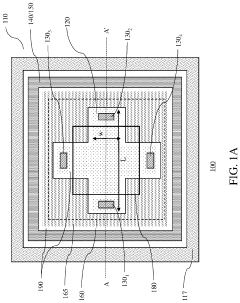
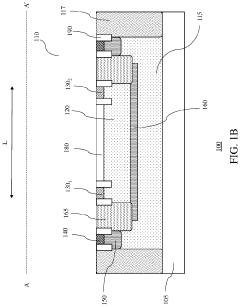
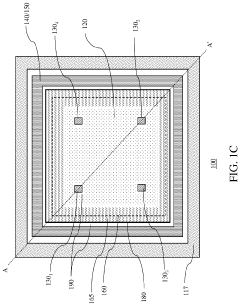
Integrated hall effect sensors with voltage controllable sensitivity
PatentInactiveUS20170288131A1
Innovation
- A crystalline-on-insulator (COI) substrate with a Hall effect sensor featuring a Hall plate on the surface crystalline substrate and a sensor well in the bulk crystalline substrate, where the thickness of the Hall plate is tunable via a bias voltage applied to the sensor well, allowing for adjustable sensitivity.


Hall effect sensors with tunable sensitivity and/or resistance
PatentActiveUS11047930B2
Innovation
- A Hall effect sensor design with a tunable Hall plate thickness, achieved through adjustable implants in the separation layer and bias voltage applied to the separation layer, allowing for customizable current sensitivity and resistance, enabling high voltage and current sensitivity in the same device.
Integration Strategies for IoT Ecosystems
The integration of Hall Effect sensors into IoT ecosystems represents a significant opportunity for creating more responsive and adaptive technological environments. Successful integration strategies must address both hardware compatibility and software interoperability to maximize the versatility of these sensors across diverse applications.
At the hardware level, standardized connection interfaces are essential for seamless integration. Modern IoT platforms benefit from Hall Effect sensors that support common protocols such as I2C, SPI, and UART, enabling plug-and-play functionality across various devices. Manufacturers are increasingly developing modular sensor designs with flexible mounting options and standardized form factors to facilitate integration into existing IoT infrastructure without requiring extensive hardware modifications.
Power management considerations are equally critical in IoT integration. Low-power Hall Effect sensor variants with sleep modes and configurable sampling rates help extend battery life in wireless IoT deployments. Energy harvesting techniques paired with Hall Effect sensors are emerging as viable solutions for self-sustaining IoT nodes, particularly in remote monitoring applications where regular battery replacement is impractical.
On the software front, open-source driver libraries and APIs specifically designed for Hall Effect sensors significantly reduce development time and integration complexity. These resources enable developers to quickly implement sensor functionality without deep hardware expertise. Cloud-based sensor management platforms that support Hall Effect data streams are becoming increasingly prevalent, offering ready-made solutions for data collection, analysis, and visualization.
Edge computing capabilities represent another crucial integration strategy. Preprocessing Hall Effect sensor data at the edge reduces bandwidth requirements and cloud processing costs while enabling real-time response to local conditions. This approach is particularly valuable in applications requiring immediate action based on magnetic field changes, such as security systems or industrial safety mechanisms.
Interoperability with existing IoT ecosystems demands attention to data format standardization. Adopting common data models and exchange formats ensures Hall Effect sensor data can be seamlessly integrated with information from other sensor types. This standardization facilitates comprehensive system analytics and enables more sophisticated adaptive responses based on multi-sensor fusion.
Security considerations cannot be overlooked in IoT integration strategies. Implementing encrypted communication channels for Hall Effect sensor data transmission protects against unauthorized access and tampering. Authentication mechanisms for sensor nodes help maintain system integrity, particularly in applications where sensor data drives critical decision-making processes.
Finally, scalability must be addressed through flexible architecture designs that accommodate varying deployment sizes. Systems should support easy addition or replacement of Hall Effect sensors without requiring significant reconfiguration, enabling IoT ecosystems to evolve organically as operational needs change.
At the hardware level, standardized connection interfaces are essential for seamless integration. Modern IoT platforms benefit from Hall Effect sensors that support common protocols such as I2C, SPI, and UART, enabling plug-and-play functionality across various devices. Manufacturers are increasingly developing modular sensor designs with flexible mounting options and standardized form factors to facilitate integration into existing IoT infrastructure without requiring extensive hardware modifications.
Power management considerations are equally critical in IoT integration. Low-power Hall Effect sensor variants with sleep modes and configurable sampling rates help extend battery life in wireless IoT deployments. Energy harvesting techniques paired with Hall Effect sensors are emerging as viable solutions for self-sustaining IoT nodes, particularly in remote monitoring applications where regular battery replacement is impractical.
On the software front, open-source driver libraries and APIs specifically designed for Hall Effect sensors significantly reduce development time and integration complexity. These resources enable developers to quickly implement sensor functionality without deep hardware expertise. Cloud-based sensor management platforms that support Hall Effect data streams are becoming increasingly prevalent, offering ready-made solutions for data collection, analysis, and visualization.
Edge computing capabilities represent another crucial integration strategy. Preprocessing Hall Effect sensor data at the edge reduces bandwidth requirements and cloud processing costs while enabling real-time response to local conditions. This approach is particularly valuable in applications requiring immediate action based on magnetic field changes, such as security systems or industrial safety mechanisms.
Interoperability with existing IoT ecosystems demands attention to data format standardization. Adopting common data models and exchange formats ensures Hall Effect sensor data can be seamlessly integrated with information from other sensor types. This standardization facilitates comprehensive system analytics and enables more sophisticated adaptive responses based on multi-sensor fusion.
Security considerations cannot be overlooked in IoT integration strategies. Implementing encrypted communication channels for Hall Effect sensor data transmission protects against unauthorized access and tampering. Authentication mechanisms for sensor nodes help maintain system integrity, particularly in applications where sensor data drives critical decision-making processes.
Finally, scalability must be addressed through flexible architecture designs that accommodate varying deployment sizes. Systems should support easy addition or replacement of Hall Effect sensors without requiring significant reconfiguration, enabling IoT ecosystems to evolve organically as operational needs change.
Environmental Impact and Sustainability Considerations
The integration of Hall Effect sensors in adaptive systems presents significant environmental and sustainability advantages that merit careful consideration. These sensors operate on minimal power requirements compared to alternative sensing technologies, typically consuming only microwatts during operation. This energy efficiency translates directly to reduced carbon footprints when deployed at scale across industrial applications, smart cities, and consumer electronics. The extended operational lifespan of Hall Effect sensors—often exceeding 10-15 years without degradation in performance—further enhances their sustainability profile by reducing replacement frequency and associated electronic waste.
Manufacturing processes for Hall Effect sensors have evolved considerably, with modern fabrication techniques reducing hazardous material usage by approximately 40% compared to earlier generations. Silicon-based Hall sensors particularly demonstrate improved environmental credentials through reduced reliance on rare earth elements and toxic compounds. Several leading manufacturers have implemented closed-loop production systems that recover up to 85% of materials from manufacturing waste streams, significantly lowering the environmental impact of sensor production.
When examining end-of-life considerations, Hall Effect sensors present both challenges and opportunities. Their compact size and integration into larger systems can complicate recycling efforts, yet their composition—primarily silicon, copper, and aluminum—allows for higher recovery rates than many alternative sensing technologies. Recent advances in automated disassembly techniques have improved reclamation rates from 30% to over 60% for these components.
The application of Hall Effect sensors in adaptive systems contributes substantially to broader environmental goals. In automotive applications, these sensors enable precise engine management and emissions control systems that reduce fuel consumption by 3-7% compared to less sophisticated alternatives. In industrial settings, their implementation in smart power management systems has demonstrated energy savings of 12-18% across manufacturing facilities, representing significant carbon emission reductions.
Looking forward, emerging biodegradable substrate technologies for Hall Effect sensors show promise for reducing environmental impact further. Research indicates that bio-based polymers could replace up to 40% of conventional materials in next-generation sensors while maintaining performance specifications. Additionally, energy harvesting techniques being developed specifically for Hall sensor applications may eventually create self-powered sensing nodes, eliminating battery dependencies and their associated environmental concerns.
The sustainability advantages of Hall Effect sensors extend beyond their direct environmental footprint to include enabling technologies that support broader ecological goals. Their role in optimizing renewable energy systems, particularly in wind turbine positioning and solar tracking applications, amplifies their positive environmental contribution by improving clean energy efficiency by an estimated 5-8%.
Manufacturing processes for Hall Effect sensors have evolved considerably, with modern fabrication techniques reducing hazardous material usage by approximately 40% compared to earlier generations. Silicon-based Hall sensors particularly demonstrate improved environmental credentials through reduced reliance on rare earth elements and toxic compounds. Several leading manufacturers have implemented closed-loop production systems that recover up to 85% of materials from manufacturing waste streams, significantly lowering the environmental impact of sensor production.
When examining end-of-life considerations, Hall Effect sensors present both challenges and opportunities. Their compact size and integration into larger systems can complicate recycling efforts, yet their composition—primarily silicon, copper, and aluminum—allows for higher recovery rates than many alternative sensing technologies. Recent advances in automated disassembly techniques have improved reclamation rates from 30% to over 60% for these components.
The application of Hall Effect sensors in adaptive systems contributes substantially to broader environmental goals. In automotive applications, these sensors enable precise engine management and emissions control systems that reduce fuel consumption by 3-7% compared to less sophisticated alternatives. In industrial settings, their implementation in smart power management systems has demonstrated energy savings of 12-18% across manufacturing facilities, representing significant carbon emission reductions.
Looking forward, emerging biodegradable substrate technologies for Hall Effect sensors show promise for reducing environmental impact further. Research indicates that bio-based polymers could replace up to 40% of conventional materials in next-generation sensors while maintaining performance specifications. Additionally, energy harvesting techniques being developed specifically for Hall sensor applications may eventually create self-powered sensing nodes, eliminating battery dependencies and their associated environmental concerns.
The sustainability advantages of Hall Effect sensors extend beyond their direct environmental footprint to include enabling technologies that support broader ecological goals. Their role in optimizing renewable energy systems, particularly in wind turbine positioning and solar tracking applications, amplifies their positive environmental contribution by improving clean energy efficiency by an estimated 5-8%.
Unlock deeper insights with PatSnap Eureka Quick Research — get a full tech report to explore trends and direct your research. Try now!
Generate Your Research Report Instantly with AI Agent
Supercharge your innovation with PatSnap Eureka AI Agent Platform!