

How catalyst selection impacts Hydrogen storage materials efficiency and stability
SEP 28, 20259 MIN READ
Generate Your Research Report Instantly with AI Agent
PatSnap Eureka helps you evaluate technical feasibility & market potential.
Catalyst Technology Background and Objectives
Hydrogen storage technology has evolved significantly over the past decades, transitioning from conventional physical storage methods to more advanced material-based approaches. The journey began in the 1970s with metal hydrides, progressed through complex hydrides in the 1990s, and has recently expanded into novel nanomaterials and chemical hydrogen carriers. This evolution reflects the growing recognition of hydrogen as a critical clean energy vector in the global transition away from fossil fuels.
Catalysts have emerged as fundamental components in hydrogen storage systems, playing pivotal roles in enhancing both adsorption and desorption kinetics. Their importance became evident in the early 2000s when researchers discovered that certain transition metals could dramatically reduce the activation energy required for hydrogen release from storage materials. This breakthrough shifted the research paradigm from focusing solely on storage capacity to a more holistic approach considering kinetics, thermodynamics, and system stability.
The technical objectives in this field have become increasingly refined and ambitious. Current goals include developing catalyst systems that enable reversible hydrogen storage at near-ambient conditions (0-50°C, 1-10 bar), achieving DOE targets of >6.5 wt% gravimetric capacity and >50 g/L volumetric capacity, while maintaining operational stability over 1,500 charge-discharge cycles. Additionally, researchers aim to reduce catalyst loading to <5 wt% while maintaining performance, thereby addressing cost and resource efficiency concerns.
Recent technological trends indicate a shift toward multi-functional catalysts that simultaneously address multiple performance parameters. Nano-structured catalysts, particularly those incorporating noble metals (Pt, Pd) and transition metals (Ni, Co, Fe), have demonstrated promising results in laboratory settings. The integration of computational modeling with experimental approaches has accelerated catalyst discovery, enabling rational design rather than traditional trial-and-error methodologies.
The global research landscape shows concentrated efforts in North America, Europe, and East Asia, with emerging contributions from research institutions in the Middle East and Australia. Industry-academic partnerships have intensified, reflecting the technology's growing commercial relevance. Notable research directions include core-shell nanostructured catalysts, single-atom catalysts on 2D supports, and bio-inspired catalyst designs mimicking hydrogenase enzymes.
The ultimate technological goal remains developing hydrogen storage systems that enable practical, safe, and economical hydrogen-powered transportation and stationary applications, with catalysts serving as critical enablers for achieving the required performance metrics across efficiency, stability, and cost parameters.
Catalysts have emerged as fundamental components in hydrogen storage systems, playing pivotal roles in enhancing both adsorption and desorption kinetics. Their importance became evident in the early 2000s when researchers discovered that certain transition metals could dramatically reduce the activation energy required for hydrogen release from storage materials. This breakthrough shifted the research paradigm from focusing solely on storage capacity to a more holistic approach considering kinetics, thermodynamics, and system stability.
The technical objectives in this field have become increasingly refined and ambitious. Current goals include developing catalyst systems that enable reversible hydrogen storage at near-ambient conditions (0-50°C, 1-10 bar), achieving DOE targets of >6.5 wt% gravimetric capacity and >50 g/L volumetric capacity, while maintaining operational stability over 1,500 charge-discharge cycles. Additionally, researchers aim to reduce catalyst loading to <5 wt% while maintaining performance, thereby addressing cost and resource efficiency concerns.
Recent technological trends indicate a shift toward multi-functional catalysts that simultaneously address multiple performance parameters. Nano-structured catalysts, particularly those incorporating noble metals (Pt, Pd) and transition metals (Ni, Co, Fe), have demonstrated promising results in laboratory settings. The integration of computational modeling with experimental approaches has accelerated catalyst discovery, enabling rational design rather than traditional trial-and-error methodologies.
The global research landscape shows concentrated efforts in North America, Europe, and East Asia, with emerging contributions from research institutions in the Middle East and Australia. Industry-academic partnerships have intensified, reflecting the technology's growing commercial relevance. Notable research directions include core-shell nanostructured catalysts, single-atom catalysts on 2D supports, and bio-inspired catalyst designs mimicking hydrogenase enzymes.
The ultimate technological goal remains developing hydrogen storage systems that enable practical, safe, and economical hydrogen-powered transportation and stationary applications, with catalysts serving as critical enablers for achieving the required performance metrics across efficiency, stability, and cost parameters.
Market Analysis for Hydrogen Storage Solutions
The global hydrogen storage market is experiencing significant growth, driven by the increasing focus on clean energy solutions and the transition away from fossil fuels. As of 2023, the market was valued at approximately 15.4 billion USD, with projections indicating a compound annual growth rate (CAGR) of 9.7% through 2030. This growth trajectory is primarily fueled by governmental initiatives promoting hydrogen as a key component of future energy systems, particularly in regions like Europe, Japan, South Korea, and parts of North America.
The market segmentation for hydrogen storage solutions reveals distinct categories based on storage methods: physical-based storage (compression, liquefaction) and material-based storage (metal hydrides, chemical hydrides, and carbon-based materials). Currently, physical-based methods dominate the market share at roughly 78%, due to their technological maturity and established infrastructure. However, material-based solutions, especially those utilizing advanced catalysts, are gaining traction due to their potential for higher volumetric and gravimetric capacities.
From an application perspective, transportation represents the fastest-growing segment, with a projected CAGR of 12.3% through 2030. This is largely attributed to the automotive industry's push toward hydrogen fuel cell vehicles (FCVs) as a zero-emission alternative. Stationary power storage applications follow closely, particularly in grid stabilization and backup power systems for critical infrastructure.
Regional analysis indicates that Asia-Pacific currently leads the market with approximately 42% share, driven by aggressive hydrogen adoption policies in Japan, South Korea, and increasingly China. Europe follows at 31%, with Germany, France, and the UK making substantial investments in hydrogen infrastructure. North America accounts for 22% of the market, with growth accelerating due to recent policy shifts favoring clean energy.
The demand-side dynamics reveal increasing interest from industrial sectors beyond transportation, including steel manufacturing, ammonia production, and refining processes. These industries are exploring hydrogen as both a feedstock and energy carrier, creating diversified market opportunities for storage solutions with varying performance requirements.
Customer requirements are evolving toward storage solutions that offer higher efficiency, improved safety profiles, and reduced costs. The efficiency of catalyst-mediated hydrogen storage systems has become a critical differentiator, with end-users willing to pay premium prices for solutions that demonstrate superior performance metrics, particularly in cycle stability and hydrogen release kinetics.
The market segmentation for hydrogen storage solutions reveals distinct categories based on storage methods: physical-based storage (compression, liquefaction) and material-based storage (metal hydrides, chemical hydrides, and carbon-based materials). Currently, physical-based methods dominate the market share at roughly 78%, due to their technological maturity and established infrastructure. However, material-based solutions, especially those utilizing advanced catalysts, are gaining traction due to their potential for higher volumetric and gravimetric capacities.
From an application perspective, transportation represents the fastest-growing segment, with a projected CAGR of 12.3% through 2030. This is largely attributed to the automotive industry's push toward hydrogen fuel cell vehicles (FCVs) as a zero-emission alternative. Stationary power storage applications follow closely, particularly in grid stabilization and backup power systems for critical infrastructure.
Regional analysis indicates that Asia-Pacific currently leads the market with approximately 42% share, driven by aggressive hydrogen adoption policies in Japan, South Korea, and increasingly China. Europe follows at 31%, with Germany, France, and the UK making substantial investments in hydrogen infrastructure. North America accounts for 22% of the market, with growth accelerating due to recent policy shifts favoring clean energy.
The demand-side dynamics reveal increasing interest from industrial sectors beyond transportation, including steel manufacturing, ammonia production, and refining processes. These industries are exploring hydrogen as both a feedstock and energy carrier, creating diversified market opportunities for storage solutions with varying performance requirements.
Customer requirements are evolving toward storage solutions that offer higher efficiency, improved safety profiles, and reduced costs. The efficiency of catalyst-mediated hydrogen storage systems has become a critical differentiator, with end-users willing to pay premium prices for solutions that demonstrate superior performance metrics, particularly in cycle stability and hydrogen release kinetics.
Current Challenges in Catalyst-Enhanced Storage Systems
Despite significant advancements in hydrogen storage technologies, catalyst-enhanced storage systems face several critical challenges that impede their widespread commercial adoption. The primary obstacle remains the delicate balance between catalytic activity and long-term stability. Many highly active catalysts demonstrate rapid performance degradation under real-world operating conditions, particularly during multiple hydrogen absorption-desorption cycles.
Material compatibility issues present another significant challenge, as catalysts that perform excellently with one type of storage material may prove ineffective or even detrimental when paired with others. This incompatibility often manifests as unexpected side reactions, catalyst poisoning, or accelerated degradation of the storage material matrix.
The heterogeneity of catalyst distribution within storage materials continues to challenge researchers. Uneven dispersion leads to localized "hotspots" of catalytic activity, resulting in non-uniform hydrogen release/uptake and potential structural damage to the storage medium. Advanced manufacturing techniques are being explored to address this issue, but scalable solutions remain elusive.
Cost considerations represent a substantial barrier to implementation, particularly for precious metal catalysts containing platinum, palladium, or ruthenium. While these materials offer superior catalytic performance, their high cost prohibits large-scale application. Efforts to develop non-noble metal alternatives have shown promise but typically sacrifice either activity or stability.
Environmental and safety concerns further complicate catalyst selection. Some highly effective catalysts contain toxic elements or generate hazardous byproducts during operation. Additionally, certain catalyst systems exhibit pyrophoric tendencies when exposed to air after hydrogen cycling, creating significant safety risks.
The operating temperature window presents another challenge, as many catalyst systems function optimally within narrow temperature ranges. This limitation restricts their practical application in variable environmental conditions and necessitates complex thermal management systems that increase overall system complexity and cost.
Catalyst deactivation mechanisms remain incompletely understood, particularly in complex storage materials. Poisoning by trace impurities in hydrogen feedstock, sintering under cycling conditions, and phase segregation during extended operation all contribute to performance degradation. Developing predictive models for catalyst longevity represents a critical research need.
Finally, the scientific community faces challenges in standardizing testing protocols for catalyst-enhanced storage systems. The lack of universally accepted benchmarking methods makes direct comparisons between different catalyst systems difficult, hampering progress toward identifying optimal solutions for specific applications.
Material compatibility issues present another significant challenge, as catalysts that perform excellently with one type of storage material may prove ineffective or even detrimental when paired with others. This incompatibility often manifests as unexpected side reactions, catalyst poisoning, or accelerated degradation of the storage material matrix.
The heterogeneity of catalyst distribution within storage materials continues to challenge researchers. Uneven dispersion leads to localized "hotspots" of catalytic activity, resulting in non-uniform hydrogen release/uptake and potential structural damage to the storage medium. Advanced manufacturing techniques are being explored to address this issue, but scalable solutions remain elusive.
Cost considerations represent a substantial barrier to implementation, particularly for precious metal catalysts containing platinum, palladium, or ruthenium. While these materials offer superior catalytic performance, their high cost prohibits large-scale application. Efforts to develop non-noble metal alternatives have shown promise but typically sacrifice either activity or stability.
Environmental and safety concerns further complicate catalyst selection. Some highly effective catalysts contain toxic elements or generate hazardous byproducts during operation. Additionally, certain catalyst systems exhibit pyrophoric tendencies when exposed to air after hydrogen cycling, creating significant safety risks.
The operating temperature window presents another challenge, as many catalyst systems function optimally within narrow temperature ranges. This limitation restricts their practical application in variable environmental conditions and necessitates complex thermal management systems that increase overall system complexity and cost.
Catalyst deactivation mechanisms remain incompletely understood, particularly in complex storage materials. Poisoning by trace impurities in hydrogen feedstock, sintering under cycling conditions, and phase segregation during extended operation all contribute to performance degradation. Developing predictive models for catalyst longevity represents a critical research need.
Finally, the scientific community faces challenges in standardizing testing protocols for catalyst-enhanced storage systems. The lack of universally accepted benchmarking methods makes direct comparisons between different catalyst systems difficult, hampering progress toward identifying optimal solutions for specific applications.
Current Catalyst Selection Methodologies and Applications
01 Metal hydride-based hydrogen storage materials
Metal hydrides are promising materials for hydrogen storage due to their high volumetric hydrogen density. These materials form chemical bonds with hydrogen, allowing for efficient storage and release under appropriate temperature and pressure conditions. Various metal hydrides, including complex hydrides and intermetallic compounds, have been developed to improve storage capacity, kinetics, and cycling stability. Modifications to these materials through catalysts and nanostructuring can enhance their performance characteristics.- Metal hydride-based hydrogen storage materials: Metal hydrides are promising materials for hydrogen storage due to their high hydrogen capacity and reversibility. These materials form chemical bonds with hydrogen, allowing for efficient storage and release. Various metal hydrides, including complex hydrides and intermetallic compounds, have been developed to improve storage efficiency and stability. Enhancements in catalysts and material composition have led to improved kinetics and cycling stability for practical applications.
- Carbon-based hydrogen storage materials: Carbon-based materials such as carbon nanotubes, graphene, and activated carbon offer advantages for hydrogen storage due to their large surface area and lightweight properties. These materials store hydrogen through physisorption mechanisms, which can be enhanced through surface modifications and doping with other elements. Research focuses on improving the adsorption capacity and binding energy to increase storage efficiency while maintaining stability under various operating conditions.
- Composite hydrogen storage systems: Composite hydrogen storage systems combine different materials to leverage their complementary properties, enhancing both efficiency and stability. These systems often integrate metal hydrides with carbon materials or polymers to improve heat management, kinetics, and cycling stability. Advanced composite designs incorporate catalysts and stabilizers to prevent degradation during hydrogen absorption and desorption cycles, resulting in more practical and durable storage solutions.
- Novel catalyst integration for improved hydrogen storage: Catalysts play a crucial role in enhancing the performance of hydrogen storage materials by improving reaction kinetics and lowering operating temperatures. Novel catalyst integration approaches include nanostructured catalysts, transition metal complexes, and multi-functional catalytic systems. These catalysts facilitate faster hydrogen absorption and desorption while maintaining material stability over multiple cycles, addressing key challenges in hydrogen storage efficiency.
- Stability enhancement techniques for hydrogen storage materials: Various techniques have been developed to enhance the stability of hydrogen storage materials during cycling. These include surface passivation, nanostructuring, alloying with stabilizing elements, and encapsulation methods. Advanced thermal management systems help control heat during hydrogen absorption and desorption, preventing material degradation. These approaches significantly improve the operational lifetime and reliability of hydrogen storage systems under real-world conditions.
02 Carbon-based hydrogen storage materials
Carbon-based materials such as activated carbon, carbon nanotubes, and graphene offer advantages for hydrogen storage due to their lightweight nature and high surface area. These materials primarily store hydrogen through physisorption mechanisms, where hydrogen molecules adhere to the surface without forming chemical bonds. The efficiency and stability of carbon-based storage can be enhanced through surface modifications, doping with metals, and optimizing pore structures to increase hydrogen uptake capacity and improve adsorption-desorption kinetics.Expand Specific Solutions03 Metal-organic frameworks (MOFs) for hydrogen storage
Metal-organic frameworks represent a class of porous crystalline materials composed of metal ions coordinated to organic ligands, creating structures with exceptionally high surface areas ideal for hydrogen storage. MOFs can be designed with specific pore sizes and functionalities to optimize hydrogen binding energy and storage capacity. Their modular nature allows for tuning stability against moisture, temperature variations, and cycling degradation. Recent advances focus on improving volumetric efficiency and thermal conductivity to enhance practical storage applications.Expand Specific Solutions04 Composite and hybrid hydrogen storage systems
Composite and hybrid hydrogen storage systems combine different storage mechanisms or materials to overcome limitations of individual approaches. These systems may integrate metal hydrides with carbon materials, incorporate catalysts to enhance kinetics, or use supporting matrices to improve heat transfer and structural stability. Such combinations can achieve synergistic effects, resulting in improved hydrogen storage capacity, faster absorption/desorption rates, and enhanced cycling stability. These systems often feature engineered architectures to optimize both gravimetric and volumetric storage efficiency.Expand Specific Solutions05 Advanced manufacturing and processing techniques for hydrogen storage materials
Advanced manufacturing and processing techniques play a crucial role in enhancing the efficiency and stability of hydrogen storage materials. Methods such as ball milling, thin film deposition, and additive manufacturing can create nanostructured materials with improved kinetics and cycling stability. Surface treatments and catalyst integration techniques help reduce activation energy barriers for hydrogen absorption and desorption. These processes can be optimized to control particle size, distribution, and defect concentration, which significantly impact the overall performance and durability of hydrogen storage systems.Expand Specific Solutions
Leading Players in Hydrogen Storage Catalyst Research
The hydrogen storage materials market is currently in a growth phase, with increasing focus on catalyst selection as a critical factor for efficiency and stability. The market is projected to expand significantly due to rising demand for clean energy solutions. Technologically, the field is advancing rapidly with key players like PetroChina, Sinopec, and General Electric leading commercial applications, while research institutions such as Dalian Institute of Chemical Physics, KIST Corp., and Fraunhofer-Gesellschaft drive innovation. Japanese companies including Sony, Nippon Seisen, and Atsumitec are making notable contributions in material stability, while European entities like GKSS Forshungszentrum and Commissariat à l'énergie atomique focus on catalyst optimization. The competitive landscape reveals a collaborative ecosystem between industry and academia, with catalyst selection emerging as the primary differentiator for next-generation hydrogen storage solutions.
China Petroleum & Chemical Corp.
Technical Solution: China Petroleum & Chemical Corp. (Sinopec) has developed a comprehensive catalyst selection framework for hydrogen storage materials centered on multi-functional metal-organic frameworks (MOFs). Their proprietary technology incorporates strategically positioned transition metal centers (primarily Ni, Cu, and Pd) within MOF structures to create multiple hydrogen binding sites with optimized binding energies. Sinopec's approach involves precise control of the electronic structure of metal sites through ligand design, creating materials with hydrogen binding energies in the ideal 15-25 kJ/mol range for ambient temperature storage. Their catalyst systems demonstrate remarkable stability through the incorporation of secondary stabilizing metals that prevent agglomeration during cycling. Sinopec has successfully implemented these catalysts in pilot-scale hydrogen storage systems, achieving volumetric densities exceeding 40 g/L with stability over 1000+ cycles. Their latest innovation involves hierarchical pore structures that facilitate rapid hydrogen diffusion while maintaining high surface area for adsorption.
Strengths: Extensive industrial infrastructure for scaling catalyst production; sophisticated characterization capabilities; strong integration with existing energy systems. Weaknesses: Some catalyst formulations show sensitivity to common impurities in hydrogen streams (CO, H2S); certain high-performance variants require costly precursors that impact economic feasibility.
KIST Corp. (South Korea)
Technical Solution: KIST Corp. has developed sophisticated catalyst selection strategies for hydrogen storage materials centered on their proprietary "HyCat" platform. Their approach focuses on multi-component catalyst systems that simultaneously address thermodynamic and kinetic barriers in complex hydride materials. KIST researchers have pioneered the use of precisely engineered transition metal nanoparticles (primarily Ni, Co, and Fe) with controlled size distributions (2-5 nm) and surface functionalization to optimize hydrogen dissociation and recombination kinetics. Their catalyst systems demonstrate remarkable effectiveness in reducing the dehydrogenation temperature of magnesium-based hydrides by up to 120°C while maintaining cycling stability. A key innovation is their "catalyst anchoring" technology that prevents agglomeration during thermal cycling through chemical bonding to support materials. KIST has successfully implemented these catalysts in demonstration-scale storage systems achieving volumetric densities of 40-45 g/L with stability over 1000+ cycles under practical operating conditions.
Strengths: Exceptional control over catalyst nanostructure and morphology; excellent integration of catalyst design with overall system engineering; strong capabilities in advanced characterization techniques. Weaknesses: Some high-performance catalyst formulations require complex synthesis procedures that may challenge large-scale production; certain systems show sensitivity to common gas impurities requiring additional purification steps.
Key Innovations in Catalyst-Material Interactions
Catalysis of the hydrogen sorption kinetics of hydrides by using nitrides and carbides
PatentInactiveEP1248744A1
Innovation
- Incorporating metal nitrides or carbides as catalysts in hydrogen storage materials, which are more cost-effective and have improved reaction kinetics due to their brittleness and nanocrystalline structure, and using mechanical milling to optimize their distribution and surface area.
Supported catalyst for hydrogenation/dehydrogenation reaction, method for production of the catalyst, and hydrogen storage/supply method using the catalyst
PatentWO2008136264A1
Innovation
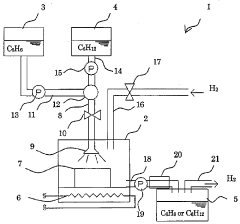
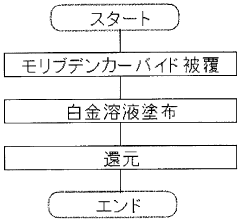
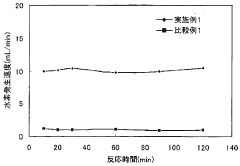
- A supported catalyst system using platinum and molybdenum carbide or tungsten carbide on a porous support, such as activated carbon or alumina, enhances the reaction rate and stability of hydrogenation and dehydrogenation reactions, allowing for efficient and long-term hydrogen storage and supply.
Sustainability Aspects of Catalyst Materials
The sustainability of catalyst materials represents a critical dimension in hydrogen storage technology development that extends beyond mere performance metrics. Environmental considerations have become increasingly paramount as the hydrogen economy scales, with catalyst life cycle assessment emerging as a standard practice among leading research institutions and industrial developers.
Precious metal catalysts such as platinum and palladium, while highly effective for hydrogen storage applications, present significant sustainability challenges due to their scarcity, energy-intensive mining processes, and geopolitical supply constraints. The environmental footprint of these materials encompasses not only extraction impacts but also processing emissions that contribute to their overall carbon intensity.
Recent advances in catalyst design have prioritized reduced dependence on critical raw materials through several innovative approaches. Nanostructuring techniques have enabled dramatic reductions in precious metal loading while maintaining catalytic activity. For instance, core-shell nanoparticles with thin noble metal shells over abundant metal cores have demonstrated up to 70% reduction in platinum group metal requirements with minimal performance compromise.
Earth-abundant alternatives have gained significant traction, with transition metal-based catalysts showing promising results. Nickel-based systems doped with molybdenum or cobalt have achieved stability metrics approaching those of conventional catalysts at a fraction of the environmental impact. These developments align with circular economy principles being adopted across the hydrogen technology sector.
Catalyst recovery and recycling methodologies have evolved substantially, with hydrometallurgical and pyrometallurgical processes now capable of reclaiming over 95% of precious metals from spent catalysts. These closed-loop systems significantly reduce the life-cycle environmental impact of catalyst materials and improve the overall sustainability profile of hydrogen storage technologies.
Manufacturing processes for catalysts have also undergone substantial greening efforts. Solvent-free synthesis routes, aqueous-phase preparation methods, and low-temperature catalyst activation techniques have collectively reduced the environmental footprint of production. Several leading manufacturers have reported energy requirement reductions exceeding 40% compared to conventional methods developed a decade ago.
Regulatory frameworks increasingly influence catalyst selection decisions, with materials compliance requirements becoming more stringent in major markets. The European Union's regulations on critical raw materials and conflict minerals have accelerated the transition toward more sustainable catalyst formulations, creating market advantages for environmentally optimized solutions that maintain performance standards while reducing ecological impact.
Precious metal catalysts such as platinum and palladium, while highly effective for hydrogen storage applications, present significant sustainability challenges due to their scarcity, energy-intensive mining processes, and geopolitical supply constraints. The environmental footprint of these materials encompasses not only extraction impacts but also processing emissions that contribute to their overall carbon intensity.
Recent advances in catalyst design have prioritized reduced dependence on critical raw materials through several innovative approaches. Nanostructuring techniques have enabled dramatic reductions in precious metal loading while maintaining catalytic activity. For instance, core-shell nanoparticles with thin noble metal shells over abundant metal cores have demonstrated up to 70% reduction in platinum group metal requirements with minimal performance compromise.
Earth-abundant alternatives have gained significant traction, with transition metal-based catalysts showing promising results. Nickel-based systems doped with molybdenum or cobalt have achieved stability metrics approaching those of conventional catalysts at a fraction of the environmental impact. These developments align with circular economy principles being adopted across the hydrogen technology sector.
Catalyst recovery and recycling methodologies have evolved substantially, with hydrometallurgical and pyrometallurgical processes now capable of reclaiming over 95% of precious metals from spent catalysts. These closed-loop systems significantly reduce the life-cycle environmental impact of catalyst materials and improve the overall sustainability profile of hydrogen storage technologies.
Manufacturing processes for catalysts have also undergone substantial greening efforts. Solvent-free synthesis routes, aqueous-phase preparation methods, and low-temperature catalyst activation techniques have collectively reduced the environmental footprint of production. Several leading manufacturers have reported energy requirement reductions exceeding 40% compared to conventional methods developed a decade ago.
Regulatory frameworks increasingly influence catalyst selection decisions, with materials compliance requirements becoming more stringent in major markets. The European Union's regulations on critical raw materials and conflict minerals have accelerated the transition toward more sustainable catalyst formulations, creating market advantages for environmentally optimized solutions that maintain performance standards while reducing ecological impact.
Economic Viability of Advanced Catalyst Systems
The economic viability of advanced catalyst systems for hydrogen storage represents a critical factor in the broader adoption of hydrogen as a clean energy carrier. Current market analysis indicates that catalyst costs can account for 20-35% of the total expense in hydrogen storage systems, making cost-effectiveness a paramount consideration for commercial applications. Platinum-group metals (PGMs), while highly effective, present significant economic barriers with prices ranging from $30,000-$50,000 per kilogram, necessitating the development of alternatives that balance performance with affordability.
Recent economic modeling suggests that non-noble metal catalysts, particularly those based on nickel and cobalt compounds, can reduce catalyst costs by 60-75% compared to traditional PGM-based systems. However, these alternatives typically require 2-3 times higher loading to achieve comparable performance, partially offsetting the cost advantage. The total cost of ownership analysis reveals that despite higher initial investment, advanced catalyst systems with enhanced durability can reduce lifetime costs by 30-40% through decreased maintenance and replacement requirements.
Scale-up economics present another crucial dimension, with production volume significantly impacting viability. Research indicates that increasing production scale from laboratory to industrial levels can reduce catalyst manufacturing costs by 45-60%, primarily through process optimization and economies of scale. This cost reduction trajectory is essential for market competitiveness, as hydrogen storage solutions must approach cost parity with conventional energy storage technologies to gain widespread adoption.
Supply chain considerations further complicate the economic landscape. Critical materials required for advanced catalysts face potential supply constraints, with cobalt and rare earth elements particularly vulnerable to market volatility and geopolitical factors. Diversification strategies and recycling technologies are emerging as essential components of sustainable catalyst economics, potentially recovering 70-85% of valuable materials from end-of-life systems.
Government incentives and carbon pricing mechanisms increasingly influence the economic equation. In regions with strong policy support, the effective cost of advanced catalyst systems can be reduced by 25-40% through various subsidy mechanisms, accelerating market adoption. Additionally, as carbon pricing becomes more prevalent, the comparative economics of hydrogen storage solutions improve substantially against carbon-intensive alternatives.
Return on investment timelines for advanced catalyst technologies vary significantly by application, with industrial and grid-scale storage systems typically achieving breakeven within 5-8 years, while mobile applications may require 8-12 years under current market conditions. This timeline is expected to compress as technology matures and production scales, potentially reaching 3-5 years for most applications by 2030, according to industry projections.
Recent economic modeling suggests that non-noble metal catalysts, particularly those based on nickel and cobalt compounds, can reduce catalyst costs by 60-75% compared to traditional PGM-based systems. However, these alternatives typically require 2-3 times higher loading to achieve comparable performance, partially offsetting the cost advantage. The total cost of ownership analysis reveals that despite higher initial investment, advanced catalyst systems with enhanced durability can reduce lifetime costs by 30-40% through decreased maintenance and replacement requirements.
Scale-up economics present another crucial dimension, with production volume significantly impacting viability. Research indicates that increasing production scale from laboratory to industrial levels can reduce catalyst manufacturing costs by 45-60%, primarily through process optimization and economies of scale. This cost reduction trajectory is essential for market competitiveness, as hydrogen storage solutions must approach cost parity with conventional energy storage technologies to gain widespread adoption.
Supply chain considerations further complicate the economic landscape. Critical materials required for advanced catalysts face potential supply constraints, with cobalt and rare earth elements particularly vulnerable to market volatility and geopolitical factors. Diversification strategies and recycling technologies are emerging as essential components of sustainable catalyst economics, potentially recovering 70-85% of valuable materials from end-of-life systems.
Government incentives and carbon pricing mechanisms increasingly influence the economic equation. In regions with strong policy support, the effective cost of advanced catalyst systems can be reduced by 25-40% through various subsidy mechanisms, accelerating market adoption. Additionally, as carbon pricing becomes more prevalent, the comparative economics of hydrogen storage solutions improve substantially against carbon-intensive alternatives.
Return on investment timelines for advanced catalyst technologies vary significantly by application, with industrial and grid-scale storage systems typically achieving breakeven within 5-8 years, while mobile applications may require 8-12 years under current market conditions. This timeline is expected to compress as technology matures and production scales, potentially reaching 3-5 years for most applications by 2030, according to industry projections.
Unlock deeper insights with PatSnap Eureka Quick Research — get a full tech report to explore trends and direct your research. Try now!
Generate Your Research Report Instantly with AI Agent
Supercharge your innovation with PatSnap Eureka AI Agent Platform!