

How Conductive Adhesives Affect Electronics Innovation
OCT 10, 202510 MIN READ
Generate Your Research Report Instantly with AI Agent
Patsnap Eureka helps you evaluate technical feasibility & market potential.
Conductive Adhesives Background and Innovation Goals
Conductive adhesives have emerged as a transformative technology in the electronics industry, evolving significantly since their introduction in the mid-20th century. Initially developed as alternatives to traditional soldering methods, these specialized materials combine adhesive properties with electrical conductivity, offering unique solutions to increasingly complex electronic assembly challenges. The evolution of conductive adhesives has been closely tied to the miniaturization trend in electronics, with each generation addressing limitations of previous formulations while expanding application possibilities.
The technological trajectory of conductive adhesives has progressed from simple epoxy-silver composites to sophisticated formulations incorporating nanomaterials and specialized polymers. This progression reflects the industry's continuous pursuit of higher performance, reliability, and environmental sustainability. Modern conductive adhesives represent the culmination of decades of materials science research, combining advances in polymer chemistry, particle technology, and surface science to create versatile connection solutions.
Market drivers for conductive adhesive innovation include the growing demand for flexible electronics, wearable devices, and miniaturized components that cannot withstand traditional high-temperature soldering processes. Additionally, global environmental regulations restricting lead and other hazardous substances have accelerated the development of conductive adhesives as eco-friendly alternatives to conventional soldering methods.
The primary technical goals in conductive adhesive development focus on several critical performance parameters. These include achieving higher electrical conductivity comparable to metallic solders, enhancing thermal conductivity for heat dissipation, improving mechanical strength and durability under various environmental conditions, and ensuring long-term reliability in diverse operating environments. Researchers are also working to develop formulations with lower curing temperatures and faster processing times to increase manufacturing efficiency.
Another significant innovation goal involves addressing the inherent trade-offs in conductive adhesive formulations. Current research aims to overcome the traditional compromise between electrical conductivity and mechanical strength by developing novel composite structures and hybrid materials. The ultimate objective is to create versatile conductive adhesive systems that can be customized for specific applications while maintaining optimal performance across multiple parameters.
Looking forward, the field is moving toward smart conductive adhesives with self-healing capabilities, stimuli-responsive properties, and enhanced compatibility with emerging substrate materials. These advanced formulations will enable new device architectures and assembly techniques previously impossible with conventional connection methods, potentially revolutionizing electronics design and manufacturing processes.
The technological trajectory of conductive adhesives has progressed from simple epoxy-silver composites to sophisticated formulations incorporating nanomaterials and specialized polymers. This progression reflects the industry's continuous pursuit of higher performance, reliability, and environmental sustainability. Modern conductive adhesives represent the culmination of decades of materials science research, combining advances in polymer chemistry, particle technology, and surface science to create versatile connection solutions.
Market drivers for conductive adhesive innovation include the growing demand for flexible electronics, wearable devices, and miniaturized components that cannot withstand traditional high-temperature soldering processes. Additionally, global environmental regulations restricting lead and other hazardous substances have accelerated the development of conductive adhesives as eco-friendly alternatives to conventional soldering methods.
The primary technical goals in conductive adhesive development focus on several critical performance parameters. These include achieving higher electrical conductivity comparable to metallic solders, enhancing thermal conductivity for heat dissipation, improving mechanical strength and durability under various environmental conditions, and ensuring long-term reliability in diverse operating environments. Researchers are also working to develop formulations with lower curing temperatures and faster processing times to increase manufacturing efficiency.
Another significant innovation goal involves addressing the inherent trade-offs in conductive adhesive formulations. Current research aims to overcome the traditional compromise between electrical conductivity and mechanical strength by developing novel composite structures and hybrid materials. The ultimate objective is to create versatile conductive adhesive systems that can be customized for specific applications while maintaining optimal performance across multiple parameters.
Looking forward, the field is moving toward smart conductive adhesives with self-healing capabilities, stimuli-responsive properties, and enhanced compatibility with emerging substrate materials. These advanced formulations will enable new device architectures and assembly techniques previously impossible with conventional connection methods, potentially revolutionizing electronics design and manufacturing processes.
Market Demand Analysis for Conductive Adhesive Solutions
The global market for conductive adhesives is experiencing robust growth, driven primarily by the miniaturization trend in electronics and the increasing demand for environmentally friendly alternatives to traditional soldering methods. Current market analysis indicates that the conductive adhesives market is expanding at a compound annual growth rate of approximately 8% globally, with particularly strong demand emerging from Asia-Pacific regions where electronics manufacturing is concentrated.
Consumer electronics represents the largest application segment for conductive adhesives, accounting for nearly 40% of total market demand. This is largely attributed to the proliferation of smartphones, tablets, and wearable devices that require compact, reliable interconnection solutions. The automotive sector follows as the second-largest consumer, where conductive adhesives are increasingly utilized in advanced driver assistance systems, infotainment units, and electric vehicle battery assemblies.
Healthcare electronics has emerged as the fastest-growing segment for conductive adhesive applications. Medical devices such as patient monitoring systems, implantable devices, and diagnostic equipment benefit from the flexibility, biocompatibility, and reliability that specialized conductive adhesives provide. Market research indicates this segment is growing at nearly 12% annually, outpacing the overall market average.
The transition toward lead-free electronics manufacturing continues to be a significant market driver. Environmental regulations, particularly in Europe and North America, have accelerated the adoption of conductive adhesives as manufacturers seek compliant alternatives to traditional lead-based solders. This regulatory push has expanded the addressable market for conductive adhesive manufacturers by creating demand even in traditionally conservative industry segments.
Flexible electronics represents another high-growth application area, with market demand increasing by approximately 15% annually. As flexible displays, printed electronics, and conformable wearable devices gain commercial traction, the limitations of rigid soldering techniques become more apparent, creating natural market opportunities for conductive adhesive solutions.
Industry surveys reveal that electronics manufacturers are increasingly prioritizing thermal management capabilities in their adhesive selection criteria. This reflects the growing power densities in modern electronic devices and the critical need to efficiently dissipate heat. Consequently, thermally conductive adhesives that offer both electrical connectivity and heat transfer properties command premium pricing and are experiencing accelerated market adoption.
Supply chain considerations are also reshaping market dynamics, with electronics manufacturers increasingly valuing domestically produced adhesive solutions to mitigate geopolitical risks and ensure continuity of supply. This trend has stimulated regional manufacturing capacity expansion among leading adhesive suppliers, particularly in North America and Europe where reshoring initiatives are gaining momentum.
Consumer electronics represents the largest application segment for conductive adhesives, accounting for nearly 40% of total market demand. This is largely attributed to the proliferation of smartphones, tablets, and wearable devices that require compact, reliable interconnection solutions. The automotive sector follows as the second-largest consumer, where conductive adhesives are increasingly utilized in advanced driver assistance systems, infotainment units, and electric vehicle battery assemblies.
Healthcare electronics has emerged as the fastest-growing segment for conductive adhesive applications. Medical devices such as patient monitoring systems, implantable devices, and diagnostic equipment benefit from the flexibility, biocompatibility, and reliability that specialized conductive adhesives provide. Market research indicates this segment is growing at nearly 12% annually, outpacing the overall market average.
The transition toward lead-free electronics manufacturing continues to be a significant market driver. Environmental regulations, particularly in Europe and North America, have accelerated the adoption of conductive adhesives as manufacturers seek compliant alternatives to traditional lead-based solders. This regulatory push has expanded the addressable market for conductive adhesive manufacturers by creating demand even in traditionally conservative industry segments.
Flexible electronics represents another high-growth application area, with market demand increasing by approximately 15% annually. As flexible displays, printed electronics, and conformable wearable devices gain commercial traction, the limitations of rigid soldering techniques become more apparent, creating natural market opportunities for conductive adhesive solutions.
Industry surveys reveal that electronics manufacturers are increasingly prioritizing thermal management capabilities in their adhesive selection criteria. This reflects the growing power densities in modern electronic devices and the critical need to efficiently dissipate heat. Consequently, thermally conductive adhesives that offer both electrical connectivity and heat transfer properties command premium pricing and are experiencing accelerated market adoption.
Supply chain considerations are also reshaping market dynamics, with electronics manufacturers increasingly valuing domestically produced adhesive solutions to mitigate geopolitical risks and ensure continuity of supply. This trend has stimulated regional manufacturing capacity expansion among leading adhesive suppliers, particularly in North America and Europe where reshoring initiatives are gaining momentum.
Current State and Technical Challenges in Conductive Adhesives
Conductive adhesives have emerged as a critical technology in modern electronics manufacturing, with global market adoption accelerating significantly over the past decade. Currently, these materials are categorized into two primary types: Isotropic Conductive Adhesives (ICAs) and Anisotropic Conductive Adhesives (ACAs), each serving distinct application scenarios in the electronics industry. The global conductive adhesive market reached approximately $3.4 billion in 2022 and is projected to grow at a CAGR of 8.7% through 2028, indicating substantial industry momentum.
Despite their widespread adoption, conductive adhesives face several significant technical challenges that limit their broader implementation. The foremost challenge remains the conductivity-stability paradox – while higher metal filler content improves electrical conductivity, it simultaneously compromises mechanical stability and adhesion strength. Most commercial ICAs achieve conductivity levels of 10^4-10^5 S/cm, still falling short of solder's 10^7 S/cm, creating a performance gap for high-power applications.
Temperature sensitivity presents another critical limitation, with many conductive adhesives experiencing significant performance degradation at temperatures exceeding 150°C. This thermal constraint restricts their use in automotive, aerospace, and high-performance computing applications where operating environments frequently exceed these thresholds. Additionally, long-term reliability remains problematic, with studies showing conductivity degradation of 15-30% after 1000 hours of environmental stress testing.
Manufacturing scalability challenges persist across the industry. Current dispensing technologies struggle to achieve the ultra-fine pitch requirements (below 50μm) demanded by next-generation microelectronics. The curing process also presents bottlenecks, with typical thermal curing requiring 30-60 minutes, significantly slower than the seconds needed for traditional solder reflow processes.
Environmental factors introduce additional complexities. While conductive adhesives offer reduced environmental impact compared to lead-based solders, their silver content raises sustainability concerns. Furthermore, moisture absorption rates of 0.5-2% by weight can dramatically impact long-term performance in humid environments, necessitating additional protective measures.
Geographically, technical development in conductive adhesives shows distinct regional characteristics. Asia-Pacific dominates manufacturing capacity, with China, Japan, and South Korea collectively accounting for approximately 65% of global production. North America leads in research innovation, particularly in nanomaterial-enhanced formulations, while European institutions focus predominantly on environmentally sustainable alternatives and standardization efforts.
Recent technical breakthroughs have begun addressing these challenges, with hybrid organic-inorganic formulations demonstrating improved thermal stability up to 200°C. Nanomaterial incorporation, particularly silver nanowires and graphene, has shown promise in reducing filler content while maintaining conductivity. However, these advanced formulations remain primarily in laboratory settings, with significant work required to achieve commercial viability and manufacturing scalability.
Despite their widespread adoption, conductive adhesives face several significant technical challenges that limit their broader implementation. The foremost challenge remains the conductivity-stability paradox – while higher metal filler content improves electrical conductivity, it simultaneously compromises mechanical stability and adhesion strength. Most commercial ICAs achieve conductivity levels of 10^4-10^5 S/cm, still falling short of solder's 10^7 S/cm, creating a performance gap for high-power applications.
Temperature sensitivity presents another critical limitation, with many conductive adhesives experiencing significant performance degradation at temperatures exceeding 150°C. This thermal constraint restricts their use in automotive, aerospace, and high-performance computing applications where operating environments frequently exceed these thresholds. Additionally, long-term reliability remains problematic, with studies showing conductivity degradation of 15-30% after 1000 hours of environmental stress testing.
Manufacturing scalability challenges persist across the industry. Current dispensing technologies struggle to achieve the ultra-fine pitch requirements (below 50μm) demanded by next-generation microelectronics. The curing process also presents bottlenecks, with typical thermal curing requiring 30-60 minutes, significantly slower than the seconds needed for traditional solder reflow processes.
Environmental factors introduce additional complexities. While conductive adhesives offer reduced environmental impact compared to lead-based solders, their silver content raises sustainability concerns. Furthermore, moisture absorption rates of 0.5-2% by weight can dramatically impact long-term performance in humid environments, necessitating additional protective measures.
Geographically, technical development in conductive adhesives shows distinct regional characteristics. Asia-Pacific dominates manufacturing capacity, with China, Japan, and South Korea collectively accounting for approximately 65% of global production. North America leads in research innovation, particularly in nanomaterial-enhanced formulations, while European institutions focus predominantly on environmentally sustainable alternatives and standardization efforts.
Recent technical breakthroughs have begun addressing these challenges, with hybrid organic-inorganic formulations demonstrating improved thermal stability up to 200°C. Nanomaterial incorporation, particularly silver nanowires and graphene, has shown promise in reducing filler content while maintaining conductivity. However, these advanced formulations remain primarily in laboratory settings, with significant work required to achieve commercial viability and manufacturing scalability.
Current Technical Solutions in Conductive Adhesive Applications
01 Conductive fillers in adhesive compositions
Conductive adhesives can be formulated with various conductive fillers to enhance electrical conductivity. These fillers include metallic particles, carbon-based materials, and other conductive substances that create electrical pathways within the adhesive matrix. The type, size, shape, and concentration of these fillers significantly impact the conductivity, adhesion strength, and processing characteristics of the final product. Innovations in this area focus on optimizing filler distribution and interface properties to achieve superior electrical performance while maintaining mechanical integrity.- Conductive fillers in adhesive compositions: Conductive adhesives can be formulated with various conductive fillers to enhance electrical conductivity. These fillers include metal particles, carbon-based materials, and other conductive substances that create electrical pathways within the adhesive matrix. The type, size, and concentration of these fillers significantly impact the conductivity, adhesion strength, and processing characteristics of the final product. Innovations in this area focus on optimizing filler distribution and interaction with the adhesive base.
- Thermal management in conductive adhesives: Advanced conductive adhesives incorporate thermal management features to address heat dissipation challenges in electronic applications. These formulations balance electrical conductivity with thermal conductivity to prevent overheating of components. Innovations include specialized additives that enhance heat transfer while maintaining electrical performance, as well as structural modifications that optimize thermal pathways. These developments are particularly important for high-power density applications where heat management is critical.
- Environmentally friendly conductive adhesive formulations: Recent innovations focus on developing eco-friendly conductive adhesives that reduce or eliminate hazardous materials while maintaining performance. These formulations replace traditional toxic components with sustainable alternatives, including bio-based materials and water-based systems. Research in this area addresses challenges such as maintaining conductivity and adhesion strength while meeting increasingly stringent environmental regulations. These green adhesives offer reduced environmental impact throughout their lifecycle.
- Anisotropic conductive adhesives: Anisotropic conductive adhesives (ACAs) provide directional conductivity, typically in the vertical direction while maintaining insulation in horizontal planes. These specialized adhesives contain precisely arranged conductive particles that create electrical connections only when compressed. Innovations in this field include novel particle designs, improved alignment techniques, and enhanced curing methods that enable finer pitch connections for advanced electronics. ACAs are particularly valuable in display technologies and high-density interconnects.
- Smart and responsive conductive adhesives: Emerging conductive adhesive technologies incorporate smart and responsive features that adapt to changing conditions. These include self-healing capabilities that restore conductivity after damage, switchable conductivity that responds to external stimuli, and sensing functionalities that monitor environmental conditions or structural integrity. Advanced formulations may integrate with IoT systems to provide real-time data on connection quality and performance. These innovations extend the reliability and functionality of conductive adhesive applications.
02 Thermal management in conductive adhesives
Advanced conductive adhesives incorporate thermal management capabilities alongside electrical conductivity. These formulations use specialized materials that efficiently dissipate heat while maintaining electrical connections, which is crucial for high-power electronic applications. Innovations include the development of adhesives with tailored thermal conductivity properties, reduced thermal resistance at interfaces, and improved stability under thermal cycling conditions. These adhesives help prevent device failure due to heat buildup and extend the operational lifetime of electronic assemblies.Expand Specific Solutions03 Environmentally friendly conductive adhesive formulations
Recent innovations focus on developing eco-friendly conductive adhesives that eliminate or reduce hazardous substances like lead and other heavy metals. These formulations use sustainable raw materials and environmentally benign processing methods while maintaining or improving electrical performance. Research in this area includes bio-based polymers, water-based systems, and reduced-VOC formulations that comply with global environmental regulations while providing reliable conductivity for electronic applications.Expand Specific Solutions04 Flexible and stretchable conductive adhesives
Innovations in flexible and stretchable conductive adhesives address the growing demand for wearable electronics, flexible displays, and conformal sensors. These specialized adhesives maintain electrical conductivity under bending, stretching, and other mechanical deformations. Formulations typically combine elastomeric polymers with specially designed conductive networks that can accommodate strain without losing connectivity. Advanced designs incorporate self-healing capabilities and strain-responsive conductivity to enhance reliability in dynamic applications.Expand Specific Solutions05 Smart conductive adhesives with enhanced functionality
Smart conductive adhesives incorporate additional functionalities beyond basic electrical conductivity. These advanced materials may feature stimuli-responsive properties, self-diagnostic capabilities, or integrated sensing functions. Innovations include adhesives that can monitor their own connection integrity, respond to environmental conditions, or change properties on demand. Some formulations incorporate nanomaterials or functional additives that enable multifunctional performance, such as simultaneous electrical, thermal, and electromagnetic shielding properties for next-generation electronic devices.Expand Specific Solutions
Key Industry Players in Conductive Adhesive Development
The conductive adhesives market is experiencing significant growth in the electronics industry, currently in a mature development phase with increasing adoption in advanced applications. The global market size is expanding rapidly, driven by miniaturization trends and demand for flexible electronics. Technology maturity varies across applications, with companies like Henkel AG, 3M Innovative Properties, and Sumitomo Electric leading innovation in high-performance adhesives. Nitto Denko and DIC Corp are advancing material science aspects, while Namics Corp specializes in electrochemical materials. Companies such as TactoTek and Enfucell are pushing boundaries in flexible electronics applications, creating new market segments. The competitive landscape is characterized by established chemical giants and specialized materials science companies developing proprietary formulations for emerging electronics needs.
Henkel AG & Co. KGaA
Technical Solution: Henkel has developed advanced electrically conductive adhesives (ECAs) that combine silver flakes with proprietary polymer matrices to create solutions for modern electronics assembly. Their LOCTITE ABLESTIK ECAs offer both isotropic and anisotropic conductivity options, with thermal curing systems that achieve reliable connections at temperatures as low as 130°C. These formulations feature controlled rheology for precision dispensing and printing applications, enabling fine-pitch connections down to 40μm line spacing. Henkel's ECAs incorporate nano-silver technology that reduces silver content while maintaining conductivity, resulting in up to 30% cost reduction compared to traditional formulations. Their latest generation products offer volume resistivity values approaching 10^-4 Ω·cm, comparable to lead-free solders, while providing superior flexibility and thermal cycling resistance for flexible and wearable electronics applications.
Strengths: Superior flexibility allowing for application in bendable electronics; environmentally friendly lead-free composition; lower processing temperatures than traditional solders protecting heat-sensitive components. Weaknesses: Higher initial cost compared to traditional soldering; potentially lower conductivity than metallic solders in some applications; shelf-life limitations requiring controlled storage conditions.
Namics Corp.
Technical Solution: Namics Corporation has developed proprietary nano-composite conductive adhesive technology specifically engineered for semiconductor packaging and advanced electronics assembly. Their H-Series conductive adhesives incorporate silver nanoparticles with customized surface treatments that enable sintering at temperatures as low as 150°C, creating metallurgical-like bonds with exceptional thermal and electrical conductivity. These formulations achieve volume resistivity values of 2-5×10^-5 Ω·cm while maintaining flexibility after curing. Namics' technology employs a unique dual-cure mechanism combining thermal and chemical cross-linking to optimize both conductivity and mechanical strength. Their latest innovations include self-healing properties that maintain electrical connections even after thermal cycling and mechanical stress, with demonstrated reliability through 3000+ temperature cycles from -55°C to +150°C. The company has also pioneered hybrid formulations that incorporate both micron-sized silver flakes and nano-particles to optimize cost-performance ratios while achieving shear strengths exceeding 30 MPa on common substrate materials.
Strengths: Exceptional thermal conductivity (up to 45 W/m·K) making them suitable for high-power applications; excellent reliability under thermal cycling; compatibility with fine-pitch applications down to 30μm spacing. Weaknesses: Requires precise process control during application and curing; higher cost than conventional conductive adhesives; limited shelf life requiring refrigerated storage.
Core Patents and Technical Literature in Conductive Adhesives
Conductive adhesive material with metallurgically-bonded conductive particles
PatentInactiveUS6802446B2
Innovation
- A conductive adhesive material with fusible particles and a polymer matrix containing a fluxing component that reduces metal oxides, allowing the particles to form metallurgical bonds when heated, providing superior electrical continuity and structural integrity.
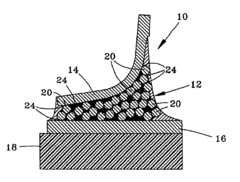
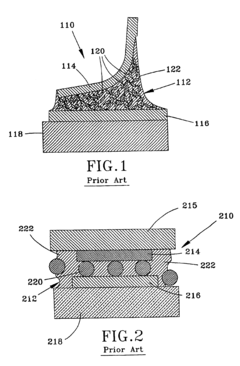
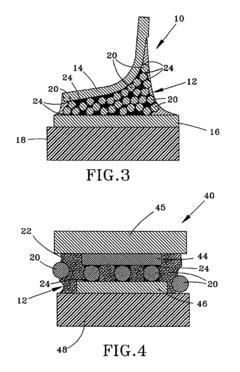
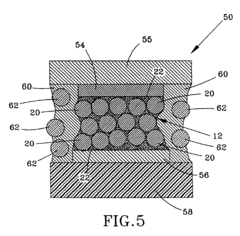
Electrically conductive adhesives
PatentActiveEP2431438A1
Innovation
- A novel adhesive composition comprising a thermosetting or thermoplastic resin component, micron-sized electrically conductive particles (2 µm to 50 µm), and sub-micron-sized electrically conductive particles (300 nm to 900 nm), which forms a stable and conductive bond between substrates, offering low processing viscosity, high electrical conductivity, and resistance to thermomechanical fatigue, with curing times ranging from 0.1 seconds to 180 minutes at 50°C to 220°C.


Environmental Impact and Sustainability Considerations
The environmental implications of conductive adhesives represent a significant paradigm shift in electronics manufacturing. Traditional soldering methods rely heavily on lead-based materials, which pose substantial environmental and health hazards throughout their lifecycle. Conductive adhesives, particularly those based on silver, copper, or carbon, offer a compelling alternative with reduced environmental footprint. These materials typically require lower curing temperatures (80-150°C compared to 220-250°C for lead-free solders), resulting in significant energy savings during manufacturing processes.
The elimination of lead from electronic assembly processes addresses critical environmental concerns related to toxic metal contamination. Lead accumulation in soil and water systems presents long-term ecological risks and potential human health impacts through bioaccumulation. Conductive adhesives help electronics manufacturers comply with stringent regulations such as RoHS (Restriction of Hazardous Substances) and WEEE (Waste Electrical and Electronic Equipment) directives without compromising product performance.
Carbon footprint assessments reveal that conductive adhesive manufacturing processes typically generate 30-45% less greenhouse gas emissions compared to traditional soldering methods. This reduction stems from lower energy requirements during curing and the elimination of flux cleaning processes that often involve volatile organic compounds (VOCs). The simplified manufacturing workflow also reduces water consumption and wastewater generation, contributing to overall resource conservation.
End-of-life considerations further highlight the sustainability advantages of conductive adhesives. Electronics assembled with these materials can be more easily disassembled for component recovery and recycling. Some advanced formulations incorporate design-for-disassembly principles, where adhesive bonds can be weakened through specific stimuli (heat, UV exposure, or chemical treatments), facilitating material separation during recycling processes.
Recent innovations in bio-based conductive adhesives represent the frontier of sustainability in this field. Research teams have developed partially bio-derived formulations using renewable resources like modified cellulose, lignin derivatives, and plant oils as replacements for petroleum-based components. Though currently limited to niche applications due to performance constraints, these materials show promising potential for reducing dependence on non-renewable resources in electronics manufacturing.
The transition to conductive adhesives also supports miniaturization trends in electronics, enabling more efficient use of materials and potentially extending product lifecycles through improved durability in certain applications. This alignment with circular economy principles positions conductive adhesives as an enabling technology for more sustainable electronics design and manufacturing paradigms.
The elimination of lead from electronic assembly processes addresses critical environmental concerns related to toxic metal contamination. Lead accumulation in soil and water systems presents long-term ecological risks and potential human health impacts through bioaccumulation. Conductive adhesives help electronics manufacturers comply with stringent regulations such as RoHS (Restriction of Hazardous Substances) and WEEE (Waste Electrical and Electronic Equipment) directives without compromising product performance.
Carbon footprint assessments reveal that conductive adhesive manufacturing processes typically generate 30-45% less greenhouse gas emissions compared to traditional soldering methods. This reduction stems from lower energy requirements during curing and the elimination of flux cleaning processes that often involve volatile organic compounds (VOCs). The simplified manufacturing workflow also reduces water consumption and wastewater generation, contributing to overall resource conservation.
End-of-life considerations further highlight the sustainability advantages of conductive adhesives. Electronics assembled with these materials can be more easily disassembled for component recovery and recycling. Some advanced formulations incorporate design-for-disassembly principles, where adhesive bonds can be weakened through specific stimuli (heat, UV exposure, or chemical treatments), facilitating material separation during recycling processes.
Recent innovations in bio-based conductive adhesives represent the frontier of sustainability in this field. Research teams have developed partially bio-derived formulations using renewable resources like modified cellulose, lignin derivatives, and plant oils as replacements for petroleum-based components. Though currently limited to niche applications due to performance constraints, these materials show promising potential for reducing dependence on non-renewable resources in electronics manufacturing.
The transition to conductive adhesives also supports miniaturization trends in electronics, enabling more efficient use of materials and potentially extending product lifecycles through improved durability in certain applications. This alignment with circular economy principles positions conductive adhesives as an enabling technology for more sustainable electronics design and manufacturing paradigms.
Reliability Testing and Performance Standards
Reliability testing and performance standards for conductive adhesives represent a critical framework for ensuring these materials meet the demanding requirements of modern electronics applications. The industry has developed comprehensive testing protocols that evaluate adhesives under various environmental conditions, mechanical stresses, and electrical loads to predict their long-term performance.
Temperature cycling tests are among the most fundamental reliability assessments, subjecting conductive adhesives to repeated thermal excursions between extreme temperatures (-65°C to 150°C) to simulate real-world operating conditions. These tests reveal how adhesives maintain conductivity and mechanical integrity when components expand and contract at different rates, a common failure mechanism in electronic assemblies.
Humidity resistance testing exposes adhesives to elevated temperature and humidity conditions (typically 85°C/85% RH) for extended periods, evaluating their ability to resist moisture ingress that could compromise electrical conductivity. This is particularly crucial for consumer electronics and automotive applications where exposure to varying environmental conditions is inevitable.
Mechanical stress testing includes shear strength, tensile strength, and impact resistance evaluations. These tests quantify the adhesive's ability to maintain electrical connections under physical stresses that occur during manufacturing, transportation, and normal operation. Industry standards like ASTM D1002 for shear strength and ASTM D897 for tensile strength provide standardized methodologies for consistent evaluation.
Electrical performance standards focus on volume resistivity, contact resistance stability, and current-carrying capacity. IPC-TM-650 test methods are widely adopted for measuring these properties, with successful conductive adhesives typically demonstrating volume resistivity below 10^-4 Ω·cm and minimal resistance shifts over time.
Accelerated aging tests attempt to compress years of operational life into weeks or months of testing. These include high-temperature storage tests, power cycling, and combined environmental stresses that help predict the long-term reliability of adhesive connections. The automotive industry's AEC-Q100 qualification requirements have become a benchmark for reliability in harsh operating environments.
Emerging standards are addressing new challenges posed by miniaturization and flexible electronics. The IPC-CC-830 standard for conformal coatings has been adapted to evaluate how conductive adhesives perform in flexible circuit applications, while new test methods are being developed to assess reliability in ultra-fine pitch applications below 0.3mm.
Temperature cycling tests are among the most fundamental reliability assessments, subjecting conductive adhesives to repeated thermal excursions between extreme temperatures (-65°C to 150°C) to simulate real-world operating conditions. These tests reveal how adhesives maintain conductivity and mechanical integrity when components expand and contract at different rates, a common failure mechanism in electronic assemblies.
Humidity resistance testing exposes adhesives to elevated temperature and humidity conditions (typically 85°C/85% RH) for extended periods, evaluating their ability to resist moisture ingress that could compromise electrical conductivity. This is particularly crucial for consumer electronics and automotive applications where exposure to varying environmental conditions is inevitable.
Mechanical stress testing includes shear strength, tensile strength, and impact resistance evaluations. These tests quantify the adhesive's ability to maintain electrical connections under physical stresses that occur during manufacturing, transportation, and normal operation. Industry standards like ASTM D1002 for shear strength and ASTM D897 for tensile strength provide standardized methodologies for consistent evaluation.
Electrical performance standards focus on volume resistivity, contact resistance stability, and current-carrying capacity. IPC-TM-650 test methods are widely adopted for measuring these properties, with successful conductive adhesives typically demonstrating volume resistivity below 10^-4 Ω·cm and minimal resistance shifts over time.
Accelerated aging tests attempt to compress years of operational life into weeks or months of testing. These include high-temperature storage tests, power cycling, and combined environmental stresses that help predict the long-term reliability of adhesive connections. The automotive industry's AEC-Q100 qualification requirements have become a benchmark for reliability in harsh operating environments.
Emerging standards are addressing new challenges posed by miniaturization and flexible electronics. The IPC-CC-830 standard for conformal coatings has been adapted to evaluate how conductive adhesives perform in flexible circuit applications, while new test methods are being developed to assess reliability in ultra-fine pitch applications below 0.3mm.
Unlock deeper insights with Patsnap Eureka Quick Research — get a full tech report to explore trends and direct your research. Try now!
Generate Your Research Report Instantly with AI Agent
Supercharge your innovation with Patsnap Eureka AI Agent Platform!