How Conductive Adhesives Transform Flexible Electronics
OCT 10, 202510 MIN READ
Generate Your Research Report Instantly with AI Agent
Patsnap Eureka helps you evaluate technical feasibility & market potential.
Conductive Adhesives Background and Objectives
Conductive adhesives have emerged as a transformative technology in the field of flexible electronics, representing a significant departure from traditional soldering methods. The evolution of these materials can be traced back to the 1960s when the first electrically conductive adhesives (ECAs) were developed primarily for military applications. Over subsequent decades, their composition and performance characteristics have undergone substantial refinement, transitioning from simple metal-filled polymers to sophisticated nanocomposite formulations with enhanced conductivity and flexibility profiles.
The technological trajectory of conductive adhesives has been shaped by several key drivers, including the increasing miniaturization of electronic components, growing environmental concerns regarding lead-based solders, and the rising demand for flexible, wearable, and stretchable electronic devices. These factors have accelerated research and development efforts in this domain, leading to significant advancements in adhesive formulations, processing techniques, and application methodologies.
Current conductive adhesive technologies can be broadly categorized into isotropic conductive adhesives (ICAs), which conduct electricity in all directions, and anisotropic conductive adhesives (ACAs), which conduct primarily in one direction. Recent innovations have focused on enhancing their thermal stability, mechanical flexibility, and electrical performance while reducing curing temperatures and processing times.
The primary technical objectives in this field include developing adhesives with conductivity levels approaching those of metallic solders while maintaining superior flexibility and adhesion properties. Researchers aim to achieve reliable performance under mechanical stress, temperature fluctuations, and humidity variations—conditions that are particularly challenging for flexible electronic applications. Additionally, there is a growing emphasis on creating environmentally sustainable formulations that minimize the use of toxic components and facilitate end-of-life recycling.
Looking forward, the technical roadmap for conductive adhesives in flexible electronics encompasses several ambitious goals: achieving ultra-fine pitch interconnections below 20 microns, developing stretchable variants capable of withstanding over 100% elongation without significant conductivity loss, and creating self-healing formulations that can restore electrical pathways after mechanical damage. These advancements would enable new generations of conformable displays, biomedical sensors, and textile-integrated electronics.
The convergence of nanotechnology, polymer science, and electronics manufacturing is expected to drive further innovations in this space, potentially revolutionizing how flexible electronic devices are designed, manufactured, and integrated into everyday applications. As these technical objectives are progressively realized, conductive adhesives will likely play an increasingly central role in enabling the next wave of electronic form factors and functionalities.
The technological trajectory of conductive adhesives has been shaped by several key drivers, including the increasing miniaturization of electronic components, growing environmental concerns regarding lead-based solders, and the rising demand for flexible, wearable, and stretchable electronic devices. These factors have accelerated research and development efforts in this domain, leading to significant advancements in adhesive formulations, processing techniques, and application methodologies.
Current conductive adhesive technologies can be broadly categorized into isotropic conductive adhesives (ICAs), which conduct electricity in all directions, and anisotropic conductive adhesives (ACAs), which conduct primarily in one direction. Recent innovations have focused on enhancing their thermal stability, mechanical flexibility, and electrical performance while reducing curing temperatures and processing times.
The primary technical objectives in this field include developing adhesives with conductivity levels approaching those of metallic solders while maintaining superior flexibility and adhesion properties. Researchers aim to achieve reliable performance under mechanical stress, temperature fluctuations, and humidity variations—conditions that are particularly challenging for flexible electronic applications. Additionally, there is a growing emphasis on creating environmentally sustainable formulations that minimize the use of toxic components and facilitate end-of-life recycling.
Looking forward, the technical roadmap for conductive adhesives in flexible electronics encompasses several ambitious goals: achieving ultra-fine pitch interconnections below 20 microns, developing stretchable variants capable of withstanding over 100% elongation without significant conductivity loss, and creating self-healing formulations that can restore electrical pathways after mechanical damage. These advancements would enable new generations of conformable displays, biomedical sensors, and textile-integrated electronics.
The convergence of nanotechnology, polymer science, and electronics manufacturing is expected to drive further innovations in this space, potentially revolutionizing how flexible electronic devices are designed, manufactured, and integrated into everyday applications. As these technical objectives are progressively realized, conductive adhesives will likely play an increasingly central role in enabling the next wave of electronic form factors and functionalities.
Market Demand Analysis for Flexible Electronics
The flexible electronics market has witnessed remarkable growth in recent years, driven by increasing demand for lightweight, bendable, and portable electronic devices. Market research indicates that the global flexible electronics market is projected to reach $42.2 billion by 2027, growing at a CAGR of 11.3% from 2020 to 2027. This substantial growth trajectory underscores the significant market potential for conductive adhesives as a critical enabling technology in this sector.
Consumer electronics represents the largest application segment for flexible electronics, with smartphones, wearables, and tablets leading the demand. The wearable technology market alone is expected to exceed $70 billion by 2025, with flexible components becoming increasingly essential for next-generation devices. Healthcare applications are emerging as another high-growth segment, with flexible biomedical sensors and monitoring devices gaining traction for continuous health monitoring and telemedicine applications.
Industry analysis reveals that automotive and aerospace sectors are rapidly adopting flexible electronics for lightweight, space-efficient solutions. The automotive industry's shift toward electric and autonomous vehicles has accelerated the integration of flexible electronic components in dashboards, lighting systems, and sensors. This trend is expected to continue as vehicle manufacturers seek to reduce weight while increasing functionality.
Regional market assessment shows Asia-Pacific dominating the flexible electronics market, accounting for approximately 45% of global market share. This dominance is attributed to the strong presence of electronics manufacturing hubs in countries like China, Japan, South Korea, and Taiwan. North America and Europe follow as significant markets, with increasing investments in research and development of advanced flexible electronic technologies.
The demand for conductive adhesives in flexible electronics is primarily driven by their ability to replace traditional soldering methods, which are often incompatible with temperature-sensitive flexible substrates. Market surveys indicate that manufacturers are increasingly seeking adhesives that can maintain conductivity under repeated bending and flexing conditions, with over 80% of industry respondents citing reliability under mechanical stress as a critical requirement.
Environmental regulations and sustainability concerns are also shaping market demand, with growing preference for lead-free and environmentally friendly conductive adhesive solutions. The RoHS and REACH regulations in Europe have accelerated the transition away from traditional solder materials containing lead and other hazardous substances, creating opportunities for innovative conductive adhesive formulations.
Customer feedback analysis highlights several unmet needs in the market, including improved thermal conductivity, enhanced adhesion to diverse substrate materials, and reduced curing temperatures. These requirements present significant opportunities for material science innovations in conductive adhesive technologies tailored specifically for flexible electronic applications.
Consumer electronics represents the largest application segment for flexible electronics, with smartphones, wearables, and tablets leading the demand. The wearable technology market alone is expected to exceed $70 billion by 2025, with flexible components becoming increasingly essential for next-generation devices. Healthcare applications are emerging as another high-growth segment, with flexible biomedical sensors and monitoring devices gaining traction for continuous health monitoring and telemedicine applications.
Industry analysis reveals that automotive and aerospace sectors are rapidly adopting flexible electronics for lightweight, space-efficient solutions. The automotive industry's shift toward electric and autonomous vehicles has accelerated the integration of flexible electronic components in dashboards, lighting systems, and sensors. This trend is expected to continue as vehicle manufacturers seek to reduce weight while increasing functionality.
Regional market assessment shows Asia-Pacific dominating the flexible electronics market, accounting for approximately 45% of global market share. This dominance is attributed to the strong presence of electronics manufacturing hubs in countries like China, Japan, South Korea, and Taiwan. North America and Europe follow as significant markets, with increasing investments in research and development of advanced flexible electronic technologies.
The demand for conductive adhesives in flexible electronics is primarily driven by their ability to replace traditional soldering methods, which are often incompatible with temperature-sensitive flexible substrates. Market surveys indicate that manufacturers are increasingly seeking adhesives that can maintain conductivity under repeated bending and flexing conditions, with over 80% of industry respondents citing reliability under mechanical stress as a critical requirement.
Environmental regulations and sustainability concerns are also shaping market demand, with growing preference for lead-free and environmentally friendly conductive adhesive solutions. The RoHS and REACH regulations in Europe have accelerated the transition away from traditional solder materials containing lead and other hazardous substances, creating opportunities for innovative conductive adhesive formulations.
Customer feedback analysis highlights several unmet needs in the market, including improved thermal conductivity, enhanced adhesion to diverse substrate materials, and reduced curing temperatures. These requirements present significant opportunities for material science innovations in conductive adhesive technologies tailored specifically for flexible electronic applications.
Current State and Challenges in Conductive Adhesive Technology
Conductive adhesives have emerged as a critical enabling technology in the flexible electronics industry, with global market adoption accelerating significantly over the past decade. Currently, the technology landscape is dominated by two primary categories: isotropic conductive adhesives (ICAs) and anisotropic conductive adhesives (ACAs), each serving distinct application needs in flexible electronic systems. ICAs offer omnidirectional conductivity while ACAs provide directional conductivity, typically in the z-axis, making them suitable for fine-pitch interconnections.
The current state of conductive adhesive technology represents a complex interplay between material science advancements and manufacturing process innovations. Silver-filled epoxy systems remain the industry standard, capturing approximately 75% of the market share due to their excellent electrical conductivity (typically 10^-4 to 10^-5 Ω·cm) and reasonable processing parameters. However, recent developments have introduced nano-particle enhanced formulations that demonstrate up to 40% improvement in conductivity while maintaining flexibility.
Despite significant progress, several technical challenges continue to impede wider adoption of conductive adhesives in flexible electronics. Foremost among these is the conductivity-flexibility trade-off – as conductive filler content increases to improve electrical performance, mechanical flexibility typically decreases, creating a fundamental materials science dilemma. This challenge is particularly acute in applications requiring repeated bending or folding operations, where microcracks can develop in the conductive pathways.
Thermal management represents another significant hurdle, as many conductive adhesives exhibit thermal conductivity values (0.3-3 W/m·K) that fall short of traditional soldering methods (approximately 30-50 W/m·K). This limitation restricts their use in high-power density applications where heat dissipation is critical. Additionally, long-term reliability under environmental stressors remains problematic, with humidity resistance being particularly challenging due to moisture absorption at the filler-polymer interface.
From a manufacturing perspective, process integration challenges persist. Current dispensing technologies struggle to achieve the precision required for ultra-fine pitch applications (below 50μm), and curing processes often require temperature profiles that can damage temperature-sensitive flexible substrates. The industry has responded with UV-curable formulations and room-temperature curing systems, though these often come with compromises in electrical performance.
Geographically, conductive adhesive technology development shows distinct regional characteristics. Asian markets, particularly Japan and South Korea, lead in anisotropic conductive film innovations, while North American and European research institutions focus more heavily on novel nanomaterial incorporation and environmentally sustainable formulations. This regional specialization has created a fragmented innovation landscape that sometimes impedes standardization efforts.
The current state of conductive adhesive technology represents a complex interplay between material science advancements and manufacturing process innovations. Silver-filled epoxy systems remain the industry standard, capturing approximately 75% of the market share due to their excellent electrical conductivity (typically 10^-4 to 10^-5 Ω·cm) and reasonable processing parameters. However, recent developments have introduced nano-particle enhanced formulations that demonstrate up to 40% improvement in conductivity while maintaining flexibility.
Despite significant progress, several technical challenges continue to impede wider adoption of conductive adhesives in flexible electronics. Foremost among these is the conductivity-flexibility trade-off – as conductive filler content increases to improve electrical performance, mechanical flexibility typically decreases, creating a fundamental materials science dilemma. This challenge is particularly acute in applications requiring repeated bending or folding operations, where microcracks can develop in the conductive pathways.
Thermal management represents another significant hurdle, as many conductive adhesives exhibit thermal conductivity values (0.3-3 W/m·K) that fall short of traditional soldering methods (approximately 30-50 W/m·K). This limitation restricts their use in high-power density applications where heat dissipation is critical. Additionally, long-term reliability under environmental stressors remains problematic, with humidity resistance being particularly challenging due to moisture absorption at the filler-polymer interface.
From a manufacturing perspective, process integration challenges persist. Current dispensing technologies struggle to achieve the precision required for ultra-fine pitch applications (below 50μm), and curing processes often require temperature profiles that can damage temperature-sensitive flexible substrates. The industry has responded with UV-curable formulations and room-temperature curing systems, though these often come with compromises in electrical performance.
Geographically, conductive adhesive technology development shows distinct regional characteristics. Asian markets, particularly Japan and South Korea, lead in anisotropic conductive film innovations, while North American and European research institutions focus more heavily on novel nanomaterial incorporation and environmentally sustainable formulations. This regional specialization has created a fragmented innovation landscape that sometimes impedes standardization efforts.
Current Technical Solutions for Flexible Electronics Bonding
01 Metal-filled conductive adhesives
Metal-filled conductive adhesives incorporate metallic particles such as silver, gold, copper, or nickel to create electrical conductivity. These adhesives typically consist of a polymer matrix loaded with metal fillers at sufficient concentration to form conductive pathways. The metal particles provide electrical and thermal conductivity while the polymer matrix offers adhesive properties and mechanical stability. These materials are widely used in electronics assembly, particularly in applications where traditional soldering is not suitable.- Metal-filled conductive adhesives: Metal-filled conductive adhesives incorporate metallic particles such as silver, gold, copper, or nickel to create electrical conductivity. These particles form conductive pathways when the adhesive cures, allowing for electrical connections between components. The concentration and type of metal filler significantly impact the conductivity level, with silver typically providing the highest conductivity. These adhesives are widely used in electronics assembly, particularly for applications requiring both mechanical bonding and electrical connectivity.
- Carbon-based conductive adhesives: Carbon-based conductive adhesives utilize carbon materials such as graphite, carbon black, carbon nanotubes, or graphene as conductive fillers. These materials provide moderate conductivity at lower cost compared to metal fillers. Carbon nanotubes and graphene offer excellent electrical properties while requiring lower loading levels, which helps maintain better mechanical properties. These adhesives are particularly useful in applications where moderate conductivity is sufficient and cost considerations are important.
- Anisotropic conductive adhesives: Anisotropic conductive adhesives (ACAs) provide electrical conductivity in one direction while maintaining insulation in other directions. These specialized adhesives contain conductive particles dispersed in an insulating polymer matrix. When compressed between electrical contacts, the particles form conductive paths only in the direction of compression. This technology is particularly valuable for fine-pitch connections in display technologies, flexible electronics, and high-density interconnects where preventing short circuits between adjacent connections is critical.
- Thermally conductive adhesives: Thermally conductive adhesives are designed to transfer heat while providing adhesive properties. These formulations typically contain fillers such as aluminum oxide, boron nitride, or aluminum nitride that enhance thermal conductivity without necessarily providing electrical conductivity. Some variants offer both thermal and electrical conductivity for applications requiring heat dissipation and electrical connections. These adhesives are crucial in electronic assemblies where heat management is essential for device reliability and performance.
- Environmentally friendly conductive adhesives: Environmentally friendly conductive adhesives address concerns about toxicity and environmental impact by eliminating lead and other hazardous materials. These formulations use bio-based polymers, water-based systems, or other eco-friendly components while maintaining necessary conductive properties. Recent innovations focus on reducing volatile organic compounds (VOCs) and creating recyclable or biodegradable options. These adhesives support compliance with global environmental regulations while meeting the technical requirements for electronic applications.
02 Carbon-based conductive adhesives
Carbon-based conductive adhesives utilize carbon materials such as graphite, carbon black, carbon nanotubes, or graphene as conductive fillers. These materials offer advantages including lower cost compared to metal fillers, lighter weight, and resistance to oxidation. Carbon-based conductive adhesives are particularly useful in applications requiring moderate conductivity, EMI shielding, or static dissipation. The carbon fillers can be dispersed in various polymer matrices to achieve different performance characteristics.Expand Specific Solutions03 Anisotropic conductive adhesives
Anisotropic conductive adhesives (ACAs) provide electrical conductivity in one direction while maintaining insulation in other directions. These specialized adhesives typically contain conductive particles dispersed in an insulating adhesive matrix. When compressed between electrical contacts, the particles form conductive pathways in the z-direction while remaining electrically isolated from each other in the x-y plane. ACAs are particularly valuable in fine-pitch electronics assembly, display technologies, and flexible circuit connections where directional conductivity is required.Expand Specific Solutions04 Thermally conductive adhesives
Thermally conductive adhesives are designed to transfer heat while providing bonding functionality. These adhesives incorporate fillers such as ceramic particles, metal oxides, or boron nitride to enhance thermal conductivity. They are essential in electronic assemblies where heat dissipation is critical for device performance and reliability. Applications include bonding heat sinks, attaching thermal interface materials, and securing components in power electronics where efficient heat transfer is necessary to prevent overheating.Expand Specific Solutions05 Hybrid and specialized conductive adhesives
Hybrid conductive adhesives combine multiple types of conductive fillers or incorporate specialized additives to achieve enhanced performance characteristics. These formulations may include combinations of metallic and carbon-based fillers, or incorporate novel materials such as conductive polymers. Specialized conductive adhesives may also feature additional properties such as optical transparency, flexibility, stretchability, or environmental resistance. These advanced formulations address specific application requirements in emerging technologies such as wearable electronics, medical devices, and automotive electronics.Expand Specific Solutions
Key Industry Players in Conductive Adhesives Market
The conductive adhesives market for flexible electronics is currently in a growth phase, with an expanding market size driven by increasing demand for wearable technology, foldable displays, and IoT devices. The technology is approaching maturity but still evolving, with innovations focused on enhancing conductivity, flexibility, and durability. Key players like 3M, Henkel, and Panasonic lead with established product lines, while specialized companies such as Nanotech Energy and Liquid Wire are advancing novel solutions for stretchable electronics. Research institutions including Nanyang Technological University and Northwestern University are pushing boundaries in nanomaterial-based adhesives. The competitive landscape features traditional electronics giants collaborating with materials science specialists to develop next-generation solutions that balance electrical performance with mechanical flexibility.
3M Innovative Properties Co.
Technical Solution: 3M has developed a comprehensive portfolio of conductive adhesive technologies specifically engineered for flexible electronics applications. Their flagship products include the Electrically Conductive Adhesive Transfer Tapes (ECATTs) that utilize proprietary conductive particle technology embedded in flexible adhesive matrices. These materials provide z-axis conductivity while maintaining electrical isolation in the x-y plane, making them ideal for flexible circuit interconnections. 3M's approach incorporates both isotropic and anisotropic conductive formulations, with their latest innovations featuring temperature-stable silicone-based adhesives that maintain performance from -40°C to +150°C. Their manufacturing process employs precision coating technologies that ensure uniform particle distribution and consistent electrical performance across large surface areas. 3M has also pioneered removable conductive adhesives that allow for rework and repair of flexible electronic assemblies without damaging delicate substrates, achieved through specialized polymer chemistry that provides reliable electrical connections but can be debonded with controlled force application.
Strengths: Extensive product range addressing various application requirements, proven reliability in harsh environments, and established global manufacturing and distribution network. Weaknesses: Some formulations have limited stretchability compared to newer elastomeric solutions, and certain products require specific surface preparation for optimal adhesion.
Nanotech Energy, Inc.
Technical Solution: Nanotech Energy has revolutionized conductive adhesives for flexible electronics through their graphene-based formulations. Their proprietary technology incorporates functionalized graphene sheets into elastomeric adhesive matrices, creating highly conductive pathways that maintain performance under extreme deformation. Unlike traditional metal-filled adhesives, Nanotech's graphene-based solutions offer conductivity values exceeding 5000 S/cm while allowing stretching up to 150% of original length without significant resistance changes. Their manufacturing process involves liquid-phase exfoliation of graphene followed by surface modification to enhance compatibility with various polymer systems. This approach enables the creation of transparent conductive adhesives with over 85% optical transparency, critical for next-generation flexible displays. Nanotech Energy has also developed self-healing variants that can restore conductivity after mechanical damage through reversible non-covalent interactions between graphene sheets.
Strengths: Exceptional stretchability while maintaining conductivity, lightweight compared to metal-filled alternatives, and potential for transparent applications. Weaknesses: Higher production costs due to graphene processing requirements and more limited commercial-scale production capacity compared to established adhesive manufacturers.
Core Patents and Innovations in Conductive Adhesive Technology
Conductive adhesives and epoxies
PatentWO2024220663A2
Innovation
- A flexible graphene-powered electrically conductive epoxy adhesive with a low viscosity diluent, silver, and a latent curing agent, which forms a strong, conductive, and thermally stable bond suitable for electronic components, offering improved drop resistance and mechanical strength.


Conductive polymer composite for adhesion to flexible substrate and method for preparing same
PatentActiveUS11866623B2
Innovation
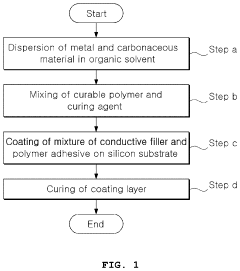
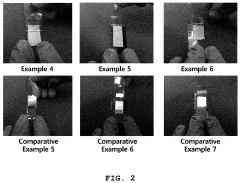
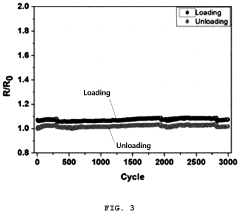
- A conductive polymer composite is developed, comprising a polymer adhesive with a curable polymer and curing agent, and a conductive filler of metal and carbonaceous materials, specifically silver and multi-walled carbon nanotubes, which is formulated to provide improved adhesion, flexibility, and stretchability on flexible substrates.
Environmental Impact and Sustainability Considerations
The shift towards conductive adhesives in flexible electronics represents a significant advancement in sustainable manufacturing practices. Traditional electronic assembly methods rely heavily on lead-based solders and harsh chemical processes that pose substantial environmental concerns. Conductive adhesives, particularly those formulated with bio-based materials and reduced metal content, offer a considerably lower environmental footprint while maintaining necessary performance characteristics.
Life cycle assessments of conductive adhesive technologies demonstrate up to 65% reduction in carbon emissions compared to conventional soldering processes. This improvement stems primarily from lower processing temperatures, which significantly reduce energy consumption during manufacturing. While traditional soldering requires temperatures exceeding 220°C, many conductive adhesives can be cured at temperatures below 150°C, representing substantial energy savings across large-scale production environments.
Water conservation presents another critical environmental advantage. Conventional PCB manufacturing processes typically consume 1,500-2,000 liters of water per square meter of board produced. Implementation of conductive adhesive technologies can reduce this water usage by approximately 40% through elimination of multiple cleaning and rinsing steps associated with flux removal in traditional soldering.
End-of-life considerations further highlight the sustainability benefits of conductive adhesives. Many formulations facilitate easier disassembly and component recovery, enhancing recyclability rates for flexible electronic devices. Research indicates that properly designed conductive adhesive systems can improve precious metal recovery rates by up to 30% compared to conventional soldered assemblies.
Regulatory frameworks worldwide increasingly favor these environmentally preferable alternatives. The European Union's Restriction of Hazardous Substances (RoHS) directive and similar regulations in Asia and North America have accelerated industry transition toward lead-free and lower-impact assembly methods. Companies adopting conductive adhesive technologies often gain competitive advantages through regulatory compliance and improved environmental performance metrics.
Despite these benefits, challenges remain in optimizing the environmental profile of conductive adhesives. Some formulations still incorporate nanomaterials and synthetic polymers with uncertain environmental fate and toxicity profiles. Ongoing research focuses on developing fully biodegradable conductive adhesive systems that maintain electrical performance while minimizing environmental persistence.
Industry collaboration with academic institutions has yielded promising developments in bio-based conductive adhesives derived from renewable resources such as cellulose, lignin, and plant oils. These next-generation materials aim to further reduce dependence on petroleum-derived components while maintaining the performance characteristics necessary for reliable flexible electronic applications.
Life cycle assessments of conductive adhesive technologies demonstrate up to 65% reduction in carbon emissions compared to conventional soldering processes. This improvement stems primarily from lower processing temperatures, which significantly reduce energy consumption during manufacturing. While traditional soldering requires temperatures exceeding 220°C, many conductive adhesives can be cured at temperatures below 150°C, representing substantial energy savings across large-scale production environments.
Water conservation presents another critical environmental advantage. Conventional PCB manufacturing processes typically consume 1,500-2,000 liters of water per square meter of board produced. Implementation of conductive adhesive technologies can reduce this water usage by approximately 40% through elimination of multiple cleaning and rinsing steps associated with flux removal in traditional soldering.
End-of-life considerations further highlight the sustainability benefits of conductive adhesives. Many formulations facilitate easier disassembly and component recovery, enhancing recyclability rates for flexible electronic devices. Research indicates that properly designed conductive adhesive systems can improve precious metal recovery rates by up to 30% compared to conventional soldered assemblies.
Regulatory frameworks worldwide increasingly favor these environmentally preferable alternatives. The European Union's Restriction of Hazardous Substances (RoHS) directive and similar regulations in Asia and North America have accelerated industry transition toward lead-free and lower-impact assembly methods. Companies adopting conductive adhesive technologies often gain competitive advantages through regulatory compliance and improved environmental performance metrics.
Despite these benefits, challenges remain in optimizing the environmental profile of conductive adhesives. Some formulations still incorporate nanomaterials and synthetic polymers with uncertain environmental fate and toxicity profiles. Ongoing research focuses on developing fully biodegradable conductive adhesive systems that maintain electrical performance while minimizing environmental persistence.
Industry collaboration with academic institutions has yielded promising developments in bio-based conductive adhesives derived from renewable resources such as cellulose, lignin, and plant oils. These next-generation materials aim to further reduce dependence on petroleum-derived components while maintaining the performance characteristics necessary for reliable flexible electronic applications.
Manufacturing Scalability and Cost Analysis
The scalability of conductive adhesive manufacturing represents a critical factor in the widespread adoption of flexible electronics technologies. Current production methods for conductive adhesives vary significantly in their scalability potential, with traditional batch processing presenting limitations for high-volume applications. Screen printing and stencil printing methods offer moderate throughput but face challenges in maintaining consistent quality across large production runs. In contrast, roll-to-roll processing demonstrates promising scalability characteristics, enabling continuous production of conductive adhesive layers with improved throughput rates of up to 30 meters per minute in advanced systems.
Cost structures for conductive adhesive manufacturing remain substantially higher than traditional soldering technologies, presenting a significant barrier to mass adoption. Material costs constitute approximately 40-60% of total production expenses, with silver-based formulations commanding premium prices of $200-500 per kilogram depending on silver content and formulation complexity. Alternative materials utilizing copper or carbon nanotubes offer potential cost reductions but currently sacrifice performance metrics. Equipment investment requirements range from $50,000 for basic dispensing systems to several million dollars for fully automated high-precision manufacturing lines.
Labor costs vary significantly by region, with specialized technical expertise commanding premium wages. Automated manufacturing processes can reduce labor requirements but necessitate higher initial capital expenditure. The economic equation becomes particularly challenging for small to medium production volumes where the amortization of equipment costs creates unfavorable unit economics compared to traditional interconnection methods.
Yield rates present another critical economic consideration, with current industry averages ranging from 85-95% depending on application complexity and quality requirements. Defect rates increase with finer pitch applications, creating exponential cost implications for high-precision flexible electronic devices. Waste management and environmental compliance add further cost layers, particularly for adhesives containing heavy metals or other regulated substances.
Future cost trajectories show promising trends, with industry analysts projecting 15-25% cost reductions over the next five years through improved manufacturing efficiencies, material innovations, and economies of scale. The development of standardized manufacturing protocols and equipment specifications could accelerate this cost reduction curve, potentially enabling price parity with traditional interconnection technologies for specific application categories by 2028-2030.
Cost structures for conductive adhesive manufacturing remain substantially higher than traditional soldering technologies, presenting a significant barrier to mass adoption. Material costs constitute approximately 40-60% of total production expenses, with silver-based formulations commanding premium prices of $200-500 per kilogram depending on silver content and formulation complexity. Alternative materials utilizing copper or carbon nanotubes offer potential cost reductions but currently sacrifice performance metrics. Equipment investment requirements range from $50,000 for basic dispensing systems to several million dollars for fully automated high-precision manufacturing lines.
Labor costs vary significantly by region, with specialized technical expertise commanding premium wages. Automated manufacturing processes can reduce labor requirements but necessitate higher initial capital expenditure. The economic equation becomes particularly challenging for small to medium production volumes where the amortization of equipment costs creates unfavorable unit economics compared to traditional interconnection methods.
Yield rates present another critical economic consideration, with current industry averages ranging from 85-95% depending on application complexity and quality requirements. Defect rates increase with finer pitch applications, creating exponential cost implications for high-precision flexible electronic devices. Waste management and environmental compliance add further cost layers, particularly for adhesives containing heavy metals or other regulated substances.
Future cost trajectories show promising trends, with industry analysts projecting 15-25% cost reductions over the next five years through improved manufacturing efficiencies, material innovations, and economies of scale. The development of standardized manufacturing protocols and equipment specifications could accelerate this cost reduction curve, potentially enabling price parity with traditional interconnection technologies for specific application categories by 2028-2030.
Unlock deeper insights with Patsnap Eureka Quick Research — get a full tech report to explore trends and direct your research. Try now!
Generate Your Research Report Instantly with AI Agent
Supercharge your innovation with Patsnap Eureka AI Agent Platform!