
How Do Wearable Biosensors Integrate with Electronics
OCT 24, 202510 MIN READ
Generate Your Research Report Instantly with AI Agent
Patsnap Eureka helps you evaluate technical feasibility & market potential.
Biosensor-Electronics Integration Background and Objectives
The integration of wearable biosensors with electronics represents a transformative convergence that has evolved significantly over the past two decades. Initially emerging from basic medical monitoring devices, this field has expanded into a sophisticated ecosystem of health tracking, performance monitoring, and preventive healthcare solutions. The technological evolution began with simple pedometers and heart rate monitors, progressing to today's complex multi-parameter sensing platforms capable of continuous, real-time physiological monitoring.
The fundamental objective of biosensor-electronics integration is to create seamless interfaces between biological systems and electronic components that can accurately detect, process, and transmit biological signals while maintaining user comfort and device reliability. This integration aims to overcome the inherent challenges of interfacing rigid electronic components with the dynamic, soft nature of biological tissues, while ensuring signal fidelity across this bio-electronic boundary.
Current technological trajectories indicate a clear movement toward increasingly miniaturized, flexible, and energy-efficient systems. The development of stretchable electronics, ultrathin form factors, and novel materials like graphene and conductive polymers has accelerated progress in creating truly wearable biosensing platforms. These advancements support the ultimate goal of developing "imperceptible electronics" that users can wear comfortably for extended periods without interference with daily activities.
Market forces have significantly shaped the evolution of this technology, with consumer wellness applications driving mass adoption while medical applications push the boundaries of accuracy and reliability. The convergence of these market segments is creating new opportunities for comprehensive health monitoring systems that bridge clinical and consumer needs.
Power management remains a critical challenge, with research focusing on energy harvesting techniques, ultra-low-power electronics, and optimized data processing algorithms to extend device operational life. Simultaneously, advances in wireless communication protocols are enabling more efficient data transmission while maintaining security and privacy of sensitive health information.
The integration landscape is further complicated by the need for multidisciplinary expertise spanning materials science, electrical engineering, biomedical engineering, and data analytics. Successful integration requires holistic approaches that consider not only technical performance but also biocompatibility, user experience, and regulatory compliance.
Looking forward, the field aims to achieve truly symbiotic relationships between biosensors and electronics, where systems can adapt to changing physiological conditions, self-calibrate, and potentially even self-power through biological energy harvesting. These objectives guide current research initiatives and commercial development roadmaps across the wearable technology ecosystem.
The fundamental objective of biosensor-electronics integration is to create seamless interfaces between biological systems and electronic components that can accurately detect, process, and transmit biological signals while maintaining user comfort and device reliability. This integration aims to overcome the inherent challenges of interfacing rigid electronic components with the dynamic, soft nature of biological tissues, while ensuring signal fidelity across this bio-electronic boundary.
Current technological trajectories indicate a clear movement toward increasingly miniaturized, flexible, and energy-efficient systems. The development of stretchable electronics, ultrathin form factors, and novel materials like graphene and conductive polymers has accelerated progress in creating truly wearable biosensing platforms. These advancements support the ultimate goal of developing "imperceptible electronics" that users can wear comfortably for extended periods without interference with daily activities.
Market forces have significantly shaped the evolution of this technology, with consumer wellness applications driving mass adoption while medical applications push the boundaries of accuracy and reliability. The convergence of these market segments is creating new opportunities for comprehensive health monitoring systems that bridge clinical and consumer needs.
Power management remains a critical challenge, with research focusing on energy harvesting techniques, ultra-low-power electronics, and optimized data processing algorithms to extend device operational life. Simultaneously, advances in wireless communication protocols are enabling more efficient data transmission while maintaining security and privacy of sensitive health information.
The integration landscape is further complicated by the need for multidisciplinary expertise spanning materials science, electrical engineering, biomedical engineering, and data analytics. Successful integration requires holistic approaches that consider not only technical performance but also biocompatibility, user experience, and regulatory compliance.
Looking forward, the field aims to achieve truly symbiotic relationships between biosensors and electronics, where systems can adapt to changing physiological conditions, self-calibrate, and potentially even self-power through biological energy harvesting. These objectives guide current research initiatives and commercial development roadmaps across the wearable technology ecosystem.
Market Analysis for Integrated Wearable Biosensors
The global market for integrated wearable biosensors is experiencing robust growth, driven by increasing health consciousness, technological advancements, and the rising prevalence of chronic diseases. Current market valuations indicate that the wearable biosensor market reached approximately 12 billion USD in 2022 and is projected to grow at a compound annual growth rate (CAGR) of 18.3% through 2030, potentially reaching 51 billion USD by the end of the forecast period.
Consumer demand is primarily concentrated in healthcare monitoring applications, with significant interest in continuous glucose monitoring, heart rate tracking, and blood oxygen level measurement. The fitness and wellness segment represents the largest market share currently, accounting for nearly 40% of total revenue, followed by medical diagnostics and monitoring at 35%.
Geographically, North America dominates the market with approximately 42% share, attributed to advanced healthcare infrastructure, higher disposable income, and greater technology adoption rates. Asia-Pacific is emerging as the fastest-growing region with a projected CAGR of 21.5%, driven by increasing healthcare expenditure in countries like China and India, growing awareness about preventive healthcare, and expanding middle-class populations.
Key consumer segments include fitness enthusiasts, patients with chronic conditions requiring continuous monitoring, elderly populations benefiting from remote health monitoring, and professional athletes seeking performance optimization. The healthcare provider segment is also showing increased adoption for remote patient monitoring solutions.
Market research indicates shifting consumer preferences toward non-invasive, comfortable, and aesthetically pleasing wearable devices with longer battery life and seamless connectivity. Price sensitivity varies significantly across different market segments, with premium pricing accepted in medical-grade devices but more resistance in consumer wellness products.
Regulatory landscapes significantly impact market dynamics, with FDA approvals in the US and CE marking in Europe serving as critical market entry barriers but also as quality assurances for consumers. The reimbursement environment is gradually evolving, with some insurance providers beginning to cover prescribed wearable monitoring devices, potentially accelerating market growth.
Future market expansion is expected in emerging applications such as mental health monitoring, hydration tracking, and hormone level assessment. The integration of artificial intelligence for predictive analytics represents a significant value-addition opportunity, potentially transforming reactive health monitoring into proactive health management systems.
Consumer demand is primarily concentrated in healthcare monitoring applications, with significant interest in continuous glucose monitoring, heart rate tracking, and blood oxygen level measurement. The fitness and wellness segment represents the largest market share currently, accounting for nearly 40% of total revenue, followed by medical diagnostics and monitoring at 35%.
Geographically, North America dominates the market with approximately 42% share, attributed to advanced healthcare infrastructure, higher disposable income, and greater technology adoption rates. Asia-Pacific is emerging as the fastest-growing region with a projected CAGR of 21.5%, driven by increasing healthcare expenditure in countries like China and India, growing awareness about preventive healthcare, and expanding middle-class populations.
Key consumer segments include fitness enthusiasts, patients with chronic conditions requiring continuous monitoring, elderly populations benefiting from remote health monitoring, and professional athletes seeking performance optimization. The healthcare provider segment is also showing increased adoption for remote patient monitoring solutions.
Market research indicates shifting consumer preferences toward non-invasive, comfortable, and aesthetically pleasing wearable devices with longer battery life and seamless connectivity. Price sensitivity varies significantly across different market segments, with premium pricing accepted in medical-grade devices but more resistance in consumer wellness products.
Regulatory landscapes significantly impact market dynamics, with FDA approvals in the US and CE marking in Europe serving as critical market entry barriers but also as quality assurances for consumers. The reimbursement environment is gradually evolving, with some insurance providers beginning to cover prescribed wearable monitoring devices, potentially accelerating market growth.
Future market expansion is expected in emerging applications such as mental health monitoring, hydration tracking, and hormone level assessment. The integration of artificial intelligence for predictive analytics represents a significant value-addition opportunity, potentially transforming reactive health monitoring into proactive health management systems.
Current Integration Challenges and Technical Limitations
Despite significant advancements in wearable biosensor technology, several critical integration challenges persist that limit their widespread adoption and effectiveness. The miniaturization of electronic components remains a fundamental obstacle, as designers struggle to balance functionality with size constraints. Current biosensors often require multiple discrete components—including sensors, microcontrollers, power management systems, and wireless communication modules—which collectively increase device bulk and complexity. This integration density problem becomes particularly acute when developing solutions for continuous health monitoring that must remain unobtrusive during daily activities.
Power management represents another significant limitation in current wearable biosensor systems. Most devices rely on lithium-ion batteries that require frequent recharging, creating interruptions in continuous monitoring capabilities. Energy harvesting alternatives such as piezoelectric, thermoelectric, or photovoltaic solutions remain inefficient for practical implementation, typically generating insufficient power for complex biosensing operations. The power-performance trade-off continues to force compromises in sampling rates, processing capabilities, and wireless transmission frequencies.
Signal integrity issues present substantial technical challenges, particularly in ambulatory conditions. Motion artifacts, electromagnetic interference, and biological noise significantly degrade sensor readings during real-world use. Current filtering algorithms and hardware solutions provide only partial remediation, often at the cost of increased power consumption or reduced temporal resolution. The interface between biological tissues and electronic sensors further complicates signal acquisition, with issues of biocompatibility, sensor drift, and biofouling affecting long-term measurement stability.
Data processing limitations constrain the analytical capabilities of wearable biosensors. Edge computing implementations remain restricted by the processing power available in miniaturized form factors, forcing many systems to offload complex analytics to smartphones or cloud platforms. This dependency creates latency issues and privacy concerns while increasing system complexity. Current microcontrollers optimized for wearable applications lack sufficient computational resources for advanced machine learning algorithms that could enhance signal processing and biomarker detection.
Biocompatibility and user comfort represent persistent challenges in biosensor integration. Materials that excel in electronic performance often cause skin irritation or allergic reactions during prolonged contact. Flexible and stretchable electronics, while promising, still exhibit reliability issues under repeated mechanical stress. Encapsulation technologies that protect sensitive electronics from sweat, water, and environmental contaminants frequently increase device rigidity and size, compromising wearability and user acceptance.
Standardization gaps across the wearable biosensor ecosystem hinder interoperability and system integration. Diverse communication protocols, data formats, and power requirements complicate the development of comprehensive health monitoring platforms. This fragmentation increases development costs and time-to-market while limiting the potential for creating integrated health solutions that leverage multiple biosensor modalities simultaneously.
Power management represents another significant limitation in current wearable biosensor systems. Most devices rely on lithium-ion batteries that require frequent recharging, creating interruptions in continuous monitoring capabilities. Energy harvesting alternatives such as piezoelectric, thermoelectric, or photovoltaic solutions remain inefficient for practical implementation, typically generating insufficient power for complex biosensing operations. The power-performance trade-off continues to force compromises in sampling rates, processing capabilities, and wireless transmission frequencies.
Signal integrity issues present substantial technical challenges, particularly in ambulatory conditions. Motion artifacts, electromagnetic interference, and biological noise significantly degrade sensor readings during real-world use. Current filtering algorithms and hardware solutions provide only partial remediation, often at the cost of increased power consumption or reduced temporal resolution. The interface between biological tissues and electronic sensors further complicates signal acquisition, with issues of biocompatibility, sensor drift, and biofouling affecting long-term measurement stability.
Data processing limitations constrain the analytical capabilities of wearable biosensors. Edge computing implementations remain restricted by the processing power available in miniaturized form factors, forcing many systems to offload complex analytics to smartphones or cloud platforms. This dependency creates latency issues and privacy concerns while increasing system complexity. Current microcontrollers optimized for wearable applications lack sufficient computational resources for advanced machine learning algorithms that could enhance signal processing and biomarker detection.
Biocompatibility and user comfort represent persistent challenges in biosensor integration. Materials that excel in electronic performance often cause skin irritation or allergic reactions during prolonged contact. Flexible and stretchable electronics, while promising, still exhibit reliability issues under repeated mechanical stress. Encapsulation technologies that protect sensitive electronics from sweat, water, and environmental contaminants frequently increase device rigidity and size, compromising wearability and user acceptance.
Standardization gaps across the wearable biosensor ecosystem hinder interoperability and system integration. Diverse communication protocols, data formats, and power requirements complicate the development of comprehensive health monitoring platforms. This fragmentation increases development costs and time-to-market while limiting the potential for creating integrated health solutions that leverage multiple biosensor modalities simultaneously.
Current Integration Architectures and Solutions
01 Wearable biosensors for health monitoring
Wearable biosensors can be integrated into devices for continuous health monitoring. These sensors can track various physiological parameters such as heart rate, blood pressure, and body temperature. The integration of these biosensors allows for real-time health data collection and analysis, enabling early detection of health issues and personalized healthcare solutions.- Wearable biosensor integration with smart devices: Integration of biosensors with smart devices like smartphones and watches enables real-time health monitoring and data analysis. These systems can connect via Bluetooth or wireless networks to transmit physiological data to applications for processing. The integration allows for continuous monitoring of vital signs and immediate alerts for abnormal readings, enhancing preventive healthcare and remote patient monitoring capabilities.
- Flexible and stretchable biosensor technologies: Advanced materials and manufacturing techniques enable the development of flexible and stretchable biosensors that conform to body contours. These sensors can be integrated into textiles or applied directly to the skin as patches, providing comfort during prolonged wear while maintaining accurate measurements. The flexibility allows for natural movement without compromising sensor performance, making them suitable for continuous health monitoring during daily activities and exercise.
- Multimodal biosensing platforms: Integrated systems that combine multiple sensing modalities in a single wearable device allow for comprehensive health monitoring. These platforms can simultaneously measure various physiological parameters such as heart rate, blood oxygen levels, temperature, and biochemical markers. The multimodal approach provides a more complete picture of the user's health status and enables more accurate diagnosis and treatment monitoring through correlation of different biomarkers.
- Energy harvesting and power management for wearable biosensors: Innovative energy solutions for wearable biosensors include harvesting energy from body heat, movement, or ambient light to extend battery life or enable self-powered operation. Advanced power management systems optimize energy consumption by adjusting sampling rates and transmission frequencies based on user activity levels and monitoring needs. These technologies address one of the major challenges in wearable biosensor design by enabling longer continuous operation without frequent recharging.
- Data security and privacy in wearable biosensor systems: Secure data handling frameworks for wearable biosensors protect sensitive health information through encryption, secure transmission protocols, and user authentication mechanisms. These systems implement privacy-preserving data processing techniques that minimize the collection of personally identifiable information while maintaining clinical utility. Compliance with healthcare data regulations ensures that biosensor data is handled according to established standards for medical information security and patient confidentiality.
02 Flexible and stretchable biosensor integration
Advanced materials and manufacturing techniques enable the development of flexible and stretchable biosensors that can be comfortably worn on the body. These sensors can conform to the contours of the skin, providing better contact and more accurate readings. The flexibility allows for integration into various wearable form factors such as patches, bands, or clothing, enhancing user comfort during extended wear.Expand Specific Solutions03 Integration of biosensors with data processing systems
Wearable biosensors can be integrated with sophisticated data processing systems that analyze the collected data in real-time. These systems can employ algorithms and artificial intelligence to interpret the biosensor readings and provide meaningful insights. The integration enables the development of smart wearable devices that can make autonomous decisions based on the sensor data, such as alerting users to potential health issues.Expand Specific Solutions04 Power management for wearable biosensors
Efficient power management is crucial for wearable biosensor integration. Various approaches include low-power circuit design, energy harvesting technologies, and optimized power consumption algorithms. These solutions extend the battery life of wearable devices, reducing the frequency of recharging and enhancing the user experience. Some advanced systems can harvest energy from body heat, movement, or ambient light to power the biosensors.Expand Specific Solutions05 Miniaturization and packaging of integrated biosensors
Miniaturization techniques allow for the development of compact biosensors that can be easily integrated into wearable devices. Advanced packaging methods protect the sensitive components while maintaining the small form factor. These approaches enable the creation of unobtrusive wearable devices that can be comfortably worn throughout daily activities, increasing user adoption and compliance with continuous monitoring protocols.Expand Specific Solutions
Leading Companies in Wearable Biosensor Technology
The wearable biosensor market is experiencing rapid growth, currently in its early maturity phase with significant innovation potential. The global market size is expanding at a CAGR of approximately 25%, driven by healthcare applications and consumer fitness tracking. Technology integration is advancing across various maturity levels: established players like Apple, Samsung, and Philips lead with commercialized solutions; DexCom and Polar Electro offer specialized medical-grade sensors; while academic institutions (MIT, Caltech, University of California) drive fundamental research. Emerging companies like Prevayl and SynchNeuro are developing next-generation integration technologies focusing on miniaturization, power efficiency, and seamless electronics integration. The competitive landscape shows a blend of consumer electronics giants, medical device specialists, and research-focused entities collaborating to overcome challenges in flexibility, biocompatibility, and power management.
Samsung Electronics Co., Ltd.
Technical Solution: Samsung has developed advanced wearable biosensor integration through their Samsung Health platform and Galaxy Watch series. Their technology combines photoplethysmography (PPG) sensors, electrocardiogram (ECG) capabilities, and bioelectrical impedance analysis (BIA) sensors into compact wearable form factors. Samsung's approach focuses on system-on-chip (SoC) designs that integrate multiple sensor types with low-power processing units. Their latest biosensors utilize a 3-in-1 BioActive Sensor that simultaneously measures ECG, PPG, and BIA, allowing for comprehensive health monitoring including heart rate, blood oxygen levels, and body composition analysis. Samsung has also pioneered flexible circuit technologies that enable better conformity to body contours while maintaining reliable electrical connections between sensors and processing components. Their integration strategy includes dedicated low-power microcontrollers that pre-process sensor data before transmission to reduce power consumption and extend battery life in their wearable devices.
Strengths: Samsung's vertical integration capabilities allow them to design custom silicon and optimize hardware-software integration for better power efficiency and performance. Their extensive consumer electronics experience enables mass production of reliable, consumer-friendly devices. Weaknesses: Their proprietary ecosystem approach can limit interoperability with third-party health platforms, and their focus on consumer applications may result in less precision compared to medical-grade devices.
Google LLC
Technical Solution: Google has developed a comprehensive approach to wearable biosensor integration through their Fitbit acquisition and Wear OS platform. Their technology focuses on seamless sensor fusion and advanced algorithms for health data interpretation. Google's biosensor integration strategy employs a multi-layered architecture where hardware sensors (optical heart rate monitors, accelerometers, gyroscopes, and temperature sensors) connect to specialized low-power co-processors that handle continuous monitoring while conserving battery life. Their Wear OS platform provides standardized APIs for biosensor data collection and processing, allowing for consistent implementation across different device manufacturers. Google has pioneered the use of machine learning algorithms that run directly on wearable devices to interpret complex biosensor data patterns, enabling features like sleep stage detection and stress monitoring without requiring constant cloud connectivity. Their recent research has focused on developing non-invasive continuous glucose monitoring capabilities using optical sensors, potentially eliminating the need for traditional invasive methods. Google's health data platform integrates biosensor information with cloud-based analytics to provide longitudinal health insights while maintaining data privacy through differential privacy techniques.
Strengths: Google excels in software integration and machine learning capabilities that extract meaningful insights from raw sensor data. Their open platform approach encourages third-party innovation and broader ecosystem development. Weaknesses: Google's hardware integration expertise is less mature than some competitors, potentially resulting in less optimized power consumption and form factors. Their business model's reliance on data collection raises privacy concerns for some users.
Key Patents in Biosensor-Electronics Interface Technology
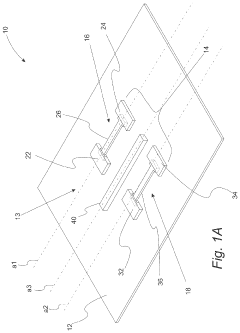
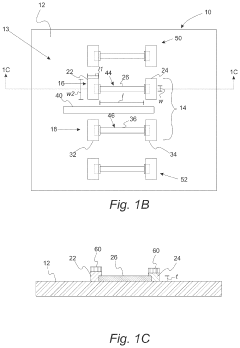
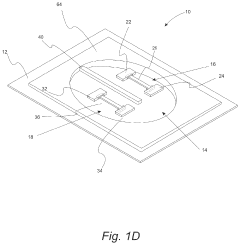
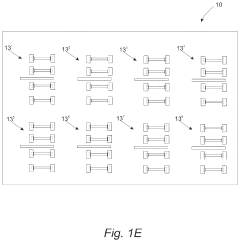
Wearable biosensors and applications thereof
PatentActiveUS11813057B2
Innovation
- Development of highly sensitive In2O3 nanoribbon transistor biosensors with integrated on-chip gold gate electrodes, deposited on flexible polyethylene terephthalate substrates, functionalized with glucose oxidase, chitosan, and single-walled carbon nanotubes, capable of detecting glucose concentrations between 10 nM to 1 mM in external body fluids without breaking the skin.
Electronics module for a wearable article and system incorporating an electronics module and a wearable article
PatentActiveGB2619291A
Innovation
- The electronics module incorporates a controller with selectable filters, including high pass filters and a variable capacitor, to adjust the level of signal filtering based on operational context, such as activity level or ambient temperature, to enhance noise rejection.


Materials Science Advancements for Flexible Biosensors
Recent advancements in materials science have revolutionized the development of flexible biosensors, enabling seamless integration with wearable electronic systems. Traditional rigid electronic components have given way to stretchable, bendable materials that conform to the human body's natural contours while maintaining high performance and reliability. These innovations address the fundamental challenge of creating biosensors that can withstand the dynamic movements of the human body without compromising data accuracy.
Polymeric substrates such as polyimide, polydimethylsiloxane (PDMS), and polyethylene terephthalate (PET) have emerged as leading materials for flexible biosensor platforms. These materials offer excellent mechanical properties, including low Young's modulus and high elongation at break, allowing them to stretch and bend repeatedly without structural failure. Additionally, researchers have developed novel composite materials that combine the flexibility of polymers with the electrical conductivity of nanomaterials like graphene, carbon nanotubes, and silver nanowires.
Conductive inks represent another significant advancement, enabling direct printing of electronic circuits onto flexible substrates. These inks typically contain metallic nanoparticles suspended in solvents that, when cured, form conductive pathways with minimal resistance. Screen printing, inkjet printing, and aerosol jet printing technologies have been optimized for depositing these materials with high precision, even on curved surfaces, facilitating mass production of flexible biosensors.
Encapsulation technologies have also progressed substantially, addressing the critical need to protect sensitive electronic components from environmental factors while maintaining flexibility. Thin-film barrier layers composed of alternating organic and inorganic materials provide effective protection against moisture and oxygen penetration while remaining mechanically compliant. These multilayer structures can achieve water vapor transmission rates below 10^-6 g/m²/day, ensuring long-term reliability of flexible biosensors in real-world applications.
Self-healing materials represent the cutting edge of flexible biosensor development, offering the ability to automatically repair mechanical damage. These materials incorporate microcapsules containing healing agents or utilize dynamic chemical bonds that can reform after being broken. When integrated into biosensor designs, self-healing materials significantly extend device lifespan by mitigating the effects of repeated mechanical stress, addressing one of the primary failure modes of wearable electronics.
Bioresorbable materials constitute another frontier, enabling the creation of temporary biosensors that naturally degrade after fulfilling their function. These materials, including certain silk fibroin derivatives, magnesium alloys, and biodegradable polymers, eliminate the need for surgical removal of implanted devices and reduce electronic waste. The controlled dissolution rates of these materials can be engineered to match specific monitoring timeframes, from days to months, expanding the application scope of wearable biosensors.
Polymeric substrates such as polyimide, polydimethylsiloxane (PDMS), and polyethylene terephthalate (PET) have emerged as leading materials for flexible biosensor platforms. These materials offer excellent mechanical properties, including low Young's modulus and high elongation at break, allowing them to stretch and bend repeatedly without structural failure. Additionally, researchers have developed novel composite materials that combine the flexibility of polymers with the electrical conductivity of nanomaterials like graphene, carbon nanotubes, and silver nanowires.
Conductive inks represent another significant advancement, enabling direct printing of electronic circuits onto flexible substrates. These inks typically contain metallic nanoparticles suspended in solvents that, when cured, form conductive pathways with minimal resistance. Screen printing, inkjet printing, and aerosol jet printing technologies have been optimized for depositing these materials with high precision, even on curved surfaces, facilitating mass production of flexible biosensors.
Encapsulation technologies have also progressed substantially, addressing the critical need to protect sensitive electronic components from environmental factors while maintaining flexibility. Thin-film barrier layers composed of alternating organic and inorganic materials provide effective protection against moisture and oxygen penetration while remaining mechanically compliant. These multilayer structures can achieve water vapor transmission rates below 10^-6 g/m²/day, ensuring long-term reliability of flexible biosensors in real-world applications.
Self-healing materials represent the cutting edge of flexible biosensor development, offering the ability to automatically repair mechanical damage. These materials incorporate microcapsules containing healing agents or utilize dynamic chemical bonds that can reform after being broken. When integrated into biosensor designs, self-healing materials significantly extend device lifespan by mitigating the effects of repeated mechanical stress, addressing one of the primary failure modes of wearable electronics.
Bioresorbable materials constitute another frontier, enabling the creation of temporary biosensors that naturally degrade after fulfilling their function. These materials, including certain silk fibroin derivatives, magnesium alloys, and biodegradable polymers, eliminate the need for surgical removal of implanted devices and reduce electronic waste. The controlled dissolution rates of these materials can be engineered to match specific monitoring timeframes, from days to months, expanding the application scope of wearable biosensors.
Power Management Strategies for Wearable Biosystems
Power management represents a critical challenge in wearable biosensor systems, requiring innovative solutions to balance performance with energy constraints. Current wearable biosensors typically employ lithium-ion or lithium-polymer batteries due to their high energy density and rechargeability. However, these power sources often constitute the bulkiest component of wearable devices, creating a fundamental design tension between battery capacity and form factor.
Advanced power management strategies have emerged to address these limitations. Dynamic voltage scaling (DVS) and adaptive duty cycling techniques allow biosensors to adjust their power consumption based on operational requirements. When full sensing capabilities are unnecessary, these systems can reduce sampling rates or enter low-power states, significantly extending battery life without compromising essential functions.
Energy harvesting technologies represent another promising frontier, enabling wearables to supplement battery power with ambient energy. Photovoltaic cells integrated into device surfaces can capture light energy, while thermoelectric generators exploit temperature differentials between the human body and environment. Kinetic energy harvesters convert body movement into electrical power, particularly effective in motion-intensive applications.
Wireless power transfer (WPT) systems offer an alternative approach, eliminating the need for physical charging connections. Near-field inductive coupling enables power transmission over short distances, while resonant coupling extends this range for greater user convenience. These technologies are particularly valuable for implantable biosensors where battery replacement presents significant challenges.
System-level optimization strategies further enhance power efficiency. Hardware-software co-design ensures that processing algorithms are optimized for the specific energy constraints of wearable platforms. Edge computing architectures reduce power consumption by processing biosensor data locally rather than transmitting raw data streams to external devices, minimizing energy-intensive wireless communication.
Recent innovations include ultra-low-power microcontrollers specifically designed for wearable applications, operating at sub-threshold voltages to minimize power consumption during both active and sleep states. Power-aware communication protocols optimize data transmission patterns, while intelligent power management systems can learn user behavior patterns to anticipate power needs and allocate resources accordingly.
The integration of these strategies creates a comprehensive approach to power management that extends device operational time while maintaining the compact form factors essential for wearable adoption. As biosensor technology continues to advance, these power management innovations will remain crucial enablers for the next generation of wearable health monitoring systems.
Advanced power management strategies have emerged to address these limitations. Dynamic voltage scaling (DVS) and adaptive duty cycling techniques allow biosensors to adjust their power consumption based on operational requirements. When full sensing capabilities are unnecessary, these systems can reduce sampling rates or enter low-power states, significantly extending battery life without compromising essential functions.
Energy harvesting technologies represent another promising frontier, enabling wearables to supplement battery power with ambient energy. Photovoltaic cells integrated into device surfaces can capture light energy, while thermoelectric generators exploit temperature differentials between the human body and environment. Kinetic energy harvesters convert body movement into electrical power, particularly effective in motion-intensive applications.
Wireless power transfer (WPT) systems offer an alternative approach, eliminating the need for physical charging connections. Near-field inductive coupling enables power transmission over short distances, while resonant coupling extends this range for greater user convenience. These technologies are particularly valuable for implantable biosensors where battery replacement presents significant challenges.
System-level optimization strategies further enhance power efficiency. Hardware-software co-design ensures that processing algorithms are optimized for the specific energy constraints of wearable platforms. Edge computing architectures reduce power consumption by processing biosensor data locally rather than transmitting raw data streams to external devices, minimizing energy-intensive wireless communication.
Recent innovations include ultra-low-power microcontrollers specifically designed for wearable applications, operating at sub-threshold voltages to minimize power consumption during both active and sleep states. Power-aware communication protocols optimize data transmission patterns, while intelligent power management systems can learn user behavior patterns to anticipate power needs and allocate resources accordingly.
The integration of these strategies creates a comprehensive approach to power management that extends device operational time while maintaining the compact form factors essential for wearable adoption. As biosensor technology continues to advance, these power management innovations will remain crucial enablers for the next generation of wearable health monitoring systems.
Unlock deeper insights with Patsnap Eureka Quick Research — get a full tech report to explore trends and direct your research. Try now!
Generate Your Research Report Instantly with AI Agent
Supercharge your innovation with Patsnap Eureka AI Agent Platform!