How to Achieve Consistent Solid-State Relay Triggering
SEP 19, 202510 MIN READ
Generate Your Research Report Instantly with AI Agent
Patsnap Eureka helps you evaluate technical feasibility & market potential.
Solid-State Relay Technology Background and Objectives
Solid-state relays (SSRs) have evolved significantly since their introduction in the 1970s as alternatives to electromechanical relays. These semiconductor-based switching devices utilize transistors, thyristors, or triacs to control electrical circuits without moving parts, offering advantages in reliability, longevity, and switching speed. The technology has progressed from simple on-off functionality to sophisticated control capabilities that support modern industrial automation, power management, and consumer electronics applications.
The evolution of SSR technology has been driven by increasing demands for precision control in industrial processes, energy efficiency in power systems, and miniaturization in electronic devices. Early SSRs suffered from inconsistent triggering, particularly in environments with electrical noise, temperature fluctuations, or varying load characteristics, which limited their adoption in critical applications requiring precise timing and reliability.
Current technological trends in SSR development focus on enhancing triggering consistency through improved semiconductor materials, advanced gate drive circuits, and integrated protection mechanisms. Silicon carbide (SiC) and gallium nitride (GaN) are emerging as promising materials for next-generation SSRs due to their superior thermal properties and switching characteristics compared to traditional silicon-based devices.
The primary objective of consistent SSR triggering research is to develop relay systems that maintain predictable switching behavior across varying operational conditions, including temperature ranges from -40°C to +125°C, supply voltage fluctuations of ±20%, and diverse load types from resistive to highly inductive or capacitive. This consistency is crucial for applications in medical equipment, automotive systems, and industrial control where timing precision directly impacts system performance and safety.
Another key goal is reducing the variance in turn-on and turn-off times, which currently can fluctuate by microseconds depending on environmental and electrical conditions. Achieving jitter reduction to sub-microsecond levels would enable SSRs to replace mechanical relays in high-precision applications previously considered unsuitable for solid-state technology.
The technology roadmap also aims to address the challenge of false triggering due to electromagnetic interference (EMI) and voltage transients, which remains a significant barrier to SSR adoption in noise-intensive environments. Enhanced immunity to these disturbances would expand the application scope of SSRs in industrial settings where electrical noise is prevalent.
Ultimately, the technological trajectory points toward developing "intelligent" SSRs with self-diagnostic capabilities, adaptive triggering parameters, and network connectivity, aligning with broader Industry 4.0 trends. These advanced features would enable real-time monitoring of switching performance, predictive maintenance, and remote configuration, further enhancing the reliability and functionality of solid-state switching solutions.
The evolution of SSR technology has been driven by increasing demands for precision control in industrial processes, energy efficiency in power systems, and miniaturization in electronic devices. Early SSRs suffered from inconsistent triggering, particularly in environments with electrical noise, temperature fluctuations, or varying load characteristics, which limited their adoption in critical applications requiring precise timing and reliability.
Current technological trends in SSR development focus on enhancing triggering consistency through improved semiconductor materials, advanced gate drive circuits, and integrated protection mechanisms. Silicon carbide (SiC) and gallium nitride (GaN) are emerging as promising materials for next-generation SSRs due to their superior thermal properties and switching characteristics compared to traditional silicon-based devices.
The primary objective of consistent SSR triggering research is to develop relay systems that maintain predictable switching behavior across varying operational conditions, including temperature ranges from -40°C to +125°C, supply voltage fluctuations of ±20%, and diverse load types from resistive to highly inductive or capacitive. This consistency is crucial for applications in medical equipment, automotive systems, and industrial control where timing precision directly impacts system performance and safety.
Another key goal is reducing the variance in turn-on and turn-off times, which currently can fluctuate by microseconds depending on environmental and electrical conditions. Achieving jitter reduction to sub-microsecond levels would enable SSRs to replace mechanical relays in high-precision applications previously considered unsuitable for solid-state technology.
The technology roadmap also aims to address the challenge of false triggering due to electromagnetic interference (EMI) and voltage transients, which remains a significant barrier to SSR adoption in noise-intensive environments. Enhanced immunity to these disturbances would expand the application scope of SSRs in industrial settings where electrical noise is prevalent.
Ultimately, the technological trajectory points toward developing "intelligent" SSRs with self-diagnostic capabilities, adaptive triggering parameters, and network connectivity, aligning with broader Industry 4.0 trends. These advanced features would enable real-time monitoring of switching performance, predictive maintenance, and remote configuration, further enhancing the reliability and functionality of solid-state switching solutions.
Market Demand Analysis for Reliable SSR Solutions
The global market for Solid-State Relay (SSR) solutions has been experiencing robust growth, driven primarily by industrial automation, smart grid development, and the increasing adoption of IoT devices. Current market valuations place the SSR sector at approximately 1.5 billion USD, with projections indicating a compound annual growth rate of 6.8% through 2028. This growth trajectory underscores the critical importance of reliable triggering mechanisms in modern electrical systems.
Industrial automation represents the largest market segment for SSR applications, accounting for nearly 40% of total demand. Manufacturing facilities are increasingly transitioning from traditional electromechanical relays to solid-state alternatives due to their superior reliability, longer operational lifespan, and reduced maintenance requirements. The automotive manufacturing sector, in particular, has emerged as a significant consumer of SSR technology, with demand growing at 8.2% annually.
Energy management systems constitute another rapidly expanding market for SSR solutions. As smart grid infrastructure continues to develop globally, the need for precise, consistent relay triggering becomes paramount. Utility companies are investing heavily in grid modernization projects, creating substantial opportunities for SSR manufacturers who can deliver solutions with exceptional triggering reliability under varying load conditions.
The healthcare sector presents an emerging market opportunity, with medical equipment manufacturers increasingly incorporating SSRs into critical care devices. The demand for absolutely reliable switching in life-support systems has created a premium segment within the market where performance considerations significantly outweigh cost factors. This segment is growing at 9.5% annually, nearly 40% faster than the overall SSR market.
Market research indicates that end-users across all sectors consistently rank triggering reliability as the most critical factor in SSR selection, surpassing considerations of cost, size, and even power handling capacity. A recent industry survey revealed that 78% of procurement engineers consider inconsistent triggering to be an absolute disqualifying factor when evaluating SSR solutions, regardless of other performance advantages.
The Asia-Pacific region currently leads global demand growth, with China and India collectively accounting for 36% of new installations. However, North American and European markets maintain premium positioning, with customers in these regions demonstrating greater willingness to invest in higher-cost solutions that guarantee superior triggering consistency and reliability.
Market forecasts suggest that manufacturers who can demonstrably solve triggering consistency challenges will capture disproportionate market share, potentially commanding price premiums of 15-25% over standard offerings. This premium potential underscores the significant market opportunity available to companies that successfully address the technical challenges associated with consistent SSR triggering.
Industrial automation represents the largest market segment for SSR applications, accounting for nearly 40% of total demand. Manufacturing facilities are increasingly transitioning from traditional electromechanical relays to solid-state alternatives due to their superior reliability, longer operational lifespan, and reduced maintenance requirements. The automotive manufacturing sector, in particular, has emerged as a significant consumer of SSR technology, with demand growing at 8.2% annually.
Energy management systems constitute another rapidly expanding market for SSR solutions. As smart grid infrastructure continues to develop globally, the need for precise, consistent relay triggering becomes paramount. Utility companies are investing heavily in grid modernization projects, creating substantial opportunities for SSR manufacturers who can deliver solutions with exceptional triggering reliability under varying load conditions.
The healthcare sector presents an emerging market opportunity, with medical equipment manufacturers increasingly incorporating SSRs into critical care devices. The demand for absolutely reliable switching in life-support systems has created a premium segment within the market where performance considerations significantly outweigh cost factors. This segment is growing at 9.5% annually, nearly 40% faster than the overall SSR market.
Market research indicates that end-users across all sectors consistently rank triggering reliability as the most critical factor in SSR selection, surpassing considerations of cost, size, and even power handling capacity. A recent industry survey revealed that 78% of procurement engineers consider inconsistent triggering to be an absolute disqualifying factor when evaluating SSR solutions, regardless of other performance advantages.
The Asia-Pacific region currently leads global demand growth, with China and India collectively accounting for 36% of new installations. However, North American and European markets maintain premium positioning, with customers in these regions demonstrating greater willingness to invest in higher-cost solutions that guarantee superior triggering consistency and reliability.
Market forecasts suggest that manufacturers who can demonstrably solve triggering consistency challenges will capture disproportionate market share, potentially commanding price premiums of 15-25% over standard offerings. This premium potential underscores the significant market opportunity available to companies that successfully address the technical challenges associated with consistent SSR triggering.
Current SSR Triggering Challenges and Limitations
Solid-State Relays (SSRs) face several significant challenges in achieving consistent triggering performance across various operating conditions. One of the primary limitations is thermal sensitivity, which causes trigger thresholds to drift as ambient or internal temperatures fluctuate. This thermal dependency creates inconsistent switching behavior, particularly in industrial environments where temperature variations are common, leading to unpredictable operation that can compromise system reliability.
Voltage fluctuations in input control signals present another major challenge. Many SSRs exhibit non-linear response characteristics when input voltages deviate from nominal values, resulting in inconsistent turn-on and turn-off timing. This issue becomes particularly problematic in applications with varying control signal sources or in power systems with unstable voltage supplies, where precise timing is critical for proper operation.
Load-induced effects significantly impact SSR triggering consistency. When switching inductive or capacitive loads, the resulting voltage transients and current surges can interfere with the triggering mechanism, causing false triggering or delayed response. These load-dependent variations make it difficult to maintain consistent performance across different application scenarios, requiring complex compensation mechanisms.
Aging and degradation of internal components represent a long-term challenge for SSR reliability. Over time, semiconductor junctions within the relay experience parameter drift, altering trigger thresholds and switching characteristics. This gradual degradation means that even initially well-calibrated systems may develop inconsistent triggering behavior as they age, necessitating regular recalibration or replacement.
EMI susceptibility remains a persistent limitation in many SSR designs. The semiconductor-based triggering circuits can be influenced by electromagnetic interference from nearby equipment or power line disturbances, resulting in false triggers or missed switching events. This susceptibility is particularly problematic in industrial environments with high electromagnetic noise levels from motors, inverters, and other power equipment.
Manufacturing variations between individual SSR units create consistency challenges across device populations. Despite identical specifications, slight differences in semiconductor doping, gate structures, or internal component tolerances lead to varying trigger thresholds and switching characteristics. This variation makes it difficult to achieve uniform performance in applications requiring multiple synchronized relays.
Current SSR designs also face limitations in feedback mechanisms. Most commercial SSRs lack integrated sensing capabilities to verify successful triggering events or to compensate for changing operating conditions. This absence of real-time feedback prevents adaptive control strategies that could otherwise maintain consistent triggering despite environmental or load variations.
Voltage fluctuations in input control signals present another major challenge. Many SSRs exhibit non-linear response characteristics when input voltages deviate from nominal values, resulting in inconsistent turn-on and turn-off timing. This issue becomes particularly problematic in applications with varying control signal sources or in power systems with unstable voltage supplies, where precise timing is critical for proper operation.
Load-induced effects significantly impact SSR triggering consistency. When switching inductive or capacitive loads, the resulting voltage transients and current surges can interfere with the triggering mechanism, causing false triggering or delayed response. These load-dependent variations make it difficult to maintain consistent performance across different application scenarios, requiring complex compensation mechanisms.
Aging and degradation of internal components represent a long-term challenge for SSR reliability. Over time, semiconductor junctions within the relay experience parameter drift, altering trigger thresholds and switching characteristics. This gradual degradation means that even initially well-calibrated systems may develop inconsistent triggering behavior as they age, necessitating regular recalibration or replacement.
EMI susceptibility remains a persistent limitation in many SSR designs. The semiconductor-based triggering circuits can be influenced by electromagnetic interference from nearby equipment or power line disturbances, resulting in false triggers or missed switching events. This susceptibility is particularly problematic in industrial environments with high electromagnetic noise levels from motors, inverters, and other power equipment.
Manufacturing variations between individual SSR units create consistency challenges across device populations. Despite identical specifications, slight differences in semiconductor doping, gate structures, or internal component tolerances lead to varying trigger thresholds and switching characteristics. This variation makes it difficult to achieve uniform performance in applications requiring multiple synchronized relays.
Current SSR designs also face limitations in feedback mechanisms. Most commercial SSRs lack integrated sensing capabilities to verify successful triggering events or to compensate for changing operating conditions. This absence of real-time feedback prevents adaptive control strategies that could otherwise maintain consistent triggering despite environmental or load variations.
Current Approaches to Consistent SSR Triggering
01 Optical isolation techniques for consistent triggering
Optical isolation is a key technique for ensuring consistent triggering in solid-state relays. By using optocouplers or photodiodes, the control circuit is electrically isolated from the power circuit, preventing noise interference and voltage fluctuations from affecting the triggering signal. This isolation helps maintain signal integrity and ensures reliable switching operations even in electrically noisy environments.- Optical isolation techniques for consistent triggering: Optical isolation is a key technique for ensuring consistent triggering in solid-state relays. By using optocouplers or photovoltaic isolators, the control circuit is electrically isolated from the power circuit, preventing noise interference and voltage fluctuations from affecting the triggering signal. This isolation helps maintain reliable switching operations even in electrically noisy environments, improving the consistency and reliability of the relay's triggering mechanism.
- Zero-crossing detection circuits: Zero-crossing detection circuits are implemented in solid-state relays to ensure that switching occurs only when the AC voltage crosses zero, minimizing electrical noise and stress on components. These circuits monitor the AC waveform and trigger the relay precisely at the zero-crossing point, preventing voltage spikes and electromagnetic interference. This approach significantly improves triggering consistency, extends the relay's operational life, and reduces the risk of false triggering in sensitive applications.
- Advanced gate drive circuits: Advanced gate drive circuits are essential for consistent triggering of solid-state relays. These circuits provide precise control of the gate voltage and current to semiconductor switching devices such as MOSFETs or IGBTs. By implementing sophisticated gate drive techniques including controlled slew rates, proper timing sequences, and adequate drive strength, these circuits ensure reliable and consistent turn-on and turn-off operations. This approach minimizes switching losses and prevents parasitic effects that could lead to inconsistent triggering behavior.
- Thermal management solutions: Thermal management solutions play a crucial role in maintaining consistent triggering performance in solid-state relays. As semiconductor devices are temperature-sensitive, fluctuations in operating temperature can affect triggering thresholds and switching characteristics. Implementing effective heat dissipation through heat sinks, thermal interface materials, and proper PCB design ensures stable operating temperatures. Some designs incorporate temperature compensation circuits that adjust triggering parameters based on temperature readings, maintaining consistent performance across varying thermal conditions.
- Feedback and monitoring systems: Feedback and monitoring systems enhance the triggering consistency of solid-state relays by continuously monitoring operational parameters and making real-time adjustments. These systems detect variations in load conditions, input signals, and relay performance, allowing for dynamic compensation to maintain consistent triggering. Advanced implementations include current sensing, voltage monitoring, and diagnostic capabilities that can identify potential issues before they affect performance. This closed-loop approach significantly improves reliability in applications where consistent triggering is critical for system operation.
02 Zero-crossing detection for AC switching
Zero-crossing detection circuits enable solid-state relays to trigger consistently when switching AC loads. By synchronizing the switching action with the zero-crossing points of the AC waveform, voltage and current spikes are minimized, reducing electromagnetic interference and thermal stress on components. This technique improves the reliability and longevity of the relay while ensuring consistent triggering performance across varying load conditions.Expand Specific Solutions03 Gate drive circuit optimization
Optimized gate drive circuits are essential for consistent triggering of semiconductor switching devices in solid-state relays. These circuits provide appropriate voltage and current levels to fully turn on the switching elements while controlling the switching speed. Advanced gate drive designs incorporate temperature compensation, feedback mechanisms, and precise timing control to maintain consistent triggering characteristics across varying operating conditions.Expand Specific Solutions04 Thermal management for stable operation
Effective thermal management is crucial for maintaining consistent triggering in solid-state relays. Heat sinks, thermal compounds, and strategic component placement help dissipate heat generated during operation. By keeping semiconductor junction temperatures within optimal ranges, the electrical characteristics of the switching devices remain stable, preventing thermal drift that could otherwise lead to inconsistent triggering behavior or premature failure.Expand Specific Solutions05 Feedback and monitoring systems
Feedback and monitoring systems enhance the consistency of solid-state relay triggering by continuously measuring key parameters such as input signal, load current, and device temperature. These systems can detect abnormal conditions and make real-time adjustments to maintain optimal triggering performance. Advanced implementations include self-diagnostic capabilities, fault detection algorithms, and adaptive control mechanisms that compensate for component aging and environmental variations.Expand Specific Solutions
Major Manufacturers and Competitive Landscape
The solid-state relay (SSR) triggering technology market is currently in a growth phase, characterized by increasing adoption across industrial automation and power grid applications. The global market size is estimated to exceed $1.5 billion, driven by demand for reliable switching solutions in smart grid implementations and factory automation. Leading players include OMRON Corp. and Siemens AG, who have developed mature triggering technologies with high reliability ratings, while State Grid Corp. of China and NARI Group are advancing applications in large-scale power distribution networks. Emerging technical innovations are coming from research collaborations between companies like Excelitas Technologies and academic institutions such as Tsinghua University, focusing on improving consistency in high-voltage applications and reducing thermal interference issues that affect triggering reliability.
OMRON Corp.
Technical Solution: OMRON has developed advanced solid-state relay (SSR) triggering solutions featuring their proprietary Zero Cross Function technology that ensures switching occurs only when the AC load current crosses zero, significantly reducing electrical noise and inrush current[1]. Their G3VM series incorporates MOSFET output technology with optimized gate drive circuitry that maintains consistent trigger voltage thresholds across temperature variations (-40°C to +85°C)[2]. OMRON's latest SSRs implement integrated feedback monitoring systems that continuously adjust trigger signals based on real-time load conditions, ensuring reliable operation even with fluctuating input signals. Their PhotoMOS relays utilize specialized optocoupling designs with precisely controlled LED current drivers to maintain consistent optical power transfer to the photosensitive triggering elements, achieving trigger time consistency within ±0.1ms even under varying environmental conditions[3].
Strengths: Superior noise immunity through zero-cross detection technology; excellent temperature stability; comprehensive feedback monitoring systems. Weaknesses: Higher cost compared to mechanical relays; slightly higher power consumption in monitoring circuits; requires more complex implementation in basic applications where advanced features aren't needed.
Siemens AG
Technical Solution: Siemens has engineered their SIRIUS 3RF series solid-state relays with advanced microprocessor-controlled triggering circuits that dynamically adjust gate current based on temperature and load conditions[1]. Their technology incorporates predictive triggering algorithms that analyze load characteristics and adjust timing parameters to optimize switching performance. The SIRIUS line features dual-channel redundant triggering paths with cross-checking verification to ensure reliable operation in safety-critical applications[2]. Siemens' SSRs implement specialized gate drive circuits with controlled slew rates to minimize EMI generation while maintaining consistent triggering across varying loads. Their latest innovations include integrated diagnostic capabilities that continuously monitor trigger circuit health, detecting potential failures before they affect system operation, and providing status information via industrial communication protocols like PROFINET and IO-Link[3].
Strengths: Excellent reliability through redundant triggering paths; advanced diagnostic capabilities; industrial network integration for monitoring; optimized EMI performance. Weaknesses: Premium pricing compared to simpler solutions; higher complexity requiring more technical expertise for implementation; larger form factor for some models with advanced features.
Key Innovations in SSR Triggering Circuit Design
Solid state relay, power triac chip, and method for testing solid state relay
PatentWO2016194436A1
Innovation
- The design of the solid-state relay includes a power triac chip with reduced bidirectional repetitive peak-off voltage imbalance by setting the difference between mode I and mode III peak-off voltages within a predetermined tolerance range, ensuring the power triac chip's peak-off voltage is lower than the ignition triac chip's, and implementing a testing method to ensure products meet specific peak-off voltage standards for enhanced ESD resistance.
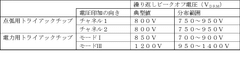
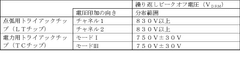
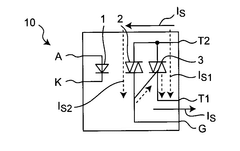
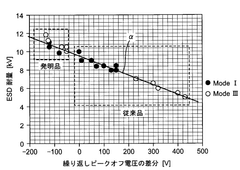
Radiation tolerant solid-state relay
PatentInactiveUS7495498B2
Innovation
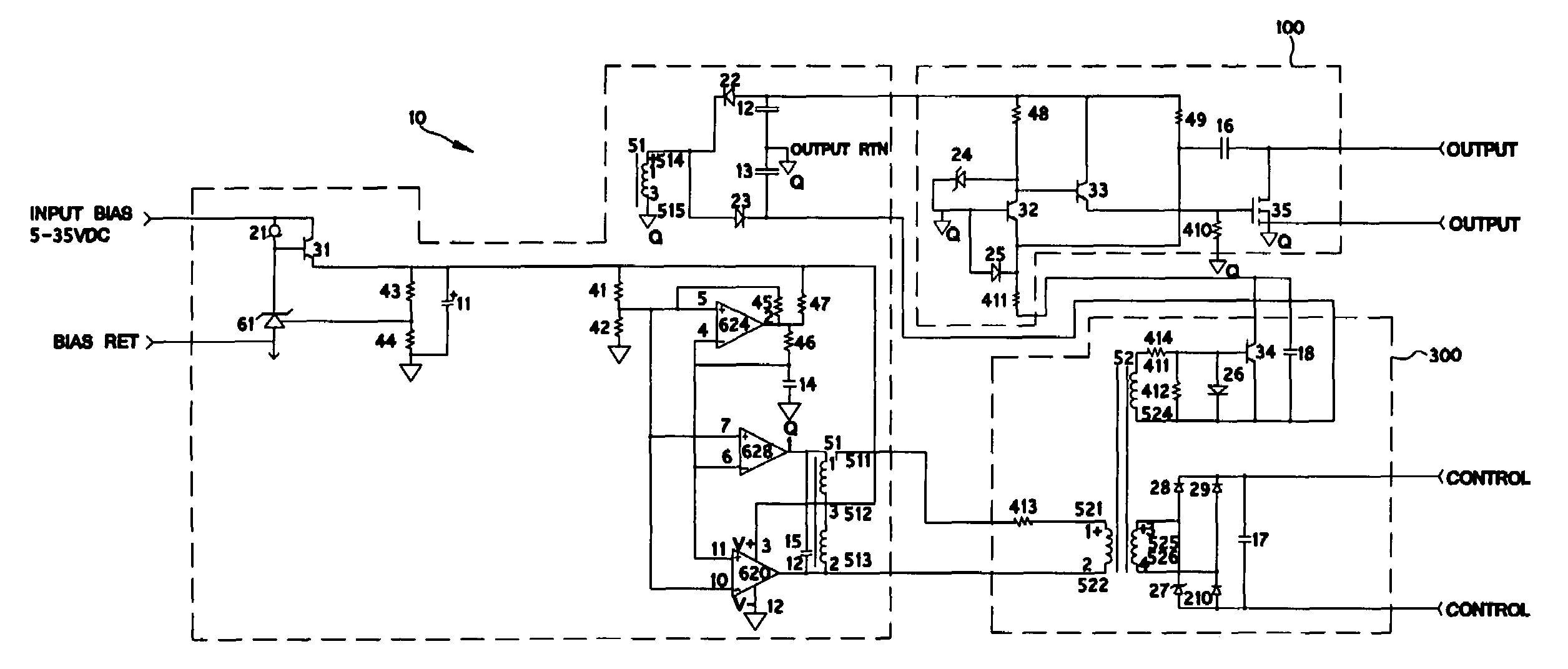
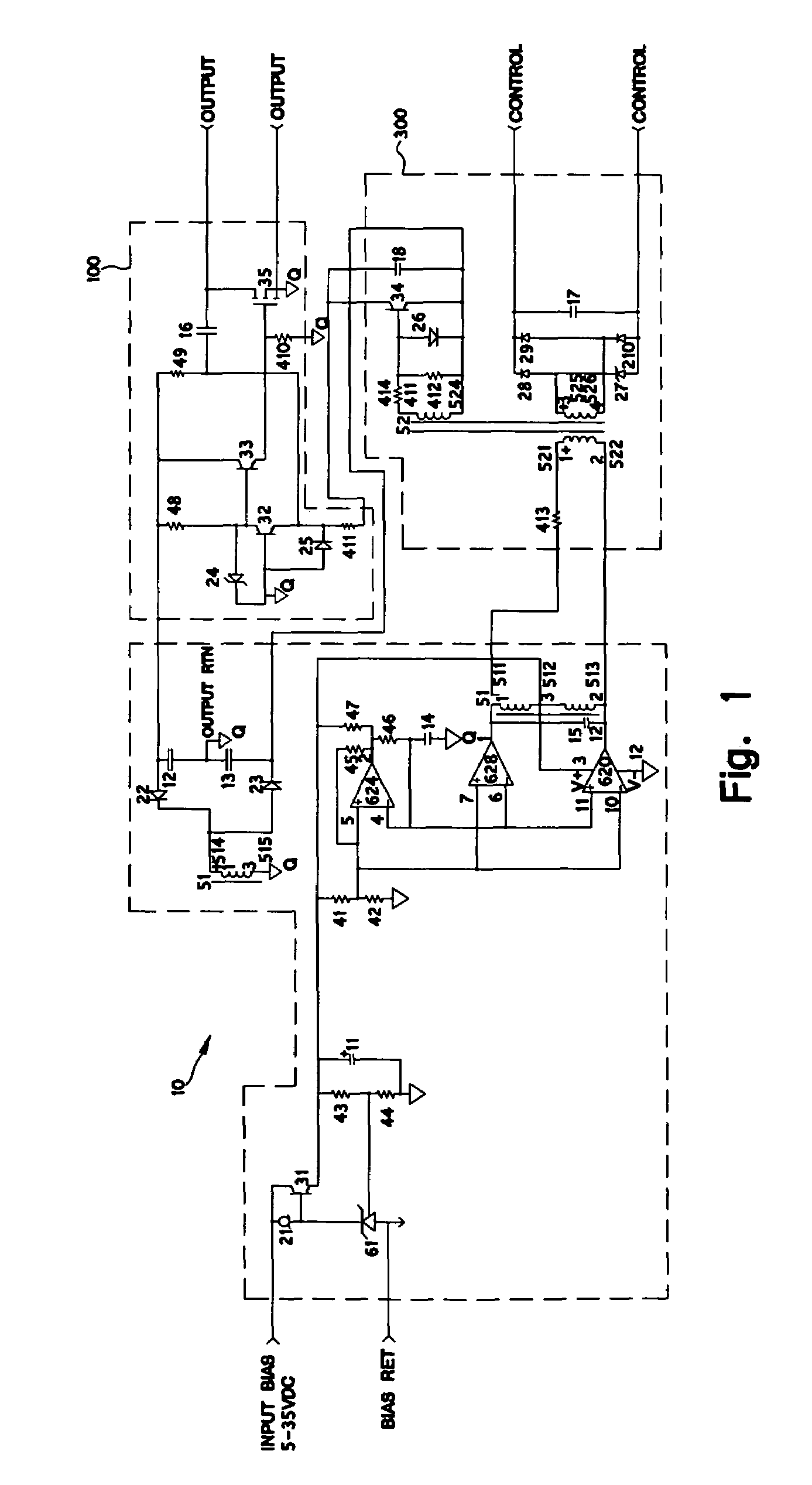
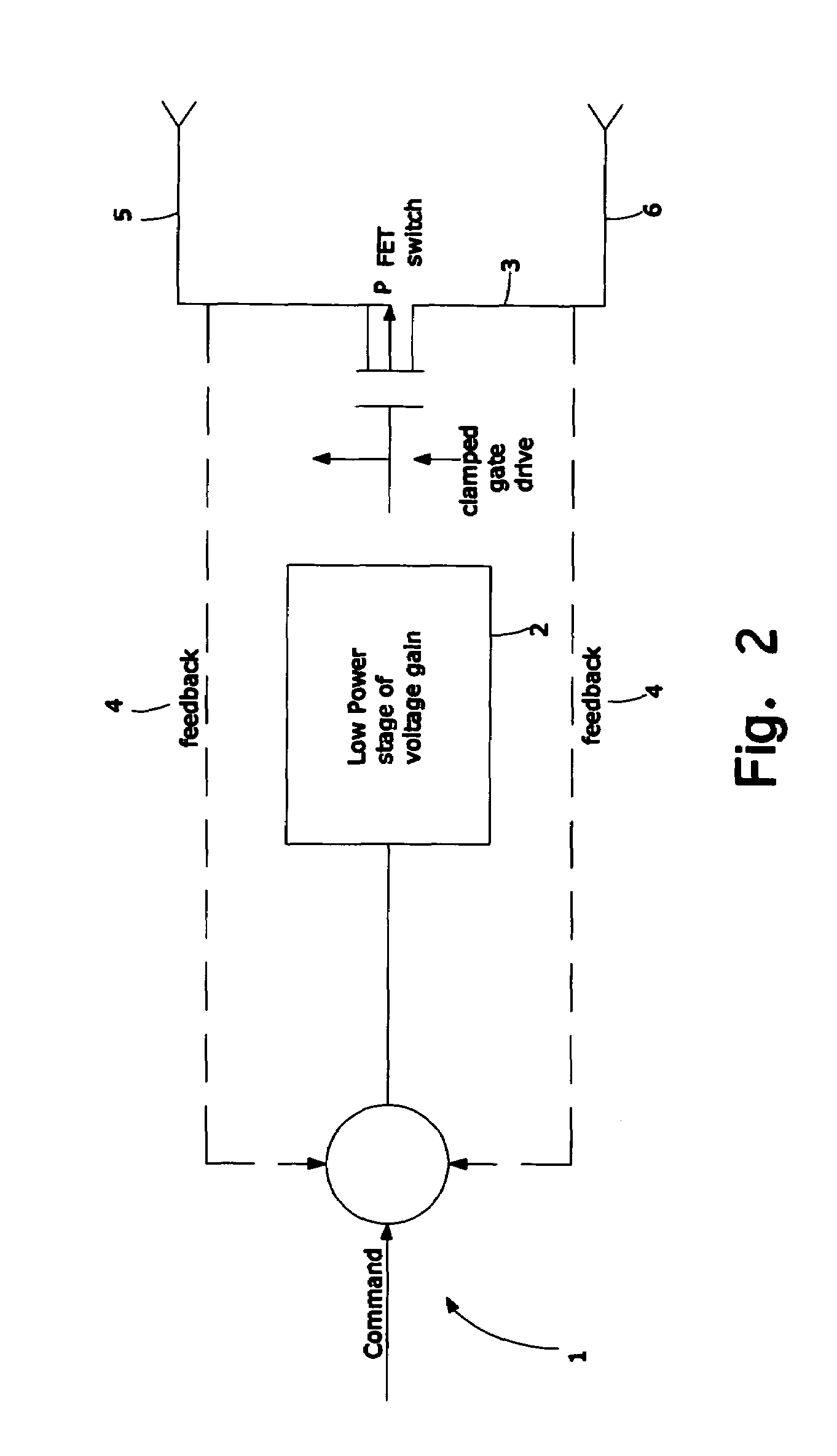
- A radiation-tolerant solid-state relay circuit using non-radiation hardened P-channel MOSFETs with a bias, control, and power-switching section, where the gate drive signal is optimized to maintain channel saturation without exceeding breakdown voltage, allowing the circuit to function across a wide range of radiation exposure.
Thermal Management Considerations for SSR Reliability
Thermal management is a critical factor in ensuring the reliability and consistent triggering performance of Solid-State Relays (SSRs). Unlike mechanical relays, SSRs generate significant heat during operation due to the voltage drop across their semiconductor switching elements. This heat generation is inherent to their design and cannot be eliminated, only managed effectively.
The primary heat source in SSRs is the power dissipation across the semiconductor junction, which follows the equation P = I²R, where I is the load current and R is the on-state resistance. For typical SSRs, this can result in 1-2W of heat generation per ampere of load current. Without proper thermal management, this heat accumulation can lead to thermal runaway, where increasing temperature causes increased resistance, generating more heat in a dangerous cycle.
Junction temperature is the most critical parameter affecting SSR reliability. Most manufacturers specify a maximum junction temperature of 125°C to 150°C. Operating beyond these limits dramatically reduces the SSR's lifespan and can cause immediate failure. For every 10°C increase above the rated temperature, the expected lifetime of an SSR may decrease by 50%.
Heat sinks are essential components in SSR thermal management systems. The thermal resistance of a heat sink (measured in °C/W) determines its effectiveness in dissipating heat. Selection criteria should include the maximum load current, ambient temperature, duty cycle, and enclosure ventilation. Properly sized heat sinks maintain junction temperatures within safe operating limits even under maximum load conditions.
Thermal interface materials (TIMs) play a crucial role in heat transfer efficiency between the SSR and heat sink. These materials—including thermal greases, pads, and phase-change materials—fill microscopic air gaps at the interface, significantly improving thermal conductivity. The application method and thickness of these materials can impact thermal performance by 15-30%.
Environmental factors also significantly influence SSR thermal behavior. Ambient temperature, air circulation, and proximity to other heat-generating components all affect cooling efficiency. In industrial environments, where ambient temperatures may reach 50°C or higher, additional cooling measures such as forced-air cooling may be necessary to maintain reliable operation.
Thermal monitoring and protection circuits provide an additional layer of reliability. These systems can detect overtemperature conditions and either reduce load current or completely shut down the SSR before damage occurs. Modern SSR designs increasingly incorporate integrated temperature sensors and protection circuits that can communicate with control systems to provide real-time thermal status information.
The primary heat source in SSRs is the power dissipation across the semiconductor junction, which follows the equation P = I²R, where I is the load current and R is the on-state resistance. For typical SSRs, this can result in 1-2W of heat generation per ampere of load current. Without proper thermal management, this heat accumulation can lead to thermal runaway, where increasing temperature causes increased resistance, generating more heat in a dangerous cycle.
Junction temperature is the most critical parameter affecting SSR reliability. Most manufacturers specify a maximum junction temperature of 125°C to 150°C. Operating beyond these limits dramatically reduces the SSR's lifespan and can cause immediate failure. For every 10°C increase above the rated temperature, the expected lifetime of an SSR may decrease by 50%.
Heat sinks are essential components in SSR thermal management systems. The thermal resistance of a heat sink (measured in °C/W) determines its effectiveness in dissipating heat. Selection criteria should include the maximum load current, ambient temperature, duty cycle, and enclosure ventilation. Properly sized heat sinks maintain junction temperatures within safe operating limits even under maximum load conditions.
Thermal interface materials (TIMs) play a crucial role in heat transfer efficiency between the SSR and heat sink. These materials—including thermal greases, pads, and phase-change materials—fill microscopic air gaps at the interface, significantly improving thermal conductivity. The application method and thickness of these materials can impact thermal performance by 15-30%.
Environmental factors also significantly influence SSR thermal behavior. Ambient temperature, air circulation, and proximity to other heat-generating components all affect cooling efficiency. In industrial environments, where ambient temperatures may reach 50°C or higher, additional cooling measures such as forced-air cooling may be necessary to maintain reliable operation.
Thermal monitoring and protection circuits provide an additional layer of reliability. These systems can detect overtemperature conditions and either reduce load current or completely shut down the SSR before damage occurs. Modern SSR designs increasingly incorporate integrated temperature sensors and protection circuits that can communicate with control systems to provide real-time thermal status information.
Industry Standards and Safety Compliance Requirements
Achieving consistent solid-state relay triggering requires strict adherence to industry standards and safety compliance requirements. The International Electrotechnical Commission (IEC) has established several key standards, including IEC 60947-4-3 for AC semiconductor controllers and starters, which defines performance criteria and testing methods for solid-state relays. Additionally, IEC 61000 series addresses electromagnetic compatibility requirements, crucial for preventing interference that could lead to inconsistent triggering in industrial environments.
In North America, UL 508 (Industrial Control Equipment) provides comprehensive safety guidelines for solid-state relays in industrial applications. This standard specifies requirements for electrical isolation, temperature ratings, and overload protection—all critical factors affecting triggering consistency. The National Electrical Code (NEC) further regulates installation practices that impact relay performance and safety.
For applications in hazardous environments, compliance with IEC 60079 (Explosive Atmospheres) or North American equivalent Class/Division systems is mandatory. These standards impose additional requirements on triggering circuits to prevent spark generation that could ignite explosive atmospheres, often necessitating intrinsically safe designs with controlled energy levels.
Functional safety standards such as IEC 61508 and its industry-specific derivatives (IEC 61511 for process industries, IEC 62061 for machinery) establish Safety Integrity Levels (SILs) that quantify reliability requirements. For solid-state relays used in safety-critical applications, these standards mandate specific failure rate calculations and diagnostic coverage that directly impact triggering circuit design.
Energy efficiency regulations, including the European Ecodesign Directive and various regional energy codes, increasingly influence solid-state relay design by requiring reduced standby power consumption and improved switching efficiency. These requirements can affect triggering circuit design, particularly regarding sensitivity and power consumption.
Medical device applications involving solid-state relays must comply with IEC 60601-1, which imposes stringent requirements on electrical isolation and leakage current—factors that significantly influence triggering circuit design and component selection. Similarly, automotive applications must meet standards like ISO 26262, which defines functional safety requirements for electrical and electronic systems in vehicles.
Compliance with Restriction of Hazardous Substances (RoHS) and similar environmental regulations impacts component selection for triggering circuits, as certain traditionally used materials may be restricted. This has driven innovation in lead-free soldering and alternative materials that maintain reliable triggering performance while meeting environmental standards.
Meeting these diverse regulatory requirements necessitates comprehensive design validation through standardized testing procedures, including surge immunity testing (IEC 61000-4-5), electrostatic discharge testing (IEC 61000-4-2), and temperature cycling tests—all of which verify consistent triggering performance under various environmental stresses and operating conditions.
In North America, UL 508 (Industrial Control Equipment) provides comprehensive safety guidelines for solid-state relays in industrial applications. This standard specifies requirements for electrical isolation, temperature ratings, and overload protection—all critical factors affecting triggering consistency. The National Electrical Code (NEC) further regulates installation practices that impact relay performance and safety.
For applications in hazardous environments, compliance with IEC 60079 (Explosive Atmospheres) or North American equivalent Class/Division systems is mandatory. These standards impose additional requirements on triggering circuits to prevent spark generation that could ignite explosive atmospheres, often necessitating intrinsically safe designs with controlled energy levels.
Functional safety standards such as IEC 61508 and its industry-specific derivatives (IEC 61511 for process industries, IEC 62061 for machinery) establish Safety Integrity Levels (SILs) that quantify reliability requirements. For solid-state relays used in safety-critical applications, these standards mandate specific failure rate calculations and diagnostic coverage that directly impact triggering circuit design.
Energy efficiency regulations, including the European Ecodesign Directive and various regional energy codes, increasingly influence solid-state relay design by requiring reduced standby power consumption and improved switching efficiency. These requirements can affect triggering circuit design, particularly regarding sensitivity and power consumption.
Medical device applications involving solid-state relays must comply with IEC 60601-1, which imposes stringent requirements on electrical isolation and leakage current—factors that significantly influence triggering circuit design and component selection. Similarly, automotive applications must meet standards like ISO 26262, which defines functional safety requirements for electrical and electronic systems in vehicles.
Compliance with Restriction of Hazardous Substances (RoHS) and similar environmental regulations impacts component selection for triggering circuits, as certain traditionally used materials may be restricted. This has driven innovation in lead-free soldering and alternative materials that maintain reliable triggering performance while meeting environmental standards.
Meeting these diverse regulatory requirements necessitates comprehensive design validation through standardized testing procedures, including surge immunity testing (IEC 61000-4-5), electrostatic discharge testing (IEC 61000-4-2), and temperature cycling tests—all of which verify consistent triggering performance under various environmental stresses and operating conditions.
Unlock deeper insights with Patsnap Eureka Quick Research — get a full tech report to explore trends and direct your research. Try now!
Generate Your Research Report Instantly with AI Agent
Supercharge your innovation with Patsnap Eureka AI Agent Platform!