

How to Analyze Solid-State Relay for Signal Integrity
SEP 19, 20259 MIN READ
Generate Your Research Report Instantly with AI Agent
PatSnap Eureka helps you evaluate technical feasibility & market potential.
Solid-State Relay Technology Background and Objectives
Solid-state relays (SSRs) have evolved significantly since their inception in the late 1960s, representing a revolutionary advancement over traditional electromechanical relays. The technology emerged as semiconductor capabilities expanded, offering a switching solution without moving parts. This fundamental shift eliminated mechanical wear and tear while dramatically improving reliability and operational lifespan. The evolution of SSRs has been closely tied to advancements in semiconductor physics, materials science, and integrated circuit design.
The progression of SSR technology has followed several distinct phases, beginning with simple thyristor-based designs and advancing to sophisticated integrated solutions incorporating MOSFETs, IGBTs, and advanced control circuitry. Each generation has brought improvements in switching speed, power handling capability, isolation characteristics, and signal integrity performance. Modern SSRs represent a convergence of multiple technological disciplines, combining power electronics with precision signal processing capabilities.
Signal integrity has become increasingly critical in SSR applications as modern systems operate at higher frequencies and lower voltages. The inherent characteristics of solid-state components—including capacitive coupling, semiconductor junction behavior, and thermal effects—create unique challenges for maintaining signal fidelity across the relay interface. These challenges are particularly pronounced in applications requiring high-speed data transmission, precise timing, or low-level signal detection.
The primary technical objectives in SSR signal integrity analysis include quantifying and minimizing signal distortion, reducing insertion loss, managing electromagnetic interference (EMI), and ensuring consistent performance across varying environmental conditions. Additionally, there is growing emphasis on understanding the complex interactions between SSRs and the systems they serve, particularly in mixed-signal environments where both power and data signals may be present.
Current research focuses on developing comprehensive analytical frameworks that can accurately model and predict SSR behavior under diverse operating conditions. This includes advanced simulation techniques, empirical testing methodologies, and the development of standardized metrics for evaluating signal integrity performance. The goal is to establish reliable design guidelines that enable engineers to select and implement SSRs with confidence in their signal handling capabilities.
As applications continue to demand higher performance in smaller packages, the technology trajectory points toward increased integration of sensing, protection, and diagnostic capabilities within SSR modules. This evolution aims to address signal integrity holistically, treating it not as an isolated parameter but as part of a comprehensive approach to system reliability and performance optimization. The convergence of power electronics, digital control systems, and advanced materials science promises to yield next-generation SSRs with unprecedented signal integrity characteristics.
The progression of SSR technology has followed several distinct phases, beginning with simple thyristor-based designs and advancing to sophisticated integrated solutions incorporating MOSFETs, IGBTs, and advanced control circuitry. Each generation has brought improvements in switching speed, power handling capability, isolation characteristics, and signal integrity performance. Modern SSRs represent a convergence of multiple technological disciplines, combining power electronics with precision signal processing capabilities.
Signal integrity has become increasingly critical in SSR applications as modern systems operate at higher frequencies and lower voltages. The inherent characteristics of solid-state components—including capacitive coupling, semiconductor junction behavior, and thermal effects—create unique challenges for maintaining signal fidelity across the relay interface. These challenges are particularly pronounced in applications requiring high-speed data transmission, precise timing, or low-level signal detection.
The primary technical objectives in SSR signal integrity analysis include quantifying and minimizing signal distortion, reducing insertion loss, managing electromagnetic interference (EMI), and ensuring consistent performance across varying environmental conditions. Additionally, there is growing emphasis on understanding the complex interactions between SSRs and the systems they serve, particularly in mixed-signal environments where both power and data signals may be present.
Current research focuses on developing comprehensive analytical frameworks that can accurately model and predict SSR behavior under diverse operating conditions. This includes advanced simulation techniques, empirical testing methodologies, and the development of standardized metrics for evaluating signal integrity performance. The goal is to establish reliable design guidelines that enable engineers to select and implement SSRs with confidence in their signal handling capabilities.
As applications continue to demand higher performance in smaller packages, the technology trajectory points toward increased integration of sensing, protection, and diagnostic capabilities within SSR modules. This evolution aims to address signal integrity holistically, treating it not as an isolated parameter but as part of a comprehensive approach to system reliability and performance optimization. The convergence of power electronics, digital control systems, and advanced materials science promises to yield next-generation SSRs with unprecedented signal integrity characteristics.
Market Demand Analysis for High-Integrity Signal Relays
The global market for high-integrity signal relays has experienced significant growth in recent years, driven by increasing demands across multiple industries for reliable signal transmission solutions. The market size for solid-state relays specifically reached approximately $1.5 billion in 2022, with projections indicating a compound annual growth rate of 6.8% through 2028. This growth trajectory reflects the expanding applications of these components in critical systems where signal integrity is paramount.
Industrial automation represents the largest market segment, accounting for nearly 35% of demand. Manufacturing facilities increasingly rely on high-integrity signal relays to ensure precise control of automated processes, where even momentary signal disruptions can result in production errors, equipment damage, or safety incidents. The push toward Industry 4.0 and smart manufacturing has further accelerated this demand, as interconnected systems require more sophisticated signal management solutions.
The telecommunications sector constitutes another significant market, with approximately 28% share. As data transmission volumes continue to surge globally, the need for relays capable of maintaining signal integrity across complex networks has become critical. Telecommunications providers are particularly focused on minimizing signal degradation in high-frequency applications, driving demand for advanced solid-state relay technologies.
Medical equipment manufacturers represent a rapidly growing market segment, currently at 15% but expanding at nearly twice the overall market rate. The life-critical nature of medical devices demands exceptionally reliable signal transmission, particularly in diagnostic equipment, patient monitoring systems, and surgical tools. Regulatory requirements in this sector further emphasize the need for components with proven signal integrity performance.
Aerospace and defense applications account for approximately 12% of the market, where extreme operating conditions and zero-tolerance for signal failures drive demand for specialized high-reliability solutions. The remaining market share is distributed across automotive, energy management, and consumer electronics applications.
Geographically, North America leads with 38% market share, followed by Europe (27%), Asia-Pacific (25%), and other regions (10%). However, the fastest growth is occurring in Asia-Pacific markets, particularly China and India, where rapid industrial expansion and infrastructure development are creating new demand centers.
Customer requirements are increasingly focused on miniaturization, enhanced switching speeds, reduced power consumption, and improved thermal management. Additionally, there is growing demand for relays capable of handling higher frequencies while maintaining signal integrity, particularly as 5G networks expand globally and IoT applications proliferate across industries.
Industrial automation represents the largest market segment, accounting for nearly 35% of demand. Manufacturing facilities increasingly rely on high-integrity signal relays to ensure precise control of automated processes, where even momentary signal disruptions can result in production errors, equipment damage, or safety incidents. The push toward Industry 4.0 and smart manufacturing has further accelerated this demand, as interconnected systems require more sophisticated signal management solutions.
The telecommunications sector constitutes another significant market, with approximately 28% share. As data transmission volumes continue to surge globally, the need for relays capable of maintaining signal integrity across complex networks has become critical. Telecommunications providers are particularly focused on minimizing signal degradation in high-frequency applications, driving demand for advanced solid-state relay technologies.
Medical equipment manufacturers represent a rapidly growing market segment, currently at 15% but expanding at nearly twice the overall market rate. The life-critical nature of medical devices demands exceptionally reliable signal transmission, particularly in diagnostic equipment, patient monitoring systems, and surgical tools. Regulatory requirements in this sector further emphasize the need for components with proven signal integrity performance.
Aerospace and defense applications account for approximately 12% of the market, where extreme operating conditions and zero-tolerance for signal failures drive demand for specialized high-reliability solutions. The remaining market share is distributed across automotive, energy management, and consumer electronics applications.
Geographically, North America leads with 38% market share, followed by Europe (27%), Asia-Pacific (25%), and other regions (10%). However, the fastest growth is occurring in Asia-Pacific markets, particularly China and India, where rapid industrial expansion and infrastructure development are creating new demand centers.
Customer requirements are increasingly focused on miniaturization, enhanced switching speeds, reduced power consumption, and improved thermal management. Additionally, there is growing demand for relays capable of handling higher frequencies while maintaining signal integrity, particularly as 5G networks expand globally and IoT applications proliferate across industries.
Current Challenges in SSR Signal Integrity Analysis
Signal integrity analysis for Solid-State Relays (SSRs) faces several significant challenges that impede accurate performance evaluation and reliable implementation. The primary challenge stems from the complex switching characteristics of SSRs, which exhibit non-linear behavior during state transitions. This non-linearity creates difficulties in predicting signal distortion, particularly in high-frequency applications where even minor anomalies can significantly impact system performance.
The parasitic capacitance inherent in SSR semiconductor structures presents another substantial obstacle. These capacitances create unwanted coupling paths that introduce noise and signal degradation, especially problematic in mixed-signal environments where analog and digital signals coexist. Current analysis methods often struggle to accurately model these parasitic elements across varying operating conditions and temperatures.
Temperature dependency further complicates SSR signal integrity analysis. The electrical characteristics of semiconductor materials within SSRs change significantly with temperature fluctuations, affecting switching times, on-state resistance, and leakage currents. Existing models frequently fail to capture these temperature-dependent variations comprehensively, leading to discrepancies between simulated and actual performance.
EMI/EMC considerations represent another critical challenge. SSRs can both generate electromagnetic interference and be susceptible to external electromagnetic fields. Current analysis tools often provide insufficient capabilities for predicting these interactions, particularly in densely packed electronic systems where multiple SSRs operate in proximity to sensitive components.
The lack of standardized testing methodologies specifically tailored for SSR signal integrity creates inconsistencies in evaluation approaches across the industry. This absence of standardization makes it difficult to compare performance metrics between different SSR implementations and manufacturers, hindering informed design decisions.
Advanced applications requiring precise timing control face challenges with SSR turn-on and turn-off delays. These delays vary based on load characteristics, control signal parameters, and environmental conditions. Current analysis methods struggle to accurately predict these timing variations, particularly in applications requiring synchronization between multiple switching elements.
Finally, the integration of SSRs into increasingly complex systems presents modeling challenges. As SSRs become part of larger integrated circuits or modules, the interactions between the SSR and surrounding components become more intricate. Existing simulation tools often fail to capture these system-level interactions adequately, leading to unexpected signal integrity issues that only manifest after physical implementation.
The parasitic capacitance inherent in SSR semiconductor structures presents another substantial obstacle. These capacitances create unwanted coupling paths that introduce noise and signal degradation, especially problematic in mixed-signal environments where analog and digital signals coexist. Current analysis methods often struggle to accurately model these parasitic elements across varying operating conditions and temperatures.
Temperature dependency further complicates SSR signal integrity analysis. The electrical characteristics of semiconductor materials within SSRs change significantly with temperature fluctuations, affecting switching times, on-state resistance, and leakage currents. Existing models frequently fail to capture these temperature-dependent variations comprehensively, leading to discrepancies between simulated and actual performance.
EMI/EMC considerations represent another critical challenge. SSRs can both generate electromagnetic interference and be susceptible to external electromagnetic fields. Current analysis tools often provide insufficient capabilities for predicting these interactions, particularly in densely packed electronic systems where multiple SSRs operate in proximity to sensitive components.
The lack of standardized testing methodologies specifically tailored for SSR signal integrity creates inconsistencies in evaluation approaches across the industry. This absence of standardization makes it difficult to compare performance metrics between different SSR implementations and manufacturers, hindering informed design decisions.
Advanced applications requiring precise timing control face challenges with SSR turn-on and turn-off delays. These delays vary based on load characteristics, control signal parameters, and environmental conditions. Current analysis methods struggle to accurately predict these timing variations, particularly in applications requiring synchronization between multiple switching elements.
Finally, the integration of SSRs into increasingly complex systems presents modeling challenges. As SSRs become part of larger integrated circuits or modules, the interactions between the SSR and surrounding components become more intricate. Existing simulation tools often fail to capture these system-level interactions adequately, leading to unexpected signal integrity issues that only manifest after physical implementation.
Current Methodologies for SSR Signal Integrity Testing
01 Noise reduction techniques in solid-state relay circuits
Various techniques are employed to reduce electrical noise and improve signal integrity in solid-state relay circuits. These include filtering components, isolation barriers, and specialized circuit designs that minimize electromagnetic interference. By implementing these noise reduction methods, the reliability of signal transmission through solid-state relays can be significantly enhanced, particularly in environments with high electrical noise.- Noise reduction techniques in solid-state relay circuits: Various techniques are employed to reduce noise and improve signal integrity in solid-state relay circuits. These include filtering components, isolation barriers, and specialized circuit designs that minimize electromagnetic interference. By implementing proper noise reduction techniques, the reliability of signal transmission through solid-state relays can be significantly enhanced, ensuring accurate switching operations even in electrically noisy environments.
- Optical isolation for signal integrity improvement: Optical isolation is a key method for maintaining signal integrity in solid-state relays. By converting electrical signals to optical signals and back, complete electrical isolation between input and output circuits is achieved. This prevents ground loops, common-mode noise, and voltage transients from affecting signal quality. Optically isolated solid-state relays provide superior protection against electromagnetic interference while ensuring reliable signal transmission.
- Advanced semiconductor materials for improved switching performance: The use of advanced semiconductor materials in solid-state relays significantly improves switching performance and signal integrity. Materials such as silicon carbide, gallium nitride, and specialized doping profiles enable faster switching speeds, lower on-state resistance, and better thermal characteristics. These improvements result in more reliable signal transmission, reduced signal distortion, and enhanced overall performance in high-frequency or high-power applications.
- Protection circuits for transient suppression: Protection circuits are essential components in solid-state relays to maintain signal integrity during transient events. These circuits include snubber networks, varistors, transient voltage suppressors, and specialized filtering components that absorb or redirect energy from voltage spikes and current surges. By implementing effective protection circuits, solid-state relays can maintain reliable operation and signal fidelity even when subjected to harsh electrical environments or switching inductive loads.
- Power management techniques for signal stability: Effective power management is crucial for maintaining signal stability in solid-state relay applications. This includes regulated power supplies, decoupling capacitors, voltage reference circuits, and power sequencing techniques. By ensuring stable and clean power delivery to the relay control and switching circuits, signal integrity is preserved throughout the switching operation. Advanced power management techniques also help minimize power consumption while maximizing switching reliability.
02 Optical isolation for signal integrity improvement
Optical isolation is a key technique for maintaining signal integrity in solid-state relays. By converting electrical signals to optical signals and back, complete electrical isolation between input and output circuits is achieved. This prevents ground loops and common-mode noise from affecting signal quality. The optical coupling components are designed to maintain fast switching speeds while providing high isolation voltage ratings.Expand Specific Solutions03 Advanced driver and control circuitry
Specialized driver and control circuits are implemented to maintain signal integrity in solid-state relays. These circuits include precise timing controls, level shifters, and impedance matching networks that ensure clean signal transitions. Advanced gate drive techniques reduce switching losses and prevent false triggering, while feedback mechanisms monitor and adjust signals to maintain optimal performance under varying conditions.Expand Specific Solutions04 Thermal management for signal stability
Effective thermal management is crucial for maintaining signal integrity in solid-state relays. Heat dissipation techniques including specialized packaging, heat sinks, and thermal interface materials help prevent temperature-related signal degradation. By controlling operating temperatures, these methods ensure consistent switching characteristics and prevent thermal runaway that could compromise signal quality or lead to device failure.Expand Specific Solutions05 EMI/EMC protection and shielding
Electromagnetic interference (EMI) and electromagnetic compatibility (EMC) protection techniques are essential for solid-state relay signal integrity. These include proper shielding, grounding schemes, and component placement strategies that minimize susceptibility to external electromagnetic fields. Specialized filter components and circuit topologies are employed to attenuate unwanted signals while allowing intended control signals to pass unimpeded.Expand Specific Solutions
Major Manufacturers and Competitive Landscape
The solid-state relay signal integrity analysis market is currently in a growth phase, with increasing demand driven by the expansion of industrial automation and smart grid applications. The market size is estimated to be around $1.2 billion globally, with a projected CAGR of 6-8% over the next five years. From a technical maturity perspective, industry leaders like IBM, Honeywell, and Robert Bosch have established advanced testing methodologies, while companies such as Synopsys and Thales are developing sophisticated simulation tools for signal integrity analysis. Taiwan Semiconductor and Samsung Electronics are focusing on integrating solid-state relay technologies with enhanced signal integrity features in their semiconductor offerings, creating a competitive landscape where hardware innovation meets software analysis capabilities.
International Business Machines Corp.
Technical Solution: IBM has developed a comprehensive solid-state relay signal integrity analysis framework that integrates advanced measurement techniques with sophisticated computational modeling. Their approach utilizes time-domain and frequency-domain analysis methods to characterize SSR performance across multiple operating conditions. IBM's system employs high-precision vector network analyzers to measure scattering parameters, providing detailed insights into signal reflection and transmission characteristics through SSRs. Their methodology incorporates eye diagram analysis techniques that can quantify signal quality metrics such as jitter, rise/fall times, and noise margins with exceptional precision. IBM has developed specialized test fixtures that maintain controlled impedance environments while allowing for accurate characterization of SSR switching behavior under various load conditions. Their analysis platform includes thermal imaging capabilities that can correlate temperature distributions with signal integrity issues, identifying potential hotspots that might affect performance. IBM's approach also leverages their expertise in quantum computing to develop next-generation analysis algorithms that can predict SSR behavior under complex operating scenarios with unprecedented accuracy.
Strengths: Industry-leading measurement precision; sophisticated computational modeling capabilities; extensive experience with high-reliability applications in data centers and mission-critical systems. Weaknesses: Solutions often optimized for high-end applications with less focus on cost-sensitive implementations; complex analysis tools require significant expertise; some proprietary technologies limit interoperability.
Synopsys, Inc.
Technical Solution: Synopsys has developed a comprehensive software-based approach to solid-state relay signal integrity analysis that integrates with their broader electronic design automation (EDA) ecosystem. Their methodology employs advanced circuit simulation techniques that can accurately model the complex switching behavior of SSRs, including parasitic effects that might impact signal integrity. Synopsys's platform includes specialized signal integrity analysis tools that can perform both time-domain and frequency-domain simulations, providing designers with a complete picture of SSR performance. Their approach incorporates electromagnetic field solvers that can accurately predict signal propagation characteristics through SSRs and surrounding circuitry. Synopsys has implemented advanced statistical analysis capabilities that can account for manufacturing variations and their impact on signal integrity, enabling robust design practices. Their methodology includes automated design rule checking specifically tailored for circuits incorporating SSRs, helping designers identify potential signal integrity issues early in the development process. Synopsys's platform also supports co-simulation of electrical and thermal effects, recognizing the significant impact that temperature variations can have on SSR performance and signal integrity.
Strengths: Seamless integration with broader electronic design workflows; sophisticated simulation capabilities that can predict performance before physical implementation; comprehensive design rule checking that catches potential issues early. Weaknesses: Primarily software-based approach may not capture all real-world behaviors; requires accurate device models which may not always be available; significant computational resources required for complex simulations.
Key Technical Innovations in Signal Integrity Analysis
User Interface for Signal Integrity Network Analyzer
PatentInactiveUS20140343883A1
Innovation
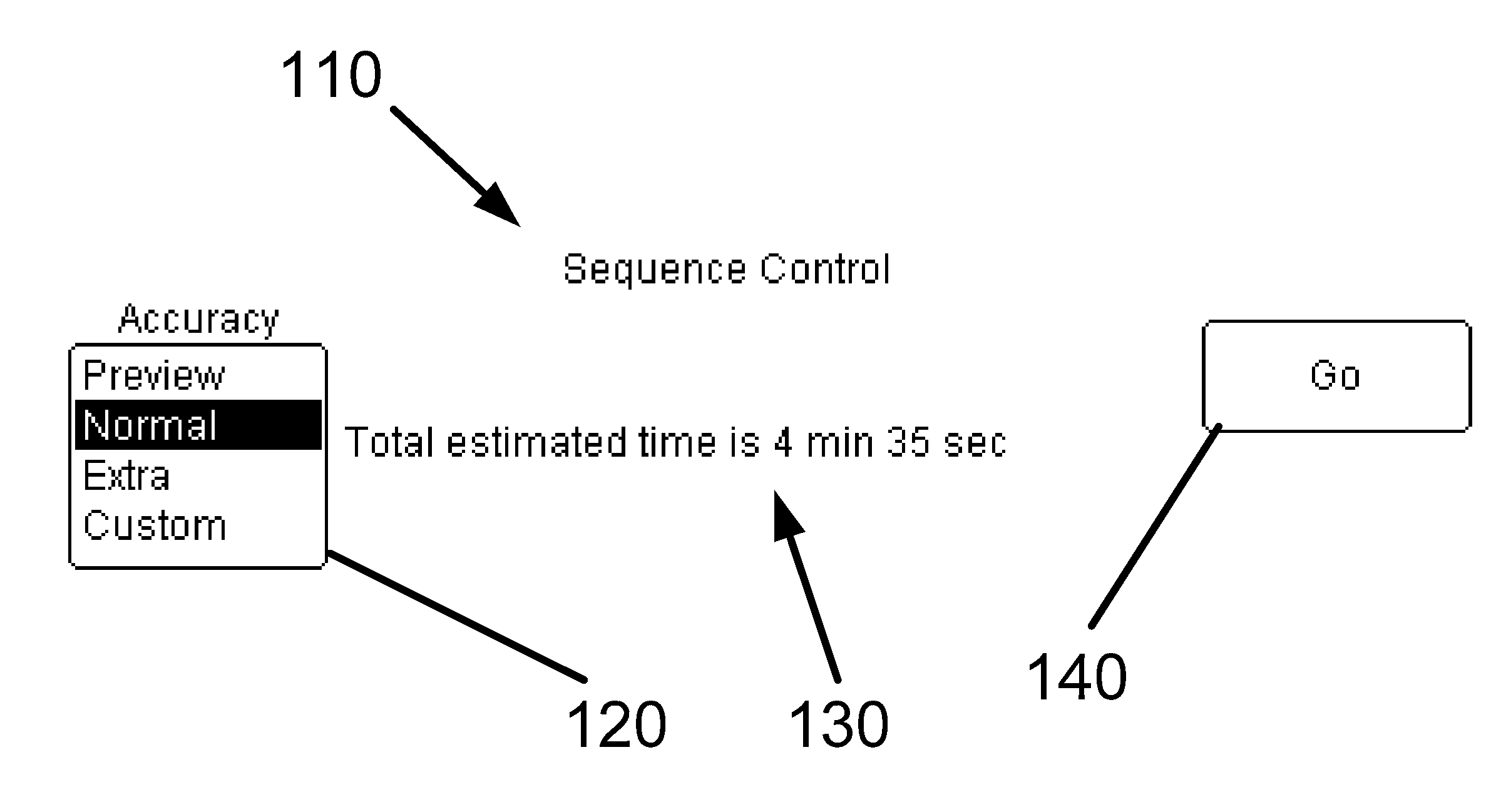
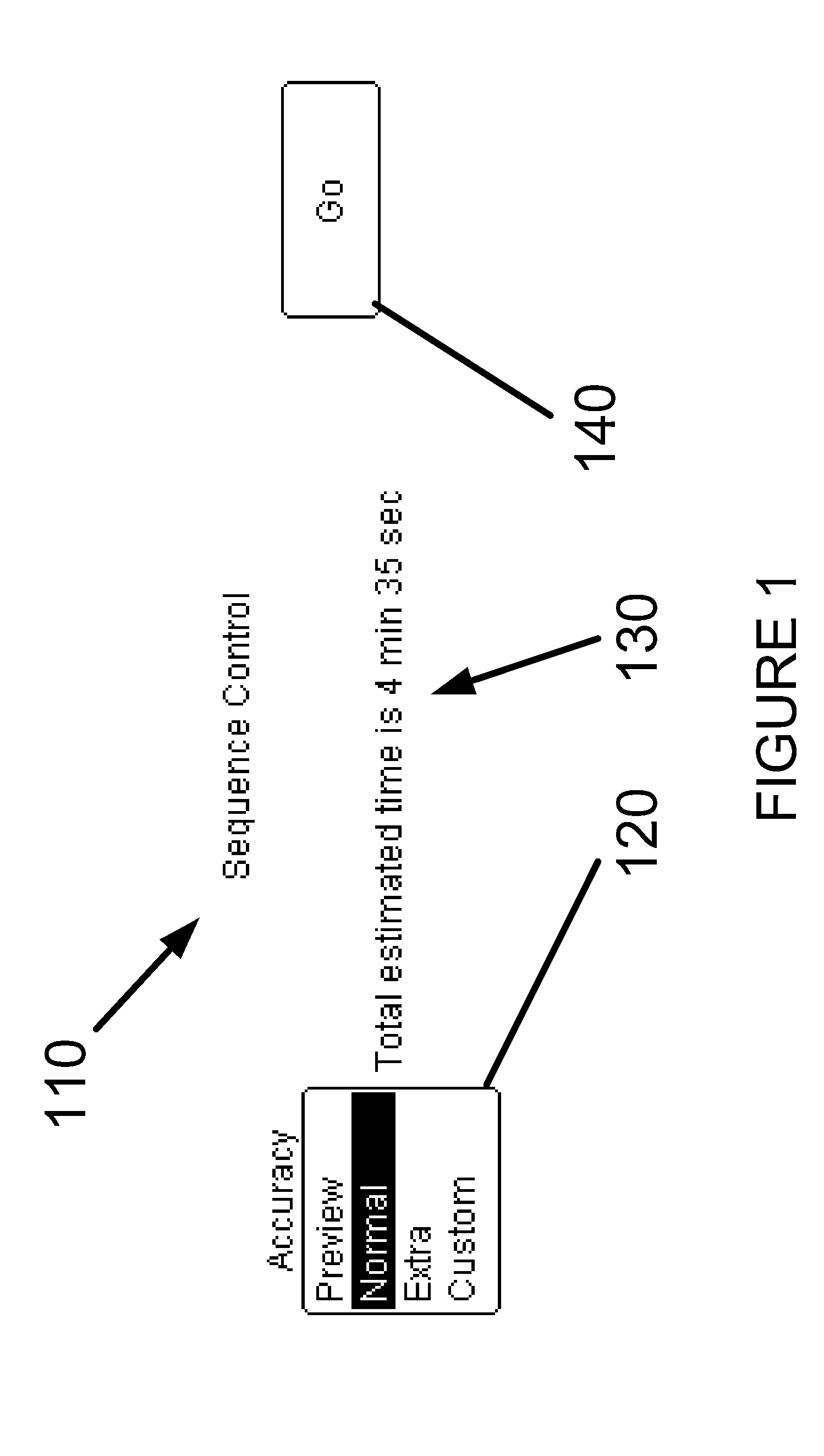
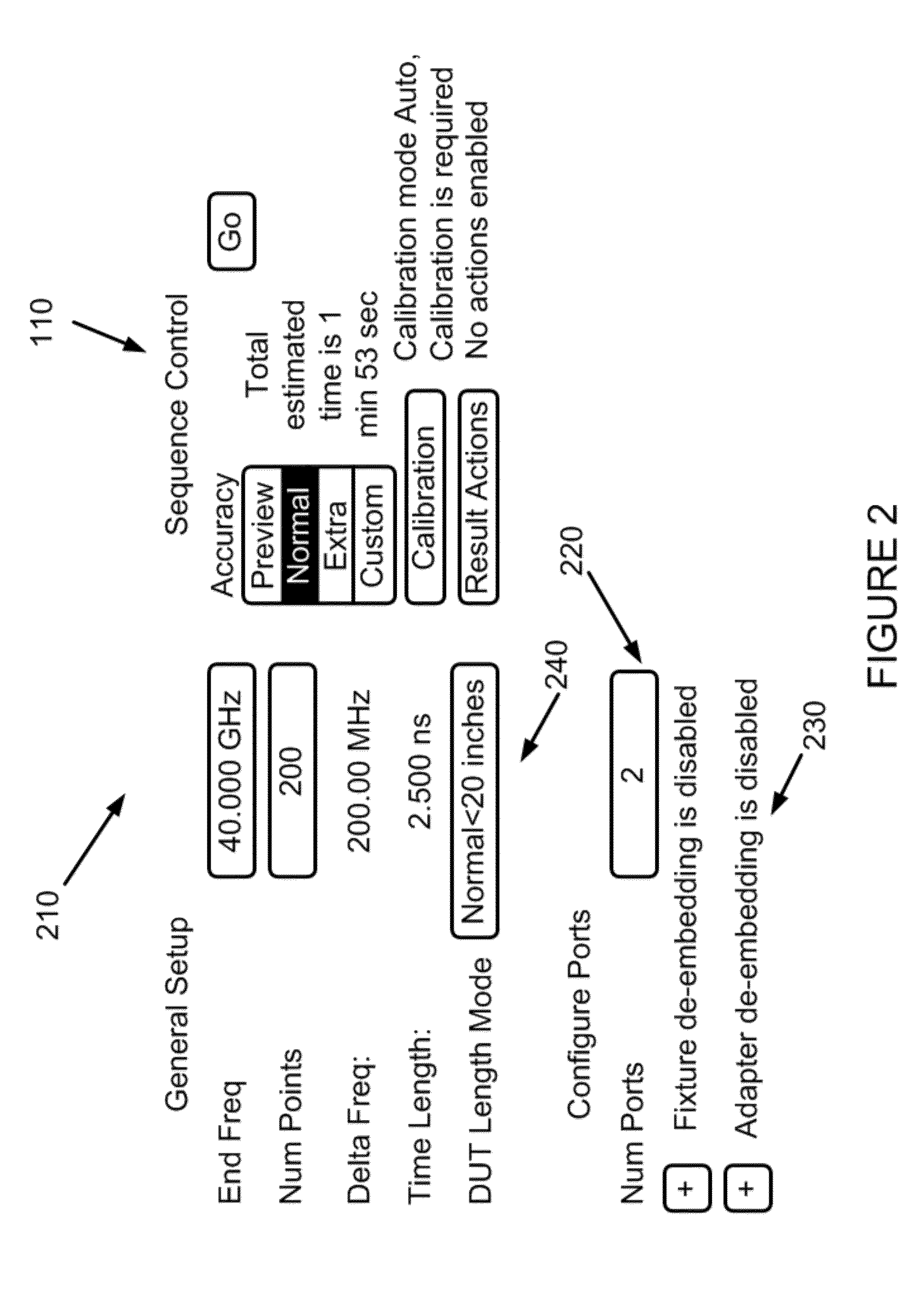
- A Signal Integrity Network Analyzer (SINA) with a user-friendly interface that enables one-click calibration and measurement, providing preset configuration settings and advanced post-processing features, allowing users to easily determine s-parameters and analyze network topologies without the need for extensive user intervention.

High-frequency solid-state relay
PatentInactiveUS5298817A
Innovation
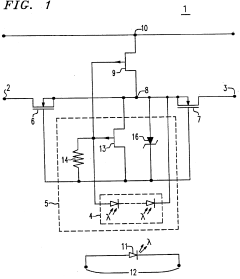
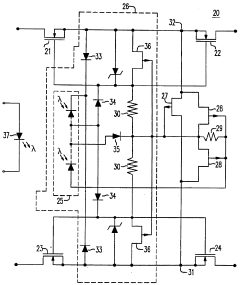
- A solid-state relay design featuring a control circuit driving pass transistors and a shunt transistor, utilizing MOSFETs and JFETs with opposite bias conductivities, to minimize feed-through and maintain high isolation during signal switching, with an optical control signal converting electrical signals to control transistor conductivity.
EMI/EMC Considerations in Solid-State Relay Applications
Electromagnetic Interference (EMI) and Electromagnetic Compatibility (EMC) are critical considerations when implementing solid-state relays (SSRs) in signal-sensitive applications. Unlike mechanical relays, SSRs utilize semiconductor switching elements that can generate significant electromagnetic noise during operation, particularly during switching transitions when rapid voltage and current changes occur.
The primary EMI sources in SSRs include the high dv/dt (rate of voltage change) during turn-on and turn-off operations, which can generate broadband electromagnetic emissions. These emissions can propagate through conduction paths or radiate into surrounding circuits, potentially compromising signal integrity in adjacent systems. Additionally, the control circuitry and optocouplers within SSRs may contribute to EMI generation, especially in high-frequency switching applications.
From an EMC perspective, solid-state relays must be designed to both minimize emissions and withstand external electromagnetic disturbances. Industry standards such as IEC 61000 and CISPR 22/32 establish specific limits for conducted and radiated emissions that SSR implementations must satisfy. Meeting these requirements often necessitates careful PCB layout techniques, including proper ground plane design, strategic component placement, and appropriate shielding measures.
Filter networks play a crucial role in mitigating EMI/EMC issues in SSR applications. Snubber circuits consisting of RC networks can effectively dampen voltage transients during switching operations, reducing high-frequency emissions. Similarly, common-mode chokes and differential filters at input and output terminals can attenuate conducted emissions that might otherwise propagate through power or signal lines.
Signal integrity analysis for SSRs must include comprehensive EMI/EMC testing under various operating conditions. This typically involves near-field probing to identify specific emission sources, conducted emission measurements through line impedance stabilization networks (LISN), and radiated emission testing in anechoic chambers. Advanced techniques such as time-domain reflectometry and spectrum analysis provide valuable insights into the electromagnetic behavior of SSR circuits.
The physical implementation of SSRs significantly impacts their EMI/EMC performance. Proper heat sinking not only ensures thermal stability but also provides an effective path for electromagnetic energy dissipation. Similarly, shielding enclosures can contain radiated emissions while protecting the SSR from external electromagnetic disturbances. In multi-channel SSR applications, careful attention must be paid to crosstalk between channels, which can be mitigated through appropriate isolation barriers and strategic routing of signal traces.
The primary EMI sources in SSRs include the high dv/dt (rate of voltage change) during turn-on and turn-off operations, which can generate broadband electromagnetic emissions. These emissions can propagate through conduction paths or radiate into surrounding circuits, potentially compromising signal integrity in adjacent systems. Additionally, the control circuitry and optocouplers within SSRs may contribute to EMI generation, especially in high-frequency switching applications.
From an EMC perspective, solid-state relays must be designed to both minimize emissions and withstand external electromagnetic disturbances. Industry standards such as IEC 61000 and CISPR 22/32 establish specific limits for conducted and radiated emissions that SSR implementations must satisfy. Meeting these requirements often necessitates careful PCB layout techniques, including proper ground plane design, strategic component placement, and appropriate shielding measures.
Filter networks play a crucial role in mitigating EMI/EMC issues in SSR applications. Snubber circuits consisting of RC networks can effectively dampen voltage transients during switching operations, reducing high-frequency emissions. Similarly, common-mode chokes and differential filters at input and output terminals can attenuate conducted emissions that might otherwise propagate through power or signal lines.
Signal integrity analysis for SSRs must include comprehensive EMI/EMC testing under various operating conditions. This typically involves near-field probing to identify specific emission sources, conducted emission measurements through line impedance stabilization networks (LISN), and radiated emission testing in anechoic chambers. Advanced techniques such as time-domain reflectometry and spectrum analysis provide valuable insights into the electromagnetic behavior of SSR circuits.
The physical implementation of SSRs significantly impacts their EMI/EMC performance. Proper heat sinking not only ensures thermal stability but also provides an effective path for electromagnetic energy dissipation. Similarly, shielding enclosures can contain radiated emissions while protecting the SSR from external electromagnetic disturbances. In multi-channel SSR applications, careful attention must be paid to crosstalk between channels, which can be mitigated through appropriate isolation barriers and strategic routing of signal traces.
Reliability Testing Standards and Certification Requirements
Reliability testing standards for Solid-State Relays (SSRs) are critical to ensure signal integrity performance under various operating conditions. The International Electrotechnical Commission (IEC) provides the primary framework through IEC 62314, which specifically addresses SSR testing methodologies. This standard outlines procedures for evaluating switching characteristics, isolation properties, and long-term reliability factors that directly impact signal integrity.
JEDEC standards, particularly JESD22-A104 for thermal cycling and JESD22-A110 for mechanical shock, complement the IEC framework by focusing on environmental stress factors that can degrade SSR performance over time. These standards establish minimum requirements for SSRs to maintain signal integrity under thermal and mechanical stresses commonly encountered in industrial applications.
UL 508 certification represents a crucial benchmark for SSRs used in industrial control equipment, with specific provisions addressing signal integrity under fault conditions. This certification requires rigorous testing of isolation barriers and transient response characteristics to ensure reliable signal transmission even during electrical anomalies.
Military-grade applications follow MIL-STD-883 for microelectronic devices, which includes specialized test methods for SSRs. Method 1015 (Burn-in test) and Method 2002 (Mechanical Shock) are particularly relevant for signal integrity assessment, as they evaluate performance under extreme conditions that could compromise signal quality.
The Automotive Electronics Council's AEC-Q100 qualification provides specific reliability requirements for SSRs used in automotive applications. Grade classifications (0-3) correspond to different temperature ranges and reliability expectations, with stringent EMI/EMC immunity requirements that directly impact signal integrity performance.
IPC standards, particularly IPC-9592 for power conversion devices, establish performance requirements for SSRs in power electronics applications. These standards include specific metrics for signal rise time, fall time, and propagation delay that must be verified through standardized testing procedures.
Certification processes typically involve third-party validation through organizations like TÜV, UL, or CSA. These certifications require comprehensive documentation of test results demonstrating compliance with relevant standards. For signal integrity analysis, certification documentation must include waveform characteristics, noise immunity measurements, and isolation performance under specified test conditions.
Emerging standards from the IEEE Power Electronics Society are addressing high-frequency switching applications where signal integrity becomes increasingly critical. These standards are developing new test methodologies specifically designed to evaluate SSR performance in applications where switching speeds exceed 100 kHz, focusing on parasitic effects that become dominant at these frequencies.
JEDEC standards, particularly JESD22-A104 for thermal cycling and JESD22-A110 for mechanical shock, complement the IEC framework by focusing on environmental stress factors that can degrade SSR performance over time. These standards establish minimum requirements for SSRs to maintain signal integrity under thermal and mechanical stresses commonly encountered in industrial applications.
UL 508 certification represents a crucial benchmark for SSRs used in industrial control equipment, with specific provisions addressing signal integrity under fault conditions. This certification requires rigorous testing of isolation barriers and transient response characteristics to ensure reliable signal transmission even during electrical anomalies.
Military-grade applications follow MIL-STD-883 for microelectronic devices, which includes specialized test methods for SSRs. Method 1015 (Burn-in test) and Method 2002 (Mechanical Shock) are particularly relevant for signal integrity assessment, as they evaluate performance under extreme conditions that could compromise signal quality.
The Automotive Electronics Council's AEC-Q100 qualification provides specific reliability requirements for SSRs used in automotive applications. Grade classifications (0-3) correspond to different temperature ranges and reliability expectations, with stringent EMI/EMC immunity requirements that directly impact signal integrity performance.
IPC standards, particularly IPC-9592 for power conversion devices, establish performance requirements for SSRs in power electronics applications. These standards include specific metrics for signal rise time, fall time, and propagation delay that must be verified through standardized testing procedures.
Certification processes typically involve third-party validation through organizations like TÜV, UL, or CSA. These certifications require comprehensive documentation of test results demonstrating compliance with relevant standards. For signal integrity analysis, certification documentation must include waveform characteristics, noise immunity measurements, and isolation performance under specified test conditions.
Emerging standards from the IEEE Power Electronics Society are addressing high-frequency switching applications where signal integrity becomes increasingly critical. These standards are developing new test methodologies specifically designed to evaluate SSR performance in applications where switching speeds exceed 100 kHz, focusing on parasitic effects that become dominant at these frequencies.
Unlock deeper insights with PatSnap Eureka Quick Research — get a full tech report to explore trends and direct your research. Try now!
Generate Your Research Report Instantly with AI Agent
Supercharge your innovation with PatSnap Eureka AI Agent Platform!