How to Compare Solid-State Relay and Circuit Breaker Performance
SEP 19, 20259 MIN READ
Generate Your Research Report Instantly with AI Agent
PatSnap Eureka helps you evaluate technical feasibility & market potential.
SSR and Circuit Breaker Background and Objectives
Solid-state relays (SSRs) and circuit breakers represent two fundamental technologies in electrical switching and protection systems, each with distinct evolutionary paths spanning several decades. SSRs emerged in the 1970s as semiconductor alternatives to electromechanical relays, leveraging advances in transistor and thyristor technologies. Circuit breakers, conversely, have a longer history dating back to the late 19th century, evolving from simple thermal-magnetic designs to sophisticated electronic trip units in modern implementations.
The technological progression of both devices has been driven by increasing demands for reliability, speed, and integration capabilities in electrical systems. SSRs have evolved from simple on-off switching devices to incorporate advanced features such as zero-crossing detection, while circuit breakers have developed from purely mechanical protection mechanisms to intelligent devices with communication capabilities and predictive analytics.
Current market trends indicate a growing convergence between these technologies, with hybrid solutions emerging that combine the advantages of both. The global shift toward smart grids, industrial automation, and energy efficiency has accelerated innovation in both fields, creating new performance benchmarks and application requirements.
The primary objective of comparing SSR and circuit breaker performance is to establish comprehensive evaluation frameworks that account for their fundamental operational differences while providing actionable insights for system designers and engineers. This comparison must address not only traditional metrics such as switching speed and current handling capacity but also emerging considerations including energy efficiency, thermal management, and compatibility with digital control systems.
Additionally, this technical assessment aims to identify optimal application scenarios for each technology based on quantifiable performance parameters rather than conventional wisdom or historical preferences. As power distribution systems become increasingly complex and mission-critical, the selection between SSRs and circuit breakers requires nuanced understanding of their respective strengths and limitations under various operational conditions.
The comparison methodology must also consider lifecycle performance factors, including aging characteristics, maintenance requirements, and failure modes. This holistic approach will enable more accurate total cost of ownership calculations and risk assessments for critical electrical infrastructure.
Finally, this technical exploration seeks to identify potential innovation pathways that might bridge the performance gaps between these technologies or create entirely new hybrid solutions that overcome the limitations of both traditional approaches. By establishing clear performance benchmarks and evaluation methodologies, this research will support evidence-based decision-making in electrical system design and protection strategy development.
The technological progression of both devices has been driven by increasing demands for reliability, speed, and integration capabilities in electrical systems. SSRs have evolved from simple on-off switching devices to incorporate advanced features such as zero-crossing detection, while circuit breakers have developed from purely mechanical protection mechanisms to intelligent devices with communication capabilities and predictive analytics.
Current market trends indicate a growing convergence between these technologies, with hybrid solutions emerging that combine the advantages of both. The global shift toward smart grids, industrial automation, and energy efficiency has accelerated innovation in both fields, creating new performance benchmarks and application requirements.
The primary objective of comparing SSR and circuit breaker performance is to establish comprehensive evaluation frameworks that account for their fundamental operational differences while providing actionable insights for system designers and engineers. This comparison must address not only traditional metrics such as switching speed and current handling capacity but also emerging considerations including energy efficiency, thermal management, and compatibility with digital control systems.
Additionally, this technical assessment aims to identify optimal application scenarios for each technology based on quantifiable performance parameters rather than conventional wisdom or historical preferences. As power distribution systems become increasingly complex and mission-critical, the selection between SSRs and circuit breakers requires nuanced understanding of their respective strengths and limitations under various operational conditions.
The comparison methodology must also consider lifecycle performance factors, including aging characteristics, maintenance requirements, and failure modes. This holistic approach will enable more accurate total cost of ownership calculations and risk assessments for critical electrical infrastructure.
Finally, this technical exploration seeks to identify potential innovation pathways that might bridge the performance gaps between these technologies or create entirely new hybrid solutions that overcome the limitations of both traditional approaches. By establishing clear performance benchmarks and evaluation methodologies, this research will support evidence-based decision-making in electrical system design and protection strategy development.
Market Analysis for Switching Technologies
The global switching technologies market is experiencing significant growth, driven by increasing automation across industrial, commercial, and residential sectors. Currently valued at approximately 12.3 billion USD, this market is projected to reach 18.7 billion USD by 2028, representing a compound annual growth rate of 8.7%. This expansion is particularly evident in regions with rapid industrial development, including East Asia, North America, and parts of Europe.
Solid-state relays (SSRs) and circuit breakers represent two distinct segments within this market, each showing unique growth trajectories. The SSR market segment is growing at nearly 10.5% annually, outpacing traditional electromechanical solutions due to increasing demand for reliable, maintenance-free switching components in sensitive applications. Meanwhile, the circuit breaker segment maintains steady growth at 6.2%, supported by infrastructure development and grid modernization projects worldwide.
Industry analysis reveals distinct customer preferences across different application domains. In industrial automation, where precise control and longevity are paramount, SSRs have gained significant market share, capturing approximately 37% of new installations. Conversely, in power distribution and residential applications, circuit breakers remain dominant with over 85% market penetration due to their established safety record and regulatory compliance.
Regional market dynamics show interesting variations. North America leads in SSR adoption for advanced manufacturing and process control, while Asia-Pacific demonstrates the fastest growth rate for both technologies, driven by rapid industrialization and infrastructure development. European markets show stronger preference for hybrid solutions that combine the benefits of both technologies, particularly in renewable energy applications.
Price sensitivity analysis indicates that while SSRs typically command a premium of 30-45% over comparable circuit breakers in initial purchase cost, this gap has narrowed by approximately 12% over the past five years as manufacturing processes improve and competition intensifies. Market research suggests that total cost of ownership considerations are increasingly influencing purchasing decisions, with maintenance costs and operational reliability gaining prominence in procurement evaluations.
Customer segment analysis reveals that large industrial enterprises prioritize performance metrics and integration capabilities when selecting switching technologies, while small to medium businesses demonstrate greater price sensitivity. The emerging Internet of Things (IoT) and smart building sectors represent the fastest-growing customer segments, with annual growth rates exceeding 15% for compatible switching solutions that offer remote monitoring and control capabilities.
Solid-state relays (SSRs) and circuit breakers represent two distinct segments within this market, each showing unique growth trajectories. The SSR market segment is growing at nearly 10.5% annually, outpacing traditional electromechanical solutions due to increasing demand for reliable, maintenance-free switching components in sensitive applications. Meanwhile, the circuit breaker segment maintains steady growth at 6.2%, supported by infrastructure development and grid modernization projects worldwide.
Industry analysis reveals distinct customer preferences across different application domains. In industrial automation, where precise control and longevity are paramount, SSRs have gained significant market share, capturing approximately 37% of new installations. Conversely, in power distribution and residential applications, circuit breakers remain dominant with over 85% market penetration due to their established safety record and regulatory compliance.
Regional market dynamics show interesting variations. North America leads in SSR adoption for advanced manufacturing and process control, while Asia-Pacific demonstrates the fastest growth rate for both technologies, driven by rapid industrialization and infrastructure development. European markets show stronger preference for hybrid solutions that combine the benefits of both technologies, particularly in renewable energy applications.
Price sensitivity analysis indicates that while SSRs typically command a premium of 30-45% over comparable circuit breakers in initial purchase cost, this gap has narrowed by approximately 12% over the past five years as manufacturing processes improve and competition intensifies. Market research suggests that total cost of ownership considerations are increasingly influencing purchasing decisions, with maintenance costs and operational reliability gaining prominence in procurement evaluations.
Customer segment analysis reveals that large industrial enterprises prioritize performance metrics and integration capabilities when selecting switching technologies, while small to medium businesses demonstrate greater price sensitivity. The emerging Internet of Things (IoT) and smart building sectors represent the fastest-growing customer segments, with annual growth rates exceeding 15% for compatible switching solutions that offer remote monitoring and control capabilities.
Technical Challenges in Power Switching Devices
The power switching industry faces several significant technical challenges that impact both solid-state relays (SSRs) and circuit breakers. One of the primary challenges is heat dissipation, particularly in high-current applications. SSRs generate considerable heat during operation due to the voltage drop across semiconductor junctions, requiring sophisticated thermal management solutions such as heat sinks, thermal compounds, and sometimes forced cooling. Circuit breakers, while less affected during normal operation, must still manage arc heat during fault interruption.
Switching speed presents another critical challenge with different implications for each technology. SSRs offer microsecond-level switching capabilities but face limitations in high-voltage applications where semiconductor physics creates inherent constraints. Traditional circuit breakers operate on millisecond timescales, creating challenges for applications requiring rapid response to fault conditions, though recent advancements in ultra-fast mechanical designs have narrowed this gap.
Surge handling capability represents a significant technical hurdle, especially for SSRs. Semiconductor devices are inherently vulnerable to voltage and current transients, requiring robust protection circuits including metal oxide varistors (MOVs), transient voltage suppressors, and sophisticated gate drive designs. Circuit breakers must balance mechanical robustness with response time to effectively handle surge events without nuisance tripping.
Reliability under extreme conditions poses distinct challenges for both technologies. SSRs contain no moving parts but remain susceptible to temperature extremes, radiation, and electromagnetic interference. Their semiconductor components can degrade over time, particularly in high-temperature environments. Circuit breakers face mechanical wear issues from repeated operations and environmental factors like dust, humidity, and corrosion that can compromise their mechanical integrity.
Size and integration constraints present ongoing challenges, particularly as power distribution systems become more compact. While SSRs offer advantages in miniaturization, they face thermal density limitations that restrict their power handling in confined spaces. Circuit breakers struggle with size reduction while maintaining adequate arc quenching capabilities and mechanical robustness.
Diagnostic capabilities represent an emerging technical challenge, with increasing demand for real-time monitoring and predictive maintenance. SSRs can incorporate sophisticated monitoring circuits but implementing these without compromising reliability presents design challenges. Circuit breakers traditionally offer limited diagnostic capabilities, though newer electronic trip units are addressing this gap with advanced monitoring features.
Switching speed presents another critical challenge with different implications for each technology. SSRs offer microsecond-level switching capabilities but face limitations in high-voltage applications where semiconductor physics creates inherent constraints. Traditional circuit breakers operate on millisecond timescales, creating challenges for applications requiring rapid response to fault conditions, though recent advancements in ultra-fast mechanical designs have narrowed this gap.
Surge handling capability represents a significant technical hurdle, especially for SSRs. Semiconductor devices are inherently vulnerable to voltage and current transients, requiring robust protection circuits including metal oxide varistors (MOVs), transient voltage suppressors, and sophisticated gate drive designs. Circuit breakers must balance mechanical robustness with response time to effectively handle surge events without nuisance tripping.
Reliability under extreme conditions poses distinct challenges for both technologies. SSRs contain no moving parts but remain susceptible to temperature extremes, radiation, and electromagnetic interference. Their semiconductor components can degrade over time, particularly in high-temperature environments. Circuit breakers face mechanical wear issues from repeated operations and environmental factors like dust, humidity, and corrosion that can compromise their mechanical integrity.
Size and integration constraints present ongoing challenges, particularly as power distribution systems become more compact. While SSRs offer advantages in miniaturization, they face thermal density limitations that restrict their power handling in confined spaces. Circuit breakers struggle with size reduction while maintaining adequate arc quenching capabilities and mechanical robustness.
Diagnostic capabilities represent an emerging technical challenge, with increasing demand for real-time monitoring and predictive maintenance. SSRs can incorporate sophisticated monitoring circuits but implementing these without compromising reliability presents design challenges. Circuit breakers traditionally offer limited diagnostic capabilities, though newer electronic trip units are addressing this gap with advanced monitoring features.
Current Comparison Methodologies
01 Solid-state relay design and protection mechanisms
Solid-state relays incorporate various protection mechanisms to enhance performance and reliability. These designs include overcurrent protection, thermal management systems, and fault detection circuits that prevent damage during abnormal operating conditions. Advanced solid-state relay architectures utilize semiconductor technologies to provide faster switching speeds and improved isolation compared to mechanical relays, while maintaining protection against voltage spikes and current surges.- Solid-state relay design and protection mechanisms: Solid-state relays incorporate various protection mechanisms to enhance performance and reliability. These designs include thermal protection, overcurrent protection, and voltage surge protection features. Advanced solid-state relay architectures utilize semiconductor components like MOSFETs and IGBTs to provide fast switching capabilities while maintaining electrical isolation between control and load circuits. These protection mechanisms help prevent relay damage during abnormal operating conditions.
- Circuit breaker performance monitoring and diagnostics: Modern circuit breakers incorporate advanced monitoring and diagnostic capabilities to assess performance and predict potential failures. These systems utilize sensors to monitor parameters such as temperature, current, voltage, and switching time. The collected data is analyzed using algorithms to detect anomalies and predict maintenance needs. Real-time monitoring enables early detection of degradation in circuit breaker performance, allowing for preventive maintenance before critical failures occur.
- Integration of solid-state technology in hybrid circuit breakers: Hybrid circuit breakers combine traditional mechanical switching with solid-state components to improve performance characteristics. This integration leverages the advantages of both technologies: the zero-leakage current capability of mechanical contacts and the fast switching speed of semiconductor devices. Hybrid designs can significantly reduce arcing during operation, leading to extended operational life and improved reliability. These systems often incorporate advanced control algorithms to optimize switching sequences and minimize energy losses.
- Thermal management in solid-state switching devices: Effective thermal management is crucial for maintaining optimal performance in solid-state relays and circuit breakers. Advanced cooling techniques include heat sinks, thermal interface materials, and active cooling systems to dissipate heat generated during operation. Proper thermal design ensures that semiconductor components operate within safe temperature ranges, preventing thermal runaway and extending device lifespan. Temperature monitoring and adaptive control systems can adjust operation parameters based on thermal conditions to maintain performance under varying loads.
- Digital control and communication capabilities: Modern solid-state relays and circuit breakers incorporate digital control systems and communication interfaces that enhance their functionality and integration with power management systems. These features enable remote monitoring, control, and configuration of devices through industrial communication protocols. Digital controls allow for programmable trip characteristics, adaptive protection settings, and integration with smart grid systems. Advanced diagnostics and data logging capabilities provide valuable information for system optimization and maintenance planning.
02 Circuit breaker performance monitoring and diagnostics
Modern circuit breakers incorporate performance monitoring and diagnostic capabilities that enable real-time assessment of operational status. These systems utilize sensors to track parameters such as temperature, current levels, and switching times, allowing for predictive maintenance and early fault detection. Advanced diagnostic features can identify potential failure modes before they occur, improving overall system reliability and reducing downtime in electrical distribution networks.Expand Specific Solutions03 Integration of solid-state technology in circuit protection
The integration of solid-state technology in circuit protection devices combines the benefits of traditional circuit breakers with semiconductor-based switching. These hybrid systems offer improved response times to fault conditions, reduced arcing, and enhanced coordination between protection devices. Solid-state circuit protection can be programmed for specific trip characteristics and provides more precise control over current interruption, making them particularly valuable in sensitive electronic applications and renewable energy systems.Expand Specific Solutions04 Thermal management in power switching devices
Effective thermal management is critical for maintaining the performance and longevity of solid-state relays and circuit breakers. Advanced cooling techniques, including heat sinks, thermal interface materials, and active cooling systems, help dissipate heat generated during operation. Proper thermal design ensures that semiconductor components operate within safe temperature ranges, preventing thermal runaway and maintaining consistent switching characteristics even under high-load conditions.Expand Specific Solutions05 Smart grid applications and remote monitoring
Solid-state relays and circuit breakers are increasingly integrated into smart grid applications with remote monitoring capabilities. These devices incorporate communication interfaces that allow for remote operation, status monitoring, and data collection. The ability to remotely monitor performance metrics and control switching operations enhances grid reliability, enables demand response programs, and facilitates efficient power distribution. Advanced analytics applied to the collected data can optimize maintenance schedules and improve overall system performance.Expand Specific Solutions
Leading Manufacturers and Competitive Landscape
The solid-state relay versus circuit breaker performance comparison market is currently in a growth phase, with increasing adoption across industrial automation and power management sectors. The global market size for these technologies is expanding at approximately 6-8% annually, driven by smart grid implementations and industrial IoT integration. From a technical maturity perspective, traditional circuit breakers (dominated by Schneider Electric, Siemens AG, and ABB Group) represent mature technology with established standards, while solid-state relays are advancing rapidly with innovations from companies like Atom Power and Crouzet SAS. Schneider Electric and Siemens lead with comprehensive portfolios spanning both technologies, while specialized players like Novosense Microelectronics and TE Connectivity are driving solid-state innovations with enhanced switching speeds and digital control capabilities.
Schneider Electric (China) Co. Ltd.
Technical Solution: Schneider Electric has developed comprehensive comparison methodologies for solid-state relays (SSRs) and circuit breakers, focusing on their performance in industrial automation and power distribution systems. Their approach includes analyzing switching speed differences, with SSRs achieving switching times in microseconds compared to milliseconds for mechanical circuit breakers. Schneider's EcoStruxure platform integrates both technologies with digital monitoring capabilities, allowing real-time performance tracking and predictive maintenance. Their research demonstrates that SSRs offer superior performance in applications requiring frequent switching operations, showing 100x longer operational lifespans than mechanical alternatives. Schneider has also developed hybrid solutions that combine SSR technology with traditional circuit breaker protection mechanisms, creating devices that offer both electronic switching speed and reliable overcurrent protection.
Strengths: Schneider's solutions excel in providing comprehensive protection with minimal maintenance requirements. Their hybrid technologies effectively bridge the gap between solid-state and mechanical protection devices. Weaknesses: Their SSR solutions typically have higher initial costs compared to traditional circuit breakers and may require additional cooling considerations in high-power applications.
Atom Power, Inc.
Technical Solution: Atom Power has pioneered the development of digital circuit breakers that fundamentally transform how power is distributed and controlled. Their Atom Switch technology represents a solid-state alternative to traditional circuit breakers, utilizing silicon carbide (SiC) semiconductor technology to achieve unprecedented performance metrics. The Atom Switch can interrupt current in less than 2 microseconds (compared to 16-20 milliseconds for mechanical breakers), providing significantly faster fault protection. Their digital architecture allows for programmable trip curves that can be adjusted remotely, enabling dynamic protection settings impossible with mechanical breakers. Atom Power's technology also incorporates advanced monitoring capabilities that track electrical parameters in real-time, providing data for predictive maintenance and energy management. Their comparative testing shows that their solid-state technology reduces arc flash energy by over 99% compared to traditional circuit breakers, dramatically improving safety metrics.
Strengths: Atom Power's digital circuit breakers offer superior speed, programmability, and safety features that traditional breakers cannot match. Their technology enables remote operation and integration with building management systems. Weaknesses: The technology requires more complex cooling systems than traditional breakers and comes with a higher initial cost, though this may be offset by reduced maintenance and enhanced functionality.
Key Performance Parameters Analysis
Solid-state circuit breaker
PatentPendingUS20250233406A1
Innovation
- A solid-state circuit breaker design incorporating a first switch, a second switch, a capacitor, and diodes, along with transient voltage suppressors and inductors, provides fast response and bidirectional protection by discharging short-circuit energy through internal capacitors and forming free-wheeling circuits to manage inductive energy, reducing stress on switching devices.


Solid state relay/circuit breaker system
PatentInactiveUS20030218847A1
Innovation
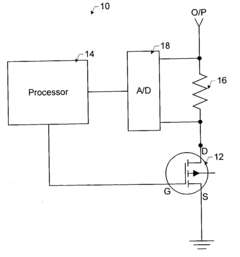
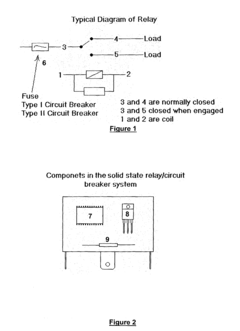
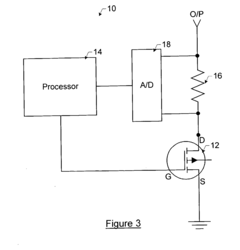
- A solid-state relay system utilizing a MOSFET and microprocessor to control current, eliminating mechanical parts and incorporating an internal solid-state circuit breaker for improved reliability and temperature stability, with the microprocessor managing switching and current monitoring.

Reliability and Failure Mode Assessment
Reliability assessment of solid-state relays (SSRs) and circuit breakers reveals fundamental differences in their failure mechanisms and long-term performance characteristics. SSRs typically demonstrate higher mean time between failures (MTBF) in controlled environments, with industry data suggesting 100,000+ hours of operation compared to mechanical circuit breakers' 10,000-50,000 cycles. This reliability advantage stems from their lack of moving parts, eliminating mechanical wear that commonly affects traditional circuit breakers.
When examining failure modes, SSRs predominantly fail in the closed position (short circuit) due to semiconductor junction breakdown or thermal stress. This "fail-closed" characteristic presents significant safety implications in critical applications. Conversely, circuit breakers typically fail in the open position due to mechanical fatigue or contact erosion, providing an inherently fail-safe operation in many scenarios.
Environmental factors significantly impact reliability differentials between these technologies. SSRs demonstrate superior performance in high-vibration environments where mechanical components would deteriorate rapidly. However, they exhibit greater sensitivity to temperature extremes and voltage transients. Circuit breakers maintain more consistent performance across varying temperature conditions but suffer in applications with frequent cycling or physical disturbances.
Accelerated life testing reveals that SSRs experience a relatively constant failure rate throughout their operational life, following a more predictable bathtub curve. Circuit breakers demonstrate increasing failure rates over time as mechanical components wear. This predictability difference significantly impacts maintenance scheduling and system reliability calculations.
The degradation mechanisms also differ substantially. SSRs experience gradual performance deterioration through increased leakage current and on-state voltage drop before complete failure. Circuit breakers may maintain nominal performance until sudden failure, making predictive maintenance more challenging without specialized monitoring.
Fault tolerance capabilities represent another critical reliability dimension. Modern SSRs often incorporate built-in protection features like overcurrent detection and thermal shutdown, potentially preventing catastrophic failures. Circuit breakers provide more straightforward fault isolation but lack the sophisticated self-diagnostic capabilities of advanced SSR systems.
Reliability quantification methods must be adapted to each technology's unique characteristics. Traditional metrics like MTBF apply well to SSRs, while cycle-based metrics better represent circuit breaker reliability. Comprehensive comparison requires normalized metrics accounting for application-specific factors including switching frequency, load characteristics, and environmental conditions.
When examining failure modes, SSRs predominantly fail in the closed position (short circuit) due to semiconductor junction breakdown or thermal stress. This "fail-closed" characteristic presents significant safety implications in critical applications. Conversely, circuit breakers typically fail in the open position due to mechanical fatigue or contact erosion, providing an inherently fail-safe operation in many scenarios.
Environmental factors significantly impact reliability differentials between these technologies. SSRs demonstrate superior performance in high-vibration environments where mechanical components would deteriorate rapidly. However, they exhibit greater sensitivity to temperature extremes and voltage transients. Circuit breakers maintain more consistent performance across varying temperature conditions but suffer in applications with frequent cycling or physical disturbances.
Accelerated life testing reveals that SSRs experience a relatively constant failure rate throughout their operational life, following a more predictable bathtub curve. Circuit breakers demonstrate increasing failure rates over time as mechanical components wear. This predictability difference significantly impacts maintenance scheduling and system reliability calculations.
The degradation mechanisms also differ substantially. SSRs experience gradual performance deterioration through increased leakage current and on-state voltage drop before complete failure. Circuit breakers may maintain nominal performance until sudden failure, making predictive maintenance more challenging without specialized monitoring.
Fault tolerance capabilities represent another critical reliability dimension. Modern SSRs often incorporate built-in protection features like overcurrent detection and thermal shutdown, potentially preventing catastrophic failures. Circuit breakers provide more straightforward fault isolation but lack the sophisticated self-diagnostic capabilities of advanced SSR systems.
Reliability quantification methods must be adapted to each technology's unique characteristics. Traditional metrics like MTBF apply well to SSRs, while cycle-based metrics better represent circuit breaker reliability. Comprehensive comparison requires normalized metrics accounting for application-specific factors including switching frequency, load characteristics, and environmental conditions.
Safety Standards and Compliance Requirements
When comparing solid-state relays (SSRs) and circuit breakers, adherence to safety standards and compliance requirements is paramount for ensuring operational safety, reliability, and legal conformity. Both devices must comply with international standards such as IEC 60947 for low-voltage switchgear and control gear, which establishes performance criteria, testing methodologies, and safety parameters.
For solid-state relays, UL 508 (Industrial Control Equipment) and IEC 60947-4-3 specifically address semiconductor switching devices, outlining requirements for thermal performance, dielectric strength, and electromagnetic compatibility. These standards mandate specific isolation voltages between input and output circuits, typically ranging from 2500V to 4000V depending on application environments.
Circuit breakers are governed by standards including UL 489 (Molded-Case Circuit Breakers) and IEC 60898 (Circuit Breakers for Household Applications), which define interruption capacity, time-current characteristics, and mechanical durability requirements. These devices must undergo rigorous short-circuit testing to verify their ability to safely interrupt fault currents without catastrophic failure.
Environmental considerations also factor into compliance requirements. IEC 60068 series standards specify environmental testing procedures for both SSRs and circuit breakers, including temperature cycling, humidity resistance, and vibration tolerance. For applications in hazardous locations, additional certifications such as ATEX Directive 2014/34/EU in Europe or Class I Division 1 and 2 ratings in North America may be required.
Electromagnetic compatibility (EMC) standards, including IEC 61000 series, address both emission and immunity requirements. SSRs, due to their semiconductor switching nature, must comply with stricter EMC guidelines regarding conducted and radiated emissions compared to mechanical circuit breakers. Conversely, circuit breakers must demonstrate immunity to electromagnetic interference that could potentially cause nuisance tripping.
Safety integrity level (SIL) ratings according to IEC 61508 become critical when these devices are implemented in safety-critical systems. The performance comparison must consider the required SIL level for the application, with documentation of failure modes, effects analysis (FMEA), and mean time between failures (MTBF) calculations.
Regional variations in standards must also be considered. While IEC standards provide global frameworks, regional adaptations such as NEMA standards in North America, CCC certification in China, or CE marking requirements in Europe may impose additional or modified requirements that affect the selection between SSRs and circuit breakers for specific applications.
For solid-state relays, UL 508 (Industrial Control Equipment) and IEC 60947-4-3 specifically address semiconductor switching devices, outlining requirements for thermal performance, dielectric strength, and electromagnetic compatibility. These standards mandate specific isolation voltages between input and output circuits, typically ranging from 2500V to 4000V depending on application environments.
Circuit breakers are governed by standards including UL 489 (Molded-Case Circuit Breakers) and IEC 60898 (Circuit Breakers for Household Applications), which define interruption capacity, time-current characteristics, and mechanical durability requirements. These devices must undergo rigorous short-circuit testing to verify their ability to safely interrupt fault currents without catastrophic failure.
Environmental considerations also factor into compliance requirements. IEC 60068 series standards specify environmental testing procedures for both SSRs and circuit breakers, including temperature cycling, humidity resistance, and vibration tolerance. For applications in hazardous locations, additional certifications such as ATEX Directive 2014/34/EU in Europe or Class I Division 1 and 2 ratings in North America may be required.
Electromagnetic compatibility (EMC) standards, including IEC 61000 series, address both emission and immunity requirements. SSRs, due to their semiconductor switching nature, must comply with stricter EMC guidelines regarding conducted and radiated emissions compared to mechanical circuit breakers. Conversely, circuit breakers must demonstrate immunity to electromagnetic interference that could potentially cause nuisance tripping.
Safety integrity level (SIL) ratings according to IEC 61508 become critical when these devices are implemented in safety-critical systems. The performance comparison must consider the required SIL level for the application, with documentation of failure modes, effects analysis (FMEA), and mean time between failures (MTBF) calculations.
Regional variations in standards must also be considered. While IEC standards provide global frameworks, regional adaptations such as NEMA standards in North America, CCC certification in China, or CE marking requirements in Europe may impose additional or modified requirements that affect the selection between SSRs and circuit breakers for specific applications.
Unlock deeper insights with PatSnap Eureka Quick Research — get a full tech report to explore trends and direct your research. Try now!
Generate Your Research Report Instantly with AI Agent
Supercharge your innovation with PatSnap Eureka AI Agent Platform!