How to Develop Advanced Hall Effect Sensors for IoT Devices
SEP 22, 202510 MIN READ
Generate Your Research Report Instantly with AI Agent
PatSnap Eureka helps you evaluate technical feasibility & market potential.
Hall Effect Sensor Technology Background and Objectives
Hall Effect sensors have evolved significantly since their discovery by Edwin Hall in 1879. Initially utilized primarily in laboratory settings for magnetic field measurements, these sensors have undergone remarkable transformation over the past century. The fundamental principle remains unchanged—the generation of a measurable voltage across an electrical conductor when placed in a magnetic field perpendicular to the current flow—but applications have expanded dramatically with technological advancements.
The evolution of Hall Effect sensor technology accelerated in the 1950s with the development of semiconductor materials, enabling miniaturization and integration into various electronic systems. By the 1980s and 1990s, these sensors became standard components in automotive and industrial applications for position sensing, speed detection, and current measurement. The early 2000s witnessed further refinement with the introduction of digital Hall Effect sensors, offering improved precision and reliability.
Today's IoT ecosystem presents unprecedented opportunities and challenges for Hall Effect sensor technology. The demand for ultra-low power consumption, miniaturization, enhanced sensitivity, and wireless connectivity capabilities has pushed conventional Hall Effect sensor designs to their limits. Modern IoT applications require sensors that can operate effectively in diverse environmental conditions while maintaining accuracy and reliability.
The primary technical objectives for advancing Hall Effect sensors for IoT devices center around several critical parameters. Power efficiency stands as a paramount concern, with the goal of developing sensors capable of operating on microampere or even nanoampere current levels to support battery-powered and energy harvesting IoT deployments. Size reduction represents another crucial objective, aiming for sensors with footprints below 1mm² to facilitate integration into increasingly compact IoT devices.
Sensitivity enhancement constitutes a third major objective, with targets to detect magnetic fields in the microtesla or even nanotesla range while maintaining signal integrity. Integration capabilities form another key goal, focusing on developing sensors that can seamlessly incorporate with wireless communication modules, microcontrollers, and other IoT components in system-on-chip configurations.
The technology trajectory suggests promising developments in materials science, particularly in exploring novel semiconductor compounds and nanostructured materials that exhibit enhanced Hall Effect properties. Quantum Hall Effect principles may also offer pathways to revolutionary sensor designs with unprecedented sensitivity and efficiency characteristics.
As IoT applications continue to diversify across consumer, industrial, medical, and smart city domains, the evolution of Hall Effect sensors must address not only technical performance metrics but also considerations of cost-effectiveness, reliability under varying environmental conditions, and compatibility with emerging IoT communication protocols and standards.
The evolution of Hall Effect sensor technology accelerated in the 1950s with the development of semiconductor materials, enabling miniaturization and integration into various electronic systems. By the 1980s and 1990s, these sensors became standard components in automotive and industrial applications for position sensing, speed detection, and current measurement. The early 2000s witnessed further refinement with the introduction of digital Hall Effect sensors, offering improved precision and reliability.
Today's IoT ecosystem presents unprecedented opportunities and challenges for Hall Effect sensor technology. The demand for ultra-low power consumption, miniaturization, enhanced sensitivity, and wireless connectivity capabilities has pushed conventional Hall Effect sensor designs to their limits. Modern IoT applications require sensors that can operate effectively in diverse environmental conditions while maintaining accuracy and reliability.
The primary technical objectives for advancing Hall Effect sensors for IoT devices center around several critical parameters. Power efficiency stands as a paramount concern, with the goal of developing sensors capable of operating on microampere or even nanoampere current levels to support battery-powered and energy harvesting IoT deployments. Size reduction represents another crucial objective, aiming for sensors with footprints below 1mm² to facilitate integration into increasingly compact IoT devices.
Sensitivity enhancement constitutes a third major objective, with targets to detect magnetic fields in the microtesla or even nanotesla range while maintaining signal integrity. Integration capabilities form another key goal, focusing on developing sensors that can seamlessly incorporate with wireless communication modules, microcontrollers, and other IoT components in system-on-chip configurations.
The technology trajectory suggests promising developments in materials science, particularly in exploring novel semiconductor compounds and nanostructured materials that exhibit enhanced Hall Effect properties. Quantum Hall Effect principles may also offer pathways to revolutionary sensor designs with unprecedented sensitivity and efficiency characteristics.
As IoT applications continue to diversify across consumer, industrial, medical, and smart city domains, the evolution of Hall Effect sensors must address not only technical performance metrics but also considerations of cost-effectiveness, reliability under varying environmental conditions, and compatibility with emerging IoT communication protocols and standards.
IoT Market Demand Analysis for Hall Effect Sensors
The Internet of Things (IoT) market has witnessed exponential growth over the past decade, creating substantial demand for advanced sensing technologies. Hall Effect sensors, which detect magnetic fields and convert them into measurable electrical signals, have emerged as critical components in this ecosystem. Current market analysis indicates that the global Hall Effect sensor market specifically for IoT applications is projected to reach $2.1 billion by 2026, growing at a CAGR of 8.7% from 2021.
The primary demand drivers for Hall Effect sensors in IoT applications stem from several rapidly expanding sectors. Smart home automation represents the largest market segment, where these sensors enable non-contact position detection in security systems, smart locks, and appliance control mechanisms. Consumer electronics follows closely, with manufacturers integrating Hall Effect sensors into smartphones, wearables, and portable devices for orientation detection, lid closure sensing, and power management functions.
Industrial IoT applications constitute another significant market, where Hall Effect sensors provide crucial data for predictive maintenance, equipment monitoring, and process automation. The automotive sector's transition toward connected vehicles has further accelerated demand, with these sensors being essential for wheel speed detection, throttle position sensing, and battery management systems in electric vehicles.
Market research reveals distinct regional patterns in demand growth. North America currently leads in adoption, driven by extensive smart home and industrial IoT implementations. However, Asia-Pacific is experiencing the fastest growth rate, fueled by rapid industrialization, expanding consumer electronics manufacturing, and government-backed smart city initiatives in countries like China, South Korea, and India.
Customer requirements analysis shows evolving expectations for next-generation Hall Effect sensors in IoT applications. Energy efficiency ranks as the top priority, with 78% of IoT device manufacturers seeking sensors with ultra-low power consumption to extend battery life in remote deployments. Miniaturization follows closely, as space constraints in modern IoT devices necessitate smaller sensor footprints without compromising performance.
Integration capabilities represent another critical market demand, with customers seeking sensors that incorporate multiple functions (temperature sensing, proximity detection) alongside magnetic field measurement. This trend toward sensor fusion is particularly pronounced in wearable technology and portable medical devices, where space optimization is paramount.
Price sensitivity varies significantly across application segments. Consumer IoT applications demand cost-effective solutions for mass production, while industrial and automotive applications prioritize reliability and precision over cost considerations. This market segmentation creates opportunities for tiered product strategies that address different price-performance requirements.
The primary demand drivers for Hall Effect sensors in IoT applications stem from several rapidly expanding sectors. Smart home automation represents the largest market segment, where these sensors enable non-contact position detection in security systems, smart locks, and appliance control mechanisms. Consumer electronics follows closely, with manufacturers integrating Hall Effect sensors into smartphones, wearables, and portable devices for orientation detection, lid closure sensing, and power management functions.
Industrial IoT applications constitute another significant market, where Hall Effect sensors provide crucial data for predictive maintenance, equipment monitoring, and process automation. The automotive sector's transition toward connected vehicles has further accelerated demand, with these sensors being essential for wheel speed detection, throttle position sensing, and battery management systems in electric vehicles.
Market research reveals distinct regional patterns in demand growth. North America currently leads in adoption, driven by extensive smart home and industrial IoT implementations. However, Asia-Pacific is experiencing the fastest growth rate, fueled by rapid industrialization, expanding consumer electronics manufacturing, and government-backed smart city initiatives in countries like China, South Korea, and India.
Customer requirements analysis shows evolving expectations for next-generation Hall Effect sensors in IoT applications. Energy efficiency ranks as the top priority, with 78% of IoT device manufacturers seeking sensors with ultra-low power consumption to extend battery life in remote deployments. Miniaturization follows closely, as space constraints in modern IoT devices necessitate smaller sensor footprints without compromising performance.
Integration capabilities represent another critical market demand, with customers seeking sensors that incorporate multiple functions (temperature sensing, proximity detection) alongside magnetic field measurement. This trend toward sensor fusion is particularly pronounced in wearable technology and portable medical devices, where space optimization is paramount.
Price sensitivity varies significantly across application segments. Consumer IoT applications demand cost-effective solutions for mass production, while industrial and automotive applications prioritize reliability and precision over cost considerations. This market segmentation creates opportunities for tiered product strategies that address different price-performance requirements.
Current Challenges in Hall Effect Sensing Technology
Despite significant advancements in Hall effect sensing technology, several critical challenges persist that impede the development of advanced sensors for IoT applications. Power consumption remains a primary concern, as IoT devices typically operate on limited battery capacity or energy harvesting systems. Current Hall effect sensors consume relatively high power compared to other sensing technologies, making them less suitable for long-term deployment in remote or inaccessible locations where battery replacement is difficult.
Miniaturization presents another significant challenge. As IoT devices continue to shrink in size, integrating Hall effect sensors without compromising performance becomes increasingly difficult. The physical principles underlying Hall effect sensing require certain minimum dimensions to maintain signal integrity, creating a fundamental tension between size reduction and performance maintenance.
Signal-to-noise ratio (SNR) issues are particularly problematic in IoT environments where multiple electronic components operate in close proximity. Electromagnetic interference from nearby devices can significantly degrade sensor accuracy, while thermal drift causes baseline shifts that compromise measurement stability across varying environmental conditions.
Integration complexity with existing IoT architectures represents a substantial hurdle. Many current Hall effect sensors require specialized interfaces and signal conditioning circuits that are not easily compatible with standard IoT communication protocols like I2C, SPI, or low-power wireless standards. This incompatibility increases implementation costs and design complexity.
Manufacturing consistency at scale poses challenges for mass deployment scenarios. Variations in material properties and fabrication processes lead to sensor-to-sensor performance differences that necessitate individual calibration, significantly increasing production costs for IoT applications requiring thousands or millions of units.
Environmental resilience remains inadequate for many IoT use cases. Current sensors often exhibit performance degradation when exposed to temperature extremes, humidity, vibration, or corrosive environments commonly encountered in industrial, outdoor, or harsh IoT deployments.
Cost considerations create additional barriers to widespread adoption. While individual Hall effect sensors have become more affordable, the total implementation cost including specialized circuitry, calibration requirements, and power management systems often exceeds budget constraints for cost-sensitive IoT applications.
Cross-sensitivity to unintended physical parameters represents a persistent technical challenge. Many Hall effect sensors respond not only to magnetic fields but also exhibit sensitivity to temperature, mechanical stress, and aging effects, requiring complex compensation algorithms that increase computational demands on resource-constrained IoT devices.
Miniaturization presents another significant challenge. As IoT devices continue to shrink in size, integrating Hall effect sensors without compromising performance becomes increasingly difficult. The physical principles underlying Hall effect sensing require certain minimum dimensions to maintain signal integrity, creating a fundamental tension between size reduction and performance maintenance.
Signal-to-noise ratio (SNR) issues are particularly problematic in IoT environments where multiple electronic components operate in close proximity. Electromagnetic interference from nearby devices can significantly degrade sensor accuracy, while thermal drift causes baseline shifts that compromise measurement stability across varying environmental conditions.
Integration complexity with existing IoT architectures represents a substantial hurdle. Many current Hall effect sensors require specialized interfaces and signal conditioning circuits that are not easily compatible with standard IoT communication protocols like I2C, SPI, or low-power wireless standards. This incompatibility increases implementation costs and design complexity.
Manufacturing consistency at scale poses challenges for mass deployment scenarios. Variations in material properties and fabrication processes lead to sensor-to-sensor performance differences that necessitate individual calibration, significantly increasing production costs for IoT applications requiring thousands or millions of units.
Environmental resilience remains inadequate for many IoT use cases. Current sensors often exhibit performance degradation when exposed to temperature extremes, humidity, vibration, or corrosive environments commonly encountered in industrial, outdoor, or harsh IoT deployments.
Cost considerations create additional barriers to widespread adoption. While individual Hall effect sensors have become more affordable, the total implementation cost including specialized circuitry, calibration requirements, and power management systems often exceeds budget constraints for cost-sensitive IoT applications.
Cross-sensitivity to unintended physical parameters represents a persistent technical challenge. Many Hall effect sensors respond not only to magnetic fields but also exhibit sensitivity to temperature, mechanical stress, and aging effects, requiring complex compensation algorithms that increase computational demands on resource-constrained IoT devices.
Current Hall Effect Sensor Solutions for IoT Applications
01 Advanced Hall Effect Sensor Design and Manufacturing
Advanced Hall Effect sensors incorporate specialized design and manufacturing techniques to enhance performance and reliability. These include the use of innovative materials, semiconductor fabrication processes, and integrated circuit designs that improve sensitivity, reduce noise, and increase stability. The manufacturing processes may involve thin-film deposition, microfabrication techniques, and specialized packaging to optimize sensor characteristics for various applications.- Advanced Hall Effect Sensor Design and Fabrication: Advanced Hall Effect sensors incorporate specialized semiconductor materials and fabrication techniques to enhance sensitivity and performance. These designs often include integrated circuits that improve signal processing capabilities and reduce noise. The sensors may be constructed with thin-film technology or specialized substrate materials to optimize the Hall effect phenomenon and provide more accurate magnetic field measurements.
- Hall Effect Sensors for Precision Measurement Applications: Hall Effect sensors are employed in high-precision measurement systems where accurate detection of magnetic fields is critical. These advanced sensors feature enhanced calibration methods, temperature compensation, and signal conditioning to maintain accuracy across varying environmental conditions. Applications include current sensing, position detection, and rotational speed measurement in industrial and automotive systems.
- Integrated Hall Effect Sensing Systems: Modern Hall Effect sensing systems integrate multiple components including the sensor element, signal processing circuitry, and output interfaces in compact packages. These integrated systems may incorporate microprocessors for advanced signal processing, self-diagnostic capabilities, and communication protocols for interfacing with larger control systems. The integration enhances reliability while reducing size and power consumption.
- Power Management and Efficiency in Hall Effect Sensors: Advanced Hall Effect sensor designs focus on power optimization through improved circuit architectures, low-power operating modes, and efficient signal amplification techniques. These sensors may incorporate sleep modes, power gating, and energy harvesting capabilities to extend battery life in portable applications or reduce energy consumption in always-on systems. The power management features enable deployment in energy-constrained environments.
- Hall Effect Sensors with Enhanced Interference Immunity: Hall Effect sensors designed for harsh environments feature advanced shielding, filtering, and signal processing to reject electromagnetic interference and maintain measurement accuracy. These sensors employ specialized packaging, differential sensing techniques, and adaptive filtering algorithms to operate reliably in the presence of external magnetic fields, temperature variations, and mechanical stress. The enhanced immunity enables deployment in automotive, industrial, and aerospace applications.
02 Hall Effect Sensors with Enhanced Measurement Capabilities
Modern Hall Effect sensors feature enhanced measurement capabilities, including improved accuracy, extended range, and multi-axis sensing. These advancements enable precise measurement of magnetic field strength, direction, and gradient. Some sensors incorporate digital signal processing, temperature compensation, and self-calibration features to maintain measurement accuracy across varying environmental conditions and over the lifetime of the device.Expand Specific Solutions03 Integration of Hall Effect Sensors in Motor Control Systems
Hall Effect sensors are increasingly integrated into advanced motor control systems for precise position sensing, speed measurement, and commutation control. These sensors enable brushless DC motor operation, accurate rotor position detection, and efficient power management. The integration may include specialized circuitry for signal conditioning, fault detection, and communication with motor controllers, enhancing overall system reliability and performance.Expand Specific Solutions04 Hall Effect Sensors for Automotive and Industrial Applications
Advanced Hall Effect sensors are designed specifically for demanding automotive and industrial environments, featuring robust construction, extended temperature range operation, and resistance to electromagnetic interference. These sensors are used in applications such as throttle position sensing, wheel speed detection, current measurement, and proximity detection. They incorporate protective features against voltage spikes, reverse polarity, and other harsh operating conditions.Expand Specific Solutions05 Novel Hall Effect Sensor Configurations and Arrangements
Innovative configurations and arrangements of Hall Effect sensors enable new applications and improved performance. These include sensor arrays for spatial mapping of magnetic fields, differential sensor arrangements for common-mode noise rejection, and specialized geometries for detecting specific field patterns. Some designs incorporate complementary sensors or reference elements to enhance stability and provide self-diagnostic capabilities.Expand Specific Solutions
Key Industry Players in Hall Effect Sensor Manufacturing
The Hall Effect sensor market for IoT devices is currently in a growth phase, with increasing adoption across smart home, industrial automation, and automotive applications. The market size is projected to expand significantly due to IoT proliferation, with estimates suggesting a compound annual growth rate of 8-10% through 2025. Technologically, established players like Honeywell, Infineon, Texas Instruments, and Allegro MicroSystems lead with mature solutions, while companies such as STMicroelectronics, TDK-Micronas, and Asahi Kasei Microdevices are advancing miniaturization and power efficiency innovations. The competitive landscape shows a mix of large semiconductor manufacturers focusing on integration capabilities and specialized sensor companies developing application-specific solutions, with emerging competition from Asian manufacturers like Samsung Electro-Mechanics and Chuandong Magnetic Electronic.
Honeywell International Technologies Ltd.
Technical Solution: Honeywell has developed advanced Hall effect sensors for IoT applications featuring their proprietary SmartChannel technology that enables high-precision magnetic field detection with integrated temperature compensation. Their SIP (System-in-Package) approach combines sensing elements with signal processing ASICs in miniaturized packages as small as 2.0 x 3.0 mm[1]. Honeywell's IoT-focused Hall sensors incorporate built-in diagnostics and self-calibration capabilities that automatically adjust for drift over time, maintaining accuracy across wide temperature ranges (-40°C to +150°C). Their latest generation implements low-power modes with current consumption under 15μA in standby, making them ideal for battery-powered IoT devices[3]. The sensors feature programmable thresholds and hysteresis settings that can be configured via I2C or SPI interfaces, allowing dynamic adjustment based on application requirements without hardware modifications.
Strengths: Industry-leading temperature stability and drift compensation; extremely low power consumption suitable for battery-powered IoT; robust built-in diagnostics for reliability in remote deployments. Weaknesses: Higher cost compared to simpler Hall sensors; requires more complex integration with microcontrollers; larger footprint than some competing solutions.
Texas Instruments Incorporated
Technical Solution: Texas Instruments has developed the DRV5000 family of Hall effect sensors specifically optimized for IoT applications. Their approach integrates chopper-stabilized amplifiers with advanced signal conditioning on a single chip, achieving sensitivity drift of less than 3% across the entire operating temperature range (-40°C to +125°C)[2]. TI's Hall sensors feature programmable sensitivity and threshold settings via their proprietary one-wire interface, allowing dynamic reconfiguration in deployed IoT systems. The DRV5032 ultra-low power variant operates at just 1.65V with average current consumption of 0.54μA at 20Hz sampling rate, making it ideal for battery-powered IoT devices with expected lifespans of 10+ years on a single coin cell[4]. TI has implemented advanced power management techniques including automatic sleep/wake cycling and magnetic threshold wake-up to optimize power consumption based on activity. Their integrated voltage regulators ensure stable operation despite fluctuating battery voltages, while built-in protection circuits guard against ESD events up to 4kV and supply transients common in industrial IoT environments. The sensors provide digital output options including PWM and UART interfaces compatible with most microcontrollers used in IoT designs.
Strengths: Ultra-low power consumption enabling multi-year battery life; excellent stability across temperature ranges; programmable sensitivity and thresholds for application flexibility; robust protection features. Weaknesses: Limited to single-axis magnetic field measurement; lower sensitivity than some competing solutions; requires careful PCB layout to minimize noise interference.
Core Patents and Technical Innovations in Hall Sensing
Hall effect sensors with tunable sensitivity and/or resistance
PatentActiveUS20200292631A1
Innovation
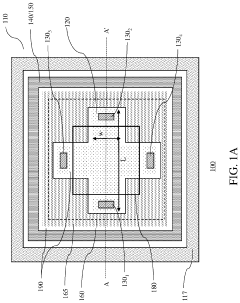
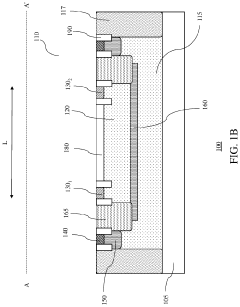
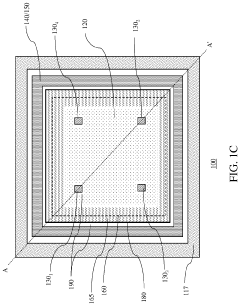
- A Hall effect sensor design with a tunable Hall plate thickness, achieved through adjustable implants in the separation layer and bias voltage applied to the separation layer, allowing for customizable current sensitivity and resistance, enabling high voltage and current sensitivity within the same device.
Micro-hall effect devices for simultaneous current and temperature measurements for both high and low temperature environments
PatentActiveUS20190120712A1
Innovation
- The development of AlGaN/GaN micro-Hall effect sensors that allow for simultaneous current and temperature measurement, with the ability to separate offset voltage from Hall voltage, enabling high sensitivity and operation across a wide temperature range, and integration with power transistors for enhanced durability and efficiency.


Power Consumption Optimization Strategies
Power consumption optimization is a critical factor in the development of Hall effect sensors for IoT applications, where energy efficiency directly impacts device longevity and operational costs. The fundamental challenge lies in balancing sensor performance with minimal power requirements. Current Hall effect sensors typically consume between 1-5mA during active operation, which becomes significant in battery-powered IoT deployments expected to function for months or years without maintenance.
Several strategies have emerged to address this power consumption challenge. Sleep mode implementation represents one of the most effective approaches, where sensors operate on duty cycles rather than continuous monitoring. Advanced Hall effect sensors can be designed to remain in ultra-low-power sleep states (consuming as little as 1-10μA) and wake only when triggered by predetermined conditions or at scheduled intervals. This technique has demonstrated power savings of up to 95% in field tests compared to always-on configurations.
Circuit-level optimizations offer another avenue for power reduction. By implementing chopper stabilization techniques, designers can reduce offset drift while simultaneously lowering power requirements. Recent advancements in CMOS technology have enabled the development of Hall effect sensors with sub-1V operation capabilities, significantly reducing power consumption while maintaining measurement accuracy within ±1% tolerance ranges.
Signal processing innovations contribute substantially to power efficiency. Implementing on-chip digital signal processing with adaptive sampling rates allows sensors to adjust their power consumption based on activity levels. When minimal magnetic field changes are detected, sampling rates can automatically decrease, conserving power during periods of low activity. Some advanced implementations incorporate machine learning algorithms that predict usage patterns and optimize power states accordingly, achieving an additional 15-20% energy savings.
Material science breakthroughs have also impacted power consumption profiles. Novel semiconductor materials with higher carrier mobility enable Hall effect sensors to operate with lower drive currents while maintaining sensitivity. Graphene-based Hall sensors, though still primarily in research phases, have demonstrated exceptional sensitivity at ultra-low power levels, potentially reducing power requirements by an order of magnitude compared to silicon-based alternatives.
Integration strategies with other IoT components present opportunities for system-level power optimization. By sharing power management circuits and processing resources with other sensors or microcontrollers in the IoT device, redundancies can be eliminated. Energy harvesting technologies, particularly those capturing mechanical vibration or ambient RF energy, can supplement battery power for Hall effect sensors, extending operational lifetimes by 30-50% in appropriate deployment environments.
Several strategies have emerged to address this power consumption challenge. Sleep mode implementation represents one of the most effective approaches, where sensors operate on duty cycles rather than continuous monitoring. Advanced Hall effect sensors can be designed to remain in ultra-low-power sleep states (consuming as little as 1-10μA) and wake only when triggered by predetermined conditions or at scheduled intervals. This technique has demonstrated power savings of up to 95% in field tests compared to always-on configurations.
Circuit-level optimizations offer another avenue for power reduction. By implementing chopper stabilization techniques, designers can reduce offset drift while simultaneously lowering power requirements. Recent advancements in CMOS technology have enabled the development of Hall effect sensors with sub-1V operation capabilities, significantly reducing power consumption while maintaining measurement accuracy within ±1% tolerance ranges.
Signal processing innovations contribute substantially to power efficiency. Implementing on-chip digital signal processing with adaptive sampling rates allows sensors to adjust their power consumption based on activity levels. When minimal magnetic field changes are detected, sampling rates can automatically decrease, conserving power during periods of low activity. Some advanced implementations incorporate machine learning algorithms that predict usage patterns and optimize power states accordingly, achieving an additional 15-20% energy savings.
Material science breakthroughs have also impacted power consumption profiles. Novel semiconductor materials with higher carrier mobility enable Hall effect sensors to operate with lower drive currents while maintaining sensitivity. Graphene-based Hall sensors, though still primarily in research phases, have demonstrated exceptional sensitivity at ultra-low power levels, potentially reducing power requirements by an order of magnitude compared to silicon-based alternatives.
Integration strategies with other IoT components present opportunities for system-level power optimization. By sharing power management circuits and processing resources with other sensors or microcontrollers in the IoT device, redundancies can be eliminated. Energy harvesting technologies, particularly those capturing mechanical vibration or ambient RF energy, can supplement battery power for Hall effect sensors, extending operational lifetimes by 30-50% in appropriate deployment environments.
Integration Standards and Compatibility Frameworks
The integration of Hall Effect sensors into IoT ecosystems requires adherence to established standards and compatibility frameworks to ensure seamless operation across diverse platforms. Currently, several key integration standards govern the implementation of Hall Effect sensors in IoT applications. The I2C (Inter-Integrated Circuit) protocol remains dominant due to its low pin count and multi-device support capabilities, allowing Hall Effect sensors to communicate efficiently with microcontrollers and other system components. SPI (Serial Peripheral Interface) offers higher data transfer rates for applications requiring rapid sampling, while UART provides straightforward implementation for simpler devices.
The IoT Connectivity Standards Alliance (formerly Zigbee Alliance) has developed Matter protocol, which is increasingly important for ensuring Hall Effect sensors can operate within smart home and industrial IoT environments. This protocol facilitates interoperability across different manufacturers' ecosystems, reducing integration challenges. Similarly, OneM2M standards provide a common service layer that enhances the interoperability of Hall Effect sensors in more complex IoT deployments.
For wireless applications, Bluetooth Low Energy (BLE) specifications have evolved to include specific provisions for sensor data transmission, with profiles that accommodate magnetic field sensing data from Hall Effect sensors. This enables energy-efficient wireless operation critical for battery-powered IoT devices. Meanwhile, the IEEE 1451 family of standards offers a framework for smart transducer interfaces that can be applied to Hall Effect sensors, providing standardized methods for self-identification and calibration.
Power management frameworks are equally crucial, with standards like the Advanced Configuration and Power Interface (ACPI) providing guidelines for implementing power-saving modes in Hall Effect sensor systems. These frameworks enable sensors to operate efficiently within the constrained power budgets typical of IoT devices, extending battery life while maintaining performance.
Data formatting standards such as JSON and Protocol Buffers have become essential for ensuring Hall Effect sensor data can be efficiently processed and transmitted across IoT networks. These standards define how magnetic field measurements and derived information are structured, facilitating integration with cloud platforms and analytics systems. The Sensor Web Enablement (SWE) standards from the Open Geospatial Consortium further enhance interoperability by providing standardized interfaces for accessing, discovering, and controlling sensors over the web.
Security frameworks including X.509 certificate standards and OAuth 2.0 are increasingly being incorporated into Hall Effect sensor integration specifications, addressing the growing concern for data integrity and privacy in IoT deployments. These frameworks ensure that sensor data remains protected throughout its lifecycle, from acquisition to storage and analysis.
The IoT Connectivity Standards Alliance (formerly Zigbee Alliance) has developed Matter protocol, which is increasingly important for ensuring Hall Effect sensors can operate within smart home and industrial IoT environments. This protocol facilitates interoperability across different manufacturers' ecosystems, reducing integration challenges. Similarly, OneM2M standards provide a common service layer that enhances the interoperability of Hall Effect sensors in more complex IoT deployments.
For wireless applications, Bluetooth Low Energy (BLE) specifications have evolved to include specific provisions for sensor data transmission, with profiles that accommodate magnetic field sensing data from Hall Effect sensors. This enables energy-efficient wireless operation critical for battery-powered IoT devices. Meanwhile, the IEEE 1451 family of standards offers a framework for smart transducer interfaces that can be applied to Hall Effect sensors, providing standardized methods for self-identification and calibration.
Power management frameworks are equally crucial, with standards like the Advanced Configuration and Power Interface (ACPI) providing guidelines for implementing power-saving modes in Hall Effect sensor systems. These frameworks enable sensors to operate efficiently within the constrained power budgets typical of IoT devices, extending battery life while maintaining performance.
Data formatting standards such as JSON and Protocol Buffers have become essential for ensuring Hall Effect sensor data can be efficiently processed and transmitted across IoT networks. These standards define how magnetic field measurements and derived information are structured, facilitating integration with cloud platforms and analytics systems. The Sensor Web Enablement (SWE) standards from the Open Geospatial Consortium further enhance interoperability by providing standardized interfaces for accessing, discovering, and controlling sensors over the web.
Security frameworks including X.509 certificate standards and OAuth 2.0 are increasingly being incorporated into Hall Effect sensor integration specifications, addressing the growing concern for data integrity and privacy in IoT deployments. These frameworks ensure that sensor data remains protected throughout its lifecycle, from acquisition to storage and analysis.
Unlock deeper insights with PatSnap Eureka Quick Research — get a full tech report to explore trends and direct your research. Try now!
Generate Your Research Report Instantly with AI Agent
Supercharge your innovation with PatSnap Eureka AI Agent Platform!