How to Interpret Hall Effect Sensor Data for Fault Detection
SEP 22, 20259 MIN READ
Generate Your Research Report Instantly with AI Agent
PatSnap Eureka helps you evaluate technical feasibility & market potential.
Hall Effect Sensor Technology Background and Objectives
Hall Effect sensors, discovered by Edwin Hall in 1879, have evolved significantly from their initial application in measuring magnetic fields to becoming integral components in modern industrial systems. These sensors operate on the principle of the Hall Effect, where a voltage difference is generated across an electrical conductor transverse to an electric current when exposed to a magnetic field. This fundamental principle has remained unchanged, while the technology surrounding it has advanced dramatically over the decades.
The evolution of Hall Effect sensors has been marked by several key developments. In the 1950s, the commercialization of semiconductor materials enabled practical Hall Effect devices. The 1970s and 1980s witnessed miniaturization and integration with other electronic components, significantly expanding their application scope. Recent advancements include enhanced sensitivity, improved temperature stability, and digital output capabilities, making these sensors more versatile and reliable.
Today, Hall Effect sensors are deployed across diverse industries including automotive, industrial automation, consumer electronics, and aerospace. Their non-contact nature, durability, and reliability make them particularly valuable for harsh operating environments where traditional sensors might fail. In automotive applications, they monitor wheel speed, crankshaft position, and throttle position. In industrial settings, they enable precise position detection and current measurement.
The technological trajectory points toward increasingly sophisticated fault detection capabilities. Modern Hall Effect sensors can detect subtle variations in magnetic fields that may indicate mechanical wear, misalignment, or impending component failure. This predictive capability is becoming crucial in maintenance strategies across industries, particularly in critical infrastructure and high-value manufacturing equipment.
The primary objective of Hall Effect sensor data interpretation for fault detection is to transform raw sensor signals into actionable maintenance insights. This involves developing algorithms that can distinguish between normal operational variations and genuine fault indicators. The goal is to achieve high detection accuracy while minimizing false positives that could lead to unnecessary maintenance interventions.
Another key objective is real-time monitoring capability, allowing systems to detect faults as they develop rather than after failure occurs. This requires efficient data processing algorithms and clear threshold definitions for various fault conditions. Additionally, there is growing interest in integrating Hall Effect sensor data with broader predictive maintenance systems, leveraging machine learning to identify complex fault patterns that might not be apparent through conventional analysis methods.
As industrial systems become increasingly automated and interconnected, the role of Hall Effect sensors in fault detection is expected to expand, driving further innovation in both sensor hardware and data interpretation methodologies.
The evolution of Hall Effect sensors has been marked by several key developments. In the 1950s, the commercialization of semiconductor materials enabled practical Hall Effect devices. The 1970s and 1980s witnessed miniaturization and integration with other electronic components, significantly expanding their application scope. Recent advancements include enhanced sensitivity, improved temperature stability, and digital output capabilities, making these sensors more versatile and reliable.
Today, Hall Effect sensors are deployed across diverse industries including automotive, industrial automation, consumer electronics, and aerospace. Their non-contact nature, durability, and reliability make them particularly valuable for harsh operating environments where traditional sensors might fail. In automotive applications, they monitor wheel speed, crankshaft position, and throttle position. In industrial settings, they enable precise position detection and current measurement.
The technological trajectory points toward increasingly sophisticated fault detection capabilities. Modern Hall Effect sensors can detect subtle variations in magnetic fields that may indicate mechanical wear, misalignment, or impending component failure. This predictive capability is becoming crucial in maintenance strategies across industries, particularly in critical infrastructure and high-value manufacturing equipment.
The primary objective of Hall Effect sensor data interpretation for fault detection is to transform raw sensor signals into actionable maintenance insights. This involves developing algorithms that can distinguish between normal operational variations and genuine fault indicators. The goal is to achieve high detection accuracy while minimizing false positives that could lead to unnecessary maintenance interventions.
Another key objective is real-time monitoring capability, allowing systems to detect faults as they develop rather than after failure occurs. This requires efficient data processing algorithms and clear threshold definitions for various fault conditions. Additionally, there is growing interest in integrating Hall Effect sensor data with broader predictive maintenance systems, leveraging machine learning to identify complex fault patterns that might not be apparent through conventional analysis methods.
As industrial systems become increasingly automated and interconnected, the role of Hall Effect sensors in fault detection is expected to expand, driving further innovation in both sensor hardware and data interpretation methodologies.
Market Demand Analysis for Hall Sensor-Based Fault Detection
The global market for Hall effect sensor-based fault detection systems is experiencing robust growth, driven by increasing industrial automation and the rising demand for predictive maintenance solutions. Current market valuations indicate that the Hall sensor market reached approximately 1.8 billion USD in 2022, with the fault detection segment representing about 22% of this value. Industry forecasts project a compound annual growth rate of 7.3% through 2028, significantly outpacing many other sensor technologies.
Manufacturing sectors, particularly automotive and aerospace industries, demonstrate the strongest demand for Hall sensor fault detection systems. These industries require high-precision monitoring of rotating machinery, where even minor misalignments or bearing failures can lead to catastrophic equipment damage. The automotive sector alone accounts for nearly 35% of the total market share, with applications ranging from engine performance monitoring to electric vehicle motor diagnostics.
Energy production and distribution represents another rapidly expanding market segment, growing at approximately 8.5% annually. Power generation facilities increasingly deploy Hall sensor arrays for real-time monitoring of turbine performance and early detection of mechanical anomalies. This trend is particularly pronounced in renewable energy installations, where remote monitoring capabilities are essential for maintaining widely distributed assets.
Consumer electronics manufacturers have also begun integrating Hall sensor fault detection into high-value products, creating a new market segment with significant growth potential. This application focuses primarily on detecting abnormal magnetic field patterns that indicate impending component failure in devices ranging from smartphones to household appliances.
Regional analysis reveals that North America currently leads market consumption at 38%, followed by Europe (29%) and Asia-Pacific (26%). However, the Asia-Pacific region demonstrates the fastest growth trajectory, with China and India making substantial investments in industrial automation infrastructure that incorporates advanced fault detection capabilities.
Market research indicates that end-users increasingly prioritize integrated solutions that combine Hall sensor hardware with sophisticated data interpretation software. This preference has created new opportunities for companies offering comprehensive fault detection packages rather than standalone sensor components. The demand for real-time analytics capabilities has grown by approximately 42% over the past three years, reflecting industry's shift toward predictive rather than reactive maintenance strategies.
Customer surveys reveal that reliability improvement and downtime reduction remain the primary motivations for adopting Hall sensor-based fault detection, with cost considerations becoming secondary as the technology demonstrates clear return on investment through extended equipment lifespans and reduced maintenance expenses.
Manufacturing sectors, particularly automotive and aerospace industries, demonstrate the strongest demand for Hall sensor fault detection systems. These industries require high-precision monitoring of rotating machinery, where even minor misalignments or bearing failures can lead to catastrophic equipment damage. The automotive sector alone accounts for nearly 35% of the total market share, with applications ranging from engine performance monitoring to electric vehicle motor diagnostics.
Energy production and distribution represents another rapidly expanding market segment, growing at approximately 8.5% annually. Power generation facilities increasingly deploy Hall sensor arrays for real-time monitoring of turbine performance and early detection of mechanical anomalies. This trend is particularly pronounced in renewable energy installations, where remote monitoring capabilities are essential for maintaining widely distributed assets.
Consumer electronics manufacturers have also begun integrating Hall sensor fault detection into high-value products, creating a new market segment with significant growth potential. This application focuses primarily on detecting abnormal magnetic field patterns that indicate impending component failure in devices ranging from smartphones to household appliances.
Regional analysis reveals that North America currently leads market consumption at 38%, followed by Europe (29%) and Asia-Pacific (26%). However, the Asia-Pacific region demonstrates the fastest growth trajectory, with China and India making substantial investments in industrial automation infrastructure that incorporates advanced fault detection capabilities.
Market research indicates that end-users increasingly prioritize integrated solutions that combine Hall sensor hardware with sophisticated data interpretation software. This preference has created new opportunities for companies offering comprehensive fault detection packages rather than standalone sensor components. The demand for real-time analytics capabilities has grown by approximately 42% over the past three years, reflecting industry's shift toward predictive rather than reactive maintenance strategies.
Customer surveys reveal that reliability improvement and downtime reduction remain the primary motivations for adopting Hall sensor-based fault detection, with cost considerations becoming secondary as the technology demonstrates clear return on investment through extended equipment lifespans and reduced maintenance expenses.
Current Challenges in Hall Effect Sensor Data Interpretation
Despite significant advancements in Hall effect sensor technology, interpreting sensor data for fault detection remains challenging due to several persistent issues. Signal-to-noise ratio presents a fundamental obstacle, as Hall sensors operate in electromagnetically noisy industrial environments where motor drives, power electronics, and other equipment generate interference that can mask subtle fault signatures. This challenge is particularly acute in applications like electric vehicle motor monitoring or industrial automation systems.
Data interpretation is further complicated by environmental factors that affect sensor readings. Temperature variations cause significant drift in Hall sensor output, with sensitivity typically decreasing as temperature increases. Vibration and mechanical stress can also induce false readings or alter the magnetic field distribution around the sensor, creating ambiguity in fault detection algorithms.
The non-linear characteristics of Hall effect sensors present another substantial challenge. Most commercial sensors exhibit some degree of non-linearity, especially at the extremes of their operating range. This non-linearity must be accurately modeled and compensated for to achieve reliable fault detection, requiring complex calibration procedures that may need periodic updates throughout the sensor's operational life.
Sensor placement optimization remains problematic, as the positioning of Hall sensors relative to the monitored components critically affects data quality. Suboptimal placement can result in weak signal capture or increased susceptibility to external magnetic interference, compromising fault detection capabilities. This challenge is exacerbated in compact modern systems where space constraints limit optimal sensor positioning options.
Cross-sensitivity issues further complicate interpretation, as Hall sensors may respond to magnetic fields from multiple sources simultaneously. In complex machinery with multiple motors or electromagnetic components, isolating the specific magnetic signature associated with a particular fault becomes exceedingly difficult, often requiring sophisticated signal processing techniques.
Data fusion and integration challenges arise when combining Hall sensor data with other sensor modalities for comprehensive fault detection. Synchronizing data streams with different sampling rates and response characteristics requires advanced algorithms, while maintaining real-time processing capabilities for timely fault detection adds another layer of complexity.
Finally, establishing reliable fault thresholds presents ongoing difficulties. The magnetic signature of incipient faults often develops gradually, making it challenging to define clear thresholds that balance false alarm rates against missed detection events. This challenge is particularly evident in critical applications where both false positives and false negatives carry significant consequences.
Data interpretation is further complicated by environmental factors that affect sensor readings. Temperature variations cause significant drift in Hall sensor output, with sensitivity typically decreasing as temperature increases. Vibration and mechanical stress can also induce false readings or alter the magnetic field distribution around the sensor, creating ambiguity in fault detection algorithms.
The non-linear characteristics of Hall effect sensors present another substantial challenge. Most commercial sensors exhibit some degree of non-linearity, especially at the extremes of their operating range. This non-linearity must be accurately modeled and compensated for to achieve reliable fault detection, requiring complex calibration procedures that may need periodic updates throughout the sensor's operational life.
Sensor placement optimization remains problematic, as the positioning of Hall sensors relative to the monitored components critically affects data quality. Suboptimal placement can result in weak signal capture or increased susceptibility to external magnetic interference, compromising fault detection capabilities. This challenge is exacerbated in compact modern systems where space constraints limit optimal sensor positioning options.
Cross-sensitivity issues further complicate interpretation, as Hall sensors may respond to magnetic fields from multiple sources simultaneously. In complex machinery with multiple motors or electromagnetic components, isolating the specific magnetic signature associated with a particular fault becomes exceedingly difficult, often requiring sophisticated signal processing techniques.
Data fusion and integration challenges arise when combining Hall sensor data with other sensor modalities for comprehensive fault detection. Synchronizing data streams with different sampling rates and response characteristics requires advanced algorithms, while maintaining real-time processing capabilities for timely fault detection adds another layer of complexity.
Finally, establishing reliable fault thresholds presents ongoing difficulties. The magnetic signature of incipient faults often develops gradually, making it challenging to define clear thresholds that balance false alarm rates against missed detection events. This challenge is particularly evident in critical applications where both false positives and false negatives carry significant consequences.
Current Data Interpretation Methods for Fault Detection
01 Signal processing and data interpretation techniques
Various methods for processing and interpreting Hall effect sensor data to improve accuracy and reliability. These techniques include digital signal processing algorithms, filtering methods to reduce noise, and calibration procedures to compensate for temperature variations and other environmental factors. Advanced interpretation algorithms can extract meaningful information from raw Hall sensor data for applications requiring precise magnetic field measurements.- Signal processing techniques for Hall effect sensors: Various signal processing techniques can be applied to interpret data from Hall effect sensors. These include filtering algorithms to reduce noise, amplification circuits to enhance weak signals, and digital signal processing methods to extract meaningful information from raw sensor outputs. Advanced techniques may involve compensation for temperature drift, offset correction, and calibration procedures to ensure accurate measurements of magnetic fields.
- Hall effect sensor design and configuration: The design and configuration of Hall effect sensors significantly impact data interpretation. Different sensor architectures, such as vertical Hall sensors, integrated Hall ICs, or array configurations, produce different output characteristics. The placement of sensing elements, magnetic concentrators, and shielding components affects the sensor's sensitivity and linearity. Proper sensor design ensures optimal signal quality for subsequent data interpretation.
- Calibration and compensation methods: Calibration and compensation methods are essential for accurate Hall effect sensor data interpretation. These include techniques to compensate for temperature variations, offset drift, and non-linearity in sensor response. Calibration procedures may involve reference measurements, lookup tables, or mathematical models to convert raw sensor outputs into standardized values. Proper calibration ensures consistent and reliable data interpretation across different operating conditions.
- Data acquisition and interface systems: Data acquisition and interface systems play a crucial role in Hall effect sensor data interpretation. These systems include analog-to-digital converters, microcontrollers, and communication protocols that capture, process, and transmit sensor data. Advanced interface systems may incorporate real-time processing capabilities, data logging functions, and integration with higher-level control systems. Efficient data acquisition ensures that sensor information is accurately captured for interpretation.
- Applications and specialized interpretation methods: Different applications require specialized methods for Hall effect sensor data interpretation. In position sensing applications, algorithms may focus on detecting threshold crossings or calculating precise angular positions. In current measurement applications, interpretation methods may involve scaling factors and offset corrections. Other specialized applications include speed detection, proximity sensing, and magnetic field mapping, each with unique data interpretation requirements tailored to the specific use case.
02 Hall sensor design and configuration for improved data output
Specific design configurations of Hall effect sensors that enhance data quality and interpretability. These include integrated circuit designs with built-in signal conditioning, differential Hall sensor arrangements to cancel common-mode noise, and specialized geometries to improve sensitivity. Such designs can incorporate temperature compensation circuits and offset cancellation techniques to provide more reliable and accurate magnetic field measurements.Expand Specific Solutions03 Magnetic field measurement and position sensing applications
Implementation of Hall effect sensors for precise position detection and magnetic field measurement applications. These sensors can be used to detect linear or rotational movement, proximity sensing, and current measurement through magnetic field detection. The data interpretation focuses on converting magnetic field variations into meaningful position or movement information for automotive, industrial, and consumer electronics applications.Expand Specific Solutions04 Calibration and compensation methods for Hall sensor data
Techniques for calibrating Hall effect sensors and compensating for various error sources to improve data accuracy. These methods address issues such as temperature drift, aging effects, mechanical stress, and manufacturing variations. Calibration procedures may include multi-point calibration, self-calibration algorithms, and real-time compensation techniques to ensure consistent and reliable sensor readings across different operating conditions.Expand Specific Solutions05 Integration with other systems and data fusion
Methods for integrating Hall effect sensor data with other sensing technologies and systems to enhance overall functionality. This includes data fusion techniques that combine Hall sensor readings with data from other sensors like accelerometers or temperature sensors. Advanced interpretation systems may employ machine learning algorithms to extract patterns from combined sensor data, enabling more sophisticated applications in automotive safety systems, industrial automation, and consumer electronics.Expand Specific Solutions
Major Industry Players in Hall Effect Sensor Market
The Hall Effect sensor fault detection market is currently in a growth phase, with increasing adoption across automotive, industrial, and consumer electronics sectors. The market size is projected to expand significantly due to rising demand for reliable condition monitoring systems. Technologically, the field shows varying maturity levels, with established players like Texas Instruments, Infineon Technologies, and Allegro MicroSystems leading innovation through advanced signal processing algorithms and integrated diagnostic capabilities. Emerging competitors such as SigmaSense and Melexis are introducing novel approaches to noise immunity and sensitivity enhancement. The competitive landscape is further shaped by automotive manufacturers like Renault and ZF Friedrichshafen driving application-specific requirements, while semiconductor specialists including STMicroelectronics and ams-OSRAM are focusing on miniaturization and power efficiency improvements for next-generation sensor solutions.
Texas Instruments Incorporated
Technical Solution: Texas Instruments has engineered a sophisticated Hall Effect sensor data interpretation platform that leverages their expertise in analog signal processing and embedded systems. Their solution combines high-precision Hall Effect sensors with dedicated signal conditioning circuitry and microcontroller-based analysis for comprehensive fault detection. TI's approach utilizes adaptive filtering techniques that dynamically adjust to changing operational conditions, maintaining detection sensitivity while minimizing false alarms[6]. Their DRV5055 and TMAG5170 sensor families incorporate programmable threshold detection with hysteresis control that prevents oscillation at boundary conditions. TI's technology implements real-time frequency analysis to identify characteristic patterns associated with specific fault types, such as bearing wear, shaft misalignment, or electrical degradation. The system features integrated temperature sensors that enable precise compensation for thermal effects on magnetic measurements, ensuring consistent fault detection across wide temperature ranges. TI's solution also includes power management features that optimize energy consumption while maintaining continuous monitoring capabilities, making it suitable for battery-powered and energy-efficient applications[7].
Strengths: Excellent signal-to-noise ratio through advanced analog front-end design; comprehensive development ecosystem with extensive software support; flexible integration options with various microcontroller families. Weaknesses: May require additional components for complete system implementation; more complex programming requirements for advanced features; higher power consumption in full-featured configuration modes.
Infineon Technologies AG
Technical Solution: Infineon has pioneered a sophisticated Hall Effect sensor data interpretation framework specifically designed for fault detection in automotive and industrial systems. Their solution integrates specialized ASIC designs with embedded diagnostic algorithms that continuously monitor magnetic field variations to detect mechanical wear, misalignment, and electrical faults. Infineon's approach employs frequency domain analysis to identify spectral signatures associated with specific failure modes, enabling predictive maintenance before catastrophic failures occur[2]. Their TLI4970 and TLE4998 sensor families incorporate built-in self-test capabilities that verify sensor functionality during operation, with automatic calibration features that compensate for aging effects and environmental variations. Infineon's technology utilizes stray field compensation techniques to minimize interference from external magnetic sources, improving detection accuracy in complex electromagnetic environments. The system processes raw Hall sensor data through multiple stages of filtering and analysis, applying machine learning algorithms to improve fault classification accuracy over time through continuous learning from operational data[3].
Strengths: Highly integrated solutions combining sensors and processing in single packages; excellent electromagnetic compatibility characteristics; sophisticated self-calibration capabilities reducing maintenance requirements. Weaknesses: Higher power consumption in some implementations; proprietary interfaces may limit integration flexibility; requires specialized knowledge for optimal implementation.
Key Algorithms and Signal Processing Techniques
Hall effect sensor circuit with offset compensation
PatentWO2016036372A1
Innovation
- A method involving a Hall effect sensor circuit that applies drive current to the sensors in alternating phases, samples voltages, and uses amplifiers and adders to sum voltages from different terminal orientations to remove offset errors, thereby isolating the magnetic field strength value without the need for a low pass filter or with a higher cutoff frequency.


Hall effect sensor system with diagnostic capabilities
PatentActiveCA2921687C
Innovation
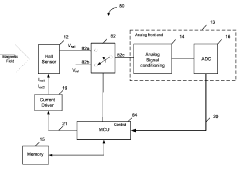
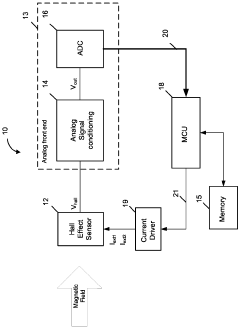
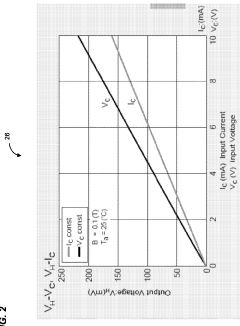
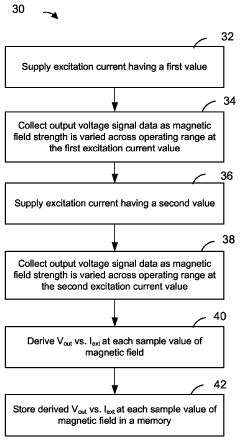
- A method and system that utilize a microcontroller to supply excitation current at different values to the hall effect sensor, obtain corresponding voltage measurements, and verify the sensor's operation based on calibration data, detecting faults in the analog front end and automatically setting the system to a safe mode if measurements are invalid.
Reliability and Environmental Factors Affecting Sensor Performance
Hall Effect sensors, while highly reliable in many applications, are subject to various environmental and operational factors that can significantly impact their performance and data accuracy in fault detection systems. Temperature variations represent one of the most critical environmental challenges, as they can cause sensor output drift and affect magnetic field sensitivity. For instance, in automotive applications where sensors may experience temperature ranges from -40°C to 150°C, output signals can vary by up to 10-15% across this range, potentially leading to false fault indications if not properly compensated.
Mechanical stress and vibration constitute another significant reliability concern, particularly in industrial environments. Excessive vibration can cause mechanical fatigue in sensor components, while physical stress may alter the semiconductor properties of the sensing element. Long-term studies have shown that continuous exposure to vibration frequencies between 10-500 Hz can reduce sensor lifespan by approximately 30% and introduce signal noise that complicates fault detection algorithms.
Electromagnetic interference (EMI) presents a substantial challenge to Hall Effect sensor reliability. Proximity to high-current conductors, power electronics, or wireless communication equipment can introduce noise into sensor readings. Field tests indicate that unshielded sensors may experience signal-to-noise ratio degradation of up to 20 dB in high-EMI environments, necessitating sophisticated filtering techniques to maintain fault detection accuracy.
Humidity and corrosive environments also affect long-term sensor performance. While most modern Hall Effect sensors incorporate protective encapsulation, prolonged exposure to humidity levels above 85% or corrosive gases can compromise packaging integrity and lead to sensor drift or complete failure. Mean Time Between Failures (MTBF) can decrease by 40-60% in such harsh environments compared to controlled conditions.
Power supply stability represents another critical factor affecting sensor reliability. Voltage fluctuations of even ±5% can introduce measurement errors that may be misinterpreted as system faults. This is particularly problematic in battery-powered applications or systems with unstable power sources, where implementing voltage regulation and power conditioning becomes essential for reliable fault detection.
Aging effects must also be considered when interpreting Hall Effect sensor data. Semiconductor properties naturally degrade over time, causing gradual shifts in sensitivity and offset voltages. Accelerated life testing indicates that after 5-7 years of continuous operation, sensitivity may decrease by 3-8%, requiring periodic recalibration or compensation algorithms to maintain fault detection accuracy throughout the system lifecycle.
Mechanical stress and vibration constitute another significant reliability concern, particularly in industrial environments. Excessive vibration can cause mechanical fatigue in sensor components, while physical stress may alter the semiconductor properties of the sensing element. Long-term studies have shown that continuous exposure to vibration frequencies between 10-500 Hz can reduce sensor lifespan by approximately 30% and introduce signal noise that complicates fault detection algorithms.
Electromagnetic interference (EMI) presents a substantial challenge to Hall Effect sensor reliability. Proximity to high-current conductors, power electronics, or wireless communication equipment can introduce noise into sensor readings. Field tests indicate that unshielded sensors may experience signal-to-noise ratio degradation of up to 20 dB in high-EMI environments, necessitating sophisticated filtering techniques to maintain fault detection accuracy.
Humidity and corrosive environments also affect long-term sensor performance. While most modern Hall Effect sensors incorporate protective encapsulation, prolonged exposure to humidity levels above 85% or corrosive gases can compromise packaging integrity and lead to sensor drift or complete failure. Mean Time Between Failures (MTBF) can decrease by 40-60% in such harsh environments compared to controlled conditions.
Power supply stability represents another critical factor affecting sensor reliability. Voltage fluctuations of even ±5% can introduce measurement errors that may be misinterpreted as system faults. This is particularly problematic in battery-powered applications or systems with unstable power sources, where implementing voltage regulation and power conditioning becomes essential for reliable fault detection.
Aging effects must also be considered when interpreting Hall Effect sensor data. Semiconductor properties naturally degrade over time, causing gradual shifts in sensitivity and offset voltages. Accelerated life testing indicates that after 5-7 years of continuous operation, sensitivity may decrease by 3-8%, requiring periodic recalibration or compensation algorithms to maintain fault detection accuracy throughout the system lifecycle.
Integration with IoT and Predictive Maintenance Systems
The integration of Hall Effect sensors with IoT and predictive maintenance systems represents a significant advancement in industrial monitoring capabilities. These systems leverage the real-time data collection capabilities of Hall Effect sensors to create comprehensive monitoring networks that can detect equipment failures before they occur. By connecting Hall Effect sensors to IoT platforms, organizations can establish continuous monitoring of critical machinery components, with data transmitted wirelessly to centralized analytics systems.
Modern IoT integration frameworks typically employ edge computing devices that perform preliminary processing of Hall Effect sensor data directly at the equipment location. This approach reduces bandwidth requirements and enables faster response to detected anomalies. The processed data is then transmitted via standard protocols such as MQTT, OPC-UA, or HTTP/REST to cloud-based predictive maintenance platforms where more sophisticated analysis occurs.
Machine learning algorithms play a crucial role in these integrated systems, analyzing patterns in Hall Effect sensor data to identify deviations that may indicate impending failures. These algorithms typically progress through several stages of implementation: initial training with historical failure data, validation against known fault conditions, and continuous refinement through feedback loops. The most effective systems employ ensemble methods that combine multiple analytical approaches to improve fault detection accuracy.
Digital twin technology has emerged as a powerful complement to Hall Effect sensor integration, creating virtual representations of physical equipment that mirror real-world conditions. These digital twins incorporate Hall Effect sensor data to simulate equipment behavior under various operating conditions, enabling maintenance teams to test different scenarios without risking actual equipment damage.
The implementation of these integrated systems follows a tiered architecture approach. At the field level, Hall Effect sensors connect to local gateways or edge devices. The middleware layer manages data flow and preliminary analytics, while the application layer houses the predictive maintenance software that generates actionable insights and maintenance recommendations.
Return on investment for such integrated systems typically manifests through reduced unplanned downtime, extended equipment lifespan, and optimized maintenance scheduling. Organizations implementing Hall Effect sensor-based predictive maintenance systems commonly report maintenance cost reductions of 15-30% and downtime reductions of 30-50%, though these figures vary significantly based on industry and application specifics.
Modern IoT integration frameworks typically employ edge computing devices that perform preliminary processing of Hall Effect sensor data directly at the equipment location. This approach reduces bandwidth requirements and enables faster response to detected anomalies. The processed data is then transmitted via standard protocols such as MQTT, OPC-UA, or HTTP/REST to cloud-based predictive maintenance platforms where more sophisticated analysis occurs.
Machine learning algorithms play a crucial role in these integrated systems, analyzing patterns in Hall Effect sensor data to identify deviations that may indicate impending failures. These algorithms typically progress through several stages of implementation: initial training with historical failure data, validation against known fault conditions, and continuous refinement through feedback loops. The most effective systems employ ensemble methods that combine multiple analytical approaches to improve fault detection accuracy.
Digital twin technology has emerged as a powerful complement to Hall Effect sensor integration, creating virtual representations of physical equipment that mirror real-world conditions. These digital twins incorporate Hall Effect sensor data to simulate equipment behavior under various operating conditions, enabling maintenance teams to test different scenarios without risking actual equipment damage.
The implementation of these integrated systems follows a tiered architecture approach. At the field level, Hall Effect sensors connect to local gateways or edge devices. The middleware layer manages data flow and preliminary analytics, while the application layer houses the predictive maintenance software that generates actionable insights and maintenance recommendations.
Return on investment for such integrated systems typically manifests through reduced unplanned downtime, extended equipment lifespan, and optimized maintenance scheduling. Organizations implementing Hall Effect sensor-based predictive maintenance systems commonly report maintenance cost reductions of 15-30% and downtime reductions of 30-50%, though these figures vary significantly based on industry and application specifics.
Unlock deeper insights with PatSnap Eureka Quick Research — get a full tech report to explore trends and direct your research. Try now!
Generate Your Research Report Instantly with AI Agent
Supercharge your innovation with PatSnap Eureka AI Agent Platform!