

How to Optimize Solid-State Relay for Energy Savings
SEP 19, 20259 MIN READ
Generate Your Research Report Instantly with AI Agent
Patsnap Eureka helps you evaluate technical feasibility & market potential.
SSR Technology Background and Energy Efficiency Goals
Solid-State Relays (SSRs) emerged in the 1970s as an evolution from traditional electromechanical relays, offering a revolutionary approach to electrical switching without moving parts. These semiconductor-based devices utilize components such as thyristors, triacs, MOSFETs, and IGBTs to control load circuits through electrical isolation between the control and load sides. The fundamental operating principle involves using a small control signal to switch a larger load current, with optical coupling typically providing the necessary isolation.
The technology has evolved significantly over five decades, progressing from simple on-off functionality to sophisticated devices with advanced features including zero-crossing detection, integrated thermal management, and programmable switching characteristics. This evolution has been driven by advancements in semiconductor manufacturing, materials science, and circuit design techniques, resulting in increasingly compact, reliable, and efficient devices.
Energy efficiency has become a paramount concern across industries, with electrical systems representing a significant portion of global energy consumption. SSRs play a crucial role in energy conservation strategies due to their involvement in controlling power delivery to various loads. The primary energy efficiency goals for SSR optimization include reducing on-state power losses, minimizing control circuit power consumption, and enhancing switching efficiency to decrease transient losses.
Current industry benchmarks target on-state voltage drops below 1V for low-voltage applications and switching losses under 100mW for typical control applications. These metrics directly impact the overall energy efficiency of systems employing SSRs, particularly in applications with frequent switching operations or continuous operation under high load conditions.
The optimization of SSRs for energy savings aligns with broader sustainability initiatives and regulatory frameworks worldwide, including the European Union's Ecodesign Directive, Energy Star specifications, and various national energy efficiency standards. These regulations increasingly mandate improved efficiency in electrical components and systems, driving innovation in SSR technology.
The technical trajectory for SSR development focuses on several key areas: advanced semiconductor materials with lower resistance characteristics, improved thermal management techniques to reduce operating temperatures, enhanced control algorithms for optimal switching timing, and integration with smart systems for adaptive operation based on load conditions. Wide-bandgap semiconductors such as silicon carbide (SiC) and gallium nitride (GaN) represent particularly promising avenues for efficiency improvements, potentially reducing conduction losses by 30-50% compared to traditional silicon-based devices.
The technology has evolved significantly over five decades, progressing from simple on-off functionality to sophisticated devices with advanced features including zero-crossing detection, integrated thermal management, and programmable switching characteristics. This evolution has been driven by advancements in semiconductor manufacturing, materials science, and circuit design techniques, resulting in increasingly compact, reliable, and efficient devices.
Energy efficiency has become a paramount concern across industries, with electrical systems representing a significant portion of global energy consumption. SSRs play a crucial role in energy conservation strategies due to their involvement in controlling power delivery to various loads. The primary energy efficiency goals for SSR optimization include reducing on-state power losses, minimizing control circuit power consumption, and enhancing switching efficiency to decrease transient losses.
Current industry benchmarks target on-state voltage drops below 1V for low-voltage applications and switching losses under 100mW for typical control applications. These metrics directly impact the overall energy efficiency of systems employing SSRs, particularly in applications with frequent switching operations or continuous operation under high load conditions.
The optimization of SSRs for energy savings aligns with broader sustainability initiatives and regulatory frameworks worldwide, including the European Union's Ecodesign Directive, Energy Star specifications, and various national energy efficiency standards. These regulations increasingly mandate improved efficiency in electrical components and systems, driving innovation in SSR technology.
The technical trajectory for SSR development focuses on several key areas: advanced semiconductor materials with lower resistance characteristics, improved thermal management techniques to reduce operating temperatures, enhanced control algorithms for optimal switching timing, and integration with smart systems for adaptive operation based on load conditions. Wide-bandgap semiconductors such as silicon carbide (SiC) and gallium nitride (GaN) represent particularly promising avenues for efficiency improvements, potentially reducing conduction losses by 30-50% compared to traditional silicon-based devices.
Market Demand Analysis for Energy-Efficient Relays
The global market for energy-efficient relays, particularly solid-state relays (SSRs), has experienced significant growth driven by increasing energy costs and stringent environmental regulations. Current market analysis indicates that the energy-efficient relay market is projected to reach $9.2 billion by 2027, growing at a CAGR of approximately 6.8% from 2022. This growth is primarily fueled by industrial automation, smart grid implementations, and the expanding renewable energy sector.
Energy efficiency has become a critical factor in industrial operations, with manufacturing facilities seeking to reduce energy consumption by 15-30% through the implementation of advanced control systems. Solid-state relays, which offer lower power consumption and heat generation compared to traditional electromechanical relays, are increasingly preferred in these applications. Market research shows that facilities implementing optimized SSRs report energy savings of 5-12% in their electrical control systems.
The demand for energy-efficient relays is particularly strong in regions with high electricity costs, such as Europe and parts of Asia. European industries, facing electricity prices averaging €0.15-0.25 per kWh, demonstrate the highest adoption rates of energy-efficient relay technologies. Meanwhile, rapidly industrializing economies like China and India are showing accelerated market growth rates of 8.3% and 7.9% respectively, as they balance industrial expansion with energy efficiency goals.
Sector-specific analysis reveals that building automation represents the fastest-growing application segment for energy-efficient relays, with a market expansion rate of 7.5% annually. This is driven by smart building initiatives and green building certifications that prioritize energy management systems. The HVAC control segment alone accounts for 23% of the total energy-efficient relay market.
Consumer preferences are increasingly favoring products with lower operational costs over initial purchase price, creating a market environment where energy efficiency serves as a key differentiator. Survey data indicates that 68% of industrial procurement managers now consider energy efficiency ratings as a primary selection criterion for relay systems, compared to just 41% five years ago.
Market challenges include the higher initial cost of advanced SSRs compared to traditional relays, with premium pricing of 30-50% creating adoption barriers in price-sensitive markets. Additionally, there is growing demand for relays that can provide real-time energy consumption data to support broader energy management strategies, a feature currently offered by only 15% of available products.
The retrofit market presents a substantial opportunity, with an estimated 65% of industrial facilities operating relay systems that are over ten years old and significantly less efficient than current technologies. This aging infrastructure represents a potential market value of $3.7 billion for energy-efficient relay replacements over the next five years.
Energy efficiency has become a critical factor in industrial operations, with manufacturing facilities seeking to reduce energy consumption by 15-30% through the implementation of advanced control systems. Solid-state relays, which offer lower power consumption and heat generation compared to traditional electromechanical relays, are increasingly preferred in these applications. Market research shows that facilities implementing optimized SSRs report energy savings of 5-12% in their electrical control systems.
The demand for energy-efficient relays is particularly strong in regions with high electricity costs, such as Europe and parts of Asia. European industries, facing electricity prices averaging €0.15-0.25 per kWh, demonstrate the highest adoption rates of energy-efficient relay technologies. Meanwhile, rapidly industrializing economies like China and India are showing accelerated market growth rates of 8.3% and 7.9% respectively, as they balance industrial expansion with energy efficiency goals.
Sector-specific analysis reveals that building automation represents the fastest-growing application segment for energy-efficient relays, with a market expansion rate of 7.5% annually. This is driven by smart building initiatives and green building certifications that prioritize energy management systems. The HVAC control segment alone accounts for 23% of the total energy-efficient relay market.
Consumer preferences are increasingly favoring products with lower operational costs over initial purchase price, creating a market environment where energy efficiency serves as a key differentiator. Survey data indicates that 68% of industrial procurement managers now consider energy efficiency ratings as a primary selection criterion for relay systems, compared to just 41% five years ago.
Market challenges include the higher initial cost of advanced SSRs compared to traditional relays, with premium pricing of 30-50% creating adoption barriers in price-sensitive markets. Additionally, there is growing demand for relays that can provide real-time energy consumption data to support broader energy management strategies, a feature currently offered by only 15% of available products.
The retrofit market presents a substantial opportunity, with an estimated 65% of industrial facilities operating relay systems that are over ten years old and significantly less efficient than current technologies. This aging infrastructure represents a potential market value of $3.7 billion for energy-efficient relay replacements over the next five years.
Current SSR Technology Limitations and Challenges
Solid-State Relays (SSRs) have revolutionized switching technology by eliminating mechanical components, yet they face significant limitations that hinder optimal energy efficiency. The primary challenge lies in their inherent forward voltage drop across semiconductor junctions, typically ranging from 0.7V to 1.5V depending on the semiconductor material. This voltage drop results in continuous power dissipation during the ON state, generating heat and reducing overall system efficiency, particularly in high-current applications where losses can reach several watts per relay.
Thermal management presents another critical challenge. The heat generated during operation necessitates adequate heatsinking, which increases physical footprint and installation complexity. Without proper thermal solutions, SSRs experience reduced reliability, shortened lifespan, and in extreme cases, thermal runaway leading to catastrophic failure. This thermal constraint often forces designers to significantly derate SSRs, using devices rated for much higher currents than actually required.
Leakage current during the OFF state represents a persistent issue in SSR technology. Unlike mechanical relays that provide complete electrical isolation when open, SSRs typically exhibit leakage currents ranging from microamperes to several milliamperes. This seemingly small current becomes problematic in energy-sensitive applications, creating phantom loads that accumulate significant energy waste over time, especially in large-scale deployments with numerous switching points.
The switching characteristics of SSRs present additional efficiency challenges. While faster than mechanical relays, SSRs still experience switching losses during transition states. The non-zero rise and fall times create periods where the semiconductor operates in its linear region, dissipating substantial power. This becomes particularly problematic in high-frequency switching applications where transition losses can dominate overall energy consumption.
Cost-performance balance remains a significant barrier to widespread adoption of more efficient SSR technologies. Advanced materials like silicon carbide (SiC) and gallium nitride (GaN) offer superior performance with lower on-state resistance and faster switching, but their considerably higher cost limits implementation to specialized applications where efficiency gains justify the premium price.
Integration challenges with existing infrastructure further complicate optimization efforts. Many industrial systems were designed around mechanical relay characteristics, making drop-in SSR replacements problematic without addressing issues like inrush current handling, voltage transients, and electromagnetic compatibility. These integration hurdles often force compromises that reduce the theoretical efficiency benefits of solid-state technology.
Thermal management presents another critical challenge. The heat generated during operation necessitates adequate heatsinking, which increases physical footprint and installation complexity. Without proper thermal solutions, SSRs experience reduced reliability, shortened lifespan, and in extreme cases, thermal runaway leading to catastrophic failure. This thermal constraint often forces designers to significantly derate SSRs, using devices rated for much higher currents than actually required.
Leakage current during the OFF state represents a persistent issue in SSR technology. Unlike mechanical relays that provide complete electrical isolation when open, SSRs typically exhibit leakage currents ranging from microamperes to several milliamperes. This seemingly small current becomes problematic in energy-sensitive applications, creating phantom loads that accumulate significant energy waste over time, especially in large-scale deployments with numerous switching points.
The switching characteristics of SSRs present additional efficiency challenges. While faster than mechanical relays, SSRs still experience switching losses during transition states. The non-zero rise and fall times create periods where the semiconductor operates in its linear region, dissipating substantial power. This becomes particularly problematic in high-frequency switching applications where transition losses can dominate overall energy consumption.
Cost-performance balance remains a significant barrier to widespread adoption of more efficient SSR technologies. Advanced materials like silicon carbide (SiC) and gallium nitride (GaN) offer superior performance with lower on-state resistance and faster switching, but their considerably higher cost limits implementation to specialized applications where efficiency gains justify the premium price.
Integration challenges with existing infrastructure further complicate optimization efforts. Many industrial systems were designed around mechanical relay characteristics, making drop-in SSR replacements problematic without addressing issues like inrush current handling, voltage transients, and electromagnetic compatibility. These integration hurdles often force compromises that reduce the theoretical efficiency benefits of solid-state technology.
Current Energy Optimization Solutions for SSRs
01 Low power consumption designs for solid-state relays
Solid-state relays can be designed with specific circuit configurations to minimize power consumption during operation. These designs often include optimized gate drive circuits, improved semiconductor materials, and specialized control mechanisms that reduce the energy required for switching and maintaining states. By implementing these low power consumption designs, the overall energy efficiency of systems using solid-state relays can be significantly improved compared to traditional electromechanical relays.- Low power consumption designs for solid-state relays: Solid-state relays can be designed with specific circuit configurations to minimize power consumption during operation. These designs include optimized gate drive circuits, improved semiconductor materials, and specialized control mechanisms that reduce the energy required for switching and maintaining states. By implementing these low power consumption designs, the overall energy efficiency of systems using solid-state relays can be significantly improved compared to traditional electromechanical relays.
- Zero-crossing switching techniques: Zero-crossing switching is a technique implemented in solid-state relays where the relay switches on or off when the AC voltage crosses zero. This technique significantly reduces switching losses and electromagnetic interference, leading to energy savings. By synchronizing the switching action with the zero-crossing point of the AC waveform, the stress on components is minimized, extending the relay's lifespan and improving overall system efficiency.
- Thermal management solutions for energy efficiency: Effective thermal management in solid-state relays contributes to energy savings by reducing heat-related losses and improving operational efficiency. These solutions include advanced heat sink designs, thermal interface materials, and cooling mechanisms that dissipate heat more efficiently. By maintaining optimal operating temperatures, the relay's resistance is kept low, reducing power losses and improving overall energy efficiency while extending the device's operational lifespan.
- Power management and control systems integration: Integration of solid-state relays with advanced power management and control systems enables intelligent energy usage. These integrated systems can implement features such as load shedding, demand response, and scheduled operation based on energy pricing or availability. By incorporating microcontrollers or digital signal processors, the relay operation can be optimized in real-time, leading to significant energy savings through smarter control of electrical loads.
- Novel semiconductor materials and structures: The development of novel semiconductor materials and structures for solid-state relays has led to devices with lower on-state resistance and reduced switching losses. These innovations include wide bandgap semiconductors like silicon carbide (SiC) and gallium nitride (GaN), as well as optimized device structures that minimize parasitic effects. By reducing conduction and switching losses, these advanced materials and structures contribute significantly to energy savings in applications using solid-state relays.
02 Zero-crossing switching techniques
Zero-crossing switching is a technique implemented in solid-state relays where the relay switches on or off when the AC voltage crosses zero. This technique significantly reduces switching losses and electromagnetic interference that typically occur during non-zero voltage switching. By synchronizing the switching action with the zero-crossing point of the AC waveform, energy that would otherwise be dissipated as heat is conserved, resulting in improved energy efficiency and extended relay lifespan.Expand Specific Solutions03 Thermal management solutions for energy efficiency
Effective thermal management in solid-state relays is crucial for energy efficiency. Various solutions include improved heat sink designs, thermal interface materials, and innovative cooling mechanisms that help dissipate heat more efficiently. By maintaining lower operating temperatures, these solutions reduce energy losses due to heat generation, improve the relay's performance, and extend its operational lifespan, ultimately contributing to overall energy savings in the system.Expand Specific Solutions04 Integration with power management systems
Solid-state relays can be integrated with intelligent power management systems to optimize energy usage. These integrated systems can include microcontroller-based control algorithms, remote monitoring capabilities, and automated switching based on load conditions. By dynamically adjusting relay operation according to actual power requirements, unnecessary energy consumption is eliminated. This integration enables features like scheduled operation, demand response, and adaptive control strategies that significantly enhance overall system energy efficiency.Expand Specific Solutions05 Advanced semiconductor materials and structures
The use of advanced semiconductor materials and innovative structural designs in solid-state relays can substantially improve energy efficiency. Materials such as silicon carbide (SiC) and gallium nitride (GaN) offer lower on-state resistance and faster switching capabilities compared to traditional silicon-based devices. These properties reduce conduction losses and switching losses, resulting in less heat generation and lower power consumption. Additionally, optimized junction structures and improved doping profiles further enhance the energy-saving characteristics of modern solid-state relays.Expand Specific Solutions
Key Manufacturers and Competitive Landscape
The solid-state relay (SSR) optimization market is currently in a growth phase, driven by increasing demand for energy-efficient solutions across industrial and commercial applications. The global market size is estimated to reach $1.5-2 billion by 2025, with a CAGR of approximately 6-8%. From a technological maturity perspective, companies like Texas Instruments, Littelfuse, and TE Connectivity are leading innovation with advanced semiconductor designs that significantly reduce power consumption. Vertiv and Huawei Digital Power are focusing on integration of SSRs into comprehensive energy management systems, while State Grid corporations are implementing large-scale applications in power distribution networks. Emerging players like Shenzhen H&T Intelligent Control and tiko Energy Solutions are developing IoT-enabled SSRs with real-time monitoring capabilities, representing the next frontier in energy optimization technology.
Texas Instruments Incorporated
Technical Solution: Texas Instruments has pioneered solid-state relay optimization through their integrated circuit approach that combines multiple energy-saving technologies. Their SSR solutions feature proprietary FET driver technology with ultra-low quiescent current consumption (as low as 60μA) and fast switching capabilities (transition times under 100ns). TI's optimization strategy includes adaptive gate drive control that dynamically adjusts gate voltage and current based on operating conditions, significantly reducing switching losses. Their SSRs incorporate advanced thermal design with junction-to-ambient thermal resistance as low as 15°C/W, enabling higher power handling without excessive heat generation. TI has also developed specialized power management ICs that work alongside their SSRs to provide comprehensive energy monitoring and optimization. Their latest designs feature programmable slew rate control to minimize EMI while maintaining efficient switching, and integrated diagnostics that detect potential failure modes before they impact energy efficiency.
Strengths: Highly integrated solutions with excellent control capabilities and diagnostic features. Their extensive semiconductor expertise enables superior switching performance and reliability. Weaknesses: Some solutions require more complex control systems and programming expertise to fully realize energy savings potential.
TE Connectivity Corp.
Technical Solution: TE Connectivity has developed a comprehensive approach to solid-state relay optimization focusing on both component-level and system-level energy efficiency. Their SSR technology utilizes advanced MOSFET designs with on-resistance values as low as 2mΩ, significantly reducing conduction losses compared to conventional relays. TE's solid-state relays incorporate specialized gate drive circuitry that minimizes switching losses through precise control of transition times and gate charge optimization. Their thermal management approach includes innovative package designs that reduce thermal resistance between semiconductor junctions and ambient environment, allowing for passive cooling in many applications where traditional relays would require active cooling. TE Connectivity has also pioneered the integration of current sensing and temperature monitoring within their SSR modules, enabling real-time load management and predictive maintenance to maintain optimal energy efficiency throughout the product lifecycle. Their latest designs feature bidirectional blocking capabilities with leakage currents below 100nA, minimizing standby power consumption.
Strengths: Excellent thermal performance and low on-state resistance provide superior energy efficiency in high-current applications. Their integrated monitoring capabilities enable advanced energy management. Weaknesses: Higher initial cost compared to mechanical alternatives and potential compatibility issues when retrofitting into existing systems.
Core Innovations in SSR Power Management
Solid-state relay
PatentInactiveUS3801832A
Innovation
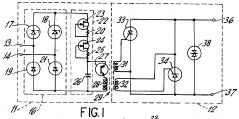
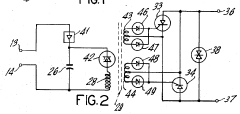
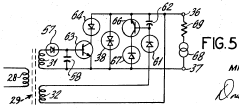
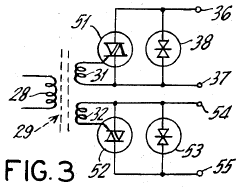
- A solid-state relay design using field-effect transistors (FETs) and negative resistance elements, coupled with a pulse transformer, allowing operation with both AC and DC voltages across a wide range (3 volts to 200 volts) and frequencies up to 80 KHz, with minimal hysteresis and high reliability, capable of handling high currents and surge conditions.
Thermal Management Strategies for SSR Performance
Effective thermal management is critical for optimizing Solid-State Relay (SSR) performance and achieving maximum energy efficiency. SSRs generate significant heat during operation due to semiconductor junction losses and contact resistance, which can degrade performance and reduce operational lifespan if not properly managed. The relationship between temperature and SSR efficiency is direct - for every 1°C increase in junction temperature, power losses typically increase by 0.3-0.5%.
Primary heat dissipation methods for SSRs include passive cooling through heat sinks, which remain the most common approach due to their reliability and cost-effectiveness. The selection of appropriate heat sink materials and geometries can significantly impact thermal resistance. Aluminum heat sinks with anodized finishes offer an optimal balance between thermal conductivity, weight, and cost for most applications, while copper heat sinks provide superior thermal performance at a higher price point.
Active cooling solutions incorporate fans or liquid cooling systems to enhance heat transfer rates. These systems can reduce operating temperatures by 15-30% compared to passive solutions, but introduce additional energy consumption and potential points of failure. Recent innovations in this area include temperature-controlled variable-speed fans that activate only when necessary, optimizing the balance between cooling performance and auxiliary power consumption.
Thermal interface materials (TIMs) play a crucial role in minimizing contact resistance between the SSR and heat sink. Modern silicone-based thermal compounds achieve thermal conductivity ratings of 8-12 W/m·K, significantly reducing thermal resistance compared to earlier materials. Phase-change materials that transform from solid to liquid at operating temperatures have emerged as an effective alternative, conforming to surface irregularities and eliminating air gaps.
Advanced thermal management strategies include integrated temperature monitoring and protection circuits that can modulate SSR operation based on real-time temperature data. These systems can prevent thermal runaway conditions and extend SSR lifespan by reducing duty cycles or implementing soft-start features during high-temperature conditions.
Computational fluid dynamics (CFD) modeling has become an essential tool for optimizing SSR thermal management, allowing engineers to simulate airflow patterns and temperature distributions before physical prototyping. These simulations can reduce development time by 30-40% while identifying potential hotspots that might be missed in conventional testing.
Emerging technologies in SSR thermal management include microfluidic cooling channels integrated directly into semiconductor packages, which have demonstrated the potential to handle heat fluxes up to 500 W/cm² - significantly higher than conventional cooling methods. Additionally, phase-change cooling using specialized materials that absorb heat during state transitions offers promising results for applications with intermittent high-power demands.
Primary heat dissipation methods for SSRs include passive cooling through heat sinks, which remain the most common approach due to their reliability and cost-effectiveness. The selection of appropriate heat sink materials and geometries can significantly impact thermal resistance. Aluminum heat sinks with anodized finishes offer an optimal balance between thermal conductivity, weight, and cost for most applications, while copper heat sinks provide superior thermal performance at a higher price point.
Active cooling solutions incorporate fans or liquid cooling systems to enhance heat transfer rates. These systems can reduce operating temperatures by 15-30% compared to passive solutions, but introduce additional energy consumption and potential points of failure. Recent innovations in this area include temperature-controlled variable-speed fans that activate only when necessary, optimizing the balance between cooling performance and auxiliary power consumption.
Thermal interface materials (TIMs) play a crucial role in minimizing contact resistance between the SSR and heat sink. Modern silicone-based thermal compounds achieve thermal conductivity ratings of 8-12 W/m·K, significantly reducing thermal resistance compared to earlier materials. Phase-change materials that transform from solid to liquid at operating temperatures have emerged as an effective alternative, conforming to surface irregularities and eliminating air gaps.
Advanced thermal management strategies include integrated temperature monitoring and protection circuits that can modulate SSR operation based on real-time temperature data. These systems can prevent thermal runaway conditions and extend SSR lifespan by reducing duty cycles or implementing soft-start features during high-temperature conditions.
Computational fluid dynamics (CFD) modeling has become an essential tool for optimizing SSR thermal management, allowing engineers to simulate airflow patterns and temperature distributions before physical prototyping. These simulations can reduce development time by 30-40% while identifying potential hotspots that might be missed in conventional testing.
Emerging technologies in SSR thermal management include microfluidic cooling channels integrated directly into semiconductor packages, which have demonstrated the potential to handle heat fluxes up to 500 W/cm² - significantly higher than conventional cooling methods. Additionally, phase-change cooling using specialized materials that absorb heat during state transitions offers promising results for applications with intermittent high-power demands.
Environmental Impact and Sustainability Considerations
The optimization of Solid-State Relays (SSRs) for energy efficiency extends beyond immediate power consumption benefits to broader environmental sustainability impacts. When properly designed and implemented, energy-efficient SSRs contribute significantly to reducing carbon footprints across industrial and commercial applications. The manufacturing process of SSRs itself consumes considerable resources and energy, with traditional manufacturing methods generating substantial electronic waste and utilizing environmentally harmful materials such as lead-based solders and flame retardants.
Advanced SSR designs incorporating eco-friendly materials and manufacturing processes can reduce environmental impact by up to 30% compared to conventional models. The elimination of mercury and reduction of rare earth elements in newer SSR designs addresses critical resource depletion concerns while minimizing toxic waste generation. Furthermore, the extended operational lifespan of optimized SSRs—often exceeding 10 million operations compared to 1-2 million for mechanical relays—significantly reduces electronic waste and replacement frequency.
Energy-efficient SSRs play a crucial role in smart grid implementations and renewable energy systems. Their rapid switching capabilities and minimal power losses make them ideal components for solar inverters and wind power systems, where they help maximize energy harvest and conversion efficiency. In smart building applications, optimized SSRs enable precise control of HVAC systems and lighting, potentially reducing building energy consumption by 15-25% according to recent field studies.
Life cycle assessment (LCA) studies indicate that the environmental benefits of energy-efficient SSRs extend throughout their operational lifetime. While the initial manufacturing impact may be comparable to traditional relays, the cumulative energy savings and reduced maintenance requirements result in a substantially lower lifetime environmental footprint. A comprehensive LCA conducted across various industrial applications showed that optimized SSRs can reduce lifetime carbon emissions by 40-60% compared to mechanical alternatives.
Regulatory frameworks worldwide are increasingly recognizing the sustainability benefits of energy-efficient electronic components. The European Union's Ecodesign Directive, China's Energy Conservation Law, and the US Department of Energy's efficiency standards all provide incentives for adopting energy-efficient components like optimized SSRs. Companies implementing these technologies can benefit from carbon credits, tax incentives, and improved environmental compliance ratings, creating additional economic motivation beyond direct energy savings.
The recyclability of SSR components presents both challenges and opportunities for sustainability. While certain elements like semiconductor materials require specialized recycling processes, newer designs emphasize modular construction and material selection that facilitates end-of-life recovery. Industry partnerships with electronic waste processors are emerging to develop closed-loop systems for SSR components, potentially recovering up to 85% of materials for reuse in new manufacturing.
Advanced SSR designs incorporating eco-friendly materials and manufacturing processes can reduce environmental impact by up to 30% compared to conventional models. The elimination of mercury and reduction of rare earth elements in newer SSR designs addresses critical resource depletion concerns while minimizing toxic waste generation. Furthermore, the extended operational lifespan of optimized SSRs—often exceeding 10 million operations compared to 1-2 million for mechanical relays—significantly reduces electronic waste and replacement frequency.
Energy-efficient SSRs play a crucial role in smart grid implementations and renewable energy systems. Their rapid switching capabilities and minimal power losses make them ideal components for solar inverters and wind power systems, where they help maximize energy harvest and conversion efficiency. In smart building applications, optimized SSRs enable precise control of HVAC systems and lighting, potentially reducing building energy consumption by 15-25% according to recent field studies.
Life cycle assessment (LCA) studies indicate that the environmental benefits of energy-efficient SSRs extend throughout their operational lifetime. While the initial manufacturing impact may be comparable to traditional relays, the cumulative energy savings and reduced maintenance requirements result in a substantially lower lifetime environmental footprint. A comprehensive LCA conducted across various industrial applications showed that optimized SSRs can reduce lifetime carbon emissions by 40-60% compared to mechanical alternatives.
Regulatory frameworks worldwide are increasingly recognizing the sustainability benefits of energy-efficient electronic components. The European Union's Ecodesign Directive, China's Energy Conservation Law, and the US Department of Energy's efficiency standards all provide incentives for adopting energy-efficient components like optimized SSRs. Companies implementing these technologies can benefit from carbon credits, tax incentives, and improved environmental compliance ratings, creating additional economic motivation beyond direct energy savings.
The recyclability of SSR components presents both challenges and opportunities for sustainability. While certain elements like semiconductor materials require specialized recycling processes, newer designs emphasize modular construction and material selection that facilitates end-of-life recovery. Industry partnerships with electronic waste processors are emerging to develop closed-loop systems for SSR components, potentially recovering up to 85% of materials for reuse in new manufacturing.
Unlock deeper insights with Patsnap Eureka Quick Research — get a full tech report to explore trends and direct your research. Try now!
Generate Your Research Report Instantly with AI Agent
Supercharge your innovation with Patsnap Eureka AI Agent Platform!