Optimize Electrochemical Cell Design for Safety Standards
AUG 28, 202510 MIN READ
Generate Your Research Report Instantly with AI Agent
PatSnap Eureka helps you evaluate technical feasibility & market potential.
Electrochemical Cell Safety Evolution and Objectives
Electrochemical cells have undergone significant evolution since their inception in the late 18th century with Alessandro Volta's pioneering work. The trajectory of development has been marked by continuous improvements in energy density, cycle life, and most critically, safety performance. Early lead-acid batteries, while revolutionary, presented numerous safety hazards including acid leakage and hydrogen gas generation. The introduction of nickel-cadmium cells in the mid-20th century improved safety profiles but introduced environmental concerns due to toxic materials.
The 1990s witnessed a paradigm shift with the commercialization of lithium-ion technology, offering unprecedented energy density but introducing new safety challenges related to thermal runaway and electrolyte flammability. These challenges became particularly evident through high-profile incidents involving consumer electronics and electric vehicles, prompting intensified research into safer electrochemical cell designs.
Current safety standards for electrochemical cells are governed by multiple regulatory frameworks including IEC 62133, UL 1642, and UN 38.3, which establish rigorous testing protocols for mechanical integrity, thermal stability, and electrical safety. These standards have evolved in response to emerging safety concerns and technological advancements, creating a complex regulatory landscape that manufacturers must navigate.
The primary objective of electrochemical cell safety optimization is to develop designs that maintain high performance while eliminating or substantially mitigating risks of thermal runaway, electrolyte leakage, and catastrophic failure under abuse conditions. This requires a multifaceted approach addressing cell chemistry, structural integrity, thermal management, and monitoring systems.
Secondary objectives include developing cells that maintain safety performance throughout their operational lifetime, even as degradation mechanisms progress. This aging-related safety dimension has gained prominence as applications demand longer service lives, particularly in energy storage systems and automotive applications where replacement is costly and logistically challenging.
The technical evolution is now trending toward intrinsically safer chemistries such as lithium iron phosphate and solid-state electrolytes, which eliminate or reduce flammability concerns. Simultaneously, advanced battery management systems with predictive analytics capabilities are being developed to detect potential failure modes before they manifest as safety incidents.
Future objectives in the field include establishing unified global safety standards that accommodate emerging technologies while ensuring consumer protection, developing accelerated testing methodologies that can reliably predict long-term safety performance, and creating design frameworks that balance safety enhancements with manufacturing scalability and economic viability.
The 1990s witnessed a paradigm shift with the commercialization of lithium-ion technology, offering unprecedented energy density but introducing new safety challenges related to thermal runaway and electrolyte flammability. These challenges became particularly evident through high-profile incidents involving consumer electronics and electric vehicles, prompting intensified research into safer electrochemical cell designs.
Current safety standards for electrochemical cells are governed by multiple regulatory frameworks including IEC 62133, UL 1642, and UN 38.3, which establish rigorous testing protocols for mechanical integrity, thermal stability, and electrical safety. These standards have evolved in response to emerging safety concerns and technological advancements, creating a complex regulatory landscape that manufacturers must navigate.
The primary objective of electrochemical cell safety optimization is to develop designs that maintain high performance while eliminating or substantially mitigating risks of thermal runaway, electrolyte leakage, and catastrophic failure under abuse conditions. This requires a multifaceted approach addressing cell chemistry, structural integrity, thermal management, and monitoring systems.
Secondary objectives include developing cells that maintain safety performance throughout their operational lifetime, even as degradation mechanisms progress. This aging-related safety dimension has gained prominence as applications demand longer service lives, particularly in energy storage systems and automotive applications where replacement is costly and logistically challenging.
The technical evolution is now trending toward intrinsically safer chemistries such as lithium iron phosphate and solid-state electrolytes, which eliminate or reduce flammability concerns. Simultaneously, advanced battery management systems with predictive analytics capabilities are being developed to detect potential failure modes before they manifest as safety incidents.
Future objectives in the field include establishing unified global safety standards that accommodate emerging technologies while ensuring consumer protection, developing accelerated testing methodologies that can reliably predict long-term safety performance, and creating design frameworks that balance safety enhancements with manufacturing scalability and economic viability.
Market Demand Analysis for Safer Battery Technologies
The global market for safer battery technologies has witnessed substantial growth in recent years, driven primarily by increasing concerns over battery safety incidents across various applications. The demand for optimized electrochemical cell designs that meet or exceed safety standards has become paramount across multiple industries, with the electric vehicle (EV) sector leading this transformation. Current market valuations indicate the global battery safety technology market exceeds $45 billion, with projections suggesting a compound annual growth rate of 18% through 2030.
Consumer electronics represents another significant market segment demanding enhanced battery safety. With numerous high-profile incidents involving smartphones, laptops, and wearable devices, manufacturers are increasingly prioritizing electrochemical cell designs that minimize thermal runaway risks. This has created a premium market segment where safety features command price premiums of 15-30% over standard battery technologies.
The energy storage system (ESS) sector presents perhaps the fastest-growing market opportunity for safer electrochemical cells. Grid-scale installations and residential energy storage solutions require batteries with exceptional safety profiles due to their proximity to infrastructure and residential areas. Market analysis indicates ESS deployments are growing at 25% annually, with safety considerations cited as the primary specification requirement by 78% of system integrators.
Regulatory pressures are significantly reshaping market demands across all sectors. The implementation of IEC 62619, UL 1642, and UN 38.3 standards has created mandatory safety thresholds that manufacturers must meet. Furthermore, regions like the European Union are implementing additional safety certification requirements through the Battery Directive revision, effectively creating market barriers for technologies that cannot demonstrate enhanced safety profiles.
Consumer awareness regarding battery safety has reached unprecedented levels, creating market pull for safer technologies. Survey data indicates 67% of consumers now consider safety ratings when purchasing battery-powered devices, compared to just 23% five years ago. This shift in consumer behavior is compelling manufacturers to prominently feature safety innovations in marketing materials and product specifications.
The aerospace and defense sectors represent premium market niches with stringent safety requirements and corresponding willingness to pay for advanced solutions. These sectors demand electrochemical cells that can withstand extreme conditions while maintaining safety integrity, creating opportunities for specialized cell designs with enhanced thermal management and fail-safe mechanisms.
Market forecasts indicate that manufacturers who successfully optimize electrochemical cell designs for enhanced safety will capture significant market share across all sectors. The economic value of preventing a single major battery safety incident can exceed hundreds of millions in direct costs and brand damage, creating compelling return-on-investment calculations for implementing advanced safety technologies.
Consumer electronics represents another significant market segment demanding enhanced battery safety. With numerous high-profile incidents involving smartphones, laptops, and wearable devices, manufacturers are increasingly prioritizing electrochemical cell designs that minimize thermal runaway risks. This has created a premium market segment where safety features command price premiums of 15-30% over standard battery technologies.
The energy storage system (ESS) sector presents perhaps the fastest-growing market opportunity for safer electrochemical cells. Grid-scale installations and residential energy storage solutions require batteries with exceptional safety profiles due to their proximity to infrastructure and residential areas. Market analysis indicates ESS deployments are growing at 25% annually, with safety considerations cited as the primary specification requirement by 78% of system integrators.
Regulatory pressures are significantly reshaping market demands across all sectors. The implementation of IEC 62619, UL 1642, and UN 38.3 standards has created mandatory safety thresholds that manufacturers must meet. Furthermore, regions like the European Union are implementing additional safety certification requirements through the Battery Directive revision, effectively creating market barriers for technologies that cannot demonstrate enhanced safety profiles.
Consumer awareness regarding battery safety has reached unprecedented levels, creating market pull for safer technologies. Survey data indicates 67% of consumers now consider safety ratings when purchasing battery-powered devices, compared to just 23% five years ago. This shift in consumer behavior is compelling manufacturers to prominently feature safety innovations in marketing materials and product specifications.
The aerospace and defense sectors represent premium market niches with stringent safety requirements and corresponding willingness to pay for advanced solutions. These sectors demand electrochemical cells that can withstand extreme conditions while maintaining safety integrity, creating opportunities for specialized cell designs with enhanced thermal management and fail-safe mechanisms.
Market forecasts indicate that manufacturers who successfully optimize electrochemical cell designs for enhanced safety will capture significant market share across all sectors. The economic value of preventing a single major battery safety incident can exceed hundreds of millions in direct costs and brand damage, creating compelling return-on-investment calculations for implementing advanced safety technologies.
Current Safety Challenges in Electrochemical Cell Design
Electrochemical cell safety has become increasingly critical as these technologies proliferate across industries from consumer electronics to electric vehicles and grid-scale energy storage. Current safety challenges in electrochemical cell design center primarily around thermal runaway events, which remain the most catastrophic failure mode. These events typically begin with internal short circuits that generate excessive heat, triggering exothermic reactions that can lead to fire, explosion, and toxic gas release.
Material instability presents another significant challenge, particularly in lithium-ion technologies. Conventional electrolytes based on organic carbonates are highly flammable and become reactive at elevated temperatures. Additionally, cathode materials can undergo oxygen release at high temperatures, further fueling thermal events. The solid-electrolyte interphase (SEI) layer, while necessary for battery function, can break down under extreme conditions, contributing to cascading failure mechanisms.
Mechanical integrity issues have emerged as batteries are designed for higher energy densities. Cell expansion during cycling, particularly in pouch and prismatic formats, creates mechanical stresses that can compromise safety features. External forces from vehicle crashes or physical damage can deform cells, potentially causing internal shorts. Current designs struggle to maintain robust mechanical protection while meeting market demands for lightweight, compact energy storage solutions.
Electrical safety challenges include overcharging and over-discharging scenarios that can lead to lithium plating, dendrite formation, and subsequent internal shorts. Modern high-power applications demand rapid charging capabilities that stress cell components and generate significant heat. Current battery management systems (BMS) often lack sufficient granularity to detect early warning signs of potential failures at the individual cell level.
Manufacturing inconsistencies represent an underappreciated safety challenge. Microscopic metal particle contamination, electrode misalignment, and separator defects can create latent failure points that manifest only after hundreds of cycles. The industry currently lacks standardized non-destructive testing methods capable of detecting these subtle manufacturing defects at production scale.
Aging and degradation mechanisms compound these challenges, as safety margins designed into new cells diminish over time. Calendar aging and cycling-induced degradation can alter internal cell chemistry and structure in ways that compromise safety features. Current accelerated aging tests fail to accurately predict long-term safety performance under real-world conditions.
Regulatory frameworks present additional challenges, with fragmented global standards creating compliance difficulties for manufacturers. Transportation regulations are particularly stringent, requiring extensive testing that may not reflect actual usage conditions. The lack of harmonized safety standards across markets increases development costs and potentially delays implementation of innovative safety solutions.
Material instability presents another significant challenge, particularly in lithium-ion technologies. Conventional electrolytes based on organic carbonates are highly flammable and become reactive at elevated temperatures. Additionally, cathode materials can undergo oxygen release at high temperatures, further fueling thermal events. The solid-electrolyte interphase (SEI) layer, while necessary for battery function, can break down under extreme conditions, contributing to cascading failure mechanisms.
Mechanical integrity issues have emerged as batteries are designed for higher energy densities. Cell expansion during cycling, particularly in pouch and prismatic formats, creates mechanical stresses that can compromise safety features. External forces from vehicle crashes or physical damage can deform cells, potentially causing internal shorts. Current designs struggle to maintain robust mechanical protection while meeting market demands for lightweight, compact energy storage solutions.
Electrical safety challenges include overcharging and over-discharging scenarios that can lead to lithium plating, dendrite formation, and subsequent internal shorts. Modern high-power applications demand rapid charging capabilities that stress cell components and generate significant heat. Current battery management systems (BMS) often lack sufficient granularity to detect early warning signs of potential failures at the individual cell level.
Manufacturing inconsistencies represent an underappreciated safety challenge. Microscopic metal particle contamination, electrode misalignment, and separator defects can create latent failure points that manifest only after hundreds of cycles. The industry currently lacks standardized non-destructive testing methods capable of detecting these subtle manufacturing defects at production scale.
Aging and degradation mechanisms compound these challenges, as safety margins designed into new cells diminish over time. Calendar aging and cycling-induced degradation can alter internal cell chemistry and structure in ways that compromise safety features. Current accelerated aging tests fail to accurately predict long-term safety performance under real-world conditions.
Regulatory frameworks present additional challenges, with fragmented global standards creating compliance difficulties for manufacturers. Transportation regulations are particularly stringent, requiring extensive testing that may not reflect actual usage conditions. The lack of harmonized safety standards across markets increases development costs and potentially delays implementation of innovative safety solutions.
Current Safety Design Solutions and Implementation Methods
01 Thermal management systems for electrochemical cells
Effective thermal management is crucial for electrochemical cell safety. Systems that monitor and control temperature prevent thermal runaway, which can lead to fires or explosions. These systems include cooling mechanisms, heat dissipation materials, and temperature sensors that can detect abnormal heat generation. Advanced thermal management designs incorporate phase change materials and specialized cooling channels to maintain optimal operating temperatures even under high-load conditions.- Thermal management systems for electrochemical cells: Thermal management systems are crucial for electrochemical cell safety as they prevent overheating and thermal runaway. These systems include cooling mechanisms, heat dissipation structures, and temperature monitoring devices that maintain optimal operating temperatures. Effective thermal management reduces the risk of fire, explosion, and other safety hazards associated with excessive heat generation in electrochemical cells.
- Safety mechanisms for preventing short circuits: Various safety mechanisms are implemented to prevent short circuits in electrochemical cells. These include separator designs with shutdown capabilities, current interrupt devices, and protective coatings on electrodes. These mechanisms can detect abnormal conditions and interrupt the electrical path before a dangerous situation develops, thereby enhancing the overall safety of the cell.
- Electrolyte safety enhancements: Safety of electrochemical cells can be improved through electrolyte modifications. Non-flammable or flame-retardant electrolytes, solid-state electrolytes, and electrolyte additives that form protective films can significantly reduce fire and explosion risks. These enhancements maintain cell performance while providing additional safety margins under abuse conditions.
- Monitoring and control systems for cell safety: Advanced monitoring and control systems play a vital role in electrochemical cell safety. These include sensors for detecting temperature, pressure, and voltage anomalies, along with battery management systems that can take corrective actions. Real-time monitoring allows for early detection of potential safety issues and implementation of preventive measures before failures occur.
- Structural design improvements for enhanced safety: Structural design improvements focus on enhancing the mechanical integrity and safety of electrochemical cells. These include reinforced cell casings, pressure relief mechanisms, improved sealing methods, and impact-resistant designs. Such structural enhancements help contain internal failures and prevent cascading failures in multi-cell systems, thereby improving overall safety performance.
02 Safety mechanisms for preventing short circuits
Short circuit prevention is essential for electrochemical cell safety. Various mechanisms include separator designs that prevent contact between electrodes, current interrupt devices that activate when pressure builds up, and specialized coatings that become non-conductive at high temperatures. These safety features can isolate cells during fault conditions, preventing cascading failures in battery packs and reducing the risk of thermal events.Expand Specific Solutions03 Monitoring and control systems for cell safety
Advanced monitoring systems continuously assess electrochemical cell parameters such as voltage, current, and temperature to detect abnormal conditions. These systems employ algorithms to identify potential safety issues before they escalate and can trigger protective measures automatically. Battery management systems integrate these monitoring capabilities with control functions to maintain safe operating conditions and extend cell life through balanced charging and discharging protocols.Expand Specific Solutions04 Structural design improvements for enhanced safety
Structural innovations in electrochemical cells significantly improve safety performance. These include reinforced cell casings that contain internal failures, pressure relief mechanisms that safely vent gases during overpressure events, and impact-resistant designs that protect cells during physical trauma. Advanced cell architectures incorporate multiple redundant safety features and utilize materials specifically selected for their ability to withstand abuse conditions without catastrophic failure.Expand Specific Solutions05 Electrolyte and electrode material safety enhancements
Safety-enhanced materials for electrochemical cells include flame-retardant electrolytes that reduce fire risks, solid-state electrolytes that eliminate leakage concerns, and electrode materials with improved thermal stability. These advanced materials maintain performance while significantly reducing safety hazards associated with traditional cell chemistries. Additives can be incorporated to suppress gas generation during abuse conditions and promote self-healing properties that extend cell life and prevent catastrophic failures.Expand Specific Solutions
Leading Manufacturers and Research Institutions in Battery Safety
The electrochemical cell safety standards optimization market is currently in a growth phase, with increasing regulatory focus driving innovation. The global market size is expanding rapidly, projected to reach significant value as electric vehicle adoption accelerates. Technologically, the field shows varying maturity levels across applications. Industry leaders like Contemporary Amperex Technology (CATL), LG Energy Solution, and NGK Insulators have established advanced safety protocols in commercial cells, while companies such as South 8 Technologies and 24M Technologies are pioneering novel electrolyte and cell architectures specifically addressing thermal runaway concerns. Traditional players including Kyocera and Seiko Instruments contribute specialized components enhancing cell safety, while automotive manufacturers like NIO and Renault are integrating these technologies into comprehensive battery management systems.
Contemporary Amperex Technology Co., Ltd.
Technical Solution: CATL has developed the Cell-to-Pack (CTP) technology that eliminates the need for battery modules, improving energy density by 10-15% and reducing parts by 40%. Their latest innovation includes the Qilin battery with built-in liquid cooling systems placed between cells rather than at the bottom, allowing for more efficient heat dissipation. The design incorporates multi-layer safety features including flame-retardant separators, thermal-resistant electrolytes, and pressure relief mechanisms. CATL's electrochemical cell design also utilizes their patented honeycomb structure that enhances mechanical integrity while allowing for thermal expansion, significantly reducing the risk of thermal runaway propagation between cells. Their Battery Management System (BMS) continuously monitors cell parameters and can preemptively identify potential safety issues before they escalate.
Strengths: Industry-leading energy density while maintaining safety standards; advanced thermal management system reduces fire risks; comprehensive real-time monitoring capabilities. Weaknesses: Higher production costs compared to conventional designs; requires specialized manufacturing equipment; thermal management system adds complexity to the overall battery design.
24M Technologies, Inc.
Technical Solution: 24M Technologies has revolutionized electrochemical cell design with their semi-solid electrode technology that eliminates the need for conventional binders and separators. Their "SemiSolid" battery architecture uses a clay-like electrode material that can be manufactured in fewer steps than traditional lithium-ion batteries, reducing production complexity by up to 50%. From a safety perspective, the semi-solid electrodes are inherently more resistant to thermal runaway as they contain less flammable liquid electrolyte per unit volume. The design incorporates wider electrodes with fewer but thicker layers, reducing the number of potential failure points within the cell. 24M's cells feature a proprietary electrolyte formulation with flame-retardant additives that significantly reduce fire risk without compromising performance. Their cell architecture also includes built-in pressure relief mechanisms that prevent catastrophic rupture by allowing controlled venting of gases during abuse conditions.
Strengths: Simplified manufacturing process reduces potential quality issues; inherently safer electrode composition with lower flammability; fewer internal interfaces reduce potential failure points. Weaknesses: Limited large-scale production experience compared to established manufacturers; semi-solid technology requires specialized handling equipment; performance in extreme low-temperature environments still being optimized.
Key Patents and Innovations in Electrochemical Cell Safety
Electrochemical Cell of Improved Safety ContainingDamping Part by Heating Fusion to Separator
PatentActiveKR1020070108582A
Innovation
- A separator damping part is formed by heat-treating a separator extending from the electrode's outer surface, fixed to the electrode ends, with a thickness of 0.5 mm or more, to prevent electrode bending and internal short circuits.


Electrochemical cell having at least one pressure-relief apparatus
PatentWO2012022448A1
Innovation
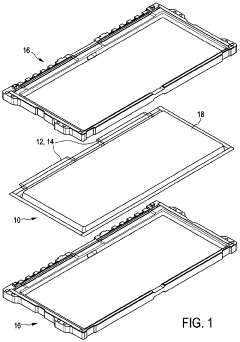
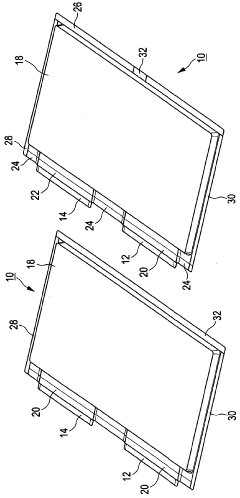
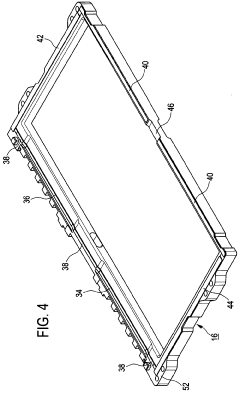
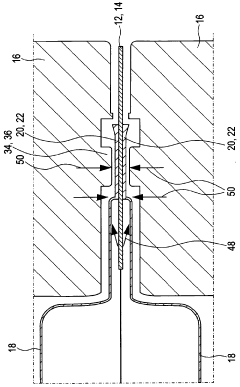
- The electrochemical cell design incorporates a frame element with a support web spaced close to the sealing seam of the casing, allowing for controlled pressure relief through a pressure relief device that vents gases or electrolytes away from the current collector and battery management system, preventing damage and ensuring safety.
Regulatory Compliance Framework for Battery Safety Standards
The regulatory landscape for battery safety standards has evolved significantly over the past decade, creating a complex framework that manufacturers must navigate. International standards such as IEC 62133, UL 1642, and UN 38.3 establish baseline requirements for electrochemical cell safety, covering thermal stability, mechanical integrity, and electrical performance under various conditions. These standards are continuously updated to address emerging safety concerns and technological advancements in battery chemistry and design.
Regional variations in regulatory requirements present significant challenges for global manufacturers. The European Union's Battery Directive and REACH regulations impose strict guidelines on material composition and end-of-life management, while North American standards focus heavily on thermal runaway prevention and fire safety. Asian markets, particularly Japan and South Korea, have developed sophisticated testing protocols that emphasize long-term reliability under extreme operating conditions.
Compliance testing methodologies have become increasingly rigorous, requiring manufacturers to demonstrate safety across multiple dimensions. Short circuit testing, overcharge protection, thermal cycling, and vibration resistance represent core components of most certification processes. The introduction of more energy-dense chemistries has prompted regulatory bodies to implement additional safeguards, particularly for lithium-ion technologies where thermal management remains a critical concern.
Certification pathways typically involve third-party testing laboratories that verify conformance to applicable standards. This process includes documentation review, sample testing, factory inspections, and ongoing compliance monitoring. The financial implications of regulatory compliance are substantial, with testing costs often exceeding $100,000 for comprehensive certification across major markets, creating barriers to entry for smaller manufacturers and startups.
Recent regulatory trends indicate a shift toward harmonization of global standards, with initiatives like the Global Technical Regulation (GTR) for electric vehicle batteries attempting to create consistent safety frameworks across jurisdictions. Simultaneously, there is increasing emphasis on sustainability metrics within safety standards, requiring manufacturers to consider environmental impact alongside traditional safety parameters.
For electrochemical cell designers, regulatory compliance necessitates early integration of safety considerations into the design process. This proactive approach requires sophisticated simulation tools to predict cell behavior under failure conditions, materials selection that anticipates regulatory restrictions, and modular design approaches that facilitate compliance testing without compromising performance objectives.
Regional variations in regulatory requirements present significant challenges for global manufacturers. The European Union's Battery Directive and REACH regulations impose strict guidelines on material composition and end-of-life management, while North American standards focus heavily on thermal runaway prevention and fire safety. Asian markets, particularly Japan and South Korea, have developed sophisticated testing protocols that emphasize long-term reliability under extreme operating conditions.
Compliance testing methodologies have become increasingly rigorous, requiring manufacturers to demonstrate safety across multiple dimensions. Short circuit testing, overcharge protection, thermal cycling, and vibration resistance represent core components of most certification processes. The introduction of more energy-dense chemistries has prompted regulatory bodies to implement additional safeguards, particularly for lithium-ion technologies where thermal management remains a critical concern.
Certification pathways typically involve third-party testing laboratories that verify conformance to applicable standards. This process includes documentation review, sample testing, factory inspections, and ongoing compliance monitoring. The financial implications of regulatory compliance are substantial, with testing costs often exceeding $100,000 for comprehensive certification across major markets, creating barriers to entry for smaller manufacturers and startups.
Recent regulatory trends indicate a shift toward harmonization of global standards, with initiatives like the Global Technical Regulation (GTR) for electric vehicle batteries attempting to create consistent safety frameworks across jurisdictions. Simultaneously, there is increasing emphasis on sustainability metrics within safety standards, requiring manufacturers to consider environmental impact alongside traditional safety parameters.
For electrochemical cell designers, regulatory compliance necessitates early integration of safety considerations into the design process. This proactive approach requires sophisticated simulation tools to predict cell behavior under failure conditions, materials selection that anticipates regulatory restrictions, and modular design approaches that facilitate compliance testing without compromising performance objectives.
Environmental Impact of Safety-Optimized Cell Designs
The optimization of electrochemical cell designs for safety standards has significant environmental implications that extend beyond the immediate safety benefits. Safety-enhanced cell designs typically incorporate advanced materials and manufacturing processes that can reduce environmental hazards throughout the product lifecycle.
When electrochemical cells are optimized for safety, they often feature improved thermal management systems that prevent overheating and thermal runaway. These systems not only enhance safety but also reduce the risk of fires and explosions that can release toxic substances into the environment. The containment of hazardous materials within safer cell designs minimizes soil and water contamination incidents, which are common environmental concerns with traditional cell designs.
Safety-optimized cells frequently utilize more stable electrolytes and electrode materials that are less reactive and potentially less toxic. This shift toward environmentally benign materials represents a positive trend for ecosystem health. For instance, the replacement of cobalt-rich cathodes with alternatives containing higher proportions of nickel, manganese, or iron phosphate reduces dependence on cobalt mining, which is associated with significant environmental degradation and human rights concerns.
The enhanced durability of safety-optimized cells extends their operational lifespan, directly reducing waste generation and resource consumption. Longer-lasting cells mean fewer replacements and consequently less manufacturing-related environmental impact. Additionally, cells designed with safety as a priority often incorporate features that facilitate easier disassembly and material recovery at end-of-life, supporting circular economy principles.
From a lifecycle perspective, safety-optimized electrochemical cells typically demonstrate improved environmental performance during production, use, and disposal phases. Manufacturing processes for these advanced cells often employ more precise material deposition techniques that minimize waste and reduce energy consumption. During the use phase, safer cells operate more efficiently with less energy loss as heat, contributing to overall system efficiency.
The environmental benefits of safety-optimized cell designs also extend to emergency response scenarios. When incidents involving electrochemical cells occur, safer designs limit the release of harmful substances, reducing the environmental remediation efforts required. This aspect is particularly important for large-scale energy storage installations where a single incident could have widespread environmental consequences.
As regulatory frameworks increasingly emphasize both safety and environmental protection, manufacturers are developing integrated approaches that address these interconnected concerns simultaneously. This holistic design philosophy is driving innovation toward electrochemical cells that not only meet stringent safety standards but also minimize environmental footprint throughout their lifecycle.
When electrochemical cells are optimized for safety, they often feature improved thermal management systems that prevent overheating and thermal runaway. These systems not only enhance safety but also reduce the risk of fires and explosions that can release toxic substances into the environment. The containment of hazardous materials within safer cell designs minimizes soil and water contamination incidents, which are common environmental concerns with traditional cell designs.
Safety-optimized cells frequently utilize more stable electrolytes and electrode materials that are less reactive and potentially less toxic. This shift toward environmentally benign materials represents a positive trend for ecosystem health. For instance, the replacement of cobalt-rich cathodes with alternatives containing higher proportions of nickel, manganese, or iron phosphate reduces dependence on cobalt mining, which is associated with significant environmental degradation and human rights concerns.
The enhanced durability of safety-optimized cells extends their operational lifespan, directly reducing waste generation and resource consumption. Longer-lasting cells mean fewer replacements and consequently less manufacturing-related environmental impact. Additionally, cells designed with safety as a priority often incorporate features that facilitate easier disassembly and material recovery at end-of-life, supporting circular economy principles.
From a lifecycle perspective, safety-optimized electrochemical cells typically demonstrate improved environmental performance during production, use, and disposal phases. Manufacturing processes for these advanced cells often employ more precise material deposition techniques that minimize waste and reduce energy consumption. During the use phase, safer cells operate more efficiently with less energy loss as heat, contributing to overall system efficiency.
The environmental benefits of safety-optimized cell designs also extend to emergency response scenarios. When incidents involving electrochemical cells occur, safer designs limit the release of harmful substances, reducing the environmental remediation efforts required. This aspect is particularly important for large-scale energy storage installations where a single incident could have widespread environmental consequences.
As regulatory frameworks increasingly emphasize both safety and environmental protection, manufacturers are developing integrated approaches that address these interconnected concerns simultaneously. This holistic design philosophy is driving innovation toward electrochemical cells that not only meet stringent safety standards but also minimize environmental footprint throughout their lifecycle.
Unlock deeper insights with PatSnap Eureka Quick Research — get a full tech report to explore trends and direct your research. Try now!
Generate Your Research Report Instantly with AI Agent
Supercharge your innovation with PatSnap Eureka AI Agent Platform!