

Optimizing Mini LED for Low Power Consumption Scenarios
SEP 12, 202510 MIN READ
Generate Your Research Report Instantly with AI Agent
PatSnap Eureka helps you evaluate technical feasibility & market potential.
Mini LED Technology Background and Power Efficiency Goals
Mini LED technology represents a significant advancement in display technology, bridging the gap between traditional LED backlighting and the more advanced Micro LED displays. Emerging in the mid-2010s, Mini LEDs are characterized by their diminutive size, typically ranging from 100 to 200 micrometers, which is substantially smaller than conventional LEDs but larger than Micro LEDs. This technology has gained substantial traction in recent years due to its ability to deliver enhanced contrast ratios, improved brightness, and more precise local dimming capabilities compared to traditional LCD displays.
The evolution of Mini LED technology has been driven by the increasing demand for higher quality displays with reduced power consumption across various applications including televisions, monitors, tablets, and automotive displays. The miniaturization of LED chips has enabled manufacturers to pack more light sources into the same area, resulting in more dimming zones and better control over backlight distribution, which directly impacts image quality and energy efficiency.
Power efficiency has emerged as a critical focus in Mini LED development, particularly as consumer electronics continue to prioritize longer battery life and reduced environmental impact. The fundamental challenge lies in maintaining or improving display performance while simultaneously reducing power requirements. This balance is particularly crucial in portable devices where battery capacity is limited and thermal management is challenging.
Current power efficiency goals for Mini LED technology center around several key areas. First is the optimization of LED chip design to improve luminous efficacy, measured in lumens per watt. Higher efficacy means more light output for the same power input, directly contributing to reduced energy consumption. Second is the development of more sophisticated local dimming algorithms that can selectively illuminate only the necessary portions of the screen, potentially saving significant power in scenarios displaying darker content.
Another important goal is the refinement of driver circuits and power management systems that can operate Mini LEDs at their optimal efficiency points while minimizing standby power consumption. This includes exploring new semiconductor materials and circuit designs that can reduce power losses during operation.
The industry is also investigating hybrid approaches that combine Mini LED backlighting with other display technologies such as quantum dots or advanced LCD panels to further enhance energy efficiency while maintaining superior image quality. These approaches aim to leverage the strengths of multiple technologies to overcome individual limitations.
As we look toward future developments, the trajectory of Mini LED technology is clearly oriented toward achieving ever-greater power efficiency without compromising on display quality. This includes research into new materials, novel manufacturing processes, and innovative control systems that can further reduce power requirements while enhancing user experience across diverse usage scenarios.
The evolution of Mini LED technology has been driven by the increasing demand for higher quality displays with reduced power consumption across various applications including televisions, monitors, tablets, and automotive displays. The miniaturization of LED chips has enabled manufacturers to pack more light sources into the same area, resulting in more dimming zones and better control over backlight distribution, which directly impacts image quality and energy efficiency.
Power efficiency has emerged as a critical focus in Mini LED development, particularly as consumer electronics continue to prioritize longer battery life and reduced environmental impact. The fundamental challenge lies in maintaining or improving display performance while simultaneously reducing power requirements. This balance is particularly crucial in portable devices where battery capacity is limited and thermal management is challenging.
Current power efficiency goals for Mini LED technology center around several key areas. First is the optimization of LED chip design to improve luminous efficacy, measured in lumens per watt. Higher efficacy means more light output for the same power input, directly contributing to reduced energy consumption. Second is the development of more sophisticated local dimming algorithms that can selectively illuminate only the necessary portions of the screen, potentially saving significant power in scenarios displaying darker content.
Another important goal is the refinement of driver circuits and power management systems that can operate Mini LEDs at their optimal efficiency points while minimizing standby power consumption. This includes exploring new semiconductor materials and circuit designs that can reduce power losses during operation.
The industry is also investigating hybrid approaches that combine Mini LED backlighting with other display technologies such as quantum dots or advanced LCD panels to further enhance energy efficiency while maintaining superior image quality. These approaches aim to leverage the strengths of multiple technologies to overcome individual limitations.
As we look toward future developments, the trajectory of Mini LED technology is clearly oriented toward achieving ever-greater power efficiency without compromising on display quality. This includes research into new materials, novel manufacturing processes, and innovative control systems that can further reduce power requirements while enhancing user experience across diverse usage scenarios.
Market Analysis for Energy-Efficient Display Solutions
The global market for energy-efficient display solutions is experiencing robust growth, driven by increasing consumer demand for devices with longer battery life and reduced environmental impact. Mini LED technology has emerged as a promising solution in this landscape, offering significant advantages in power efficiency compared to traditional LCD and OLED technologies. Current market projections indicate that the energy-efficient display market will continue to expand at a compound annual growth rate of approximately 15% through 2028, with Mini LED displays capturing an increasing share.
Consumer electronics represents the largest application segment for energy-efficient displays, with smartphones, tablets, and laptops collectively accounting for over 60% of market demand. Within this segment, there is a clear shift toward devices that prioritize battery longevity without compromising display quality. Market research indicates that consumers are willing to pay a premium of 12-20% for devices that offer substantial improvements in battery performance, creating a strong value proposition for Mini LED technology optimized for low power consumption.
The automotive sector presents another significant growth opportunity for energy-efficient display solutions. As electric vehicles gain market share, the importance of power-efficient components becomes paramount. Mini LED displays in dashboard systems, infotainment centers, and heads-up displays can contribute to extending vehicle range by reducing power draw from the battery. Industry forecasts suggest that the automotive display market will grow substantially over the next five years, with energy efficiency becoming a key differentiating factor.
Commercial and industrial applications represent an emerging market for Mini LED technology. Digital signage, control panels, and specialized displays used in healthcare, aviation, and maritime industries all benefit from reduced power consumption. These sectors are particularly sensitive to operational costs and reliability, making the efficiency advantages of optimized Mini LED solutions especially valuable.
Regional analysis reveals that Asia-Pacific currently leads the market for energy-efficient display technologies, with China, South Korea, and Taiwan serving as manufacturing hubs. North America and Europe follow, with strong demand driven by consumer preferences for sustainable technology and regulatory pressures to improve energy efficiency across all electronic devices.
Competitive analysis shows that major display manufacturers are investing heavily in Mini LED research and development, with particular focus on power optimization. Companies that can achieve significant breakthroughs in reducing power consumption while maintaining or improving display performance are positioned to capture substantial market share. The market currently features a mix of established display manufacturers and innovative startups focusing specifically on energy-efficient display solutions.
Consumer electronics represents the largest application segment for energy-efficient displays, with smartphones, tablets, and laptops collectively accounting for over 60% of market demand. Within this segment, there is a clear shift toward devices that prioritize battery longevity without compromising display quality. Market research indicates that consumers are willing to pay a premium of 12-20% for devices that offer substantial improvements in battery performance, creating a strong value proposition for Mini LED technology optimized for low power consumption.
The automotive sector presents another significant growth opportunity for energy-efficient display solutions. As electric vehicles gain market share, the importance of power-efficient components becomes paramount. Mini LED displays in dashboard systems, infotainment centers, and heads-up displays can contribute to extending vehicle range by reducing power draw from the battery. Industry forecasts suggest that the automotive display market will grow substantially over the next five years, with energy efficiency becoming a key differentiating factor.
Commercial and industrial applications represent an emerging market for Mini LED technology. Digital signage, control panels, and specialized displays used in healthcare, aviation, and maritime industries all benefit from reduced power consumption. These sectors are particularly sensitive to operational costs and reliability, making the efficiency advantages of optimized Mini LED solutions especially valuable.
Regional analysis reveals that Asia-Pacific currently leads the market for energy-efficient display technologies, with China, South Korea, and Taiwan serving as manufacturing hubs. North America and Europe follow, with strong demand driven by consumer preferences for sustainable technology and regulatory pressures to improve energy efficiency across all electronic devices.
Competitive analysis shows that major display manufacturers are investing heavily in Mini LED research and development, with particular focus on power optimization. Companies that can achieve significant breakthroughs in reducing power consumption while maintaining or improving display performance are positioned to capture substantial market share. The market currently features a mix of established display manufacturers and innovative startups focusing specifically on energy-efficient display solutions.
Current Mini LED Power Consumption Challenges
Mini LED technology, while offering significant advantages in display quality and form factor, currently faces substantial power consumption challenges that limit its application in low-power scenarios. The primary issue stems from the fundamental architecture of Mini LED backlighting systems, which require numerous individual LED chips (typically ranging from thousands to tens of thousands) to achieve precise local dimming capabilities. Each of these microscopic light sources demands power, creating a cumulative energy requirement that exceeds conventional LCD backlighting solutions.
A critical challenge lies in the driving circuits required for Mini LED arrays. The complex matrix driving systems needed to control individual zones consume significant power, with current implementations showing efficiency losses of 15-20% in the driving circuitry alone. This inefficiency becomes particularly problematic in battery-powered devices where energy conservation is paramount.
Thermal management represents another substantial power-related obstacle. As Mini LEDs operate at high brightness levels, they generate considerable heat that must be dissipated to maintain performance and longevity. Current cooling solutions add both weight and power requirements to Mini LED systems, with thermal management accounting for approximately 8-12% of the total power budget in modern implementations.
The dimming algorithms employed in Mini LED displays present additional power challenges. While local dimming theoretically offers energy savings by selectively illuminating only necessary zones, the computational overhead required for real-time zone control can partially offset these gains. Current algorithms struggle to optimize the balance between visual quality and power efficiency, particularly in dynamic content scenarios where lighting conditions change rapidly.
Manufacturing inconsistencies further exacerbate power consumption issues. The miniaturization of LED chips has led to variations in performance characteristics between individual LEDs, requiring higher overall power to ensure consistent brightness across the display. Industry data suggests that manufacturing tolerances can create up to 10% variance in power efficiency between supposedly identical Mini LED components.
Color accuracy requirements also drive increased power consumption. To achieve wide color gamuts (such as DCI-P3 or Rec. 2020), Mini LED systems often employ phosphor conversion layers or additional color enhancement technologies that reduce overall system efficiency. The trade-off between color accuracy and power efficiency remains unresolved in current implementations.
Battery-powered devices face particular constraints when implementing Mini LED technology. Current smartphone and tablet designs incorporating Mini LED displays show 20-30% higher power consumption for display components compared to conventional LCD alternatives, significantly impacting overall device battery life. This limitation has restricted Mini LED adoption primarily to premium devices where performance takes precedence over battery longevity.
A critical challenge lies in the driving circuits required for Mini LED arrays. The complex matrix driving systems needed to control individual zones consume significant power, with current implementations showing efficiency losses of 15-20% in the driving circuitry alone. This inefficiency becomes particularly problematic in battery-powered devices where energy conservation is paramount.
Thermal management represents another substantial power-related obstacle. As Mini LEDs operate at high brightness levels, they generate considerable heat that must be dissipated to maintain performance and longevity. Current cooling solutions add both weight and power requirements to Mini LED systems, with thermal management accounting for approximately 8-12% of the total power budget in modern implementations.
The dimming algorithms employed in Mini LED displays present additional power challenges. While local dimming theoretically offers energy savings by selectively illuminating only necessary zones, the computational overhead required for real-time zone control can partially offset these gains. Current algorithms struggle to optimize the balance between visual quality and power efficiency, particularly in dynamic content scenarios where lighting conditions change rapidly.
Manufacturing inconsistencies further exacerbate power consumption issues. The miniaturization of LED chips has led to variations in performance characteristics between individual LEDs, requiring higher overall power to ensure consistent brightness across the display. Industry data suggests that manufacturing tolerances can create up to 10% variance in power efficiency between supposedly identical Mini LED components.
Color accuracy requirements also drive increased power consumption. To achieve wide color gamuts (such as DCI-P3 or Rec. 2020), Mini LED systems often employ phosphor conversion layers or additional color enhancement technologies that reduce overall system efficiency. The trade-off between color accuracy and power efficiency remains unresolved in current implementations.
Battery-powered devices face particular constraints when implementing Mini LED technology. Current smartphone and tablet designs incorporating Mini LED displays show 20-30% higher power consumption for display components compared to conventional LCD alternatives, significantly impacting overall device battery life. This limitation has restricted Mini LED adoption primarily to premium devices where performance takes precedence over battery longevity.
Current Power Optimization Techniques for Mini LED
01 Power-efficient driving circuits for Mini LED displays
Various driving circuit designs can significantly reduce power consumption in Mini LED displays. These include optimized current control mechanisms, pulse width modulation techniques, and intelligent power management systems that adjust brightness based on content and ambient conditions. Advanced driver ICs incorporate power-saving modes and can selectively control individual Mini LEDs to minimize energy usage while maintaining display quality.- Power-efficient Mini LED backlight designs: Various designs for Mini LED backlights focus on reducing power consumption while maintaining display performance. These designs include optimized circuit configurations, specialized driving methods, and improved thermal management systems. By implementing these designs, Mini LED displays can achieve higher energy efficiency compared to traditional LED displays while delivering enhanced brightness and contrast.
- Dynamic power management systems for Mini LEDs: Dynamic power management systems adjust the power supplied to Mini LEDs based on display content and ambient conditions. These systems include adaptive brightness control, local dimming technologies, and intelligent power distribution algorithms. By dynamically controlling power delivery to specific zones or individual Mini LEDs, these systems significantly reduce overall power consumption while maintaining optimal visual quality.
- Thermal efficiency improvements in Mini LED displays: Thermal efficiency improvements focus on reducing heat generation and improving heat dissipation in Mini LED displays. These improvements include advanced heat sink designs, thermal interface materials, and optimized component layouts. By enhancing thermal efficiency, these innovations allow Mini LEDs to operate at lower temperatures, which directly reduces power consumption and extends the lifespan of the display.
- Novel driver circuits for Mini LED power optimization: Specialized driver circuits for Mini LEDs focus on minimizing power losses during operation. These circuits incorporate high-efficiency power conversion technologies, precise current control mechanisms, and reduced standby power consumption. Advanced driver designs also include features like voltage regulation, current balancing, and protection against overcurrent conditions, all contributing to overall power savings in Mini LED applications.
- Integration of Mini LEDs with energy-saving control systems: Integration approaches combine Mini LED technology with sophisticated control systems to maximize energy efficiency. These systems include ambient light sensors, presence detection, and AI-based content analysis to adjust display parameters in real-time. By integrating Mini LEDs with these intelligent control systems, displays can automatically optimize power consumption based on usage scenarios and environmental conditions without compromising visual performance.
02 Thermal management solutions for Mini LED efficiency
Effective thermal management is crucial for Mini LED power efficiency as heat generation directly impacts energy consumption. Innovative heat dissipation structures, thermally conductive materials, and optimized component layouts help maintain lower operating temperatures. These solutions prevent efficiency degradation due to thermal issues and extend the lifespan of Mini LED displays while reducing overall power requirements.Expand Specific Solutions03 Backlight architecture optimization for Mini LED displays
The architectural design of Mini LED backlights significantly affects power consumption. Zoned dimming technologies, optimized light guide plates, and strategic LED placement patterns enable more efficient light distribution. Local dimming capabilities allow for selective illumination of only necessary display areas, substantially reducing power requirements compared to traditional LED backlighting systems.Expand Specific Solutions04 Power management systems for Mini LED applications
Sophisticated power management systems specifically designed for Mini LED displays incorporate adaptive brightness control, ambient light sensing, and dynamic power allocation. These systems can intelligently adjust power delivery based on display content, user preferences, and battery status. Advanced power supply designs with high conversion efficiency further reduce energy losses in Mini LED implementations.Expand Specific Solutions05 Material innovations for energy-efficient Mini LEDs
Novel semiconductor materials and substrate designs can significantly improve the energy efficiency of Mini LEDs. High-quality epitaxial structures, advanced phosphor compositions, and innovative quantum dot implementations enhance light output while reducing power requirements. These material innovations improve electron-to-photon conversion efficiency and minimize energy losses, resulting in Mini LED displays that deliver higher brightness with lower power consumption.Expand Specific Solutions
Leading Mini LED Manufacturers and Technology Providers
The Mini LED market for low power consumption applications is in a growth phase, with increasing adoption across display technologies. The market size is expanding rapidly, driven by demand for energy-efficient displays in portable devices and automotive applications. Technologically, Mini LED is maturing with key players making significant advancements. BOE Technology and TCL China Star Optoelectronics lead in display integration, while specialized manufacturers like San'an Optoelectronics and APT Electronics focus on LED chip development. Companies including AUO, Sharp, and Konka are advancing power optimization techniques. The competitive landscape shows both vertical integration from display giants and specialized innovation from semiconductor firms, with collaboration between research institutions like KAIST and Beijing University of Technology accelerating technological breakthroughs in power efficiency.
BOE Technology Group Co., Ltd.
Technical Solution: BOE has developed an advanced Mini LED backlight technology that significantly reduces power consumption through several innovative approaches. Their solution incorporates high-efficiency LED chips with improved luminous efficacy (>200 lm/W) and utilizes precise local dimming algorithms that can control thousands of dimming zones independently. BOE's power optimization strategy includes dynamic power allocation based on content analysis, where the system analyzes displayed content in real-time and adjusts backlight intensity accordingly. They've also implemented a sophisticated thermal management system that reduces energy loss through heat dissipation, incorporating graphene-based materials to efficiently conduct heat away from LED components. Additionally, BOE has developed specialized driver ICs with reduced internal resistance and improved current regulation precision, allowing for more efficient power delivery to Mini LED arrays.
Strengths: Industry-leading local dimming technology with thousands of zones provides excellent power efficiency while maintaining high contrast ratios. Their integrated manufacturing ecosystem allows for tight quality control across the entire supply chain. Weaknesses: Higher initial production costs compared to conventional LCD backlighting solutions, and their advanced dimming algorithms require significant processing power which can offset some power savings in portable applications.
AUO Corp.
Technical Solution: AUO has pioneered a comprehensive Mini LED power optimization framework called "AmLED" (Advanced Mini LED) specifically designed for low power consumption scenarios. Their approach combines hardware and software innovations to achieve significant power reductions. On the hardware side, AUO utilizes high-efficiency GaN-based Mini LED chips with optimized phosphor compositions that deliver improved light conversion efficiency. Their proprietary circuit design implements a multi-channel constant current driver architecture that minimizes power loss during LED operation. AUO's solution also features an adaptive brightness control system that leverages ambient light sensors to automatically adjust backlight intensity based on environmental conditions. The company has developed specialized optical films that enhance light extraction and distribution efficiency, reducing the number of LEDs required for the same brightness level. Additionally, AUO's power management algorithms incorporate AI-based content analysis to dynamically adjust local dimming patterns, further reducing power consumption during real-world usage.
Strengths: AUO's solution offers exceptional color accuracy while maintaining low power consumption, making it ideal for professional displays and high-end consumer electronics. Their advanced optical films provide superior light uniformity with fewer LEDs. Weaknesses: The sophisticated control systems require complex calibration during manufacturing, potentially increasing production costs. The technology may also face challenges in ultra-thin device integration due to the thermal management requirements.
Key Innovations in Low Power Mini LED Technologies
Light emitting diode chip and method of manufacturing the same, and display device
PatentPendingUS20240339575A1
Innovation
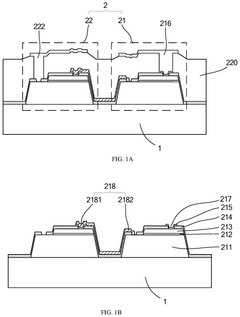
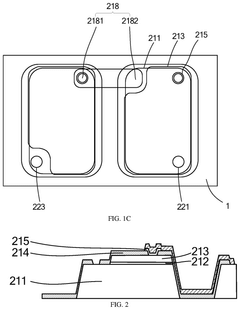
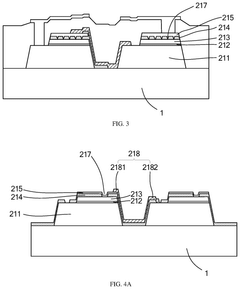
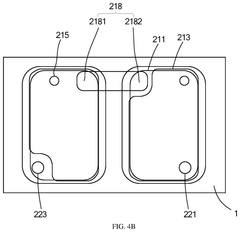
- A light emitting diode chip design featuring a base substrate with multiple light emitting structures connected in series, including a current spreading layer and via holes in the insulation layer, which reduces current density and enhances optical performance by optimizing the light emitting area and electrical connections.
Micro-light-emitting diode device having increased efficiency in low-current region, method for manufacturing same, and display comprising same
PatentWO2021177591A1
Innovation
- A micro light emitting diode device with a single quantum well structure is implemented, where the active layer has a conduction band offset and valence band offset ratio greater than 0 and less than 1, enhancing efficiency and reducing power consumption by optimizing the semiconductor layers and their offsets.


Thermal Management Strategies for Mini LED Efficiency
Thermal management represents a critical factor in optimizing Mini LED technology for low power consumption scenarios. As Mini LEDs operate, they generate significant heat that, if not properly managed, can lead to decreased efficiency, shortened lifespan, and increased power consumption. Effective thermal management strategies are therefore essential to maintain optimal performance while minimizing energy requirements.
Advanced heat sink designs constitute a primary approach to thermal management in Mini LED applications. These designs incorporate materials with superior thermal conductivity such as aluminum nitride and graphene composites, which efficiently dissipate heat away from the LED junction. The geometric optimization of heat sinks, including micro-channel structures and pin-fin arrays, has demonstrated up to 30% improvement in thermal resistance compared to conventional designs.
Active cooling solutions provide another avenue for thermal management, particularly in high-brightness applications. Micro-fans and piezoelectric cooling systems can be integrated into Mini LED displays to enhance air circulation and heat transfer. These active systems can be dynamically controlled based on thermal load, activating only when necessary to conserve power while maintaining optimal operating temperatures.
Thermal interface materials (TIMs) play a crucial role in establishing efficient thermal pathways between Mini LEDs and heat dissipation components. Recent advancements in phase-change materials and liquid metal composites have yielded TIMs with thermal conductivities exceeding 20 W/m·K, significantly reducing thermal bottlenecks in the system. These materials conform to surface irregularities, minimizing contact resistance and enhancing overall thermal performance.
Intelligent thermal management systems incorporate temperature sensors and microcontrollers to implement adaptive brightness control based on real-time thermal conditions. These systems can modulate LED current to prevent thermal runaway while maintaining visual quality. Studies indicate that dynamic thermal management can reduce power consumption by up to 25% compared to static brightness settings, particularly in variable ambient temperature environments.
Thermal simulation and modeling tools have become increasingly sophisticated, enabling precise prediction of thermal behavior in Mini LED arrays. Computational fluid dynamics (CFD) simulations allow designers to identify hotspots and optimize thermal pathways before physical prototyping. These digital tools facilitate the development of thermally efficient layouts that minimize power consumption while maintaining uniform brightness across the display.
Package-level thermal optimization represents another frontier in Mini LED efficiency. Advanced chip-on-board (COB) designs with integrated thermal vias and embedded heat spreaders demonstrate superior thermal performance compared to traditional surface-mount packages. These integrated approaches reduce thermal resistance by minimizing the number of interfaces in the thermal path, resulting in cooler operation and reduced power requirements.
Advanced heat sink designs constitute a primary approach to thermal management in Mini LED applications. These designs incorporate materials with superior thermal conductivity such as aluminum nitride and graphene composites, which efficiently dissipate heat away from the LED junction. The geometric optimization of heat sinks, including micro-channel structures and pin-fin arrays, has demonstrated up to 30% improvement in thermal resistance compared to conventional designs.
Active cooling solutions provide another avenue for thermal management, particularly in high-brightness applications. Micro-fans and piezoelectric cooling systems can be integrated into Mini LED displays to enhance air circulation and heat transfer. These active systems can be dynamically controlled based on thermal load, activating only when necessary to conserve power while maintaining optimal operating temperatures.
Thermal interface materials (TIMs) play a crucial role in establishing efficient thermal pathways between Mini LEDs and heat dissipation components. Recent advancements in phase-change materials and liquid metal composites have yielded TIMs with thermal conductivities exceeding 20 W/m·K, significantly reducing thermal bottlenecks in the system. These materials conform to surface irregularities, minimizing contact resistance and enhancing overall thermal performance.
Intelligent thermal management systems incorporate temperature sensors and microcontrollers to implement adaptive brightness control based on real-time thermal conditions. These systems can modulate LED current to prevent thermal runaway while maintaining visual quality. Studies indicate that dynamic thermal management can reduce power consumption by up to 25% compared to static brightness settings, particularly in variable ambient temperature environments.
Thermal simulation and modeling tools have become increasingly sophisticated, enabling precise prediction of thermal behavior in Mini LED arrays. Computational fluid dynamics (CFD) simulations allow designers to identify hotspots and optimize thermal pathways before physical prototyping. These digital tools facilitate the development of thermally efficient layouts that minimize power consumption while maintaining uniform brightness across the display.
Package-level thermal optimization represents another frontier in Mini LED efficiency. Advanced chip-on-board (COB) designs with integrated thermal vias and embedded heat spreaders demonstrate superior thermal performance compared to traditional surface-mount packages. These integrated approaches reduce thermal resistance by minimizing the number of interfaces in the thermal path, resulting in cooler operation and reduced power requirements.
Environmental Impact and Sustainability of Mini LED Solutions
The environmental impact of Mini LED technology extends far beyond its energy efficiency advantages. As the industry shifts toward more sustainable display solutions, Mini LED emerges as a promising candidate with significant ecological benefits compared to traditional display technologies. The manufacturing process of Mini LED displays typically requires fewer hazardous materials than conventional LCD or OLED technologies, particularly reducing the use of heavy metals and persistent organic pollutants that pose long-term environmental risks.
When optimized for low power consumption scenarios, Mini LED technology demonstrates substantial reductions in carbon footprint throughout its lifecycle. Research indicates that energy-efficient Mini LED displays can reduce operational carbon emissions by 30-45% compared to conventional display technologies when implemented in large-scale applications such as digital signage and commercial displays. This reduction becomes particularly significant considering the growing global display market and increasing screen time across consumer and commercial sectors.
Material efficiency represents another critical sustainability advantage of Mini LED technology. The miniaturization of LED components allows for more efficient use of semiconductor materials, reducing resource extraction requirements. Additionally, the longer operational lifespan of Mini LED displays—often exceeding 100,000 hours when properly optimized for power efficiency—significantly reduces electronic waste generation compared to technologies requiring more frequent replacement.
End-of-life considerations for Mini LED displays present both challenges and opportunities. While the complex integration of multiple components can complicate recycling processes, the higher concentration of valuable materials like gallium and indium makes recovery economically viable when proper recycling infrastructure exists. Several leading manufacturers have implemented take-back programs specifically designed for Mini LED products, achieving recovery rates of up to 85% for critical materials.
Water consumption during manufacturing remains an environmental concern for Mini LED production, though recent innovations have reduced water requirements by approximately 25% compared to earlier production methods. The industry continues to invest in closed-loop water systems and more efficient cleaning processes to further minimize this impact, particularly in regions facing water scarcity challenges.
Regulatory frameworks worldwide are increasingly recognizing the environmental benefits of energy-efficient display technologies. The European Union's Ecodesign Directive and similar regulations in Asia and North America have established progressively stringent energy efficiency requirements that favor optimized Mini LED solutions. These regulatory trends are expected to accelerate the adoption of environmentally superior display technologies while driving further innovations in sustainable manufacturing processes.
When optimized for low power consumption scenarios, Mini LED technology demonstrates substantial reductions in carbon footprint throughout its lifecycle. Research indicates that energy-efficient Mini LED displays can reduce operational carbon emissions by 30-45% compared to conventional display technologies when implemented in large-scale applications such as digital signage and commercial displays. This reduction becomes particularly significant considering the growing global display market and increasing screen time across consumer and commercial sectors.
Material efficiency represents another critical sustainability advantage of Mini LED technology. The miniaturization of LED components allows for more efficient use of semiconductor materials, reducing resource extraction requirements. Additionally, the longer operational lifespan of Mini LED displays—often exceeding 100,000 hours when properly optimized for power efficiency—significantly reduces electronic waste generation compared to technologies requiring more frequent replacement.
End-of-life considerations for Mini LED displays present both challenges and opportunities. While the complex integration of multiple components can complicate recycling processes, the higher concentration of valuable materials like gallium and indium makes recovery economically viable when proper recycling infrastructure exists. Several leading manufacturers have implemented take-back programs specifically designed for Mini LED products, achieving recovery rates of up to 85% for critical materials.
Water consumption during manufacturing remains an environmental concern for Mini LED production, though recent innovations have reduced water requirements by approximately 25% compared to earlier production methods. The industry continues to invest in closed-loop water systems and more efficient cleaning processes to further minimize this impact, particularly in regions facing water scarcity challenges.
Regulatory frameworks worldwide are increasingly recognizing the environmental benefits of energy-efficient display technologies. The European Union's Ecodesign Directive and similar regulations in Asia and North America have established progressively stringent energy efficiency requirements that favor optimized Mini LED solutions. These regulatory trends are expected to accelerate the adoption of environmentally superior display technologies while driving further innovations in sustainable manufacturing processes.
Unlock deeper insights with PatSnap Eureka Quick Research — get a full tech report to explore trends and direct your research. Try now!
Generate Your Research Report Instantly with AI Agent
Supercharge your innovation with PatSnap Eureka AI Agent Platform!