Reliability Standards And Qualification For VCSEL Modules
AUG 27, 20259 MIN READ
Generate Your Research Report Instantly with AI Agent
PatSnap Eureka helps you evaluate technical feasibility & market potential.
VCSEL Technology Evolution and Qualification Objectives
Vertical-Cavity Surface-Emitting Lasers (VCSELs) have evolved significantly since their inception in the late 1970s, transforming from laboratory curiosities to essential components in modern optoelectronic systems. The initial breakthrough came with the first demonstration of continuous-wave operation at room temperature in 1989, which marked the beginning of practical VCSEL applications. Throughout the 1990s, development focused primarily on improving fundamental performance parameters such as threshold current, efficiency, and output power.
The early 2000s witnessed a shift toward commercialization, with VCSELs becoming standard in short-reach data communication applications. This period saw significant advancements in reliability engineering and manufacturing processes, establishing the foundation for today's qualification standards. By 2010, VCSEL technology had expanded beyond telecommunications into consumer electronics, with the introduction of VCSELs in computer mice and subsequently in facial recognition systems.
Recent technological evolution has centered on increasing modulation speeds, wavelength diversification, and array scaling. Modern VCSELs now routinely operate at data rates exceeding 25 Gbps, with research demonstrations approaching 50 Gbps for single devices. Wavelength options have expanded from the traditional 850nm to include 940nm for sensing applications and longer wavelengths (1310nm, 1550nm) for extended-reach communications.
The qualification objectives for VCSEL modules have evolved in parallel with these technological advancements. Early qualification focused primarily on basic reliability metrics such as mean time to failure and operating temperature range. Contemporary qualification frameworks have become significantly more comprehensive, addressing application-specific requirements across diverse deployment scenarios.
For data communication applications, qualification objectives emphasize long-term reliability under high-frequency modulation, resistance to electrostatic discharge, and consistent performance across varying temperatures. Consumer electronics applications, particularly in mobile devices, prioritize miniaturization, power efficiency, and resistance to mechanical shock.
Emerging applications in automotive LiDAR and industrial sensing have introduced new qualification objectives related to extreme temperature operation, vibration resistance, and long-term stability under varying environmental conditions. These applications demand qualification protocols that can predict device behavior over operational lifetimes exceeding 10 years in harsh environments.
The evolution of qualification standards reflects the increasing maturity of VCSEL technology and its expanding application space. Industry standards such as Telcordia GR-468, AEC-Q102 for automotive applications, and various MIL-STD specifications provide frameworks for qualification, but application-specific requirements often necessitate customized testing protocols that go beyond these baseline standards.
The early 2000s witnessed a shift toward commercialization, with VCSELs becoming standard in short-reach data communication applications. This period saw significant advancements in reliability engineering and manufacturing processes, establishing the foundation for today's qualification standards. By 2010, VCSEL technology had expanded beyond telecommunications into consumer electronics, with the introduction of VCSELs in computer mice and subsequently in facial recognition systems.
Recent technological evolution has centered on increasing modulation speeds, wavelength diversification, and array scaling. Modern VCSELs now routinely operate at data rates exceeding 25 Gbps, with research demonstrations approaching 50 Gbps for single devices. Wavelength options have expanded from the traditional 850nm to include 940nm for sensing applications and longer wavelengths (1310nm, 1550nm) for extended-reach communications.
The qualification objectives for VCSEL modules have evolved in parallel with these technological advancements. Early qualification focused primarily on basic reliability metrics such as mean time to failure and operating temperature range. Contemporary qualification frameworks have become significantly more comprehensive, addressing application-specific requirements across diverse deployment scenarios.
For data communication applications, qualification objectives emphasize long-term reliability under high-frequency modulation, resistance to electrostatic discharge, and consistent performance across varying temperatures. Consumer electronics applications, particularly in mobile devices, prioritize miniaturization, power efficiency, and resistance to mechanical shock.
Emerging applications in automotive LiDAR and industrial sensing have introduced new qualification objectives related to extreme temperature operation, vibration resistance, and long-term stability under varying environmental conditions. These applications demand qualification protocols that can predict device behavior over operational lifetimes exceeding 10 years in harsh environments.
The evolution of qualification standards reflects the increasing maturity of VCSEL technology and its expanding application space. Industry standards such as Telcordia GR-468, AEC-Q102 for automotive applications, and various MIL-STD specifications provide frameworks for qualification, but application-specific requirements often necessitate customized testing protocols that go beyond these baseline standards.
Market Demand Analysis for Reliable VCSEL Modules
The global market for VCSEL (Vertical-Cavity Surface-Emitting Laser) modules has experienced significant growth in recent years, driven primarily by increasing applications in consumer electronics, automotive systems, and data communications. Market research indicates that the VCSEL market is projected to reach $3.89 billion by 2025, growing at a CAGR of approximately 17.3% from 2020 to 2025.
The demand for reliable VCSEL modules is particularly strong in three key sectors. First, in consumer electronics, where VCSELs are integral components in facial recognition systems, proximity sensors, and 3D sensing applications for smartphones and tablets. Apple's implementation of Face ID technology has been a major catalyst, creating a ripple effect across the industry as competitors seek similar capabilities.
Second, the automotive industry represents a rapidly expanding market for VCSEL technology. Advanced driver-assistance systems (ADAS) and autonomous driving technologies rely heavily on LiDAR systems, where VCSELs offer advantages in terms of size, cost, and reliability compared to traditional laser technologies. Industry forecasts suggest that by 2026, over 40% of new vehicles will incorporate some form of LiDAR technology, creating substantial demand for highly reliable VCSEL modules.
Third, data communications and networking infrastructure continue to drive demand for VCSELs in optical interconnects and transceivers. With global data traffic increasing exponentially and the rollout of 5G networks, there is growing pressure for higher bandwidth and more reliable optical communication components. The data center market alone is expected to consume over 30 million VCSEL-based transceivers annually by 2023.
Market analysis reveals that reliability has become a critical differentiator in the VCSEL module market. End users across all sectors are increasingly demanding components with extended operational lifetimes, consistent performance across varying environmental conditions, and improved mean time between failures (MTBF). This shift is particularly evident in automotive and industrial applications, where harsh operating environments necessitate robust reliability standards.
Survey data from system integrators indicates that 78% consider reliability certifications a primary factor in VCSEL module selection, ahead of both cost and performance metrics. This represents a significant shift from five years ago, when price was the dominant consideration. The willingness to pay premium prices for modules with demonstrated reliability has increased by approximately 23% since 2018.
Regional analysis shows that while North America and Europe have historically led in demanding stringent reliability standards, Asian markets are rapidly adopting similar requirements, driven by the growth of domestic smartphone manufacturers and automotive suppliers seeking to compete in global markets.
The demand for reliable VCSEL modules is particularly strong in three key sectors. First, in consumer electronics, where VCSELs are integral components in facial recognition systems, proximity sensors, and 3D sensing applications for smartphones and tablets. Apple's implementation of Face ID technology has been a major catalyst, creating a ripple effect across the industry as competitors seek similar capabilities.
Second, the automotive industry represents a rapidly expanding market for VCSEL technology. Advanced driver-assistance systems (ADAS) and autonomous driving technologies rely heavily on LiDAR systems, where VCSELs offer advantages in terms of size, cost, and reliability compared to traditional laser technologies. Industry forecasts suggest that by 2026, over 40% of new vehicles will incorporate some form of LiDAR technology, creating substantial demand for highly reliable VCSEL modules.
Third, data communications and networking infrastructure continue to drive demand for VCSELs in optical interconnects and transceivers. With global data traffic increasing exponentially and the rollout of 5G networks, there is growing pressure for higher bandwidth and more reliable optical communication components. The data center market alone is expected to consume over 30 million VCSEL-based transceivers annually by 2023.
Market analysis reveals that reliability has become a critical differentiator in the VCSEL module market. End users across all sectors are increasingly demanding components with extended operational lifetimes, consistent performance across varying environmental conditions, and improved mean time between failures (MTBF). This shift is particularly evident in automotive and industrial applications, where harsh operating environments necessitate robust reliability standards.
Survey data from system integrators indicates that 78% consider reliability certifications a primary factor in VCSEL module selection, ahead of both cost and performance metrics. This represents a significant shift from five years ago, when price was the dominant consideration. The willingness to pay premium prices for modules with demonstrated reliability has increased by approximately 23% since 2018.
Regional analysis shows that while North America and Europe have historically led in demanding stringent reliability standards, Asian markets are rapidly adopting similar requirements, driven by the growth of domestic smartphone manufacturers and automotive suppliers seeking to compete in global markets.
Current Reliability Standards and Technical Challenges
The reliability standards for VCSEL (Vertical-Cavity Surface-Emitting Laser) modules have evolved significantly over the past decade, driven by increasing demands in telecommunications, consumer electronics, and automotive applications. Currently, the industry follows several established standards, with Telcordia GR-468 serving as the primary framework for qualification testing of optoelectronic devices. This standard encompasses a comprehensive suite of tests including temperature cycling, humidity testing, mechanical shock, vibration, and accelerated aging.
For consumer electronics applications, particularly in mobile devices utilizing face recognition technology, the JEDEC standards (specifically JESD22 series) have been widely adopted to ensure reliability under various environmental conditions. Additionally, the automotive industry has implemented the AEC-Q102 standard specifically for optoelectronic components, requiring more stringent testing due to the harsh operating environments and safety-critical nature of automotive applications.
Despite these established standards, the industry faces significant technical challenges in VCSEL module reliability. One major challenge is the development of standardized testing methodologies for emerging high-power VCSEL arrays used in LiDAR applications, where existing standards may not adequately address the unique failure modes associated with high-density arrays operating at elevated power levels.
Thermal management remains a critical challenge, as VCSEL performance and lifetime are highly temperature-dependent. Current reliability standards often struggle to accurately model the complex thermal behaviors in advanced packaging configurations, particularly in multi-chip modules where thermal crosstalk becomes significant. The industry lacks standardized approaches for evaluating thermal performance under dynamic operating conditions that reflect real-world usage patterns.
Another significant challenge lies in reliability prediction models. The acceleration factors used in current standards were primarily developed for traditional edge-emitting lasers and may not accurately represent the failure mechanisms in modern VCSEL structures, particularly those incorporating novel materials or designs. This creates uncertainty in lifetime predictions and reliability assessments.
The miniaturization trend in VCSEL modules has introduced additional reliability concerns related to mechanical stability and optical alignment precision. Current standards provide limited guidance on evaluating the long-term stability of micro-optical components and sub-micron alignment tolerances in highly integrated photonic packages.
Furthermore, there is a growing need for reliability standards that address the unique requirements of VCSELs in emerging applications such as quantum sensing, high-speed optical interconnects, and medical devices. These applications often operate under specialized conditions not fully covered by existing qualification frameworks, creating a standardization gap that the industry must address to support continued innovation and market expansion.
For consumer electronics applications, particularly in mobile devices utilizing face recognition technology, the JEDEC standards (specifically JESD22 series) have been widely adopted to ensure reliability under various environmental conditions. Additionally, the automotive industry has implemented the AEC-Q102 standard specifically for optoelectronic components, requiring more stringent testing due to the harsh operating environments and safety-critical nature of automotive applications.
Despite these established standards, the industry faces significant technical challenges in VCSEL module reliability. One major challenge is the development of standardized testing methodologies for emerging high-power VCSEL arrays used in LiDAR applications, where existing standards may not adequately address the unique failure modes associated with high-density arrays operating at elevated power levels.
Thermal management remains a critical challenge, as VCSEL performance and lifetime are highly temperature-dependent. Current reliability standards often struggle to accurately model the complex thermal behaviors in advanced packaging configurations, particularly in multi-chip modules where thermal crosstalk becomes significant. The industry lacks standardized approaches for evaluating thermal performance under dynamic operating conditions that reflect real-world usage patterns.
Another significant challenge lies in reliability prediction models. The acceleration factors used in current standards were primarily developed for traditional edge-emitting lasers and may not accurately represent the failure mechanisms in modern VCSEL structures, particularly those incorporating novel materials or designs. This creates uncertainty in lifetime predictions and reliability assessments.
The miniaturization trend in VCSEL modules has introduced additional reliability concerns related to mechanical stability and optical alignment precision. Current standards provide limited guidance on evaluating the long-term stability of micro-optical components and sub-micron alignment tolerances in highly integrated photonic packages.
Furthermore, there is a growing need for reliability standards that address the unique requirements of VCSELs in emerging applications such as quantum sensing, high-speed optical interconnects, and medical devices. These applications often operate under specialized conditions not fully covered by existing qualification frameworks, creating a standardization gap that the industry must address to support continued innovation and market expansion.
Mainstream Qualification Methodologies and Protocols
01 Thermal management for VCSEL reliability
Effective thermal management is crucial for ensuring the reliability of VCSEL modules. Heat dissipation techniques such as improved heat sinks, thermal interface materials, and optimized package designs help maintain operational temperature within safe limits. Proper thermal management prevents degradation mechanisms like thermal runaway and extends the operational lifetime of VCSEL modules under high-power conditions.- Thermal management for VCSEL reliability: Effective thermal management is crucial for ensuring the reliability of VCSEL modules. Heat dissipation techniques such as improved heat sinks, thermal interface materials, and optimized package designs help maintain operational temperature within safe limits. Controlling temperature fluctuations prevents thermal stress that can lead to premature failure and performance degradation. Advanced cooling solutions enable VCSELs to operate reliably at higher power outputs and in demanding environmental conditions.
- Failure detection and monitoring systems: Implementing robust failure detection and monitoring systems significantly improves VCSEL module reliability. These systems continuously track operational parameters such as output power, wavelength stability, and drive current to identify potential issues before catastrophic failure occurs. Real-time monitoring allows for predictive maintenance and early intervention when performance begins to degrade. Advanced diagnostic capabilities enable more accurate reliability testing and lifetime prediction for VCSEL modules in various applications.
- Packaging and hermetic sealing techniques: The reliability of VCSEL modules is heavily influenced by packaging and hermetic sealing techniques. Advanced packaging methods protect sensitive optical components from environmental factors such as moisture, dust, and mechanical stress. Hermetic sealing prevents contamination that could degrade performance over time. Specialized materials and bonding techniques ensure long-term stability of optical alignment and electrical connections, contributing to extended operational lifetimes in various deployment environments.
- Drive circuit optimization for stable operation: Optimizing drive circuits is essential for maintaining stable VCSEL operation and enhancing reliability. Advanced current control mechanisms prevent current spikes and ensure consistent power output. Temperature compensation circuits adjust operating parameters in response to environmental changes. Feedback systems monitor and regulate performance in real-time, while protection circuits prevent damage from electrical anomalies. These circuit optimizations collectively extend VCSEL module lifespan and maintain performance consistency across varying operational conditions.
- Material selection and fabrication processes: The selection of high-quality materials and refined fabrication processes significantly impacts VCSEL module reliability. Advanced semiconductor materials with optimized compositions enhance thermal stability and resistance to degradation. Precision manufacturing techniques reduce defects that could lead to premature failure. Quality control during fabrication ensures consistency across production batches. Special attention to epitaxial growth parameters and interface quality results in VCSEL structures with improved long-term stability and performance under operational stress.
02 Failure detection and monitoring systems
Implementing robust failure detection and monitoring systems enhances VCSEL module reliability. These systems include real-time performance monitoring, automated diagnostics, and predictive maintenance algorithms that can detect early signs of degradation. By continuously monitoring operational parameters such as optical output power, drive current, and temperature, potential failures can be identified before they cause system-wide issues.Expand Specific Solutions03 Packaging and assembly techniques
Advanced packaging and assembly techniques significantly impact VCSEL module reliability. Hermetic sealing, precision alignment methods, and robust bonding technologies protect the sensitive optical components from environmental factors. Specialized packaging designs that minimize mechanical stress and prevent contamination ensure long-term stability and consistent performance of VCSEL modules in various operating conditions.Expand Specific Solutions04 Drive circuit optimization
Optimizing drive circuits is essential for VCSEL module reliability. Advanced current control mechanisms, protection against electrical overstress, and stable power supply designs prevent damage from current spikes and electrical transients. Properly designed drive circuits maintain consistent optical output while protecting the VCSEL from electrical stresses that could lead to premature failure or performance degradation.Expand Specific Solutions05 Environmental robustness and testing
Enhancing environmental robustness through comprehensive testing protocols ensures VCSEL module reliability in diverse operating conditions. Accelerated life testing, environmental stress screening, and qualification procedures help identify potential failure modes. Testing under extreme temperature cycles, humidity, mechanical shock, and vibration validates the design's resilience and provides data for reliability predictions and continuous improvement of VCSEL module designs.Expand Specific Solutions
Key Industry Players in VCSEL Module Manufacturing
The VCSEL module reliability standards and qualification market is in a growth phase, with increasing demand driven by applications in data communications, consumer electronics, and automotive sectors. The market is expected to reach significant scale as VCSEL technology becomes more mainstream in sensing and 3D imaging applications. Technologically, the field is maturing with established players like Broadcom (formerly Avago), Coherent (II-VI Delaware), Finisar, and Vixar leading development of standardized qualification methodologies. Research institutions such as Technical University of Berlin and National Central University collaborate with industry leaders including LG Innotek and ams-OSRAM to advance reliability testing frameworks. The competitive landscape features telecommunications giants like China Mobile alongside specialized optoelectronics manufacturers, indicating a diversifying ecosystem focused on establishing uniform reliability standards for this critical photonics technology.
Vixar, Inc.
Technical Solution: Vixar has developed comprehensive reliability standards for VCSEL modules focusing on accelerated aging tests and performance degradation analysis. Their approach includes rigorous temperature cycling (-40°C to +85°C) and high-temperature operating life (HTOL) tests at 85°C with maximum drive current for 5,000+ hours. Vixar's qualification methodology incorporates advanced failure mode analysis using electron microscopy and spectral monitoring to identify degradation mechanisms. Their standards emphasize maintaining optical output power stability within 10% of initial values throughout the product lifetime, with particular attention to oxide aperture reliability and metal migration prevention. Vixar implements statistical process control during manufacturing with 100% burn-in screening for early failure detection[1][3].
Strengths: Specialized expertise in VCSEL technology with comprehensive testing protocols that exceed industry standards. Their methodology effectively identifies potential failure modes before field deployment. Weaknesses: Testing procedures may be overly conservative, potentially increasing time-to-market and production costs compared to competitors with more streamlined qualification processes.
II-VI Delaware, Inc.
Technical Solution: II-VI has established an industry-leading reliability qualification framework for VCSEL modules that combines traditional Telcordia GR-468 standards with customized testing protocols specific to VCSEL applications. Their approach includes extended high-temperature operating life tests (10,000+ hours), mechanical shock testing (1500G), and vibration testing tailored to automotive and consumer electronics requirements. II-VI employs advanced characterization techniques including near-field scanning optical microscopy and time-resolved photoluminescence to detect early indicators of degradation mechanisms. Their qualification process incorporates accelerated humidity testing (85°C/85% RH) for 1,000 hours and temperature cycling from -40°C to +125°C for 1,000 cycles. II-VI has developed proprietary statistical models to extrapolate lifetime performance from accelerated test data[2][5].
Strengths: Comprehensive qualification framework that addresses multiple application environments (consumer, automotive, industrial) with specialized testing for each market segment. Advanced characterization capabilities enable precise failure analysis. Weaknesses: Complex qualification process may result in longer development cycles and higher costs, potentially challenging for rapid product iterations in fast-moving markets.
Critical Patents and Technical Literature on VCSEL Reliability
High-power single-mode vertical cavity-surface emitting laser
PatentInactiveUS20060029118A1
Innovation
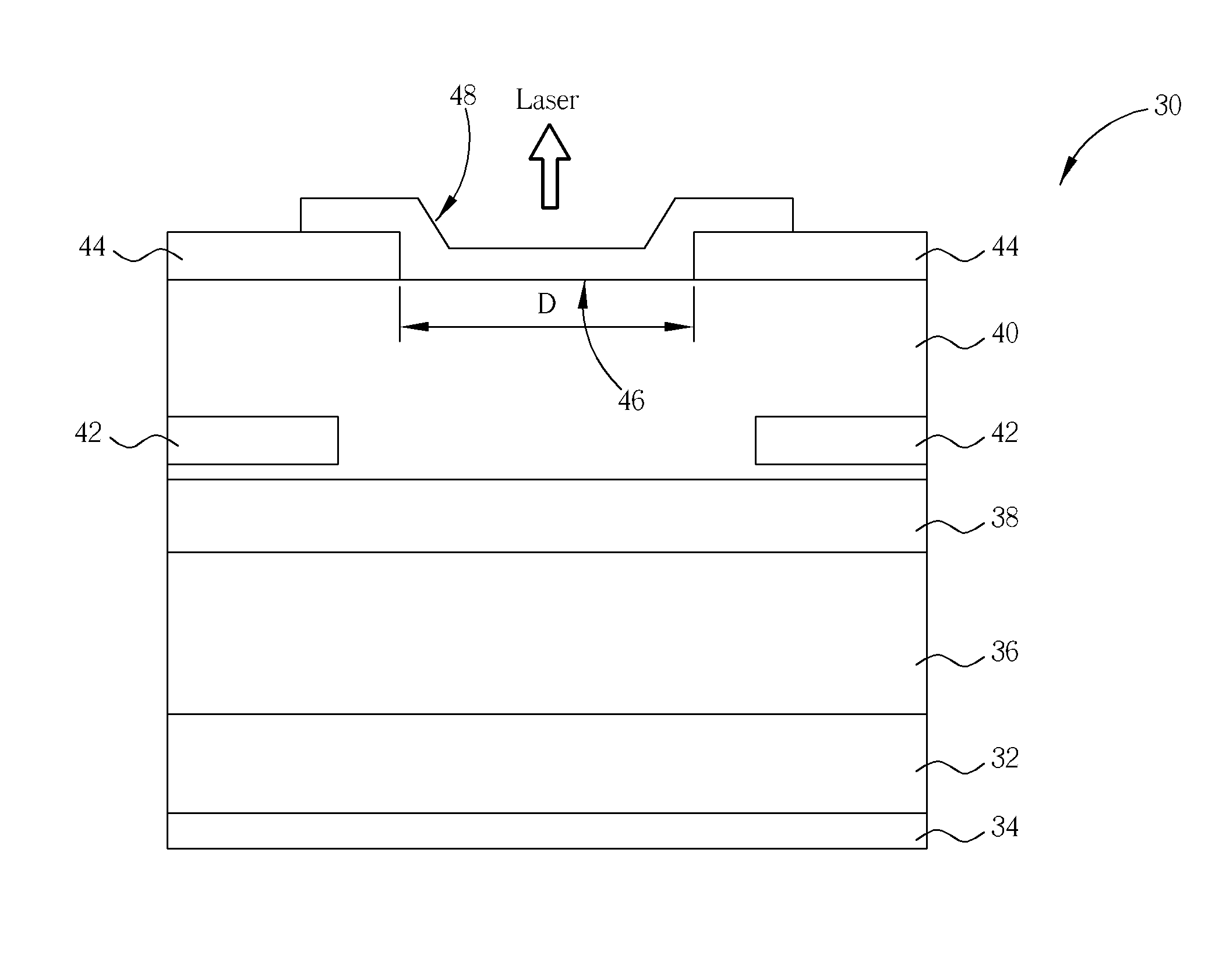
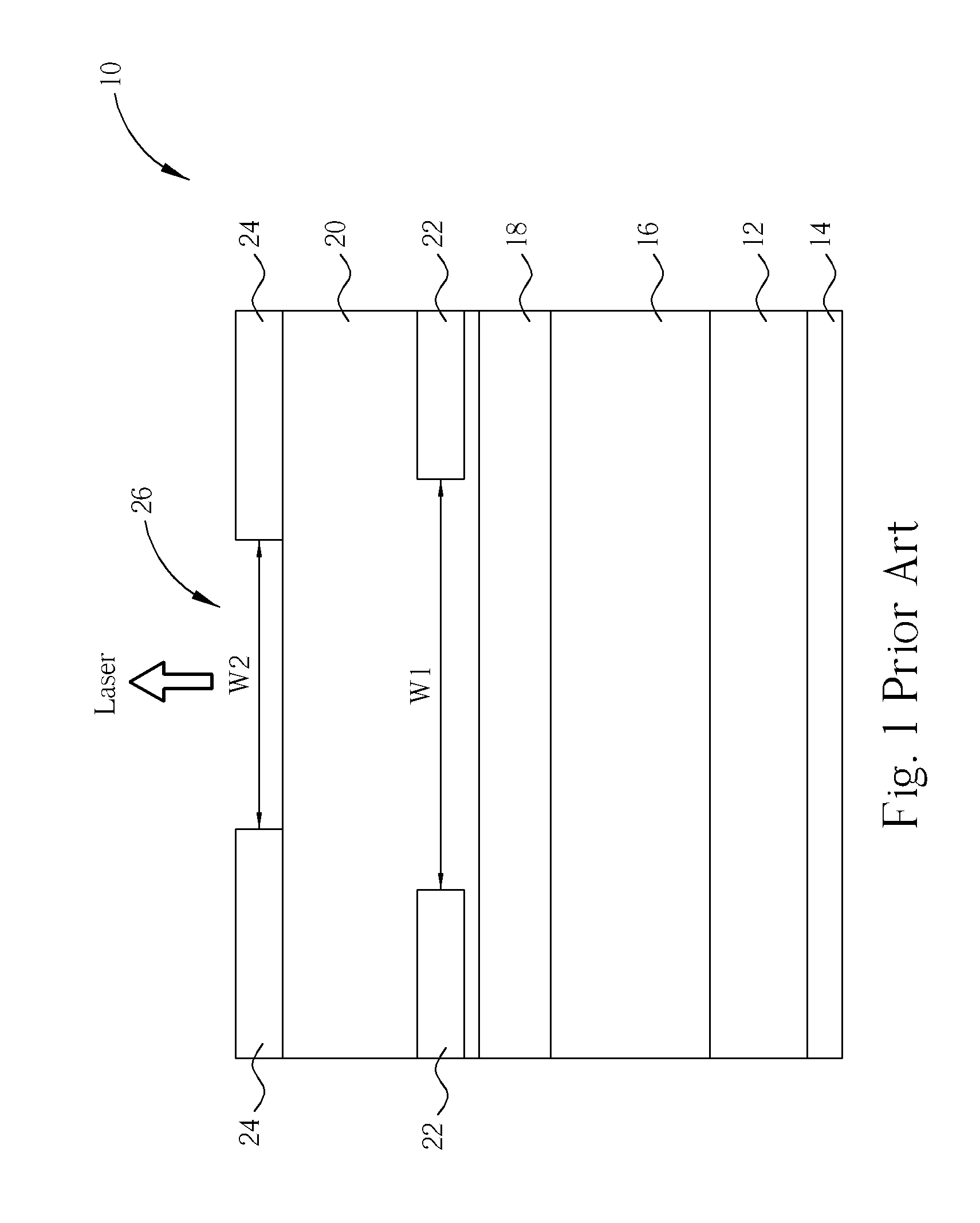
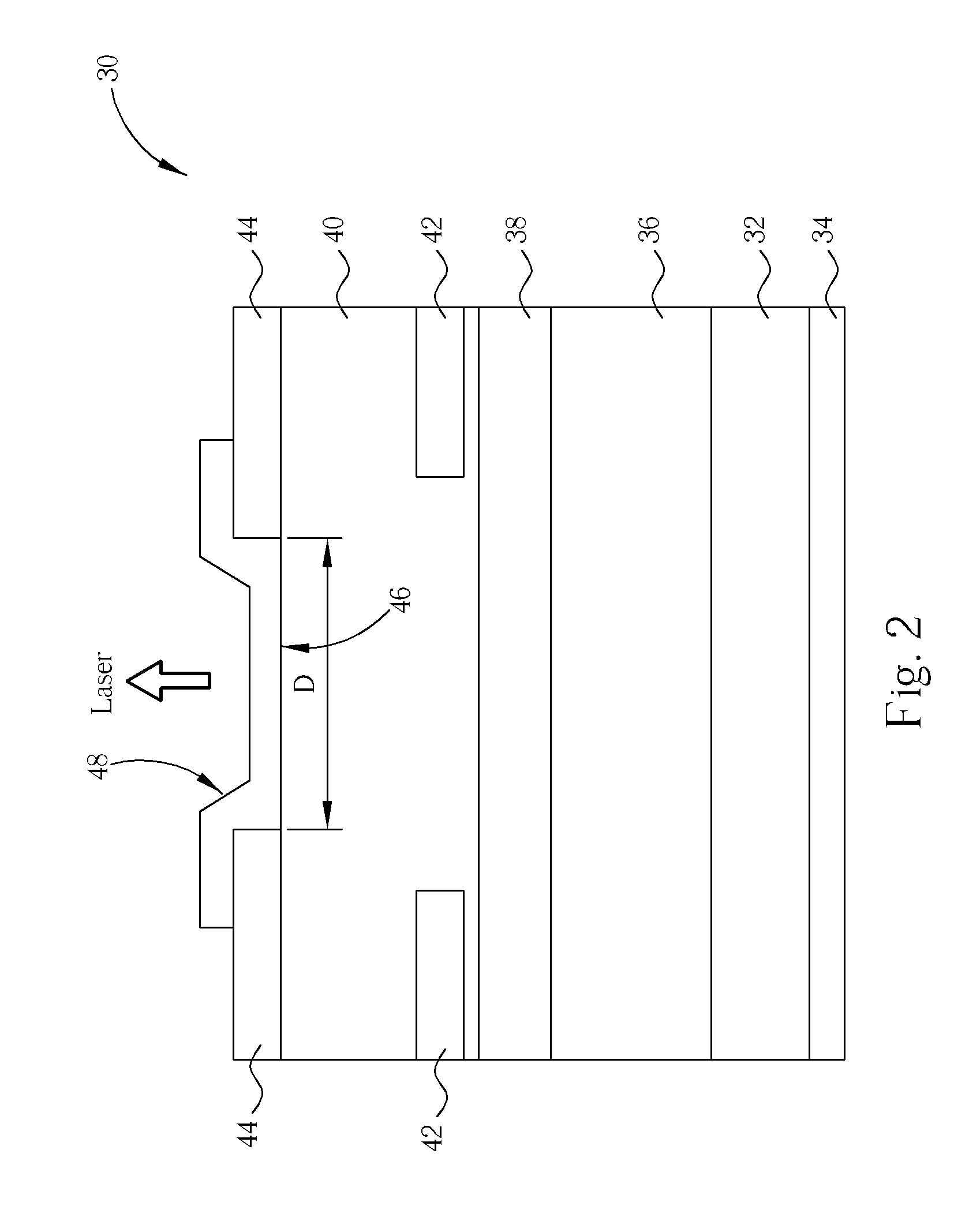
- A vertical cavity-surface emitting laser with an anti-reflection film covering the top emitting region, where the film's thickness is controlled to reduce reflectivity and prevent high-level mode emission, allowing only single-mode laser generation without the need to shorten the widths between ion implantation layers.

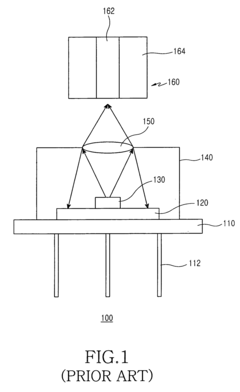
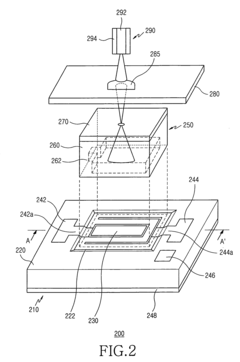
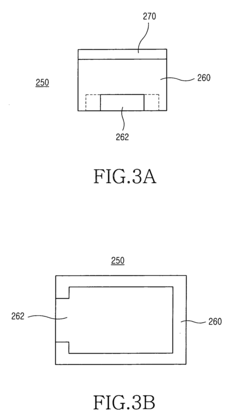
Vertical cavity surface emitting laser module
PatentInactiveUS20050147360A1
Innovation
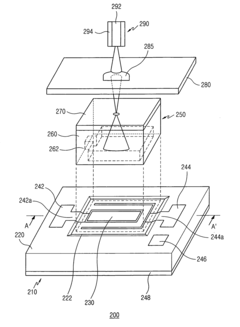
- A VCSEL module design where the lower surface of the VCSEL is etched, allowing direct detection of light emitted downwards by a monitor photodiode region, eliminating the need for reflected light monitoring and minimizing light absorption, thereby enhancing the ability to monitor the output state of the VCSEL.
Industry-Specific Reliability Requirements
VCSEL modules face varying reliability requirements across different industries due to their diverse application environments. In telecommunications, these modules must maintain stable performance over 25+ years with minimal degradation, as they form critical components in fiber optic networks where downtime carries significant financial implications. Telco standards like Telcordia GR-468 impose rigorous qualification protocols including extended high-temperature operating life tests and temperature cycling requirements.
The automotive sector presents particularly demanding conditions, with VCSEL modules in LiDAR systems and in-cabin monitoring requiring operational stability across extreme temperature ranges (-40°C to +125°C). Automotive qualification standard AEC-Q102 mandates enhanced vibration resistance, thermal shock tolerance, and humidity testing protocols significantly more stringent than consumer electronics requirements.
Medical applications introduce unique reliability challenges, particularly for VCSELs used in implantable devices or diagnostic equipment. These modules must undergo biocompatibility testing and sterilization resistance validation, with FDA requirements necessitating comprehensive documentation of reliability testing methodologies and results. Medical-grade VCSELs typically require failure rates below 10 PPM and operational stability over 10+ years in vivo.
Consumer electronics represent a high-volume but less demanding application space, with smartphones and facial recognition systems requiring 3-5 year operational lifespans. However, miniaturization trends create thermal management challenges that impact reliability, requiring specialized testing protocols for small form factor implementations.
Industrial automation and aerospace applications present extreme environmental challenges, with industrial standards requiring resistance to chemical exposure, dust ingress, and mechanical shock. Aerospace applications demand radiation hardening and vacuum operation capability, with qualification procedures following MIL-STD-883 protocols.
Each industry maintains specific failure criteria definitions that vary significantly. While telecommunications may define failure as a 2dB power reduction, medical applications might use more stringent metrics like wavelength stability within ±0.5nm. These industry-specific requirements necessitate customized qualification procedures beyond generic reliability standards, with testing protocols tailored to simulate the actual operating conditions and stress factors relevant to each application domain.
The automotive sector presents particularly demanding conditions, with VCSEL modules in LiDAR systems and in-cabin monitoring requiring operational stability across extreme temperature ranges (-40°C to +125°C). Automotive qualification standard AEC-Q102 mandates enhanced vibration resistance, thermal shock tolerance, and humidity testing protocols significantly more stringent than consumer electronics requirements.
Medical applications introduce unique reliability challenges, particularly for VCSELs used in implantable devices or diagnostic equipment. These modules must undergo biocompatibility testing and sterilization resistance validation, with FDA requirements necessitating comprehensive documentation of reliability testing methodologies and results. Medical-grade VCSELs typically require failure rates below 10 PPM and operational stability over 10+ years in vivo.
Consumer electronics represent a high-volume but less demanding application space, with smartphones and facial recognition systems requiring 3-5 year operational lifespans. However, miniaturization trends create thermal management challenges that impact reliability, requiring specialized testing protocols for small form factor implementations.
Industrial automation and aerospace applications present extreme environmental challenges, with industrial standards requiring resistance to chemical exposure, dust ingress, and mechanical shock. Aerospace applications demand radiation hardening and vacuum operation capability, with qualification procedures following MIL-STD-883 protocols.
Each industry maintains specific failure criteria definitions that vary significantly. While telecommunications may define failure as a 2dB power reduction, medical applications might use more stringent metrics like wavelength stability within ±0.5nm. These industry-specific requirements necessitate customized qualification procedures beyond generic reliability standards, with testing protocols tailored to simulate the actual operating conditions and stress factors relevant to each application domain.
Failure Analysis and Lifetime Prediction Models
Failure analysis of VCSEL modules reveals several common degradation mechanisms that impact device reliability. The most prevalent failure modes include gradual degradation of the active region due to defect propagation, catastrophic optical damage at high power densities, and contact or interconnect failures. These mechanisms manifest through increased threshold current, reduced output power, spectral shifts, or complete device failure. Advanced analytical techniques such as electron microscopy, electroluminescence mapping, and thermal imaging are essential for identifying the root causes of these failures.
The development of accurate lifetime prediction models represents a critical aspect of VCSEL reliability engineering. Current models typically incorporate Arrhenius-based acceleration factors to extrapolate device lifetime under normal operating conditions from accelerated aging tests. These models account for temperature, current density, and humidity as primary stress factors. The industry standard approach involves calculating the activation energy specific to each failure mechanism, which typically ranges from 0.3 to 0.7 eV for VCSELs depending on the material system and device structure.
Recent advancements in lifetime prediction have moved beyond simple Arrhenius models to incorporate more sophisticated approaches. Monte Carlo simulations that account for statistical variations in device parameters provide more realistic lifetime distributions rather than single-point estimates. Physics-of-failure models that incorporate detailed understanding of degradation mechanisms at the quantum well level offer improved accuracy in predicting device behavior under various stress conditions.
Machine learning techniques have emerged as powerful tools for reliability prediction, particularly for complex VCSEL array modules where traditional models may fall short. By analyzing patterns in test data across thousands of devices, these algorithms can identify subtle correlations between manufacturing parameters, early-life performance metrics, and long-term reliability outcomes. This approach has proven especially valuable for consumer electronics applications where large datasets are available.
The correlation between accelerated life testing and field reliability remains challenging. Industry data suggests that while laboratory testing can identify many failure modes, some field failures occur through mechanisms not adequately stressed during qualification. This has led to the development of combined stress tests that simultaneously apply multiple stressors (temperature, humidity, current, and mechanical stress) to better simulate real-world conditions. The implementation of these advanced testing methodologies has significantly improved the accuracy of lifetime predictions for VCSEL modules in demanding applications such as automotive LiDAR and high-speed data communications.
The development of accurate lifetime prediction models represents a critical aspect of VCSEL reliability engineering. Current models typically incorporate Arrhenius-based acceleration factors to extrapolate device lifetime under normal operating conditions from accelerated aging tests. These models account for temperature, current density, and humidity as primary stress factors. The industry standard approach involves calculating the activation energy specific to each failure mechanism, which typically ranges from 0.3 to 0.7 eV for VCSELs depending on the material system and device structure.
Recent advancements in lifetime prediction have moved beyond simple Arrhenius models to incorporate more sophisticated approaches. Monte Carlo simulations that account for statistical variations in device parameters provide more realistic lifetime distributions rather than single-point estimates. Physics-of-failure models that incorporate detailed understanding of degradation mechanisms at the quantum well level offer improved accuracy in predicting device behavior under various stress conditions.
Machine learning techniques have emerged as powerful tools for reliability prediction, particularly for complex VCSEL array modules where traditional models may fall short. By analyzing patterns in test data across thousands of devices, these algorithms can identify subtle correlations between manufacturing parameters, early-life performance metrics, and long-term reliability outcomes. This approach has proven especially valuable for consumer electronics applications where large datasets are available.
The correlation between accelerated life testing and field reliability remains challenging. Industry data suggests that while laboratory testing can identify many failure modes, some field failures occur through mechanisms not adequately stressed during qualification. This has led to the development of combined stress tests that simultaneously apply multiple stressors (temperature, humidity, current, and mechanical stress) to better simulate real-world conditions. The implementation of these advanced testing methodologies has significantly improved the accuracy of lifetime predictions for VCSEL modules in demanding applications such as automotive LiDAR and high-speed data communications.
Unlock deeper insights with PatSnap Eureka Quick Research — get a full tech report to explore trends and direct your research. Try now!
Generate Your Research Report Instantly with AI Agent
Supercharge your innovation with PatSnap Eureka AI Agent Platform!