VCSEL Module Assembly Yield Improvement Techniques
AUG 27, 20259 MIN READ
Generate Your Research Report Instantly with AI Agent
PatSnap Eureka helps you evaluate technical feasibility & market potential.
VCSEL Module Assembly Background and Objectives
Vertical-Cavity Surface-Emitting Laser (VCSEL) technology has evolved significantly over the past three decades, transitioning from laboratory research to commercial applications across multiple industries. Initially developed in the late 1980s, VCSELs have become critical components in data communications, sensing applications, and consumer electronics due to their unique advantages including low power consumption, high-speed modulation capabilities, and cost-effective manufacturing potential.
The assembly process for VCSEL modules represents a critical manufacturing step that directly impacts device performance, reliability, and production economics. Historically, VCSEL module assembly has faced persistent yield challenges, with industry averages often ranging between 70-85% depending on application requirements and manufacturing sophistication. These yield limitations have constrained market growth and hindered broader adoption across emerging applications.
Recent market developments, particularly the integration of VCSELs in mobile devices for facial recognition, LiDAR systems for autonomous vehicles, and next-generation data centers, have dramatically increased production volumes and heightened the economic importance of assembly yield improvements. Industry forecasts project the global VCSEL market to grow at a CAGR of approximately 15-18% through 2028, further emphasizing the strategic importance of manufacturing optimization.
The primary technical objectives for VCSEL module assembly yield improvement focus on several interconnected areas. First, enhancing die attach accuracy and consistency to ensure optimal thermal management and optical alignment. Second, improving wire bonding reliability to minimize electrical failures that currently account for approximately 25-30% of assembly defects. Third, developing more robust hermetic sealing techniques to prevent environmental contamination and extend device lifetime.
Additionally, the industry aims to implement advanced in-line inspection and testing methodologies capable of identifying potential failures earlier in the production process. This includes the development of automated optical inspection systems specifically calibrated for VCSEL module characteristics and the implementation of statistical process control techniques to identify process drift before yield impacts occur.
The ultimate goal is to achieve assembly yields consistently above 95% while simultaneously reducing cycle time and accommodating increasingly complex module designs. This represents a significant technical challenge requiring innovations in materials science, precision automation, and process engineering. Success in this domain would substantially reduce manufacturing costs, potentially opening new market opportunities where cost barriers have previously limited VCSEL adoption.
The assembly process for VCSEL modules represents a critical manufacturing step that directly impacts device performance, reliability, and production economics. Historically, VCSEL module assembly has faced persistent yield challenges, with industry averages often ranging between 70-85% depending on application requirements and manufacturing sophistication. These yield limitations have constrained market growth and hindered broader adoption across emerging applications.
Recent market developments, particularly the integration of VCSELs in mobile devices for facial recognition, LiDAR systems for autonomous vehicles, and next-generation data centers, have dramatically increased production volumes and heightened the economic importance of assembly yield improvements. Industry forecasts project the global VCSEL market to grow at a CAGR of approximately 15-18% through 2028, further emphasizing the strategic importance of manufacturing optimization.
The primary technical objectives for VCSEL module assembly yield improvement focus on several interconnected areas. First, enhancing die attach accuracy and consistency to ensure optimal thermal management and optical alignment. Second, improving wire bonding reliability to minimize electrical failures that currently account for approximately 25-30% of assembly defects. Third, developing more robust hermetic sealing techniques to prevent environmental contamination and extend device lifetime.
Additionally, the industry aims to implement advanced in-line inspection and testing methodologies capable of identifying potential failures earlier in the production process. This includes the development of automated optical inspection systems specifically calibrated for VCSEL module characteristics and the implementation of statistical process control techniques to identify process drift before yield impacts occur.
The ultimate goal is to achieve assembly yields consistently above 95% while simultaneously reducing cycle time and accommodating increasingly complex module designs. This represents a significant technical challenge requiring innovations in materials science, precision automation, and process engineering. Success in this domain would substantially reduce manufacturing costs, potentially opening new market opportunities where cost barriers have previously limited VCSEL adoption.
Market Demand Analysis for High-Yield VCSEL Modules
The global market for VCSEL (Vertical-Cavity Surface-Emitting Laser) modules has experienced exponential growth in recent years, primarily driven by increasing applications in consumer electronics, automotive LiDAR systems, and data communication. Market research indicates that the VCSEL market is projected to reach $3.89 billion by 2025, growing at a CAGR of 17.3% from 2020. This robust growth trajectory underscores the critical importance of yield improvement techniques in VCSEL module assembly.
Consumer electronics represents the largest market segment for VCSEL modules, with 3D sensing applications in smartphones and tablets leading demand. Apple's implementation of Face ID technology catalyzed widespread adoption, creating a ripple effect across the industry. Market analysis shows that approximately 45% of smartphones shipped in 2022 incorporated some form of 3D sensing technology, with this percentage expected to surpass 60% by 2026.
The automotive sector presents another significant growth opportunity for high-yield VCSEL modules. As autonomous driving technologies advance, the demand for reliable LiDAR systems has intensified. Industry forecasts suggest that the automotive LiDAR market will grow at 34.7% CAGR through 2028, with VCSEL-based solutions gaining market share due to their compact size and cost advantages over traditional laser technologies.
Data centers and high-speed optical communication networks constitute another crucial market segment. The transition to 400G and 800G data transmission rates necessitates more reliable and efficient optical components. VCSEL arrays with high yield and performance consistency are becoming essential for meeting these demanding specifications, with the data communication segment expected to grow at 22.1% CAGR through 2027.
Market analysis reveals a strong correlation between VCSEL module yield rates and market competitiveness. Manufacturers achieving yield rates above 90% command premium pricing and secure preferred supplier status with major OEMs. Conversely, those struggling with yields below 80% face significant margin pressure and risk losing market share. This yield-to-market-position relationship has intensified competition in yield improvement technologies.
Regional market assessment indicates that Asia-Pacific dominates VCSEL module demand, accounting for approximately 65% of global consumption. This concentration stems from the region's electronics manufacturing ecosystem. North America follows with roughly 20% market share, driven primarily by data center applications and defense sector demand.
Industry surveys highlight that end-users increasingly prioritize reliability metrics alongside cost considerations. The mean time between failures (MTBF) for VCSEL modules has become a key purchasing criterion, with automotive and industrial applications demanding MTBF ratings exceeding 50,000 hours. This reliability requirement directly correlates with assembly yield quality, further emphasizing the market value of yield improvement techniques.
Consumer electronics represents the largest market segment for VCSEL modules, with 3D sensing applications in smartphones and tablets leading demand. Apple's implementation of Face ID technology catalyzed widespread adoption, creating a ripple effect across the industry. Market analysis shows that approximately 45% of smartphones shipped in 2022 incorporated some form of 3D sensing technology, with this percentage expected to surpass 60% by 2026.
The automotive sector presents another significant growth opportunity for high-yield VCSEL modules. As autonomous driving technologies advance, the demand for reliable LiDAR systems has intensified. Industry forecasts suggest that the automotive LiDAR market will grow at 34.7% CAGR through 2028, with VCSEL-based solutions gaining market share due to their compact size and cost advantages over traditional laser technologies.
Data centers and high-speed optical communication networks constitute another crucial market segment. The transition to 400G and 800G data transmission rates necessitates more reliable and efficient optical components. VCSEL arrays with high yield and performance consistency are becoming essential for meeting these demanding specifications, with the data communication segment expected to grow at 22.1% CAGR through 2027.
Market analysis reveals a strong correlation between VCSEL module yield rates and market competitiveness. Manufacturers achieving yield rates above 90% command premium pricing and secure preferred supplier status with major OEMs. Conversely, those struggling with yields below 80% face significant margin pressure and risk losing market share. This yield-to-market-position relationship has intensified competition in yield improvement technologies.
Regional market assessment indicates that Asia-Pacific dominates VCSEL module demand, accounting for approximately 65% of global consumption. This concentration stems from the region's electronics manufacturing ecosystem. North America follows with roughly 20% market share, driven primarily by data center applications and defense sector demand.
Industry surveys highlight that end-users increasingly prioritize reliability metrics alongside cost considerations. The mean time between failures (MTBF) for VCSEL modules has become a key purchasing criterion, with automotive and industrial applications demanding MTBF ratings exceeding 50,000 hours. This reliability requirement directly correlates with assembly yield quality, further emphasizing the market value of yield improvement techniques.
Current Challenges in VCSEL Assembly Processes
VCSEL assembly processes face significant challenges that impact production yield and device performance. The miniaturization trend in VCSEL modules has created mounting difficulties in handling and positioning components with sub-micron precision. Die attachment processes frequently encounter issues with thermal management, as improper heat dissipation can lead to wavelength shifts and reduced device lifetime. The thermal expansion coefficient mismatch between different materials in the assembly creates mechanical stress during operation, potentially causing alignment shifts and performance degradation over time.
Optical alignment represents one of the most critical challenges, requiring precision within 0.1-0.5μm to ensure optimal coupling efficiency. Current automated alignment systems struggle to maintain this precision at high production volumes, resulting in inconsistent optical performance across manufactured units. The wire bonding process introduces additional complexities, as bond wire placement and loop formation must be precisely controlled to prevent electrical performance variations and potential short circuits in the densely packed assemblies.
Environmental contamination during assembly poses another significant yield challenge. Dust particles, moisture, or chemical residues can compromise optical surfaces and electrical connections. Even microscopic contaminants measuring less than 1μm can cause catastrophic failures in VCSEL operation or gradual performance degradation. Current cleanroom protocols and inspection methods often fail to detect these minute contaminants consistently.
Testing and quality control procedures present additional bottlenecks in the assembly process. The need for both electrical and optical characterization at multiple stages increases cycle time and cost. Many manufacturers struggle with implementing effective in-line testing that can identify defects early in the assembly process without adding excessive handling steps that themselves introduce yield risks.
Supply chain inconsistencies further compound these challenges. Variations in component quality from different suppliers or even between batches from the same supplier create unpredictable assembly outcomes. The industry lacks standardized specifications for many VCSEL components, making it difficult to establish consistent quality control benchmarks across the supply chain.
Labor skill requirements represent another significant challenge. The assembly of VCSEL modules demands highly trained technicians with specialized skills in microelectronics and optoelectronics. The shortage of qualified personnel and the steep learning curve for new operators contribute to yield variations between production shifts and facilities. Automation efforts are ongoing but have not yet reached the level of sophistication required to eliminate human factors from critical assembly steps.
Optical alignment represents one of the most critical challenges, requiring precision within 0.1-0.5μm to ensure optimal coupling efficiency. Current automated alignment systems struggle to maintain this precision at high production volumes, resulting in inconsistent optical performance across manufactured units. The wire bonding process introduces additional complexities, as bond wire placement and loop formation must be precisely controlled to prevent electrical performance variations and potential short circuits in the densely packed assemblies.
Environmental contamination during assembly poses another significant yield challenge. Dust particles, moisture, or chemical residues can compromise optical surfaces and electrical connections. Even microscopic contaminants measuring less than 1μm can cause catastrophic failures in VCSEL operation or gradual performance degradation. Current cleanroom protocols and inspection methods often fail to detect these minute contaminants consistently.
Testing and quality control procedures present additional bottlenecks in the assembly process. The need for both electrical and optical characterization at multiple stages increases cycle time and cost. Many manufacturers struggle with implementing effective in-line testing that can identify defects early in the assembly process without adding excessive handling steps that themselves introduce yield risks.
Supply chain inconsistencies further compound these challenges. Variations in component quality from different suppliers or even between batches from the same supplier create unpredictable assembly outcomes. The industry lacks standardized specifications for many VCSEL components, making it difficult to establish consistent quality control benchmarks across the supply chain.
Labor skill requirements represent another significant challenge. The assembly of VCSEL modules demands highly trained technicians with specialized skills in microelectronics and optoelectronics. The shortage of qualified personnel and the steep learning curve for new operators contribute to yield variations between production shifts and facilities. Automation efforts are ongoing but have not yet reached the level of sophistication required to eliminate human factors from critical assembly steps.
Current Yield Improvement Methodologies
01 Assembly techniques for improving VCSEL module yield
Various assembly techniques can significantly improve the yield of VCSEL module production. These techniques include precise alignment methods, specialized bonding processes, and automated assembly systems that reduce manual handling errors. Implementing standardized assembly protocols and using advanced positioning equipment can ensure consistent placement of optical components, resulting in higher production yields and more reliable VCSEL modules.- VCSEL alignment techniques for improved assembly yield: Various alignment techniques are employed during VCSEL module assembly to ensure optimal coupling between the laser and optical components. These include active alignment methods where the VCSEL is powered during assembly to monitor optical output in real-time, passive alignment using precision mechanical features, and automated alignment systems. Proper alignment is critical for maximizing light output efficiency and ensuring consistent performance across manufactured modules, directly impacting assembly yield.
- Thermal management solutions in VCSEL module assembly: Effective thermal management is essential for VCSEL module assembly yield. Techniques include integration of heat sinks, thermal interface materials, and optimized substrate designs that facilitate heat dissipation. Temperature control during assembly and operation prevents performance degradation and premature failure. Advanced cooling solutions ensure stable operation under various conditions, maintaining consistent optical output and extending device lifetime, which significantly improves manufacturing yield and product reliability.
- Packaging innovations for VCSEL modules: Innovative packaging designs for VCSEL modules contribute to improved assembly yield. These include hermetically sealed packages that protect sensitive components from environmental factors, flip-chip bonding techniques that reduce assembly steps, and modular designs that allow for easier testing and replacement of components. Advanced packaging materials and structures also help with thermal management and mechanical stability, reducing stress on the VCSEL elements during assembly and operation.
- Testing and quality control methods for VCSEL assembly: Comprehensive testing and quality control methods are implemented throughout the VCSEL module assembly process to identify defects early and improve overall yield. These include in-line optical performance testing, burn-in procedures to identify early failures, automated visual inspection systems, and statistical process control. Advanced characterization techniques help manufacturers understand failure modes and implement corrective actions, leading to continuous improvement in assembly yield.
- Material selection and handling for VCSEL assembly: Careful material selection and handling procedures significantly impact VCSEL module assembly yield. This includes using high-purity materials for optical components, implementing clean room protocols to prevent contamination, employing anti-static measures to protect sensitive components, and utilizing precision handling equipment. Specialized bonding materials and techniques ensure reliable electrical and mechanical connections while minimizing stress on the VCSEL structure, reducing defects and improving manufacturing consistency.
02 Thermal management solutions for VCSEL modules
Effective thermal management is crucial for maintaining high yields in VCSEL module assembly. Solutions include advanced heat sink designs, thermal interface materials, and optimized substrate materials that efficiently dissipate heat. Proper thermal management prevents performance degradation and failure during operation, extending the lifespan of VCSEL modules and improving overall production yield by reducing temperature-related defects during the assembly process.Expand Specific Solutions03 Testing and quality control methods for VCSEL modules
Comprehensive testing and quality control methods are essential for achieving high VCSEL module assembly yields. These include in-line optical performance testing, automated visual inspection systems, and burn-in procedures to identify early failures. Advanced characterization techniques can detect subtle defects before final assembly, allowing for process adjustments that significantly improve overall yield rates and ensure consistent performance of the finished modules.Expand Specific Solutions04 Packaging innovations for VCSEL modules
Innovative packaging solutions play a critical role in enhancing VCSEL module assembly yield. These include hermetic sealing techniques, advanced encapsulation materials, and modular designs that simplify the assembly process. Specialized packaging approaches protect sensitive optical components from environmental factors while facilitating easier integration and testing, resulting in fewer defects and higher production yields.Expand Specific Solutions05 Optical alignment and coupling efficiency improvements
Precise optical alignment and coupling efficiency improvements are fundamental to high VCSEL module assembly yields. Advanced alignment techniques, including active alignment systems and automated optical feedback mechanisms, ensure optimal positioning of optical components. Enhanced coupling methods between VCSELs and other optical elements reduce light loss and improve overall module performance, directly contributing to higher manufacturing yields by minimizing alignment-related failures.Expand Specific Solutions
Key Industry Players in VCSEL Manufacturing
The VCSEL Module Assembly Yield Improvement market is currently in a growth phase, with increasing adoption across consumer electronics, automotive, and data communications sectors. The global market size is expanding rapidly, projected to reach significant valuation due to rising applications in 3D sensing, facial recognition, and LiDAR systems. Technologically, the field shows moderate maturity with established players like II-VI Delaware (Coherent), Finisar, and Lumentum leading innovation, while companies such as Samsung Electronics, Sony, and Taiwan Semiconductor Manufacturing Co. are advancing manufacturing processes. Asian manufacturers including Fujian Huixin Laser and Zhejiang RaySea Technology are emerging as competitive forces, particularly in high-volume consumer applications, creating a dynamic competitive landscape balancing established expertise with new market entrants.
II-VI Delaware, Inc.
Technical Solution: II-VI has developed a comprehensive VCSEL module assembly yield improvement system that integrates advanced automation and precision alignment technologies. Their approach includes automated active alignment systems that utilize closed-loop feedback mechanisms to achieve sub-micron positioning accuracy during VCSEL array assembly. The company employs proprietary in-situ testing methodologies that enable real-time performance verification during the assembly process, significantly reducing post-assembly failures. II-VI has implemented statistical process control (SPC) systems that continuously monitor key assembly parameters and automatically adjust process variables to maintain optimal yield rates. Their advanced die attach technology utilizes precision-controlled eutectic bonding or specialized epoxies with optimized thermal profiles to minimize stress-induced failures and ensure consistent thermal performance across assembled modules[1][3].
Strengths: Industry-leading automation capabilities that reduce human error factors; proprietary testing methodologies that catch defects early in the assembly process; vertical integration allowing for better control over component quality. Weaknesses: Higher initial capital investment required for their advanced assembly systems; complex implementation requiring specialized technical expertise; potentially longer setup times for new product introductions.
Finisar Corp.
Technical Solution: Finisar has pioneered a multi-faceted approach to VCSEL module assembly yield improvement centered around their patented "Optical Bench" technology. This platform provides precise optical alignment with automated six-axis positioning systems that achieve alignment accuracy within 0.1μm. Their process incorporates real-time optical feedback during assembly to optimize coupling efficiency between VCSELs and other optical components. Finisar employs advanced wafer-level testing and binning procedures to categorize VCSEL dies based on performance characteristics before assembly, ensuring optimal component matching. The company has developed specialized non-destructive inspection techniques using infrared imaging to detect potential failure points without damaging components. Their assembly process includes controlled atmosphere environments with precise temperature and humidity regulation to prevent contamination-related failures. Finisar also utilizes machine learning algorithms to analyze historical yield data and predict potential assembly issues before they occur[2][5].
Strengths: Exceptional optical alignment precision leading to higher performance consistency; comprehensive pre-assembly testing reducing downstream failures; advanced predictive analytics for continuous yield improvement. Weaknesses: Higher production costs compared to less sophisticated assembly methods; longer cycle times due to extensive testing procedures; requires highly specialized operator training.
Critical Patents and Technical Innovations
Vertical cavity surface emitting laser module and manufacturing method therefor sequentially stacked with a substrate, a first mirror layer, an activation layer, an oxidation layer, a second mirror layer, a tunneling joint surface layer, and a third mirror layer
PatentActiveTW202228347A
Innovation
- The VCSEL element is redesigned with a p-type distributed Bragg reflector layer (P-DBR) transposed into an n-type distributed Bragg reflector layer (N-DBR) using a tunnel junction layer, reducing the number of P-DBR layers and incorporating n-type and p-type filling layers to maintain reflectivity while lowering series resistance.


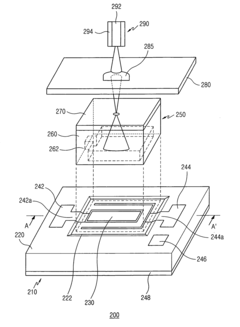
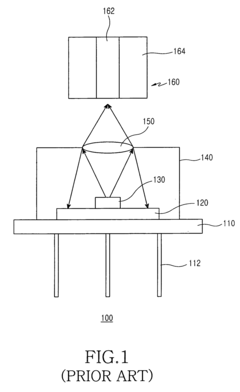
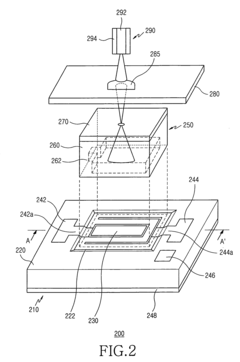
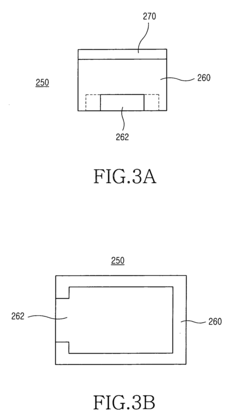
Vertical cavity surface emitting laser module
PatentInactiveUS20050147360A1
Innovation
- A VCSEL module design where the lower surface of the VCSEL is etched, allowing direct detection of light emitted downwards by a monitor photodiode region, eliminating the need for reflected light monitoring and minimizing light absorption, thereby enhancing the ability to monitor the output state of the VCSEL.
Cost-Benefit Analysis of Yield Enhancement Strategies
The implementation of yield improvement techniques for VCSEL module assembly requires careful evaluation of cost versus benefit to ensure optimal resource allocation. Initial investments in advanced equipment such as automated optical inspection systems typically range from $200,000 to $500,000, representing significant capital expenditure. However, these systems can increase yield rates by 15-25% within the first year of implementation, resulting in potential annual savings of $350,000 to $700,000 for medium to large-scale production facilities.
Process optimization strategies, including statistical process control and design of experiments, offer a more cost-effective approach with implementation costs between $50,000 and $150,000. These methodologies have demonstrated yield improvements of 10-18% with return on investment typically achieved within 6-9 months. The relatively low implementation barrier makes these strategies particularly attractive for smaller manufacturers or as initial improvement steps.
Training and workforce development programs represent another dimension of yield enhancement with costs ranging from $20,000 to $75,000 annually. While the direct yield improvement from these programs (5-12%) may appear modest compared to technological solutions, the cumulative effect of reduced human error and increased process consistency provides sustainable long-term benefits with minimal ongoing investment.
Environmental control systems for cleanroom optimization require moderate capital investment ($100,000-$300,000) but deliver consistent yield improvements of 8-15% by minimizing contamination-related failures. The operational costs, primarily energy consumption and maintenance, typically add 15-20% to the initial investment annually but are offset by the reduction in defect rates.
Comparative analysis of implementation timeframes reveals significant variations: automated solutions require 3-6 months for full integration, process optimization methodologies can be implemented within 2-4 months, while training programs can begin showing results within 1-2 months. This temporal dimension is critical when balancing immediate yield requirements against long-term strategic improvements.
The most favorable cost-benefit ratio is generally achieved through a phased approach, beginning with process optimization and training initiatives to secure early gains, followed by targeted investments in automation and environmental control systems. This strategy typically delivers a compound yield improvement of 25-35% over a two-year implementation period, with positive ROI achieved by the 12-15 month mark.
Process optimization strategies, including statistical process control and design of experiments, offer a more cost-effective approach with implementation costs between $50,000 and $150,000. These methodologies have demonstrated yield improvements of 10-18% with return on investment typically achieved within 6-9 months. The relatively low implementation barrier makes these strategies particularly attractive for smaller manufacturers or as initial improvement steps.
Training and workforce development programs represent another dimension of yield enhancement with costs ranging from $20,000 to $75,000 annually. While the direct yield improvement from these programs (5-12%) may appear modest compared to technological solutions, the cumulative effect of reduced human error and increased process consistency provides sustainable long-term benefits with minimal ongoing investment.
Environmental control systems for cleanroom optimization require moderate capital investment ($100,000-$300,000) but deliver consistent yield improvements of 8-15% by minimizing contamination-related failures. The operational costs, primarily energy consumption and maintenance, typically add 15-20% to the initial investment annually but are offset by the reduction in defect rates.
Comparative analysis of implementation timeframes reveals significant variations: automated solutions require 3-6 months for full integration, process optimization methodologies can be implemented within 2-4 months, while training programs can begin showing results within 1-2 months. This temporal dimension is critical when balancing immediate yield requirements against long-term strategic improvements.
The most favorable cost-benefit ratio is generally achieved through a phased approach, beginning with process optimization and training initiatives to secure early gains, followed by targeted investments in automation and environmental control systems. This strategy typically delivers a compound yield improvement of 25-35% over a two-year implementation period, with positive ROI achieved by the 12-15 month mark.
Quality Control and Reliability Testing Frameworks
Quality control and reliability testing frameworks are essential components in the VCSEL module assembly process, directly impacting yield rates and product performance. Comprehensive testing protocols must be implemented at multiple stages of production to identify defects early and ensure consistent quality. These frameworks typically incorporate both in-line and end-of-line testing methodologies, creating a multi-layered quality assurance system.
Statistical Process Control (SPC) techniques form the backbone of modern VCSEL quality frameworks, enabling real-time monitoring of critical parameters such as optical power, wavelength stability, and beam divergence. By establishing upper and lower control limits for these parameters, manufacturers can quickly identify process drift before it results in yield loss. Advanced SPC implementations utilize machine learning algorithms to detect subtle patterns that might escape traditional statistical methods.
Accelerated life testing represents another crucial element in VCSEL reliability frameworks. These tests subject modules to elevated temperature, humidity, and current conditions to simulate years of operation within weeks. The Arrhenius model is commonly applied to extrapolate long-term reliability from accelerated test data, though recent research suggests modified models may better account for VCSEL-specific failure mechanisms.
Burn-in procedures have evolved significantly for VCSEL modules, with adaptive burn-in techniques gaining prominence. These approaches dynamically adjust stress conditions based on real-time device response, optimizing the effectiveness of infant mortality screening while minimizing unnecessary stress on robust devices. Data indicates that properly implemented adaptive burn-in can improve final yield by 3-7% compared to traditional fixed-duration approaches.
Automated optical inspection (AOI) systems equipped with high-resolution imaging and spectral analysis capabilities have become standard in high-volume VCSEL production. These systems can detect submicron alignment issues, bond quality problems, and optical anomalies at speeds compatible with modern production lines. Integration of AOI data with manufacturing execution systems enables closed-loop process improvement, creating a continuous feedback mechanism for yield enhancement.
Failure analysis protocols constitute the final critical component of effective quality frameworks. When defects occur despite preventive measures, systematic root cause analysis methodologies help identify whether issues stem from design limitations, material defects, process variations, or handling errors. Advanced techniques such as scanning acoustic microscopy, cross-sectional analysis, and electroluminescence microscopy provide detailed insights into failure mechanisms at the physical level.
Statistical Process Control (SPC) techniques form the backbone of modern VCSEL quality frameworks, enabling real-time monitoring of critical parameters such as optical power, wavelength stability, and beam divergence. By establishing upper and lower control limits for these parameters, manufacturers can quickly identify process drift before it results in yield loss. Advanced SPC implementations utilize machine learning algorithms to detect subtle patterns that might escape traditional statistical methods.
Accelerated life testing represents another crucial element in VCSEL reliability frameworks. These tests subject modules to elevated temperature, humidity, and current conditions to simulate years of operation within weeks. The Arrhenius model is commonly applied to extrapolate long-term reliability from accelerated test data, though recent research suggests modified models may better account for VCSEL-specific failure mechanisms.
Burn-in procedures have evolved significantly for VCSEL modules, with adaptive burn-in techniques gaining prominence. These approaches dynamically adjust stress conditions based on real-time device response, optimizing the effectiveness of infant mortality screening while minimizing unnecessary stress on robust devices. Data indicates that properly implemented adaptive burn-in can improve final yield by 3-7% compared to traditional fixed-duration approaches.
Automated optical inspection (AOI) systems equipped with high-resolution imaging and spectral analysis capabilities have become standard in high-volume VCSEL production. These systems can detect submicron alignment issues, bond quality problems, and optical anomalies at speeds compatible with modern production lines. Integration of AOI data with manufacturing execution systems enables closed-loop process improvement, creating a continuous feedback mechanism for yield enhancement.
Failure analysis protocols constitute the final critical component of effective quality frameworks. When defects occur despite preventive measures, systematic root cause analysis methodologies help identify whether issues stem from design limitations, material defects, process variations, or handling errors. Advanced techniques such as scanning acoustic microscopy, cross-sectional analysis, and electroluminescence microscopy provide detailed insights into failure mechanisms at the physical level.
Unlock deeper insights with PatSnap Eureka Quick Research — get a full tech report to explore trends and direct your research. Try now!
Generate Your Research Report Instantly with AI Agent
Supercharge your innovation with PatSnap Eureka AI Agent Platform!