Testing Methods For VCSEL Thermal Runaway Conditions
AUG 27, 20259 MIN READ
Generate Your Research Report Instantly with AI Agent
PatSnap Eureka helps you evaluate technical feasibility & market potential.
VCSEL Thermal Runaway Background and Objectives
Vertical-Cavity Surface-Emitting Lasers (VCSELs) have emerged as critical components in various optoelectronic applications, including facial recognition systems, LiDAR for autonomous vehicles, optical communications, and consumer electronics. Since their commercial introduction in the 1990s, VCSELs have evolved from niche components to mainstream photonic devices due to their unique advantages of low power consumption, high modulation bandwidth, and cost-effective manufacturing.
Thermal runaway represents one of the most significant reliability challenges for VCSEL technology. This phenomenon occurs when the device enters a positive feedback loop where increased temperature leads to higher current flow, which further increases temperature until catastrophic device failure. The historical development of VCSEL thermal management has progressed from basic heat sink solutions to sophisticated thermal design architectures incorporating advanced materials and monitoring systems.
The global VCSEL market is projected to grow at a CAGR of approximately 15-17% between 2023-2028, highlighting the increasing importance of reliable VCSEL operation across multiple industries. As applications demand higher power densities and longer operational lifetimes, understanding and preventing thermal runaway conditions has become paramount for device manufacturers and system integrators.
Current testing methodologies for VCSEL thermal runaway vary significantly across the industry, ranging from basic current-voltage-temperature (I-V-T) characterization to more sophisticated transient thermal impedance measurements. However, standardized testing protocols specifically targeting thermal runaway prediction and prevention remain underdeveloped, creating challenges for quality assurance and reliability engineering teams.
The primary objective of this technical research is to comprehensively evaluate existing testing methodologies for VCSEL thermal runaway conditions and identify opportunities for standardization and improvement. We aim to establish a framework for early detection of thermal instability indicators that can be implemented during both manufacturing quality control and in-field monitoring systems.
Secondary objectives include mapping the correlation between device design parameters and thermal runaway susceptibility, evaluating the effectiveness of various thermal management solutions, and developing accelerated testing protocols that can accurately predict long-term reliability without requiring extended testing periods. These objectives align with industry trends toward higher-power VCSEL arrays and more demanding operational environments.
Recent technological breakthroughs in thermal imaging, real-time monitoring systems, and computational modeling have created new opportunities for advanced testing methodologies that can more accurately predict and prevent thermal runaway conditions. This research will explore how these emerging technologies can be integrated into comprehensive testing frameworks suitable for various VCSEL applications and operational contexts.
Thermal runaway represents one of the most significant reliability challenges for VCSEL technology. This phenomenon occurs when the device enters a positive feedback loop where increased temperature leads to higher current flow, which further increases temperature until catastrophic device failure. The historical development of VCSEL thermal management has progressed from basic heat sink solutions to sophisticated thermal design architectures incorporating advanced materials and monitoring systems.
The global VCSEL market is projected to grow at a CAGR of approximately 15-17% between 2023-2028, highlighting the increasing importance of reliable VCSEL operation across multiple industries. As applications demand higher power densities and longer operational lifetimes, understanding and preventing thermal runaway conditions has become paramount for device manufacturers and system integrators.
Current testing methodologies for VCSEL thermal runaway vary significantly across the industry, ranging from basic current-voltage-temperature (I-V-T) characterization to more sophisticated transient thermal impedance measurements. However, standardized testing protocols specifically targeting thermal runaway prediction and prevention remain underdeveloped, creating challenges for quality assurance and reliability engineering teams.
The primary objective of this technical research is to comprehensively evaluate existing testing methodologies for VCSEL thermal runaway conditions and identify opportunities for standardization and improvement. We aim to establish a framework for early detection of thermal instability indicators that can be implemented during both manufacturing quality control and in-field monitoring systems.
Secondary objectives include mapping the correlation between device design parameters and thermal runaway susceptibility, evaluating the effectiveness of various thermal management solutions, and developing accelerated testing protocols that can accurately predict long-term reliability without requiring extended testing periods. These objectives align with industry trends toward higher-power VCSEL arrays and more demanding operational environments.
Recent technological breakthroughs in thermal imaging, real-time monitoring systems, and computational modeling have created new opportunities for advanced testing methodologies that can more accurately predict and prevent thermal runaway conditions. This research will explore how these emerging technologies can be integrated into comprehensive testing frameworks suitable for various VCSEL applications and operational contexts.
Market Demand for VCSEL Reliability Testing
The global market for VCSEL (Vertical-Cavity Surface-Emitting Laser) reliability testing has experienced significant growth in recent years, driven primarily by the expanding applications of VCSELs in consumer electronics, automotive LiDAR systems, data communications, and emerging sensing technologies. As VCSELs become increasingly integrated into mission-critical applications, the demand for comprehensive reliability testing, particularly for thermal runaway conditions, has intensified across multiple industry sectors.
Consumer electronics represents the largest market segment for VCSEL reliability testing, with smartphone manufacturers incorporating multiple VCSEL arrays for facial recognition, augmented reality, and proximity sensing features. These high-volume applications demand stringent reliability standards, as thermal runaway failures could lead to device malfunction, customer dissatisfaction, and costly recalls. Industry analysts report that smartphone manufacturers have increased their testing requirements for VCSEL suppliers by approximately 30% over the past three years.
The automotive sector presents the fastest-growing market for VCSEL reliability testing, with compound annual growth rates exceeding those of other segments. As autonomous driving technologies advance, LiDAR systems utilizing VCSELs require exceptional reliability under extreme temperature variations and extended operational lifetimes. Automotive-grade VCSELs must undergo rigorous thermal stability testing to ensure performance in environments ranging from -40°C to 125°C, creating substantial demand for specialized testing methodologies.
Data center and telecommunications applications constitute another significant market driver, where VCSEL arrays in optical transceivers must maintain stable operation despite increasing power densities and miniaturization trends. The financial consequences of thermal runaway failures in these environments can be substantial, with data center downtime costs averaging thousands of dollars per minute, compelling operators to demand comprehensive reliability verification.
Market research indicates that testing equipment manufacturers are responding to these demands by developing specialized thermal characterization systems for VCSELs, with several new product introductions in the past 18 months. These systems command premium prices due to their ability to detect early indicators of thermal runaway conditions before catastrophic failure occurs.
Geographically, North America and Asia-Pacific dominate the market for VCSEL reliability testing, with China showing the most rapid growth as domestic VCSEL manufacturing capacity expands. European demand is primarily driven by automotive applications, reflecting the region's strong position in premium vehicle manufacturing.
Industry forecasts suggest that the market for specialized VCSEL thermal runaway testing equipment and services will continue to expand as applications diversify beyond current use cases into medical devices, industrial sensing, and consumer wearables, each bringing unique reliability requirements and testing challenges.
Consumer electronics represents the largest market segment for VCSEL reliability testing, with smartphone manufacturers incorporating multiple VCSEL arrays for facial recognition, augmented reality, and proximity sensing features. These high-volume applications demand stringent reliability standards, as thermal runaway failures could lead to device malfunction, customer dissatisfaction, and costly recalls. Industry analysts report that smartphone manufacturers have increased their testing requirements for VCSEL suppliers by approximately 30% over the past three years.
The automotive sector presents the fastest-growing market for VCSEL reliability testing, with compound annual growth rates exceeding those of other segments. As autonomous driving technologies advance, LiDAR systems utilizing VCSELs require exceptional reliability under extreme temperature variations and extended operational lifetimes. Automotive-grade VCSELs must undergo rigorous thermal stability testing to ensure performance in environments ranging from -40°C to 125°C, creating substantial demand for specialized testing methodologies.
Data center and telecommunications applications constitute another significant market driver, where VCSEL arrays in optical transceivers must maintain stable operation despite increasing power densities and miniaturization trends. The financial consequences of thermal runaway failures in these environments can be substantial, with data center downtime costs averaging thousands of dollars per minute, compelling operators to demand comprehensive reliability verification.
Market research indicates that testing equipment manufacturers are responding to these demands by developing specialized thermal characterization systems for VCSELs, with several new product introductions in the past 18 months. These systems command premium prices due to their ability to detect early indicators of thermal runaway conditions before catastrophic failure occurs.
Geographically, North America and Asia-Pacific dominate the market for VCSEL reliability testing, with China showing the most rapid growth as domestic VCSEL manufacturing capacity expands. European demand is primarily driven by automotive applications, reflecting the region's strong position in premium vehicle manufacturing.
Industry forecasts suggest that the market for specialized VCSEL thermal runaway testing equipment and services will continue to expand as applications diversify beyond current use cases into medical devices, industrial sensing, and consumer wearables, each bringing unique reliability requirements and testing challenges.
Current Challenges in VCSEL Thermal Management
Despite significant advancements in VCSEL technology, thermal management remains one of the most critical challenges facing the industry. VCSELs are particularly susceptible to thermal issues due to their compact structure and high power density. The primary concern is thermal runaway, a catastrophic failure mode where increased temperature leads to higher current flow, which further increases temperature in a positive feedback loop until device failure occurs.
Current thermal management approaches for VCSELs face several limitations. Traditional heat sinks and thermal interface materials often prove inadequate for high-power VCSEL arrays, especially in applications requiring continuous operation. The thermal resistance between the active region and heat sink creates bottlenecks that limit maximum operational power and reliability.
Miniaturization trends in consumer electronics further exacerbate these challenges, as smaller form factors restrict the implementation of conventional cooling solutions. This is particularly problematic in emerging applications such as facial recognition, LiDAR systems for autonomous vehicles, and AR/VR devices, where space constraints are significant but thermal stability is crucial for consistent performance.
Another major challenge lies in the accurate measurement and prediction of thermal behavior in operating VCSELs. Current testing methodologies often fail to capture the complex thermal dynamics under various operational conditions, making it difficult to establish reliable thermal runaway thresholds. This gap in testing capabilities increases development cycles and reduces confidence in device reliability margins.
Material limitations also contribute significantly to thermal management difficulties. While advances in substrate materials have improved thermal conductivity, the fundamental thermal properties of semiconductor materials used in VCSELs still impose inherent limitations on heat dissipation capabilities. The thermal boundary resistance at material interfaces further compounds these issues.
Integration challenges present another dimension of complexity. As VCSELs are increasingly incorporated into sophisticated systems-on-chip and heterogeneous integrated circuits, the interaction between different components creates complex thermal profiles that are difficult to model and manage. Cross-heating effects between adjacent VCSELs in arrays can trigger premature thermal runaway in specific elements.
The industry also faces a standardization gap in thermal testing protocols. The lack of universally accepted methodologies for evaluating thermal runaway conditions leads to inconsistent reporting across manufacturers and research institutions, hampering comparative analysis and slowing industry-wide progress in addressing these thermal challenges.
Current thermal management approaches for VCSELs face several limitations. Traditional heat sinks and thermal interface materials often prove inadequate for high-power VCSEL arrays, especially in applications requiring continuous operation. The thermal resistance between the active region and heat sink creates bottlenecks that limit maximum operational power and reliability.
Miniaturization trends in consumer electronics further exacerbate these challenges, as smaller form factors restrict the implementation of conventional cooling solutions. This is particularly problematic in emerging applications such as facial recognition, LiDAR systems for autonomous vehicles, and AR/VR devices, where space constraints are significant but thermal stability is crucial for consistent performance.
Another major challenge lies in the accurate measurement and prediction of thermal behavior in operating VCSELs. Current testing methodologies often fail to capture the complex thermal dynamics under various operational conditions, making it difficult to establish reliable thermal runaway thresholds. This gap in testing capabilities increases development cycles and reduces confidence in device reliability margins.
Material limitations also contribute significantly to thermal management difficulties. While advances in substrate materials have improved thermal conductivity, the fundamental thermal properties of semiconductor materials used in VCSELs still impose inherent limitations on heat dissipation capabilities. The thermal boundary resistance at material interfaces further compounds these issues.
Integration challenges present another dimension of complexity. As VCSELs are increasingly incorporated into sophisticated systems-on-chip and heterogeneous integrated circuits, the interaction between different components creates complex thermal profiles that are difficult to model and manage. Cross-heating effects between adjacent VCSELs in arrays can trigger premature thermal runaway in specific elements.
The industry also faces a standardization gap in thermal testing protocols. The lack of universally accepted methodologies for evaluating thermal runaway conditions leads to inconsistent reporting across manufacturers and research institutions, hampering comparative analysis and slowing industry-wide progress in addressing these thermal challenges.
Existing VCSEL Thermal Runaway Testing Solutions
01 Thermal management structures for VCSELs
Various thermal management structures can be integrated into VCSEL designs to prevent thermal runaway. These include heat sinks, thermal vias, and specialized substrate materials that efficiently dissipate heat away from the active region. Improved thermal conductivity pathways help maintain stable operating temperatures even at high power levels, preventing the positive feedback loop that leads to thermal runaway conditions.- Thermal management structures for VCSELs: Various thermal management structures can be integrated into VCSEL designs to prevent thermal runaway. These include heat sinks, thermal vias, and specialized substrate materials with high thermal conductivity. These structures help dissipate heat efficiently away from the active region of the laser, maintaining operational temperature within safe limits and preventing the positive feedback loop that leads to thermal runaway.
- Temperature monitoring and control systems: Advanced temperature monitoring and control systems can be implemented to detect and respond to temperature fluctuations in VCSELs. These systems may include integrated temperature sensors, feedback control loops, and automatic power adjustment mechanisms that reduce current when temperature rises beyond certain thresholds, effectively preventing the onset of thermal runaway conditions.
- Novel VCSEL design architectures: Innovative VCSEL design architectures can inherently improve thermal stability. These include modified active region designs, optimized mirror structures, and specialized current confinement approaches. By engineering the laser structure to operate more efficiently at higher temperatures or to generate less heat during operation, these designs fundamentally address the root causes of thermal runaway.
- Current distribution and injection optimization: Optimizing current distribution and injection in VCSELs can significantly reduce localized heating that often triggers thermal runaway. Techniques include improved current spreading layers, optimized oxide aperture designs, and graded interfaces that minimize electrical resistance. These approaches ensure more uniform current flow through the device, eliminating hot spots that can initiate thermal instability.
- Advanced materials for thermal stability: The incorporation of advanced materials with superior thermal properties can enhance VCSEL resistance to thermal runaway. These materials may include novel semiconductor compounds, improved dielectric layers, and specialized bonding materials. By selecting materials with higher thermal conductivity, lower thermal resistance, or better temperature stability, VCSELs can operate reliably under more demanding conditions without entering thermal runaway.
02 Temperature monitoring and control systems
Advanced temperature monitoring and control systems can be implemented to detect and prevent thermal runaway in VCSELs. These systems utilize integrated temperature sensors, feedback loops, and control algorithms to continuously monitor device temperature and adjust operating parameters accordingly. When temperature thresholds are approached, the system can reduce current or implement other mitigation strategies to prevent the onset of thermal runaway.Expand Specific Solutions03 Novel VCSEL structures with improved thermal stability
Innovative VCSEL designs incorporate structural modifications specifically aimed at enhancing thermal stability. These include optimized active region designs, specialized distributed Bragg reflectors with improved thermal properties, and novel cavity geometries. These structural improvements help maintain stable operation across a wider temperature range and power levels, significantly reducing susceptibility to thermal runaway events.Expand Specific Solutions04 Current confinement and distribution techniques
Advanced current confinement and distribution techniques help prevent localized heating that can trigger thermal runaway. These include optimized oxide apertures, current spreading layers, and novel current injection schemes. By ensuring more uniform current distribution throughout the device, these techniques eliminate hotspots that could otherwise initiate thermal runaway, even at high operating currents.Expand Specific Solutions05 Operational parameter optimization and control
Sophisticated methods for optimizing and controlling VCSEL operational parameters can effectively prevent thermal runaway. These include adaptive driving schemes, pulsed operation protocols, and dynamic bias adjustment techniques. By carefully managing driving current, duty cycle, and other operational parameters based on real-time performance metrics, these approaches maintain device operation within safe thermal limits even under demanding conditions.Expand Specific Solutions
Key Industry Players in VCSEL Manufacturing and Testing
The VCSEL thermal runaway testing methods market is in a growth phase, characterized by increasing demand for reliable testing solutions as VCSEL technology becomes more prevalent in automotive, consumer electronics, and data communication sectors. The market is expected to reach significant value by 2030, driven by applications in 3D sensing, LiDAR, and optical communications. Technologically, the field is moderately mature but evolving rapidly, with companies like Vixar, Sony Semiconductor Solutions, and Avago Technologies (Broadcom) leading VCSEL development. Research institutions including Tsinghua University and Arizona State University are advancing testing methodologies, while automotive players such as Mercedes-Benz, Hyundai, and BYD are driving adoption in vehicle applications, creating a competitive landscape balanced between specialized component manufacturers and end-users requiring robust thermal management solutions.
Vixar, Inc.
Technical Solution: Vixar has developed a comprehensive thermal runaway testing methodology for VCSELs that combines real-time temperature monitoring with precise current control. Their approach utilizes an integrated thermal imaging system that captures heat distribution patterns across the VCSEL array while simultaneously measuring electrical characteristics. This allows for identification of early thermal runaway indicators before catastrophic failure occurs. The system employs a proprietary algorithm that analyzes the relationship between current injection, optical output power, and temperature gradients to establish device-specific thermal stability boundaries. Vixar's testing protocol includes accelerated aging tests under controlled environmental conditions to simulate various operational scenarios and predict long-term reliability[1]. Their method also incorporates transient thermal impedance measurements to characterize the heat dissipation pathways and identify potential thermal bottlenecks in VCSEL designs.
Strengths: Highly specialized in VCSEL technology with deep expertise in thermal management; provides early detection of potential failures before catastrophic damage occurs; offers comprehensive reliability data for device qualification. Weaknesses: Testing equipment requires significant capital investment; methodology may be overly specialized for general manufacturing environments; testing process can be time-consuming for high-volume production.
Mellanox Technologies Ltd.
Technical Solution: Mellanox Technologies has developed a specialized VCSEL thermal runaway testing methodology focused on high-speed optical interconnect applications. Their approach addresses the unique challenges of testing VCSELs intended for data center and high-performance computing environments where reliability under sustained high-data-rate operation is critical. The testing system combines high-frequency electrical characterization with thermal imaging to evaluate device performance under realistic operating conditions. Mellanox's methodology incorporates detailed eye diagram analysis at various temperature points to correlate signal integrity degradation with thermal effects. Their testing protocol includes extended burn-in procedures with active monitoring of key parameters to identify devices prone to thermal instability over time. The company has developed specialized test fixtures that simulate the thermal environment of dense optical transceiver modules, allowing for accurate assessment of thermal management strategies. Mellanox's approach also includes comprehensive reliability modeling based on accelerated life testing data to predict long-term performance and establish appropriate derating factors for different application scenarios[5]. Their methodology emphasizes the relationship between thermal management and signal integrity, which is particularly relevant for high-bandwidth optical communications.
Strengths: Specialized expertise in high-speed optical interconnects; strong focus on signal integrity correlation with thermal effects; comprehensive reliability modeling capabilities. Weaknesses: Testing methodology primarily optimized for data center applications; complex testing equipment requires specialized knowledge; limited focus on consumer or automotive VCSEL applications.
Critical Technologies for Thermal Runaway Detection
Wide temperature range vertical cavity surface emitting laser
PatentInactiveUS20040228377A1
Innovation
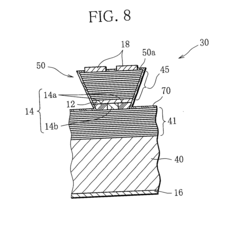
- A VCSEL module is designed to operate over a wide temperature range by tuning the VCSEL to operate efficiently at higher temperatures and incorporating a heater and temperature sensor to maintain optimal temperature, reducing current requirements and extending the VCSEL's lifetime without degrading signal quality.


Vertical cavity surface emitting laser device and vertical cavity surface emitting laser array
PatentInactiveUS20020110169A1
Innovation
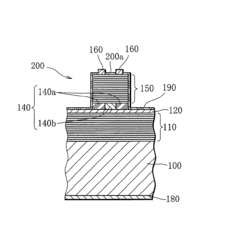
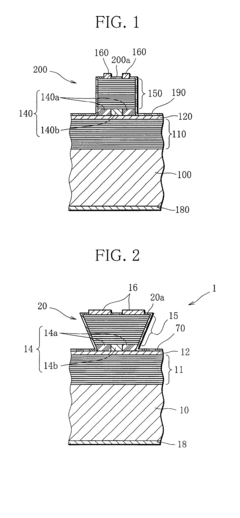
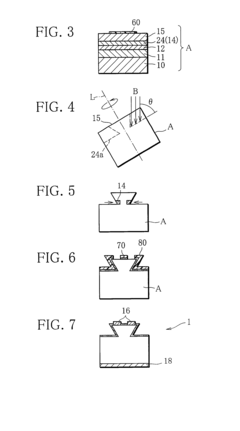
- The solution involves forming a mesa structure with an upper end surface area larger than its cross-section near the current confinement layer, allowing for a wider ring-shaped electrode with a larger outer diameter, thereby increasing the contact area and reducing contact resistance, while maintaining a smaller cross-section near the current confinement layer to prevent productivity degradation and variations in oxidization characteristics.
Safety Standards and Compliance Requirements
VCSEL thermal runaway testing must adhere to stringent safety standards and compliance requirements across multiple regulatory frameworks. The International Electrotechnical Commission (IEC) has established IEC 60825, which specifically addresses laser product safety classifications and requirements, with VCSEL devices typically falling under Class 1, 1M, 3R, or 3B depending on their power output and application. This standard mandates specific testing protocols to verify that devices remain within their designated safety class even under potential thermal runaway conditions.
The American National Standards Institute (ANSI) Z136 series complements IEC standards by providing detailed guidelines for safe use of lasers in various environments, with ANSI Z136.1 being particularly relevant for VCSEL testing facilities. These standards require implementation of engineering controls, administrative procedures, and personal protective equipment during thermal runaway testing.
For consumer electronics incorporating VCSELs, compliance with FDA regulations (21 CFR 1040.10 and 1040.11) is mandatory in the United States, requiring manufacturers to implement specific testing methodologies that can accurately predict and prevent thermal runaway scenarios. The FDA's Laser Notice No. 56 provides guidance on conformance with IEC standards while meeting FDA requirements.
In automotive applications, the ISO 26262 functional safety standard applies to VCSEL-based LiDAR systems, requiring Failure Mode and Effects Analysis (FMEA) that specifically addresses thermal runaway as a critical failure mode. Testing methods must demonstrate compliance with Automotive Safety Integrity Levels (ASIL) appropriate to the application.
European market access requires CE marking, indicating compliance with applicable EU directives including the Low Voltage Directive (2014/35/EU) and Electromagnetic Compatibility Directive (2014/30/EU). Testing protocols must verify that VCSEL devices maintain compliance even when operating near thermal runaway thresholds.
For industrial applications, IEC 61508 (Functional Safety) establishes Safety Integrity Levels (SIL) that dictate the rigor of testing required. VCSEL thermal runaway testing must demonstrate that failure rates remain within acceptable probability bounds for the designated SIL level, typically requiring accelerated life testing methodologies.
Military and aerospace applications follow MIL-STD-810G environmental testing standards, which include specific protocols for temperature cycling and thermal shock that can help identify thermal runaway vulnerabilities. These standards mandate more rigorous testing conditions than commercial equivalents, including extended temperature ranges and rapid thermal transitions.
The American National Standards Institute (ANSI) Z136 series complements IEC standards by providing detailed guidelines for safe use of lasers in various environments, with ANSI Z136.1 being particularly relevant for VCSEL testing facilities. These standards require implementation of engineering controls, administrative procedures, and personal protective equipment during thermal runaway testing.
For consumer electronics incorporating VCSELs, compliance with FDA regulations (21 CFR 1040.10 and 1040.11) is mandatory in the United States, requiring manufacturers to implement specific testing methodologies that can accurately predict and prevent thermal runaway scenarios. The FDA's Laser Notice No. 56 provides guidance on conformance with IEC standards while meeting FDA requirements.
In automotive applications, the ISO 26262 functional safety standard applies to VCSEL-based LiDAR systems, requiring Failure Mode and Effects Analysis (FMEA) that specifically addresses thermal runaway as a critical failure mode. Testing methods must demonstrate compliance with Automotive Safety Integrity Levels (ASIL) appropriate to the application.
European market access requires CE marking, indicating compliance with applicable EU directives including the Low Voltage Directive (2014/35/EU) and Electromagnetic Compatibility Directive (2014/30/EU). Testing protocols must verify that VCSEL devices maintain compliance even when operating near thermal runaway thresholds.
For industrial applications, IEC 61508 (Functional Safety) establishes Safety Integrity Levels (SIL) that dictate the rigor of testing required. VCSEL thermal runaway testing must demonstrate that failure rates remain within acceptable probability bounds for the designated SIL level, typically requiring accelerated life testing methodologies.
Military and aerospace applications follow MIL-STD-810G environmental testing standards, which include specific protocols for temperature cycling and thermal shock that can help identify thermal runaway vulnerabilities. These standards mandate more rigorous testing conditions than commercial equivalents, including extended temperature ranges and rapid thermal transitions.
Economic Impact of VCSEL Failures
The economic impact of VCSEL failures, particularly those caused by thermal runaway conditions, extends far beyond the immediate cost of component replacement. In consumer electronics markets, where VCSELs are increasingly deployed in facial recognition systems, 3D sensing applications, and proximity sensors, device failures can trigger costly product recalls and warranty claims. For instance, a single batch of defective VCSELs in a flagship smartphone model could necessitate the recall of millions of units, with estimated costs potentially reaching hundreds of millions of dollars when accounting for logistics, replacement components, and repair labor.
In industrial applications such as data centers and telecommunications infrastructure, VCSEL failures carry even more significant financial implications. The downtime associated with optical interconnect failures can cost data center operators between $5,000 and $10,000 per minute, according to industry estimates. When considering that a thermal runaway event could potentially affect multiple VCSELs simultaneously within a system, the cumulative financial impact becomes substantial.
Manufacturing yield losses represent another critical economic consideration. Current production processes for VCSELs typically achieve yields of 85-90% under optimal conditions. However, inadequate testing for thermal runaway susceptibility can reduce effective yields to below 80% in field applications, as devices that passed initial quality control may still fail prematurely when deployed. This translates to significant waste in materials, energy, and production capacity.
The reputational damage following widespread VCSEL failures presents perhaps the most difficult economic impact to quantify but may ultimately prove most costly. Companies experiencing high-profile product failures due to VCSEL thermal issues often face stock devaluation, decreased consumer confidence, and lost market share. Historical cases in the optoelectronics industry suggest that recovery from such reputational damage typically requires 2-3 years of flawless performance to restore customer trust.
Insurance and liability considerations further compound these economic impacts. As VCSELs increasingly power safety-critical applications like automotive LiDAR systems, the potential liability from component failures escalates dramatically. Insurers have begun developing specialized policies for manufacturers in this space, with premiums directly tied to the robustness of thermal runaway testing protocols.
Preventive investment in comprehensive thermal runaway testing methodologies, while representing an upfront cost, delivers substantial return on investment through avoided failures. Analysis indicates that each dollar invested in advanced VCSEL testing protocols typically yields $7-$10 in prevented failure costs across the product lifecycle.
In industrial applications such as data centers and telecommunications infrastructure, VCSEL failures carry even more significant financial implications. The downtime associated with optical interconnect failures can cost data center operators between $5,000 and $10,000 per minute, according to industry estimates. When considering that a thermal runaway event could potentially affect multiple VCSELs simultaneously within a system, the cumulative financial impact becomes substantial.
Manufacturing yield losses represent another critical economic consideration. Current production processes for VCSELs typically achieve yields of 85-90% under optimal conditions. However, inadequate testing for thermal runaway susceptibility can reduce effective yields to below 80% in field applications, as devices that passed initial quality control may still fail prematurely when deployed. This translates to significant waste in materials, energy, and production capacity.
The reputational damage following widespread VCSEL failures presents perhaps the most difficult economic impact to quantify but may ultimately prove most costly. Companies experiencing high-profile product failures due to VCSEL thermal issues often face stock devaluation, decreased consumer confidence, and lost market share. Historical cases in the optoelectronics industry suggest that recovery from such reputational damage typically requires 2-3 years of flawless performance to restore customer trust.
Insurance and liability considerations further compound these economic impacts. As VCSELs increasingly power safety-critical applications like automotive LiDAR systems, the potential liability from component failures escalates dramatically. Insurers have begun developing specialized policies for manufacturers in this space, with premiums directly tied to the robustness of thermal runaway testing protocols.
Preventive investment in comprehensive thermal runaway testing methodologies, while representing an upfront cost, delivers substantial return on investment through avoided failures. Analysis indicates that each dollar invested in advanced VCSEL testing protocols typically yields $7-$10 in prevented failure costs across the product lifecycle.
Unlock deeper insights with PatSnap Eureka Quick Research — get a full tech report to explore trends and direct your research. Try now!
Generate Your Research Report Instantly with AI Agent
Supercharge your innovation with PatSnap Eureka AI Agent Platform!