

Safety Testing Evolution for Lithium Iron Phosphate Batteries
AUG 7, 20259 MIN READ
Generate Your Research Report Instantly with AI Agent
Patsnap Eureka helps you evaluate technical feasibility & market potential.
LFP Battery Safety Background and Objectives
Lithium Iron Phosphate (LFP) batteries have emerged as a prominent technology in the energy storage landscape, particularly in electric vehicles and renewable energy systems. The evolution of safety testing for LFP batteries is rooted in the broader development of lithium-ion battery technology, which began in the 1970s and saw commercial introduction in the early 1990s.
The primary objective of safety testing for LFP batteries is to ensure their reliable and secure operation under various conditions, minimizing risks associated with thermal runaway, short circuits, and other potential failure modes. This goal has become increasingly critical as the adoption of LFP batteries has expanded across multiple industries, necessitating robust safety standards and testing protocols.
LFP chemistry, first reported by John Goodenough's research group in 1996, offers inherent safety advantages over other lithium-ion chemistries due to its thermal and chemical stability. However, as applications for LFP batteries have diversified and energy densities have increased, the complexity of safety considerations has grown proportionally.
The evolution of safety testing for LFP batteries has been driven by several key factors. Firstly, the rapid scaling of production and deployment has highlighted the need for comprehensive safety assessments that account for manufacturing variability and real-world usage conditions. Secondly, high-profile incidents involving lithium-ion batteries in consumer electronics and electric vehicles have intensified regulatory scrutiny and public concern, prompting more stringent safety requirements.
Technological advancements in battery management systems, cell design, and materials science have continually reshaped the landscape of LFP battery safety. This has necessitated an ongoing evolution of testing methodologies to keep pace with these innovations and ensure their efficacy in enhancing overall battery safety.
The objectives of modern LFP battery safety testing encompass a wide range of considerations. These include evaluating thermal stability under extreme conditions, assessing the effectiveness of safety mechanisms such as pressure relief vents and current interrupt devices, and analyzing the battery's response to mechanical stress, electrical abuse, and environmental factors.
Furthermore, safety testing aims to validate the performance of battery management systems in preventing and mitigating potential safety issues. This includes testing the system's ability to detect and respond to abnormal conditions such as overcharging, over-discharging, and internal short circuits.
As the industry moves towards higher energy densities and faster charging capabilities, safety testing objectives have expanded to address these new challenges. This includes developing protocols to assess the long-term safety implications of repeated fast charging and the potential for lithium plating under various operational conditions.
In conclusion, the background and objectives of LFP battery safety testing reflect a dynamic and critical aspect of battery technology development. The ongoing evolution of these practices is essential for maintaining public trust, meeting regulatory requirements, and enabling the continued expansion of LFP battery applications across diverse sectors.
The primary objective of safety testing for LFP batteries is to ensure their reliable and secure operation under various conditions, minimizing risks associated with thermal runaway, short circuits, and other potential failure modes. This goal has become increasingly critical as the adoption of LFP batteries has expanded across multiple industries, necessitating robust safety standards and testing protocols.
LFP chemistry, first reported by John Goodenough's research group in 1996, offers inherent safety advantages over other lithium-ion chemistries due to its thermal and chemical stability. However, as applications for LFP batteries have diversified and energy densities have increased, the complexity of safety considerations has grown proportionally.
The evolution of safety testing for LFP batteries has been driven by several key factors. Firstly, the rapid scaling of production and deployment has highlighted the need for comprehensive safety assessments that account for manufacturing variability and real-world usage conditions. Secondly, high-profile incidents involving lithium-ion batteries in consumer electronics and electric vehicles have intensified regulatory scrutiny and public concern, prompting more stringent safety requirements.
Technological advancements in battery management systems, cell design, and materials science have continually reshaped the landscape of LFP battery safety. This has necessitated an ongoing evolution of testing methodologies to keep pace with these innovations and ensure their efficacy in enhancing overall battery safety.
The objectives of modern LFP battery safety testing encompass a wide range of considerations. These include evaluating thermal stability under extreme conditions, assessing the effectiveness of safety mechanisms such as pressure relief vents and current interrupt devices, and analyzing the battery's response to mechanical stress, electrical abuse, and environmental factors.
Furthermore, safety testing aims to validate the performance of battery management systems in preventing and mitigating potential safety issues. This includes testing the system's ability to detect and respond to abnormal conditions such as overcharging, over-discharging, and internal short circuits.
As the industry moves towards higher energy densities and faster charging capabilities, safety testing objectives have expanded to address these new challenges. This includes developing protocols to assess the long-term safety implications of repeated fast charging and the potential for lithium plating under various operational conditions.
In conclusion, the background and objectives of LFP battery safety testing reflect a dynamic and critical aspect of battery technology development. The ongoing evolution of these practices is essential for maintaining public trust, meeting regulatory requirements, and enabling the continued expansion of LFP battery applications across diverse sectors.
Market Demand for Safe LFP Batteries
The market demand for safe Lithium Iron Phosphate (LFP) batteries has been experiencing significant growth in recent years, driven by the increasing adoption of electric vehicles (EVs) and renewable energy storage systems. As safety concerns remain paramount in battery technology, LFP batteries have gained traction due to their inherent stability and improved safety characteristics compared to other lithium-ion chemistries.
In the automotive sector, major manufacturers are shifting towards LFP batteries for their entry-level and mid-range EV models. This trend is particularly evident in China, where LFP batteries have captured a substantial market share. The demand for safe LFP batteries in EVs is expected to continue its upward trajectory as governments worldwide implement stricter emissions regulations and offer incentives for EV adoption.
The stationary energy storage market is another key driver for safe LFP batteries. Grid-scale energy storage projects, residential solar-plus-storage systems, and commercial backup power solutions are increasingly utilizing LFP technology due to its long cycle life, thermal stability, and enhanced safety profile. This sector's growth is fueled by the global push for renewable energy integration and grid resilience.
Consumer electronics manufacturers are also exploring LFP batteries as a safer alternative for portable devices. While the energy density of LFP cells is lower compared to other lithium-ion chemistries, the safety advantages make them attractive for applications where safety is a critical concern.
The industrial sector, including material handling equipment and power tools, represents another growing market for safe LFP batteries. The robustness and safety features of LFP technology align well with the demanding requirements of industrial applications, where reliability and minimal downtime are essential.
As safety standards and regulations for battery systems become more stringent globally, the demand for LFP batteries is expected to surge. Manufacturers and end-users are increasingly prioritizing safety alongside performance, driving innovation in LFP battery technology and safety testing methodologies.
The market's focus on sustainability also contributes to the growing demand for safe LFP batteries. The absence of cobalt in LFP chemistry addresses ethical sourcing concerns and aligns with corporate sustainability goals, further boosting market appeal.
In conclusion, the market demand for safe LFP batteries is robust and multifaceted, spanning various industries and applications. As safety remains a critical factor in battery technology adoption, the LFP chemistry's inherent safety advantages position it favorably for continued market growth and technological advancement.
In the automotive sector, major manufacturers are shifting towards LFP batteries for their entry-level and mid-range EV models. This trend is particularly evident in China, where LFP batteries have captured a substantial market share. The demand for safe LFP batteries in EVs is expected to continue its upward trajectory as governments worldwide implement stricter emissions regulations and offer incentives for EV adoption.
The stationary energy storage market is another key driver for safe LFP batteries. Grid-scale energy storage projects, residential solar-plus-storage systems, and commercial backup power solutions are increasingly utilizing LFP technology due to its long cycle life, thermal stability, and enhanced safety profile. This sector's growth is fueled by the global push for renewable energy integration and grid resilience.
Consumer electronics manufacturers are also exploring LFP batteries as a safer alternative for portable devices. While the energy density of LFP cells is lower compared to other lithium-ion chemistries, the safety advantages make them attractive for applications where safety is a critical concern.
The industrial sector, including material handling equipment and power tools, represents another growing market for safe LFP batteries. The robustness and safety features of LFP technology align well with the demanding requirements of industrial applications, where reliability and minimal downtime are essential.
As safety standards and regulations for battery systems become more stringent globally, the demand for LFP batteries is expected to surge. Manufacturers and end-users are increasingly prioritizing safety alongside performance, driving innovation in LFP battery technology and safety testing methodologies.
The market's focus on sustainability also contributes to the growing demand for safe LFP batteries. The absence of cobalt in LFP chemistry addresses ethical sourcing concerns and aligns with corporate sustainability goals, further boosting market appeal.
In conclusion, the market demand for safe LFP batteries is robust and multifaceted, spanning various industries and applications. As safety remains a critical factor in battery technology adoption, the LFP chemistry's inherent safety advantages position it favorably for continued market growth and technological advancement.
Current LFP Safety Testing Challenges
The safety testing of Lithium Iron Phosphate (LFP) batteries faces several significant challenges in the current landscape. One of the primary issues is the lack of standardized testing protocols specifically tailored for LFP chemistry. While general lithium-ion battery safety standards exist, they may not fully address the unique characteristics and failure modes of LFP cells. This gap in standardization can lead to inconsistent testing practices across manufacturers and testing facilities, potentially compromising the reliability of safety assessments.
Another challenge lies in the dynamic nature of LFP battery technology. As manufacturers continually improve cell designs and introduce new materials, existing safety tests may become outdated or inadequate. The rapid pace of innovation in LFP batteries necessitates frequent updates to testing methodologies, which can be time-consuming and resource-intensive for both manufacturers and regulatory bodies.
The scalability of safety tests presents an additional hurdle. As LFP batteries find applications in increasingly larger systems, such as electric vehicles and grid-scale energy storage, traditional safety tests designed for smaller cells may not accurately represent the risks associated with these larger configurations. Developing and implementing tests that can effectively evaluate the safety of high-capacity LFP battery packs and systems remains a significant challenge.
Furthermore, the long-term aging effects on LFP battery safety are not yet fully understood. Current testing protocols often focus on new or relatively young cells, potentially overlooking safety issues that may emerge as batteries age. Developing accelerated aging tests that can reliably predict long-term safety performance is a complex task that researchers are still grappling with.
The environmental conditions under which LFP batteries operate can vary widely, from extreme cold to high heat and humidity. Designing safety tests that adequately cover this broad range of operating conditions while remaining practical and cost-effective is an ongoing challenge. Additionally, simulating real-world abuse scenarios, such as mechanical impacts or thermal runaways in large-scale systems, requires sophisticated testing equipment and facilities that may not be readily available to all manufacturers or testing laboratories.
Lastly, the interpretation and analysis of safety test results pose their own set of challenges. As LFP batteries become more advanced, the complexity of failure modes and their interactions increases. This complexity demands more sophisticated data analysis techniques and expertise to accurately assess safety risks and predict potential failure scenarios. Developing robust predictive models and risk assessment frameworks that can effectively utilize safety test data remains an area of active research and development in the LFP battery industry.
Another challenge lies in the dynamic nature of LFP battery technology. As manufacturers continually improve cell designs and introduce new materials, existing safety tests may become outdated or inadequate. The rapid pace of innovation in LFP batteries necessitates frequent updates to testing methodologies, which can be time-consuming and resource-intensive for both manufacturers and regulatory bodies.
The scalability of safety tests presents an additional hurdle. As LFP batteries find applications in increasingly larger systems, such as electric vehicles and grid-scale energy storage, traditional safety tests designed for smaller cells may not accurately represent the risks associated with these larger configurations. Developing and implementing tests that can effectively evaluate the safety of high-capacity LFP battery packs and systems remains a significant challenge.
Furthermore, the long-term aging effects on LFP battery safety are not yet fully understood. Current testing protocols often focus on new or relatively young cells, potentially overlooking safety issues that may emerge as batteries age. Developing accelerated aging tests that can reliably predict long-term safety performance is a complex task that researchers are still grappling with.
The environmental conditions under which LFP batteries operate can vary widely, from extreme cold to high heat and humidity. Designing safety tests that adequately cover this broad range of operating conditions while remaining practical and cost-effective is an ongoing challenge. Additionally, simulating real-world abuse scenarios, such as mechanical impacts or thermal runaways in large-scale systems, requires sophisticated testing equipment and facilities that may not be readily available to all manufacturers or testing laboratories.
Lastly, the interpretation and analysis of safety test results pose their own set of challenges. As LFP batteries become more advanced, the complexity of failure modes and their interactions increases. This complexity demands more sophisticated data analysis techniques and expertise to accurately assess safety risks and predict potential failure scenarios. Developing robust predictive models and risk assessment frameworks that can effectively utilize safety test data remains an area of active research and development in the LFP battery industry.
Existing LFP Battery Safety Test Methods
01 Improved battery structure for enhanced safety
Lithium iron phosphate batteries can be made safer through structural improvements. This includes designing better casings, implementing internal safety mechanisms, and optimizing the arrangement of battery components. These enhancements help prevent physical damage, contain potential failures, and improve overall battery stability.- Improved cathode materials for enhanced safety: Development of advanced cathode materials for lithium iron phosphate batteries to improve safety characteristics. This includes modifications to the crystal structure, doping with other elements, or surface coatings to enhance thermal stability and reduce the risk of thermal runaway.
- Battery management systems for safety monitoring: Implementation of sophisticated battery management systems that continuously monitor temperature, voltage, and current to prevent overcharging, over-discharging, and overheating. These systems can include early warning mechanisms and automatic shut-off features to enhance overall battery safety.
- Improved electrolyte formulations: Development of novel electrolyte formulations that are less flammable and more stable at high temperatures. This includes the use of additives or alternative solvents to reduce the risk of electrolyte decomposition and gas generation during battery operation.
- Enhanced battery pack design and thermal management: Innovative battery pack designs that incorporate advanced thermal management systems, including improved heat dissipation mechanisms and fire-resistant materials. These designs aim to prevent thermal propagation between cells and contain potential thermal events.
- Safety testing and certification protocols: Development and implementation of rigorous safety testing and certification protocols specifically designed for lithium iron phosphate batteries. These protocols include abuse tests, environmental stress tests, and long-term cycling tests to ensure battery safety under various operating conditions and potential failure modes.
02 Thermal management systems
Effective thermal management is crucial for lithium iron phosphate battery safety. This involves implementing cooling systems, heat dissipation techniques, and temperature monitoring devices. These measures help prevent overheating, reduce the risk of thermal runaway, and maintain optimal operating temperatures for improved safety and performance.Expand Specific Solutions03 Advanced battery management systems (BMS)
Sophisticated battery management systems play a vital role in ensuring the safety of lithium iron phosphate batteries. These systems monitor and control various parameters such as voltage, current, and temperature. They can detect abnormalities, balance cell charges, and implement protective measures to prevent overcharging, over-discharging, and other potentially hazardous conditions.Expand Specific Solutions04 Electrolyte and separator improvements
Enhancing the safety of lithium iron phosphate batteries can be achieved through advancements in electrolyte and separator technologies. This includes developing flame-retardant electrolytes, implementing solid-state or gel electrolytes, and using high-performance separators. These improvements help reduce the risk of short circuits, electrolyte leakage, and thermal runaway.Expand Specific Solutions05 Safety testing and certification protocols
Rigorous safety testing and certification protocols are essential for ensuring the safety of lithium iron phosphate batteries. This involves subjecting batteries to various stress tests, including mechanical, thermal, and electrical abuse. Standardized testing procedures and compliance with international safety standards help identify potential risks and validate the safety features of battery designs.Expand Specific Solutions
Key Players in LFP Battery Safety Testing
The safety testing evolution for Lithium Iron Phosphate (LFP) batteries is at a critical juncture, with the market experiencing rapid growth and technological advancements. The global LFP battery market is expanding significantly, driven by increasing demand in electric vehicles and energy storage systems. Companies like BYD, CATL, and LG Energy Solution are leading the charge, investing heavily in research and development to enhance safety protocols and performance. The technology is maturing, with improvements in energy density, cycle life, and thermal stability. However, ongoing research at institutions like California Institute of Technology and University of Southern California continues to push the boundaries of LFP battery safety and efficiency.
LG Energy Solution Ltd.
Technical Solution: LG Energy Solution has developed a comprehensive safety testing framework for their LFP batteries, focusing on both cell and pack-level safety. Their approach includes advanced thermal management systems to prevent thermal runaway, and the implementation of a smart diagnostic function in their BMS to detect potential safety issues before they escalate. LG has invested in state-of-the-art testing facilities capable of simulating extreme conditions, including overcharging, external short circuits, and mechanical impacts. They have also developed proprietary separator technology that enhances the overall safety of their LFP cells by improving thermal stability and reducing the risk of internal short circuits[4][5]. LG's safety testing evolution incorporates machine learning algorithms to analyze vast amounts of test data, enabling predictive maintenance and early warning systems for potential battery failures.
Strengths: Advanced thermal management, smart diagnostic BMS, and proprietary separator technology. Weaknesses: Potential higher production costs due to advanced safety features, which may impact market competitiveness.
BYD Co., Ltd.
Technical Solution: BYD has pioneered the Blade Battery, an innovative LFP battery design that emphasizes safety. Their safety testing evolution includes extreme nail penetration tests, heat exposure tests up to 300°C, and compressive tests exerting up to 50 tons of force. BYD's approach focuses on structural innovations, such as the long, thin cells of the Blade Battery, which improve heat dissipation and reduce the risk of thermal runaway. They have developed a unique cell-to-pack integration method that enhances overall battery pack safety while increasing energy density. BYD's safety testing protocols also include long-term cycling tests under various environmental conditions to ensure battery longevity and safety throughout the product lifecycle[6][7]. Additionally, BYD has implemented advanced quality control measures in their production process, using AI-powered inspection systems to detect potential defects that could lead to safety issues.
Strengths: Innovative Blade Battery design with exceptional safety performance, comprehensive extreme condition testing. Weaknesses: Proprietary technology may limit adoption by other manufacturers, potentially slowing industry-wide safety improvements.
Innovative LFP Safety Testing Techniques
Method of determining the state of safety (SOS) of a rechargeable battery
PatentWO2022254392A1
Innovation
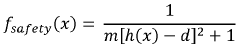
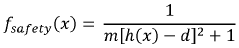
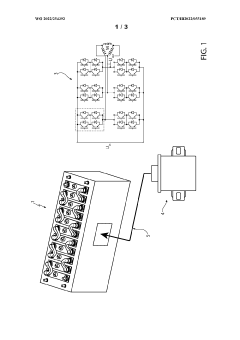
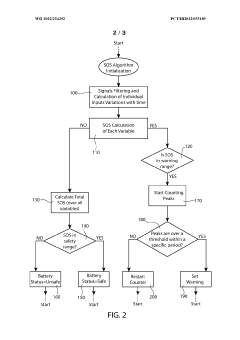
- A method that measures various battery variables like direct current internal resistance, temperature, open-circuit voltage, state of health, state of charge, and insulation resistance, calculates their variations, and uses a safety function to provide a numerical State of Safety (SOS) value, allowing for continuous monitoring and automatic notifications of safe, warning, or unsafe states.
Safety detection method of explosion-proof lithium ion power storage battery power supply device
PatentActiveCN107796441A
Innovation
- An explosion-proof lithium-ion power battery power supply device safety detection method is proposed, which includes comprehensive testing of the charge and discharge performance, safety performance of single cells and battery packs, the protective action performance of the battery management system, and the explosion-proof performance of the power supply device to ensure that it Safe and reliable in explosive environments.


Regulatory Framework for LFP Battery Safety
The regulatory framework for Lithium Iron Phosphate (LFP) battery safety has evolved significantly in recent years, reflecting the growing importance of these energy storage systems in various applications. Regulatory bodies worldwide have developed comprehensive standards and testing protocols to ensure the safety and reliability of LFP batteries throughout their lifecycle.
At the forefront of LFP battery safety regulations is the United Nations (UN) Manual of Tests and Criteria, specifically UN 38.3, which outlines the requirements for transportation of lithium batteries. This standard encompasses a series of tests including altitude simulation, thermal cycling, vibration, shock, external short circuit, impact, overcharge, and forced discharge. These tests are designed to simulate various conditions that batteries may encounter during transportation and use.
In the United States, the Consumer Product Safety Commission (CPSC) and the Department of Transportation (DOT) play crucial roles in regulating LFP battery safety. The CPSC focuses on consumer product safety, while the DOT regulates the transportation of hazardous materials, including lithium batteries. The National Fire Protection Association (NFPA) has also developed standards, such as NFPA 855, which addresses the installation of stationary energy storage systems.
The European Union has implemented the Battery Directive (2006/66/EC) and its subsequent amendments, which set requirements for battery safety, labeling, and disposal. Additionally, the UN ECE Regulation No. 100 provides specific requirements for the approval of vehicles with regard to specific requirements for the electric power train, including battery safety.
In Asia, countries like China, Japan, and South Korea have established their own regulatory frameworks. China's GB/T 31485 standard, for instance, outlines safety requirements and test methods for traction battery packs and systems for electric vehicles. Japan's JIS C8715 standard provides similar guidelines for lithium-ion batteries used in portable applications.
International standards organizations, such as the International Electrotechnical Commission (IEC) and the Institute of Electrical and Electronics Engineers (IEEE), have also developed relevant standards. The IEC 62133 standard, for example, specifies requirements and tests for the safe operation of portable sealed secondary lithium cells and batteries.
As the technology and applications of LFP batteries continue to advance, regulatory frameworks are expected to evolve further. Future regulations may focus on more stringent safety requirements, improved recycling and disposal processes, and the integration of smart battery management systems to enhance overall safety and performance.
At the forefront of LFP battery safety regulations is the United Nations (UN) Manual of Tests and Criteria, specifically UN 38.3, which outlines the requirements for transportation of lithium batteries. This standard encompasses a series of tests including altitude simulation, thermal cycling, vibration, shock, external short circuit, impact, overcharge, and forced discharge. These tests are designed to simulate various conditions that batteries may encounter during transportation and use.
In the United States, the Consumer Product Safety Commission (CPSC) and the Department of Transportation (DOT) play crucial roles in regulating LFP battery safety. The CPSC focuses on consumer product safety, while the DOT regulates the transportation of hazardous materials, including lithium batteries. The National Fire Protection Association (NFPA) has also developed standards, such as NFPA 855, which addresses the installation of stationary energy storage systems.
The European Union has implemented the Battery Directive (2006/66/EC) and its subsequent amendments, which set requirements for battery safety, labeling, and disposal. Additionally, the UN ECE Regulation No. 100 provides specific requirements for the approval of vehicles with regard to specific requirements for the electric power train, including battery safety.
In Asia, countries like China, Japan, and South Korea have established their own regulatory frameworks. China's GB/T 31485 standard, for instance, outlines safety requirements and test methods for traction battery packs and systems for electric vehicles. Japan's JIS C8715 standard provides similar guidelines for lithium-ion batteries used in portable applications.
International standards organizations, such as the International Electrotechnical Commission (IEC) and the Institute of Electrical and Electronics Engineers (IEEE), have also developed relevant standards. The IEC 62133 standard, for example, specifies requirements and tests for the safe operation of portable sealed secondary lithium cells and batteries.
As the technology and applications of LFP batteries continue to advance, regulatory frameworks are expected to evolve further. Future regulations may focus on more stringent safety requirements, improved recycling and disposal processes, and the integration of smart battery management systems to enhance overall safety and performance.
Environmental Impact of LFP Safety Testing
The environmental impact of safety testing for Lithium Iron Phosphate (LFP) batteries is a critical consideration in the evolving landscape of battery technology. As safety testing protocols become more rigorous and comprehensive, their ecological footprint has come under increased scrutiny.
Traditional safety testing methods for LFP batteries often involve destructive testing, which can lead to the release of potentially harmful materials into the environment. These tests may include overcharging, short-circuiting, and physical abuse, all of which can result in the emission of toxic gases, electrolyte leakage, and the generation of hazardous waste. The disposal of these test specimens poses significant environmental challenges, as they contain heavy metals and other pollutants that require specialized handling and recycling processes.
However, the evolution of safety testing for LFP batteries has begun to address these environmental concerns. Advanced non-destructive testing techniques, such as X-ray imaging, ultrasonic scanning, and electrochemical impedance spectroscopy, are being increasingly adopted. These methods allow for thorough safety assessments without the need for battery destruction, significantly reducing waste generation and environmental contamination.
Furthermore, the development of more sophisticated computer modeling and simulation tools has enabled researchers to predict battery behavior under various stress conditions. This approach minimizes the number of physical tests required, thereby reducing the overall environmental impact of the testing process. Virtual testing environments can simulate extreme conditions and rare events without the associated material waste and energy consumption of real-world tests.
The shift towards more sustainable testing practices has also led to innovations in recycling and material recovery processes specifically designed for LFP batteries used in safety tests. These advancements aim to maximize the reclamation of valuable materials and minimize the environmental burden of battery disposal.
Energy consumption during safety testing is another area where environmental impact is being addressed. The implementation of more energy-efficient testing equipment and procedures has helped to reduce the carbon footprint associated with LFP battery safety evaluations. Additionally, there is a growing trend towards using renewable energy sources to power testing facilities, further mitigating the environmental impact of these essential safety procedures.
As the demand for LFP batteries continues to grow, particularly in electric vehicles and renewable energy storage applications, the importance of environmentally conscious safety testing practices becomes increasingly apparent. The industry is witnessing a gradual transition towards a more holistic approach that balances rigorous safety standards with environmental stewardship, ensuring that the benefits of LFP technology are not overshadowed by the ecological costs of its development and testing.
Traditional safety testing methods for LFP batteries often involve destructive testing, which can lead to the release of potentially harmful materials into the environment. These tests may include overcharging, short-circuiting, and physical abuse, all of which can result in the emission of toxic gases, electrolyte leakage, and the generation of hazardous waste. The disposal of these test specimens poses significant environmental challenges, as they contain heavy metals and other pollutants that require specialized handling and recycling processes.
However, the evolution of safety testing for LFP batteries has begun to address these environmental concerns. Advanced non-destructive testing techniques, such as X-ray imaging, ultrasonic scanning, and electrochemical impedance spectroscopy, are being increasingly adopted. These methods allow for thorough safety assessments without the need for battery destruction, significantly reducing waste generation and environmental contamination.
Furthermore, the development of more sophisticated computer modeling and simulation tools has enabled researchers to predict battery behavior under various stress conditions. This approach minimizes the number of physical tests required, thereby reducing the overall environmental impact of the testing process. Virtual testing environments can simulate extreme conditions and rare events without the associated material waste and energy consumption of real-world tests.
The shift towards more sustainable testing practices has also led to innovations in recycling and material recovery processes specifically designed for LFP batteries used in safety tests. These advancements aim to maximize the reclamation of valuable materials and minimize the environmental burden of battery disposal.
Energy consumption during safety testing is another area where environmental impact is being addressed. The implementation of more energy-efficient testing equipment and procedures has helped to reduce the carbon footprint associated with LFP battery safety evaluations. Additionally, there is a growing trend towards using renewable energy sources to power testing facilities, further mitigating the environmental impact of these essential safety procedures.
As the demand for LFP batteries continues to grow, particularly in electric vehicles and renewable energy storage applications, the importance of environmentally conscious safety testing practices becomes increasingly apparent. The industry is witnessing a gradual transition towards a more holistic approach that balances rigorous safety standards with environmental stewardship, ensuring that the benefits of LFP technology are not overshadowed by the ecological costs of its development and testing.
Unlock deeper insights with Patsnap Eureka Quick Research — get a full tech report to explore trends and direct your research. Try now!
Generate Your Research Report Instantly with AI Agent
Supercharge your innovation with Patsnap Eureka AI Agent Platform!