
Solid-State Relay Energy Efficiency in Power Systems
SEP 19, 20259 MIN READ
Generate Your Research Report Instantly with AI Agent
Patsnap Eureka helps you evaluate technical feasibility & market potential.
SSR Technology Background and Objectives
Solid-state relays (SSRs) emerged in the late 1960s as an evolution from traditional electromechanical relays, representing a significant advancement in switching technology. Unlike their mechanical counterparts, SSRs operate without moving parts, utilizing semiconductor devices such as thyristors, triacs, MOSFETs, or IGBTs to control electrical circuits. This fundamental difference has positioned SSRs as a critical component in modern power systems where reliability, longevity, and energy efficiency are paramount concerns.
The technological trajectory of SSRs has been characterized by continuous improvements in semiconductor materials, manufacturing processes, and circuit designs. Early SSRs suffered from high on-state resistance and significant heat generation, limiting their application in high-power systems. However, advancements in semiconductor technology have progressively addressed these limitations, with modern SSRs featuring significantly reduced on-state resistance and improved thermal management capabilities.
Recent developments in wide-bandgap semiconductors, particularly silicon carbide (SiC) and gallium nitride (GaN), represent a paradigm shift in SSR technology. These materials offer superior electrical properties compared to traditional silicon, including higher breakdown voltage, faster switching speeds, and lower on-state resistance. The integration of these advanced materials into SSR designs has opened new possibilities for energy-efficient power control in increasingly demanding applications.
The primary technical objective in SSR development is to optimize energy efficiency while maintaining or enhancing reliability and performance. This involves minimizing power losses during both on-state conduction and switching transitions. On-state losses are primarily determined by the resistance of the semiconductor switch, while switching losses occur during the transition between on and off states. Balancing these factors while considering thermal management, isolation requirements, and cost constraints presents a complex engineering challenge.
Another critical objective is the integration of SSRs into smart grid and Internet of Things (IoT) ecosystems. This requires the development of SSRs with advanced communication capabilities, remote monitoring features, and compatibility with digital control systems. Such integration enables more sophisticated power management strategies, predictive maintenance, and enhanced system reliability through real-time monitoring and control.
The evolution of SSR technology is also driven by sustainability considerations, with emphasis on reducing the environmental footprint of power systems. Energy-efficient SSRs contribute to this goal by minimizing power losses, extending the lifespan of electrical systems, and enabling more efficient use of renewable energy sources through improved power conversion and distribution capabilities.
The technological trajectory of SSRs has been characterized by continuous improvements in semiconductor materials, manufacturing processes, and circuit designs. Early SSRs suffered from high on-state resistance and significant heat generation, limiting their application in high-power systems. However, advancements in semiconductor technology have progressively addressed these limitations, with modern SSRs featuring significantly reduced on-state resistance and improved thermal management capabilities.
Recent developments in wide-bandgap semiconductors, particularly silicon carbide (SiC) and gallium nitride (GaN), represent a paradigm shift in SSR technology. These materials offer superior electrical properties compared to traditional silicon, including higher breakdown voltage, faster switching speeds, and lower on-state resistance. The integration of these advanced materials into SSR designs has opened new possibilities for energy-efficient power control in increasingly demanding applications.
The primary technical objective in SSR development is to optimize energy efficiency while maintaining or enhancing reliability and performance. This involves minimizing power losses during both on-state conduction and switching transitions. On-state losses are primarily determined by the resistance of the semiconductor switch, while switching losses occur during the transition between on and off states. Balancing these factors while considering thermal management, isolation requirements, and cost constraints presents a complex engineering challenge.
Another critical objective is the integration of SSRs into smart grid and Internet of Things (IoT) ecosystems. This requires the development of SSRs with advanced communication capabilities, remote monitoring features, and compatibility with digital control systems. Such integration enables more sophisticated power management strategies, predictive maintenance, and enhanced system reliability through real-time monitoring and control.
The evolution of SSR technology is also driven by sustainability considerations, with emphasis on reducing the environmental footprint of power systems. Energy-efficient SSRs contribute to this goal by minimizing power losses, extending the lifespan of electrical systems, and enabling more efficient use of renewable energy sources through improved power conversion and distribution capabilities.
Market Demand Analysis for Energy-Efficient Relays
The global market for energy-efficient relays, particularly Solid-State Relays (SSRs), has experienced significant growth driven by increasing energy conservation requirements and industrial automation trends. Current market valuations place the global SSR market at approximately 1.2 billion USD in 2023, with projections indicating a compound annual growth rate of 6.8% through 2030, potentially reaching 1.9 billion USD by the end of the forecast period.
Energy efficiency has become a critical market driver as industries worldwide face mounting pressure to reduce energy consumption and carbon footprints. This pressure stems from both regulatory requirements and economic incentives, with many countries implementing stringent energy efficiency standards for industrial equipment and offering tax benefits for energy-saving technologies implementation.
The power systems sector represents the largest market segment for energy-efficient SSRs, accounting for roughly 32% of total market demand. This is followed closely by industrial automation (28%), building management systems (18%), renewable energy integration (14%), and other applications (8%). The renewable energy sector, in particular, shows the highest growth potential with an estimated CAGR of 9.2% through 2030.
Geographically, Asia-Pacific dominates the market with approximately 42% share, driven primarily by rapid industrialization in China and India, alongside Japan's advanced manufacturing sector. North America and Europe follow with 27% and 23% market shares respectively, with their demand primarily focused on replacement of aging infrastructure and smart grid implementations.
Customer requirements are evolving beyond basic functionality, with increasing demand for SSRs that offer enhanced energy efficiency, smaller footprints, higher reliability, and integration capabilities with IoT systems. Market research indicates that customers are willing to pay a premium of 15-20% for SSRs that can demonstrate energy savings of at least 30% compared to traditional electromagnetic relays.
The market is also witnessing a shift toward specialized SSRs designed for specific applications, particularly in renewable energy integration, electric vehicle charging infrastructure, and smart building management systems. These specialized markets are growing at rates exceeding the overall market average, presenting significant opportunities for manufacturers with application-specific expertise.
Supply chain challenges remain a concern, with semiconductor shortages affecting production capacity and lead times. This has created a temporary market imbalance where demand exceeds supply, particularly for high-performance SSRs utilizing advanced semiconductor materials like silicon carbide (SiC) and gallium nitride (GaN).
Energy efficiency has become a critical market driver as industries worldwide face mounting pressure to reduce energy consumption and carbon footprints. This pressure stems from both regulatory requirements and economic incentives, with many countries implementing stringent energy efficiency standards for industrial equipment and offering tax benefits for energy-saving technologies implementation.
The power systems sector represents the largest market segment for energy-efficient SSRs, accounting for roughly 32% of total market demand. This is followed closely by industrial automation (28%), building management systems (18%), renewable energy integration (14%), and other applications (8%). The renewable energy sector, in particular, shows the highest growth potential with an estimated CAGR of 9.2% through 2030.
Geographically, Asia-Pacific dominates the market with approximately 42% share, driven primarily by rapid industrialization in China and India, alongside Japan's advanced manufacturing sector. North America and Europe follow with 27% and 23% market shares respectively, with their demand primarily focused on replacement of aging infrastructure and smart grid implementations.
Customer requirements are evolving beyond basic functionality, with increasing demand for SSRs that offer enhanced energy efficiency, smaller footprints, higher reliability, and integration capabilities with IoT systems. Market research indicates that customers are willing to pay a premium of 15-20% for SSRs that can demonstrate energy savings of at least 30% compared to traditional electromagnetic relays.
The market is also witnessing a shift toward specialized SSRs designed for specific applications, particularly in renewable energy integration, electric vehicle charging infrastructure, and smart building management systems. These specialized markets are growing at rates exceeding the overall market average, presenting significant opportunities for manufacturers with application-specific expertise.
Supply chain challenges remain a concern, with semiconductor shortages affecting production capacity and lead times. This has created a temporary market imbalance where demand exceeds supply, particularly for high-performance SSRs utilizing advanced semiconductor materials like silicon carbide (SiC) and gallium nitride (GaN).
Current State and Challenges in SSR Efficiency
Solid-State Relays (SSRs) have evolved significantly over the past decades, with current global market adoption varying across regions. In North America and Europe, SSR technology has reached maturity with widespread implementation in industrial automation, while Asia-Pacific regions are experiencing rapid growth in adoption rates, particularly in manufacturing and smart grid applications. The global SSR market was valued at approximately $1.2 billion in 2022 and is projected to grow at a CAGR of 6.8% through 2028.
Despite their advantages over electromechanical relays, SSRs face several efficiency challenges. The primary technical limitation remains the voltage drop across semiconductor switching elements, typically 1-1.5V for MOSFETs and 1-2V for IGBTs, resulting in significant power losses during high-current applications. This creates a fundamental efficiency barrier that increases proportionally with current flow, making SSRs less efficient than mechanical relays in certain high-power scenarios.
Thermal management represents another critical challenge, as power dissipation in semiconductor junctions generates heat that must be effectively removed to prevent performance degradation and premature failure. Current cooling solutions add complexity, cost, and size to SSR implementations, limiting their application in space-constrained environments.
The semiconductor materials used in contemporary SSRs present inherent limitations. Silicon-based devices dominate the market but face fundamental physical constraints in switching speed and power handling capabilities. While wide-bandgap semiconductors like SiC and GaN offer promising alternatives with superior thermal conductivity and lower on-resistance, their integration faces challenges including higher production costs and reliability concerns under extreme operating conditions.
Standby power consumption remains problematic in many SSR designs, particularly in optically-isolated variants where the LED driver circuits continuously draw power. This parasitic consumption, though small per unit, becomes significant in large-scale deployments such as smart grid applications or industrial control systems with hundreds of relay points.
Regulatory frameworks and standards for SSR efficiency vary globally, creating compliance challenges for manufacturers targeting international markets. The IEC 62314 standard provides guidelines for SSR performance but lacks comprehensive efficiency metrics, while regional energy efficiency initiatives like the EU's Ecodesign Directive are beginning to address solid-state switching technologies but without standardized testing methodologies.
Research institutions and industry leaders are actively addressing these challenges, with collaborative efforts focusing on novel semiconductor materials, improved thermal interface materials, and advanced control architectures to optimize switching behavior and reduce losses.
Despite their advantages over electromechanical relays, SSRs face several efficiency challenges. The primary technical limitation remains the voltage drop across semiconductor switching elements, typically 1-1.5V for MOSFETs and 1-2V for IGBTs, resulting in significant power losses during high-current applications. This creates a fundamental efficiency barrier that increases proportionally with current flow, making SSRs less efficient than mechanical relays in certain high-power scenarios.
Thermal management represents another critical challenge, as power dissipation in semiconductor junctions generates heat that must be effectively removed to prevent performance degradation and premature failure. Current cooling solutions add complexity, cost, and size to SSR implementations, limiting their application in space-constrained environments.
The semiconductor materials used in contemporary SSRs present inherent limitations. Silicon-based devices dominate the market but face fundamental physical constraints in switching speed and power handling capabilities. While wide-bandgap semiconductors like SiC and GaN offer promising alternatives with superior thermal conductivity and lower on-resistance, their integration faces challenges including higher production costs and reliability concerns under extreme operating conditions.
Standby power consumption remains problematic in many SSR designs, particularly in optically-isolated variants where the LED driver circuits continuously draw power. This parasitic consumption, though small per unit, becomes significant in large-scale deployments such as smart grid applications or industrial control systems with hundreds of relay points.
Regulatory frameworks and standards for SSR efficiency vary globally, creating compliance challenges for manufacturers targeting international markets. The IEC 62314 standard provides guidelines for SSR performance but lacks comprehensive efficiency metrics, while regional energy efficiency initiatives like the EU's Ecodesign Directive are beginning to address solid-state switching technologies but without standardized testing methodologies.
Research institutions and industry leaders are actively addressing these challenges, with collaborative efforts focusing on novel semiconductor materials, improved thermal interface materials, and advanced control architectures to optimize switching behavior and reduce losses.
Current Energy Efficiency Solutions for SSRs
01 Low power consumption designs for solid-state relays
Various designs focus on reducing the power consumption of solid-state relays through optimized circuit configurations. These designs incorporate specialized components and architectures that minimize energy losses during operation. Key approaches include improved gate drive circuits, reduced on-state resistance, and enhanced thermal management techniques that collectively contribute to higher energy efficiency in solid-state relay applications.- Low power consumption designs for solid-state relays: Various designs focus on reducing power consumption in solid-state relays through optimized circuit configurations. These designs incorporate specialized components and architectures that minimize energy losses during operation. Key approaches include improved semiconductor materials, enhanced thermal management, and reduced leakage current. These innovations result in solid-state relays that maintain high switching performance while significantly decreasing energy consumption compared to conventional designs.
- Heat dissipation techniques for energy-efficient operation: Effective heat dissipation is crucial for maintaining energy efficiency in solid-state relays. Advanced thermal management solutions include specialized heat sinks, improved packaging designs, and thermally conductive materials that efficiently transfer heat away from semiconductor components. These techniques prevent performance degradation due to overheating, extend the operational lifespan of the relay, and maintain optimal energy efficiency during continuous operation by reducing thermal resistance and improving heat flow.
- Zero-crossing switching technology for reduced power losses: Zero-crossing switching technology significantly improves energy efficiency in solid-state relays by activating the switching mechanism only when the AC voltage crosses zero. This approach minimizes switching losses, reduces electromagnetic interference, and prevents current surges that typically occur during random switching. The technology incorporates specialized timing circuits and detection mechanisms that synchronize switching operations with the zero-voltage points of the AC waveform, resulting in cooler operation and extended component life.
- Advanced semiconductor materials for improved efficiency: The use of advanced semiconductor materials significantly enhances the energy efficiency of solid-state relays. Materials such as silicon carbide (SiC) and gallium nitride (GaN) offer superior electrical properties compared to conventional silicon, including lower on-state resistance, faster switching speeds, and better thermal conductivity. These characteristics reduce conduction losses and switching losses, allowing the relays to operate at higher temperatures with improved reliability while consuming less power during both on and off states.
- Intelligent control systems for optimized energy usage: Intelligent control systems integrate microprocessors and advanced algorithms to optimize the energy consumption of solid-state relays. These systems dynamically adjust operating parameters based on load conditions, implement power-saving modes during periods of inactivity, and provide precise timing control for switching operations. Some designs incorporate feedback mechanisms that continuously monitor performance metrics and make real-time adjustments to maintain optimal efficiency, while others feature programmable settings that allow customization based on specific application requirements.
02 Zero-crossing switching techniques
Zero-crossing switching techniques are implemented in solid-state relays to reduce switching losses and electromagnetic interference. By synchronizing the switching operation with the zero-crossing point of the AC waveform, these relays minimize energy dissipation during state transitions. This approach significantly improves energy efficiency while extending the operational lifespan of the relay and connected equipment.Expand Specific Solutions03 Advanced semiconductor materials for improved efficiency
The use of advanced semiconductor materials in solid-state relays enhances energy efficiency through improved electrical characteristics. Materials such as silicon carbide (SiC) and gallium nitride (GaN) offer lower conduction losses, faster switching speeds, and better thermal performance compared to traditional silicon-based devices. These properties enable the development of solid-state relays with significantly reduced power losses during operation.Expand Specific Solutions04 Thermal management solutions
Effective thermal management solutions are critical for maintaining the energy efficiency of solid-state relays. Innovative heat dissipation techniques, including advanced heat sink designs, thermal interface materials, and active cooling systems, help minimize temperature rise during operation. By keeping operating temperatures lower, these solutions reduce conduction losses and prevent efficiency degradation, particularly in high-power applications.Expand Specific Solutions05 Intelligent control and monitoring systems
Integration of intelligent control and monitoring systems in solid-state relays enables dynamic optimization of energy efficiency. These systems incorporate microcontrollers, sensors, and advanced algorithms to adjust operating parameters based on load conditions. Features such as adaptive switching timing, load-dependent operation modes, and real-time performance monitoring allow for continuous efficiency optimization while providing protection against abnormal operating conditions.Expand Specific Solutions
Key Industry Players in SSR Manufacturing
Solid-State Relay (SSR) technology in power systems is currently in a growth phase, with the market expected to expand significantly due to increasing demand for energy-efficient solutions. The global SSR market is projected to reach approximately $1.5 billion by 2026, driven by industrial automation and smart grid applications. Technologically, SSRs are maturing rapidly with key players advancing different aspects of efficiency. Texas Instruments and Littelfuse lead in semiconductor integration, while Novosense and Mornsun are developing innovative thermal management solutions. Schneider Electric and Eaton focus on system-level implementations, and Vertiv and TE Connectivity are enhancing reliability for critical applications. University collaborations with companies like TDK Electronics are accelerating research into next-generation materials to further improve energy efficiency and reduce switching losses.
Texas Instruments Incorporated
Technical Solution: Texas Instruments has developed advanced solid-state relay solutions featuring optically isolated MOSFET-based designs that significantly improve energy efficiency in power systems. Their technology integrates low on-resistance MOSFETs with sophisticated gate drive circuitry to minimize conduction losses. TI's solid-state relays incorporate zero-crossing detection circuits that reduce switching losses and electromagnetic interference by ensuring switching occurs only when the AC voltage crosses zero. Their latest designs feature integrated thermal management solutions with advanced packaging techniques that optimize heat dissipation, allowing for higher current handling capabilities without compromising efficiency. TI has also implemented intelligent power management features that enable dynamic control of the relay based on load conditions, further enhancing energy efficiency by optimizing operation parameters in real-time.
Strengths: Superior integration capabilities allowing for compact designs with advanced features; extensive semiconductor expertise enabling optimized MOSFET characteristics for lower losses; comprehensive ecosystem of supporting components. Weaknesses: Higher initial cost compared to electromechanical relays; requires more complex driving circuits; potentially more susceptible to damage from voltage transients without additional protection.
Suzhou Novosense Microelectronics Co., Ltd.
Technical Solution: Novosense has developed cutting-edge solid-state relay technology focused on maximizing energy efficiency through innovative semiconductor design and integration. Their SSR solutions feature proprietary silicon-on-insulator (SOI) technology that significantly reduces parasitic capacitances and leakage currents, resulting in lower power consumption during both switching and steady-state operation. Novosense's solid-state relays incorporate advanced gate drive optimization that minimizes switching losses through precise control of slew rates and timing parameters. Their technology utilizes innovative packaging techniques with improved thermal interfaces that reduce junction-to-case thermal resistance, allowing for more efficient heat dissipation and higher current handling capabilities. Novosense has also implemented intelligent protection features including overcurrent, overvoltage, and overtemperature monitoring that dynamically adjust operating parameters to maintain optimal efficiency across varying load conditions and environmental factors.
Strengths: Cost-effective designs making advanced SSR technology more accessible; strong focus on miniaturization while maintaining thermal performance; rapidly evolving technology portfolio with frequent innovations. Weaknesses: Less established global presence and support infrastructure compared to larger competitors; more limited application-specific optimization resources; narrower product portfolio breadth.
Core Innovations in SSR Power Management
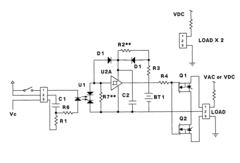
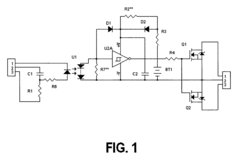
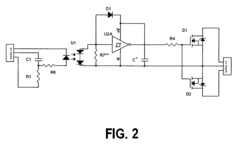
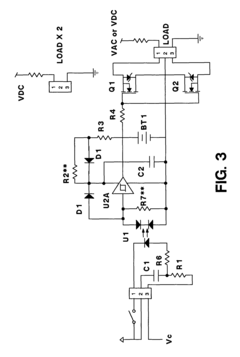
Very low power consumption solid state relay
PatentInactiveUS7755414B2
Innovation
- A solid-state relay using field effect devices and electronic circuitry replaces mechanical contacts and coils, featuring low power consumption, resistance to shock and vibration, and long operating life, with normally closed contacts and full isolation between input and output terminals, utilizing semiconductor devices and energy storage devices like capacitors or batteries to maintain active contacts for extended periods.
Solid state relay and method of operating the same
PatentInactiveUS7196435B2
Innovation
- A solid-state relay design featuring series-connected power semiconductor switches and parallel-coupled power diodes, controlled by a circuit that monitors phase bus polarity to manage switching states, eliminating the need for precise timing and allowing operation across varying frequencies.


Thermal Management Strategies in SSR Design
Thermal management represents a critical aspect of Solid-State Relay (SSR) design that directly impacts energy efficiency in power systems. As semiconductor devices, SSRs generate heat during operation primarily due to forward voltage drop across the switching elements. This heat generation constitutes the main source of energy loss in SSR applications, making effective thermal management essential for maximizing efficiency.
The primary thermal management strategies in modern SSR design include passive cooling techniques utilizing heat sinks with optimized fin structures. These heat sinks facilitate natural convection and increase the surface area available for heat dissipation. Material selection plays a crucial role, with aluminum and copper being preferred for their superior thermal conductivity properties. Advanced designs incorporate phase-change materials that absorb heat during temperature increases, providing additional thermal buffering capacity.
Active cooling solutions represent the next tier of thermal management, employing forced-air cooling through fans or blowers to enhance convection rates. In high-power applications, liquid cooling systems offer significantly higher heat transfer coefficients, though at the cost of increased system complexity and maintenance requirements. These systems circulate coolants through channels integrated within or attached to the SSR package.
Thermal interface materials (TIMs) serve as critical components in the thermal pathway, filling microscopic air gaps between the SSR and heat sink surfaces. Recent advancements in TIM technology include graphene-enhanced compounds and metal-infused polymers that offer thermal conductivity values exceeding 5 W/m·K while maintaining electrical isolation properties essential for SSR operation.
Integrated thermal protection mechanisms represent another vital aspect of SSR thermal management. These include temperature sensors embedded within the SSR package that monitor operating temperatures and trigger protective responses when thermal thresholds are approached. Advanced designs implement dynamic thermal management systems that adjust switching characteristics based on real-time temperature data, reducing switching losses during periods of elevated thermal stress.
Computational fluid dynamics (CFD) modeling has revolutionized thermal management design processes, enabling precise prediction of thermal behavior under various operating conditions. These simulation tools allow engineers to optimize heat sink geometries, airflow patterns, and component placement before physical prototyping, significantly reducing development cycles and improving final design performance.
Emerging technologies in SSR thermal management include direct substrate cooling, where cooling channels are integrated directly into the semiconductor substrate, and advanced packaging techniques that minimize thermal resistance between heat-generating components and cooling systems. These innovations promise to further enhance the energy efficiency of SSR-based power systems by addressing thermal limitations that currently constrain performance.
The primary thermal management strategies in modern SSR design include passive cooling techniques utilizing heat sinks with optimized fin structures. These heat sinks facilitate natural convection and increase the surface area available for heat dissipation. Material selection plays a crucial role, with aluminum and copper being preferred for their superior thermal conductivity properties. Advanced designs incorporate phase-change materials that absorb heat during temperature increases, providing additional thermal buffering capacity.
Active cooling solutions represent the next tier of thermal management, employing forced-air cooling through fans or blowers to enhance convection rates. In high-power applications, liquid cooling systems offer significantly higher heat transfer coefficients, though at the cost of increased system complexity and maintenance requirements. These systems circulate coolants through channels integrated within or attached to the SSR package.
Thermal interface materials (TIMs) serve as critical components in the thermal pathway, filling microscopic air gaps between the SSR and heat sink surfaces. Recent advancements in TIM technology include graphene-enhanced compounds and metal-infused polymers that offer thermal conductivity values exceeding 5 W/m·K while maintaining electrical isolation properties essential for SSR operation.
Integrated thermal protection mechanisms represent another vital aspect of SSR thermal management. These include temperature sensors embedded within the SSR package that monitor operating temperatures and trigger protective responses when thermal thresholds are approached. Advanced designs implement dynamic thermal management systems that adjust switching characteristics based on real-time temperature data, reducing switching losses during periods of elevated thermal stress.
Computational fluid dynamics (CFD) modeling has revolutionized thermal management design processes, enabling precise prediction of thermal behavior under various operating conditions. These simulation tools allow engineers to optimize heat sink geometries, airflow patterns, and component placement before physical prototyping, significantly reducing development cycles and improving final design performance.
Emerging technologies in SSR thermal management include direct substrate cooling, where cooling channels are integrated directly into the semiconductor substrate, and advanced packaging techniques that minimize thermal resistance between heat-generating components and cooling systems. These innovations promise to further enhance the energy efficiency of SSR-based power systems by addressing thermal limitations that currently constrain performance.
Grid Integration and Smart Power Applications
The integration of Solid-State Relays (SSRs) into modern power grids represents a significant advancement in energy management systems. These semiconductor-based switching devices offer superior performance characteristics compared to traditional electromechanical relays, making them ideal components for smart grid applications. When properly implemented, SSRs enable precise control of power flow, facilitate demand response programs, and support the integration of renewable energy sources into existing infrastructure.
Smart grid technologies leverage SSRs' fast switching capabilities and programmable features to optimize power distribution in real-time. This dynamic control allows grid operators to respond rapidly to fluctuations in supply and demand, particularly important when managing intermittent renewable energy sources such as solar and wind power. The absence of mechanical components in SSRs eliminates contact bounce and arcing issues, resulting in cleaner switching transitions that reduce electromagnetic interference in sensitive grid communication systems.
Advanced metering infrastructure (AMI) systems benefit significantly from SSR integration. These systems utilize SSRs for remote connect/disconnect operations, enabling utilities to implement time-of-use pricing models and manage peak demand periods more effectively. The solid-state technology allows for millions of switching operations without performance degradation, ensuring long-term reliability in these critical applications.
In microgrid environments, SSRs serve as essential components for seamless transitions between grid-connected and island modes. Their rapid response times—typically in the microsecond range—enable instantaneous isolation from the main grid during fault conditions, protecting sensitive equipment and maintaining power quality for critical loads. This capability is particularly valuable in healthcare facilities, data centers, and industrial processes where even momentary power disruptions can have severe consequences.
Building automation systems represent another frontier for SSR implementation in smart power applications. These systems utilize SSRs for HVAC control, lighting management, and other energy-intensive operations. The precise switching control offered by SSRs allows for fine-tuned energy management strategies that can reduce consumption by 15-30% compared to conventional systems, according to recent field studies.
The emergence of Internet of Things (IoT) platforms for energy management has further expanded SSR applications in grid systems. These platforms leverage SSRs' digital control interfaces to create responsive, data-driven power distribution networks. Real-time monitoring capabilities allow system operators to identify inefficiencies, predict potential failures, and implement preventive maintenance protocols that minimize downtime and extend equipment lifespan.
Smart grid technologies leverage SSRs' fast switching capabilities and programmable features to optimize power distribution in real-time. This dynamic control allows grid operators to respond rapidly to fluctuations in supply and demand, particularly important when managing intermittent renewable energy sources such as solar and wind power. The absence of mechanical components in SSRs eliminates contact bounce and arcing issues, resulting in cleaner switching transitions that reduce electromagnetic interference in sensitive grid communication systems.
Advanced metering infrastructure (AMI) systems benefit significantly from SSR integration. These systems utilize SSRs for remote connect/disconnect operations, enabling utilities to implement time-of-use pricing models and manage peak demand periods more effectively. The solid-state technology allows for millions of switching operations without performance degradation, ensuring long-term reliability in these critical applications.
In microgrid environments, SSRs serve as essential components for seamless transitions between grid-connected and island modes. Their rapid response times—typically in the microsecond range—enable instantaneous isolation from the main grid during fault conditions, protecting sensitive equipment and maintaining power quality for critical loads. This capability is particularly valuable in healthcare facilities, data centers, and industrial processes where even momentary power disruptions can have severe consequences.
Building automation systems represent another frontier for SSR implementation in smart power applications. These systems utilize SSRs for HVAC control, lighting management, and other energy-intensive operations. The precise switching control offered by SSRs allows for fine-tuned energy management strategies that can reduce consumption by 15-30% compared to conventional systems, according to recent field studies.
The emergence of Internet of Things (IoT) platforms for energy management has further expanded SSR applications in grid systems. These platforms leverage SSRs' digital control interfaces to create responsive, data-driven power distribution networks. Real-time monitoring capabilities allow system operators to identify inefficiencies, predict potential failures, and implement preventive maintenance protocols that minimize downtime and extend equipment lifespan.
Unlock deeper insights with Patsnap Eureka Quick Research — get a full tech report to explore trends and direct your research. Try now!
Generate Your Research Report Instantly with AI Agent
Supercharge your innovation with Patsnap Eureka AI Agent Platform!