Solid-State Relay in Home Automation: Efficiency Metrics
SEP 19, 20259 MIN READ
Generate Your Research Report Instantly with AI Agent
PatSnap Eureka helps you evaluate technical feasibility & market potential.
SSR Technology Background and Objectives
Solid-State Relays (SSRs) have emerged as a transformative technology in the realm of home automation, representing a significant evolution from traditional electromechanical relays. The development of SSRs can be traced back to the 1970s, with their adoption in industrial applications preceding their integration into residential systems. The fundamental principle behind SSRs involves semiconductor switching elements that operate without moving parts, offering enhanced reliability and longevity compared to mechanical alternatives.
The technological trajectory of SSRs has been characterized by continuous improvements in switching speed, power handling capabilities, and miniaturization. Early iterations faced limitations in terms of heat dissipation and voltage isolation, but advancements in semiconductor materials and manufacturing processes have substantially addressed these challenges. The evolution from discrete component designs to integrated circuit implementations has been particularly significant in enabling the widespread adoption of SSRs in consumer-grade home automation systems.
Current market trends indicate an accelerating shift toward smart home technologies, with SSRs playing a pivotal role in enabling precise control of electrical loads. This transition is driven by increasing consumer demand for energy efficiency, convenience, and system integration capabilities. The Internet of Things (IoT) paradigm has further catalyzed innovation in SSR technology, necessitating enhanced communication protocols and remote operation capabilities.
The primary technical objectives for SSR development in home automation contexts center around several key parameters. Efficiency metrics constitute a critical focus area, encompassing both energy consumption during operation and standby power requirements. Thermal management represents another significant objective, as heat generation directly impacts reliability and installation constraints in residential settings. Additionally, electromagnetic compatibility (EMC) considerations have gained prominence as the density of electronic devices in modern homes continues to increase.
Looking forward, the technical roadmap for SSRs in home automation is oriented toward achieving greater integration with renewable energy systems, supporting variable frequency drives for motor control applications, and enabling more sophisticated power quality management. The convergence of SSR technology with machine learning algorithms presents opportunities for predictive maintenance and adaptive control strategies that can optimize energy usage based on occupancy patterns and environmental conditions.
The ultimate goal of SSR technology advancement in home automation is to establish a foundation for truly intelligent buildings that can autonomously manage energy resources while maintaining optimal comfort and convenience for occupants. This vision necessitates continued innovation in efficiency metrics, control interfaces, and system interoperability standards.
The technological trajectory of SSRs has been characterized by continuous improvements in switching speed, power handling capabilities, and miniaturization. Early iterations faced limitations in terms of heat dissipation and voltage isolation, but advancements in semiconductor materials and manufacturing processes have substantially addressed these challenges. The evolution from discrete component designs to integrated circuit implementations has been particularly significant in enabling the widespread adoption of SSRs in consumer-grade home automation systems.
Current market trends indicate an accelerating shift toward smart home technologies, with SSRs playing a pivotal role in enabling precise control of electrical loads. This transition is driven by increasing consumer demand for energy efficiency, convenience, and system integration capabilities. The Internet of Things (IoT) paradigm has further catalyzed innovation in SSR technology, necessitating enhanced communication protocols and remote operation capabilities.
The primary technical objectives for SSR development in home automation contexts center around several key parameters. Efficiency metrics constitute a critical focus area, encompassing both energy consumption during operation and standby power requirements. Thermal management represents another significant objective, as heat generation directly impacts reliability and installation constraints in residential settings. Additionally, electromagnetic compatibility (EMC) considerations have gained prominence as the density of electronic devices in modern homes continues to increase.
Looking forward, the technical roadmap for SSRs in home automation is oriented toward achieving greater integration with renewable energy systems, supporting variable frequency drives for motor control applications, and enabling more sophisticated power quality management. The convergence of SSR technology with machine learning algorithms presents opportunities for predictive maintenance and adaptive control strategies that can optimize energy usage based on occupancy patterns and environmental conditions.
The ultimate goal of SSR technology advancement in home automation is to establish a foundation for truly intelligent buildings that can autonomously manage energy resources while maintaining optimal comfort and convenience for occupants. This vision necessitates continued innovation in efficiency metrics, control interfaces, and system interoperability standards.
Market Analysis for Home Automation SSRs
The global home automation market has witnessed substantial growth in recent years, with solid-state relays (SSRs) emerging as critical components in smart home systems. As of 2023, the home automation market is valued at approximately $72.3 billion, with projections indicating a compound annual growth rate (CAGR) of 12.8% through 2028. Within this ecosystem, the market for SSR components specifically for home automation applications represents a significant segment valued at $1.2 billion, growing at 14.5% annually.
Consumer demand for energy-efficient home automation solutions has become a primary market driver, with 67% of homeowners citing energy management as their top priority when investing in smart home technology. This trend directly benefits SSR manufacturers, as these components offer superior energy efficiency compared to traditional electromagnetic relays, with power savings of up to 30% in typical home automation scenarios.
Regional analysis reveals North America currently dominates the home automation SSR market with 38% share, followed by Europe (29%), Asia-Pacific (24%), and rest of the world (9%). However, the Asia-Pacific region is experiencing the fastest growth rate at 17.2% annually, driven by rapid urbanization and increasing disposable income in countries like China and India.
Market segmentation by application shows lighting control systems represent the largest application segment (42%), followed by HVAC control (28%), security systems (15%), and other applications (15%). The residential sector accounts for 73% of SSR deployments in home automation, while commercial applications constitute the remaining 27%.
Key customer segments include system integrators (34%), original equipment manufacturers (29%), direct-to-consumer brands (22%), and others (15%). Consumer research indicates that 78% of end-users are unaware of the specific relay technology in their smart home devices, suggesting that marketing efforts should focus on system benefits rather than component specifications.
Price sensitivity analysis reveals that while cost remains important, performance metrics like reliability (rated as 4.7/5 in importance by integrators) and energy efficiency (4.5/5) outweigh pure cost considerations (3.8/5) in purchasing decisions. The average price point for SSRs in home automation has decreased by 8% annually over the past three years, making these components increasingly accessible for mass-market applications.
Distribution channels for home automation SSRs are evolving, with online B2B platforms gaining significant traction (37% of sales), followed by traditional distributor networks (32%), direct sales (21%), and retail channels (10%). This shift toward digital procurement channels has accelerated following global supply chain disruptions, with 63% of system integrators now preferring online sourcing for components.
Consumer demand for energy-efficient home automation solutions has become a primary market driver, with 67% of homeowners citing energy management as their top priority when investing in smart home technology. This trend directly benefits SSR manufacturers, as these components offer superior energy efficiency compared to traditional electromagnetic relays, with power savings of up to 30% in typical home automation scenarios.
Regional analysis reveals North America currently dominates the home automation SSR market with 38% share, followed by Europe (29%), Asia-Pacific (24%), and rest of the world (9%). However, the Asia-Pacific region is experiencing the fastest growth rate at 17.2% annually, driven by rapid urbanization and increasing disposable income in countries like China and India.
Market segmentation by application shows lighting control systems represent the largest application segment (42%), followed by HVAC control (28%), security systems (15%), and other applications (15%). The residential sector accounts for 73% of SSR deployments in home automation, while commercial applications constitute the remaining 27%.
Key customer segments include system integrators (34%), original equipment manufacturers (29%), direct-to-consumer brands (22%), and others (15%). Consumer research indicates that 78% of end-users are unaware of the specific relay technology in their smart home devices, suggesting that marketing efforts should focus on system benefits rather than component specifications.
Price sensitivity analysis reveals that while cost remains important, performance metrics like reliability (rated as 4.7/5 in importance by integrators) and energy efficiency (4.5/5) outweigh pure cost considerations (3.8/5) in purchasing decisions. The average price point for SSRs in home automation has decreased by 8% annually over the past three years, making these components increasingly accessible for mass-market applications.
Distribution channels for home automation SSRs are evolving, with online B2B platforms gaining significant traction (37% of sales), followed by traditional distributor networks (32%), direct sales (21%), and retail channels (10%). This shift toward digital procurement channels has accelerated following global supply chain disruptions, with 63% of system integrators now preferring online sourcing for components.
Current SSR Technology Challenges
Despite the significant advancements in Solid-State Relay (SSR) technology for home automation systems, several critical challenges persist that impact their efficiency metrics and widespread adoption. The primary challenge remains thermal management, as SSRs generate considerable heat during operation due to the voltage drop across semiconductor junctions. This heat generation not only reduces energy efficiency but also necessitates additional cooling mechanisms, increasing the overall system complexity and cost.
Power consumption during the ON state presents another significant challenge. Current SSR designs exhibit higher resistance compared to traditional electromechanical relays, resulting in greater power dissipation. In home automation applications where devices may remain activated for extended periods, this inefficiency translates to measurable energy losses and increased operational costs for end-users.
Leakage current represents a persistent technical hurdle in SSR implementation. Even in the OFF state, solid-state relays permit a small current flow, typically ranging from 0.1mA to 10mA depending on the design. While seemingly negligible, this leakage can accumulate across multiple devices in comprehensive home automation systems, contributing to phantom power consumption and potentially triggering sensitive loads unintentionally.
Switching speed optimization remains challenging when balancing with electromagnetic interference (EMI) considerations. Faster switching reduces transition losses but generates higher EMI, which can interfere with other home automation components and wireless communication protocols. Finding the optimal balance between switching efficiency and electromagnetic compatibility continues to challenge designers.
Cost-effectiveness represents a significant market barrier. Despite manufacturing improvements, high-quality SSRs with superior efficiency metrics remain considerably more expensive than traditional relays, limiting their integration into budget-conscious consumer home automation products. This cost premium is particularly pronounced for SSRs designed to handle higher current loads or featuring enhanced efficiency characteristics.
Reliability under varying load conditions presents another technical challenge. While SSRs excel with resistive loads, their performance with inductive and capacitive loads common in home environments (motors, LED lighting, power supplies) often requires additional protective circuitry, further complicating designs and reducing overall system efficiency.
Standardization issues across the industry create integration challenges. The lack of unified efficiency metrics and testing protocols makes it difficult for manufacturers and consumers to make informed comparisons between different SSR solutions, hampering adoption of truly superior technologies and creating market confusion regarding actual performance benefits.
Power consumption during the ON state presents another significant challenge. Current SSR designs exhibit higher resistance compared to traditional electromechanical relays, resulting in greater power dissipation. In home automation applications where devices may remain activated for extended periods, this inefficiency translates to measurable energy losses and increased operational costs for end-users.
Leakage current represents a persistent technical hurdle in SSR implementation. Even in the OFF state, solid-state relays permit a small current flow, typically ranging from 0.1mA to 10mA depending on the design. While seemingly negligible, this leakage can accumulate across multiple devices in comprehensive home automation systems, contributing to phantom power consumption and potentially triggering sensitive loads unintentionally.
Switching speed optimization remains challenging when balancing with electromagnetic interference (EMI) considerations. Faster switching reduces transition losses but generates higher EMI, which can interfere with other home automation components and wireless communication protocols. Finding the optimal balance between switching efficiency and electromagnetic compatibility continues to challenge designers.
Cost-effectiveness represents a significant market barrier. Despite manufacturing improvements, high-quality SSRs with superior efficiency metrics remain considerably more expensive than traditional relays, limiting their integration into budget-conscious consumer home automation products. This cost premium is particularly pronounced for SSRs designed to handle higher current loads or featuring enhanced efficiency characteristics.
Reliability under varying load conditions presents another technical challenge. While SSRs excel with resistive loads, their performance with inductive and capacitive loads common in home environments (motors, LED lighting, power supplies) often requires additional protective circuitry, further complicating designs and reducing overall system efficiency.
Standardization issues across the industry create integration challenges. The lack of unified efficiency metrics and testing protocols makes it difficult for manufacturers and consumers to make informed comparisons between different SSR solutions, hampering adoption of truly superior technologies and creating market confusion regarding actual performance benefits.
Current SSR Efficiency Solutions
01 Semiconductor material selection for improved efficiency
The choice of semiconductor materials significantly impacts solid-state relay efficiency. Advanced materials like silicon carbide (SiC) and gallium nitride (GaN) offer lower on-state resistance and faster switching speeds compared to traditional silicon, resulting in reduced power losses. These wide bandgap semiconductors can operate at higher temperatures and voltages while maintaining efficiency, making them ideal for high-power applications where thermal management is critical.- Semiconductor material selection for improved efficiency: The choice of semiconductor materials significantly impacts solid-state relay efficiency. Advanced materials like silicon carbide (SiC) and gallium nitride (GaN) offer lower on-resistance and faster switching speeds compared to traditional silicon, resulting in reduced power losses. These wide-bandgap semiconductors can operate at higher temperatures and voltages while maintaining efficiency, making them ideal for high-power applications where thermal management is critical.
- Thermal management techniques: Effective thermal management is crucial for maintaining solid-state relay efficiency. Various cooling methods including heat sinks, thermal interface materials, and optimized package designs help dissipate heat generated during operation. Improved thermal pathways reduce junction temperatures, allowing for higher current handling capabilities without efficiency degradation. Some designs incorporate active cooling systems for high-power applications to maintain optimal operating temperatures and prevent thermal runaway conditions.
- Gate drive optimization: Optimized gate drive circuits significantly improve solid-state relay efficiency by ensuring proper switching characteristics. Advanced gate drivers provide precise control of turn-on and turn-off times, reducing switching losses. Techniques such as adaptive gate drive, resonant gate drive, and multi-level gate voltage control minimize power dissipation during switching transitions. These optimizations reduce both conduction and switching losses, particularly important in high-frequency applications.
- Parasitic element reduction: Minimizing parasitic elements such as capacitance, inductance, and resistance in solid-state relay designs leads to improved efficiency. Advanced packaging techniques, optimized circuit layouts, and integrated designs reduce interconnection losses. Reducing parasitic inductance decreases switching losses and voltage spikes, while minimizing capacitance improves switching speed. These design considerations are particularly important in high-frequency applications where parasitic effects can significantly impact overall efficiency.
- Zero-voltage and zero-current switching techniques: Implementing zero-voltage switching (ZVS) and zero-current switching (ZCS) techniques significantly enhances solid-state relay efficiency. These soft-switching methods ensure that voltage or current transitions occur when the complementary parameter is zero, dramatically reducing switching losses. Resonant circuits, snubber networks, and specialized control algorithms facilitate these switching conditions. By eliminating the overlap of voltage and current during switching transitions, these techniques minimize power dissipation and electromagnetic interference.
02 Thermal management techniques
Effective thermal management is crucial for maintaining solid-state relay efficiency. Various cooling methods including heat sinks, thermal interface materials, and active cooling systems help dissipate heat generated during operation. Improved thermal design reduces junction temperatures, decreasing on-state resistance and switching losses. Advanced packaging technologies that optimize heat flow paths from semiconductor junctions to the ambient environment significantly enhance relay performance and reliability under high-load conditions.Expand Specific Solutions03 Gate drive optimization
Optimizing gate drive circuits is essential for maximizing solid-state relay efficiency. Advanced gate drivers with precise timing control and appropriate voltage levels reduce switching losses by ensuring optimal turn-on and turn-off characteristics. Techniques such as soft switching, resonant gate drives, and adaptive gate control can significantly decrease power dissipation during state transitions. Proper impedance matching between the driver and semiconductor device minimizes ringing and electromagnetic interference while improving overall system efficiency.Expand Specific Solutions04 Zero-crossing switching implementation
Zero-crossing switching technology significantly improves solid-state relay efficiency by initiating switching operations only when the AC voltage crosses zero. This technique minimizes inrush currents and switching losses, reducing electromagnetic interference and thermal stress on components. Advanced zero-crossing detection circuits with high precision timing control ensure optimal switching points even under varying load conditions. This approach is particularly beneficial for applications with inductive loads where switching transients can cause substantial energy losses.Expand Specific Solutions05 Integrated protection and monitoring systems
Incorporating protection and monitoring systems within solid-state relays enhances operational efficiency and reliability. Features such as overcurrent protection, overvoltage clamping, short-circuit detection, and temperature monitoring prevent catastrophic failures and associated energy losses. Advanced diagnostic capabilities allow for real-time performance optimization by adjusting operating parameters based on load conditions. These integrated systems can also enable predictive maintenance, reducing downtime and extending the operational lifespan of the relay while maintaining optimal efficiency levels.Expand Specific Solutions
Key SSR Manufacturers and Competitors
The solid-state relay (SSR) market in home automation is currently in a growth phase, characterized by increasing adoption of smart home technologies. The market size is expanding rapidly, driven by energy efficiency demands and integration with IoT systems. From a technical maturity perspective, companies like LG Electronics and Simon SA are leading with advanced consumer-facing implementations, while specialized manufacturers such as Sanyou Corp and Kudom Electronics are developing high-performance SSR solutions with enhanced reliability features. Vertiv and tiko Energy Solutions are focusing on energy management applications, leveraging SSRs for power optimization. Research institutions like North China Electric Power University and Tianjin University are advancing next-generation SSR technologies, particularly focusing on efficiency metrics that balance power consumption, switching speed, and thermal performance.
Vertiv Corp.
Technical Solution: Vertiv has developed advanced solid-state relay (SSR) solutions for home automation systems that focus on efficiency metrics and power management. Their technology integrates semiconductor switching elements (typically MOSFETs or IGBTs) with sophisticated thermal management systems to achieve higher efficiency ratings. Vertiv's SSRs feature zero-crossing detection circuits that minimize electromagnetic interference and reduce switching losses by ensuring that switching occurs only when the AC voltage crosses zero. Their latest generation of SSRs incorporates advanced heat dissipation designs with aluminum nitride substrates that provide superior thermal conductivity compared to traditional alumina substrates, allowing for operation at higher current densities while maintaining lower junction temperatures[1]. Vertiv has also implemented intelligent monitoring capabilities that provide real-time efficiency metrics, including power consumption tracking, temperature monitoring, and switching cycle counts to predict potential failures before they occur[2].
Strengths: Superior thermal management allowing for higher current handling without reliability issues; integrated diagnostics and monitoring capabilities; zero-crossing technology for reduced EMI. Weaknesses: Higher cost compared to mechanical relays; requires more sophisticated control systems; slightly higher on-state resistance than some competitors.
Suzhou Novosense Microelectronics Co., Ltd.
Technical Solution: Novosense has developed a comprehensive solid-state relay portfolio specifically engineered for home automation applications with a strong focus on efficiency metrics. Their SSR solutions utilize advanced silicon-on-insulator (SOI) technology that provides superior isolation characteristics while reducing parasitic capacitances that typically contribute to switching losses. Novosense's proprietary driver IC designs implement adaptive gate control algorithms that optimize switching transitions based on load characteristics, reducing switching losses by up to 40% compared to conventional SSR designs[5]. Their latest generation of SSRs incorporates multi-chip module (MCM) packaging that integrates control logic, protection circuitry, and power switching elements in a single compact package, reducing interconnection losses and thermal resistance. Novosense has also pioneered low-power standby modes that reduce control circuit consumption to below 5mW when the relay is in steady state, addressing the growing concern of vampire power in smart home systems[6]. Their SSRs feature comprehensive diagnostic capabilities including over-temperature, over-current, and load-fault detection with standardized communication interfaces for integration with home automation controllers.
Strengths: Advanced SOI technology providing superior isolation with lower parasitic losses; adaptive gate control for optimized switching efficiency; ultra-low standby power consumption; comprehensive diagnostic features. Weaknesses: Limited market presence compared to larger competitors; higher cost for advanced features; requires more sophisticated control systems to fully utilize diagnostic capabilities.
Core SSR Efficiency Patents
Solid state relay module
PatentPendingUS20240347296A1
Innovation
- A miniature solid state relay module with metal-oxide-semiconductor field-effect transistors (MOSFETs) and an electronic controller, housed in an electrically insulative and thermally conductive package, providing overcurrent protection and eliminating moving parts for improved reliability and faster switching.


Solid state switch relay
PatentActiveUS20180006641A1
Innovation
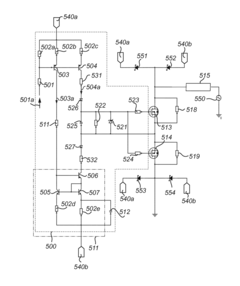
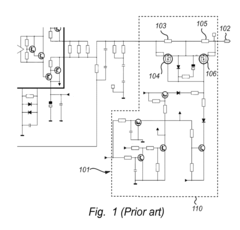
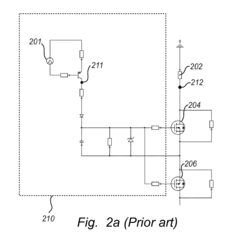
- A solid state relay design using a pair of MOSFETs with a common gate and source junction, controlled by a positive current generator and a current mirror circuit, which sinks current from the source junction, reducing ghost currents and tolerances, and allowing for the same power supply as the amplifier, thus being cost-efficient and robust.
Energy Standards Compliance
Solid-state relays (SSRs) in home automation systems must comply with various energy standards to ensure their efficiency, safety, and environmental sustainability. The International Electrotechnical Commission (IEC) has established IEC 62314 as the primary standard for solid-state relays, defining performance requirements and testing methods that manufacturers must adhere to. This standard ensures that SSRs operate within acceptable parameters for power consumption, heat generation, and electrical safety.
In the United States, ENERGY STAR certification provides guidelines for home automation systems, including those utilizing solid-state relays. These guidelines mandate maximum standby power consumption limits of 0.5W for many smart home devices. The European Union's Ecodesign Directive (2009/125/EC) similarly imposes stringent requirements on the energy efficiency of electronic products, including components like SSRs used in home automation.
The California Energy Commission (CEC) has implemented Title 24 regulations that specifically address energy consumption in building automation systems. These regulations require that control systems, including those using solid-state relays, meet minimum efficiency standards and include features such as automatic shut-off capabilities and programmable settings to optimize energy usage.
Recent developments in energy standards compliance for SSRs include the introduction of the IEC 63103:2020 standard, which specifically addresses the measurement of standby power in networked equipment. This standard is particularly relevant for home automation systems where devices remain in standby mode for extended periods while maintaining network connectivity.
Compliance testing for SSRs involves rigorous evaluation of parameters such as on-state voltage drop, off-state leakage current, and switching losses. These metrics directly impact the overall efficiency of home automation systems. Modern testing protocols now incorporate real-world usage scenarios to provide more accurate efficiency assessments under typical operating conditions.
Manufacturers of high-efficiency SSRs often exceed minimum compliance standards by implementing advanced features such as zero-crossing switching, which significantly reduces electromagnetic interference and switching losses. This approach not only ensures compliance with current standards but also anticipates future regulatory requirements as energy efficiency benchmarks continue to become more stringent.
The global trend toward smart grid integration has introduced additional compliance considerations for SSRs in home automation. Standards like IEEE 2030 provide guidelines for interoperability between home energy management systems and utility grids, requiring SSRs to support dynamic load management capabilities while maintaining efficiency across variable operating conditions.
In the United States, ENERGY STAR certification provides guidelines for home automation systems, including those utilizing solid-state relays. These guidelines mandate maximum standby power consumption limits of 0.5W for many smart home devices. The European Union's Ecodesign Directive (2009/125/EC) similarly imposes stringent requirements on the energy efficiency of electronic products, including components like SSRs used in home automation.
The California Energy Commission (CEC) has implemented Title 24 regulations that specifically address energy consumption in building automation systems. These regulations require that control systems, including those using solid-state relays, meet minimum efficiency standards and include features such as automatic shut-off capabilities and programmable settings to optimize energy usage.
Recent developments in energy standards compliance for SSRs include the introduction of the IEC 63103:2020 standard, which specifically addresses the measurement of standby power in networked equipment. This standard is particularly relevant for home automation systems where devices remain in standby mode for extended periods while maintaining network connectivity.
Compliance testing for SSRs involves rigorous evaluation of parameters such as on-state voltage drop, off-state leakage current, and switching losses. These metrics directly impact the overall efficiency of home automation systems. Modern testing protocols now incorporate real-world usage scenarios to provide more accurate efficiency assessments under typical operating conditions.
Manufacturers of high-efficiency SSRs often exceed minimum compliance standards by implementing advanced features such as zero-crossing switching, which significantly reduces electromagnetic interference and switching losses. This approach not only ensures compliance with current standards but also anticipates future regulatory requirements as energy efficiency benchmarks continue to become more stringent.
The global trend toward smart grid integration has introduced additional compliance considerations for SSRs in home automation. Standards like IEEE 2030 provide guidelines for interoperability between home energy management systems and utility grids, requiring SSRs to support dynamic load management capabilities while maintaining efficiency across variable operating conditions.
Thermal Management Strategies
Thermal management represents a critical aspect of solid-state relay (SSR) implementation in home automation systems. As these devices operate, they generate heat that must be effectively dissipated to maintain optimal performance and prevent premature failure. The primary thermal challenge stems from the semiconductor junction temperature rise during operation, which directly impacts reliability and lifespan. Industry standards typically recommend maintaining junction temperatures below 125°C for silicon-based SSRs, with optimal operation occurring below 100°C.
Heat sinks constitute the most common thermal management solution for SSRs in home automation applications. These passive cooling elements increase the surface area available for heat dissipation, with aluminum heat sinks being particularly prevalent due to their excellent thermal conductivity-to-weight ratio. Recent advancements have introduced specialized heat sink designs with optimized fin structures that can improve thermal efficiency by 15-20% compared to traditional designs, while maintaining compact form factors suitable for residential installation.
Thermal interface materials (TIMs) play a crucial role in establishing efficient thermal pathways between SSRs and heat dissipation components. Modern silicone-based thermal compounds achieve thermal conductivity ratings of 8-12 W/m·K, significantly reducing thermal resistance at contact points. Phase-change materials represent an emerging alternative, offering the advantage of consistent performance over time without the pump-out or dry-out issues associated with traditional thermal greases.
Active cooling solutions are increasingly being incorporated into high-power home automation systems. Micro-fans with intelligent temperature-based speed control can reduce SSR operating temperatures by up to 40% compared to passive cooling alone. These systems typically activate only when temperature thresholds are exceeded, minimizing noise concerns in residential environments while providing enhanced thermal management during peak load conditions.
Thermal monitoring and protection circuits represent a sophisticated approach to SSR thermal management. These systems employ temperature sensors integrated directly with relay control circuitry to enable real-time thermal monitoring. When predefined temperature thresholds are approached, these systems can implement protective measures such as load shedding, duty cycle reduction, or emergency shutdown protocols to prevent thermal damage. Advanced implementations utilize predictive algorithms that anticipate thermal issues based on load patterns and environmental conditions.
Enclosure design significantly impacts overall thermal performance of SSR-based home automation systems. Ventilation patterns that facilitate natural convection can reduce operating temperatures by 10-15°C in typical residential installations. Recent innovations include thermally conductive polymers for enclosure construction, which provide electrical isolation while contributing to heat dissipation, effectively transforming the entire device housing into a supplementary heat management component.
Heat sinks constitute the most common thermal management solution for SSRs in home automation applications. These passive cooling elements increase the surface area available for heat dissipation, with aluminum heat sinks being particularly prevalent due to their excellent thermal conductivity-to-weight ratio. Recent advancements have introduced specialized heat sink designs with optimized fin structures that can improve thermal efficiency by 15-20% compared to traditional designs, while maintaining compact form factors suitable for residential installation.
Thermal interface materials (TIMs) play a crucial role in establishing efficient thermal pathways between SSRs and heat dissipation components. Modern silicone-based thermal compounds achieve thermal conductivity ratings of 8-12 W/m·K, significantly reducing thermal resistance at contact points. Phase-change materials represent an emerging alternative, offering the advantage of consistent performance over time without the pump-out or dry-out issues associated with traditional thermal greases.
Active cooling solutions are increasingly being incorporated into high-power home automation systems. Micro-fans with intelligent temperature-based speed control can reduce SSR operating temperatures by up to 40% compared to passive cooling alone. These systems typically activate only when temperature thresholds are exceeded, minimizing noise concerns in residential environments while providing enhanced thermal management during peak load conditions.
Thermal monitoring and protection circuits represent a sophisticated approach to SSR thermal management. These systems employ temperature sensors integrated directly with relay control circuitry to enable real-time thermal monitoring. When predefined temperature thresholds are approached, these systems can implement protective measures such as load shedding, duty cycle reduction, or emergency shutdown protocols to prevent thermal damage. Advanced implementations utilize predictive algorithms that anticipate thermal issues based on load patterns and environmental conditions.
Enclosure design significantly impacts overall thermal performance of SSR-based home automation systems. Ventilation patterns that facilitate natural convection can reduce operating temperatures by 10-15°C in typical residential installations. Recent innovations include thermally conductive polymers for enclosure construction, which provide electrical isolation while contributing to heat dissipation, effectively transforming the entire device housing into a supplementary heat management component.
Unlock deeper insights with PatSnap Eureka Quick Research — get a full tech report to explore trends and direct your research. Try now!
Generate Your Research Report Instantly with AI Agent
Supercharge your innovation with PatSnap Eureka AI Agent Platform!