Solid-State Relay Load Capacity: Measurement Techniques
SEP 19, 20259 MIN READ
Generate Your Research Report Instantly with AI Agent
PatSnap Eureka helps you evaluate technical feasibility & market potential.
SSR Load Capacity Background and Objectives
Solid-state relays (SSRs) have evolved significantly since their inception in the late 1960s, transforming from simple semiconductor switching devices to sophisticated power control components. The technological progression has been driven by advancements in semiconductor materials, manufacturing processes, and circuit design techniques. Initially limited by their load handling capabilities, modern SSRs now offer impressive performance characteristics that continue to expand their application scope across various industries.
The measurement of load capacity in solid-state relays represents a critical aspect of their specification and application. Unlike mechanical relays with visible contacts and straightforward current ratings, SSRs exhibit complex electrical behaviors that necessitate specialized measurement approaches. The load capacity of an SSR is influenced by multiple factors including semiconductor junction temperature, thermal management systems, switching frequency, and environmental conditions.
Current industry trends indicate a growing demand for SSRs with higher load capacities while maintaining compact form factors. This demand stems from the increasing electrification of industrial processes, automotive systems, renewable energy installations, and smart building technologies. As power densities increase in modern electronic systems, accurate measurement and characterization of SSR load capacity become increasingly important for ensuring reliable operation and preventing premature failures.
The primary objective of investigating measurement techniques for SSR load capacity is to establish standardized, accurate, and reproducible methods that can reliably predict real-world performance. Traditional measurement approaches often fail to account for the dynamic behavior of solid-state relays under varying load conditions, leading to potential misapplications and reliability issues. Developing comprehensive measurement methodologies will enable more precise specification of SSR capabilities and limitations.
Another key goal is to bridge the gap between theoretical load capacity calculations and practical operational limits. While manufacturers provide ratings based on idealized conditions, actual implementation environments frequently deviate from these assumptions. Advanced measurement techniques aim to capture the effects of thermal cycling, load transients, and long-term degradation mechanisms that impact the sustainable load capacity of solid-state relays throughout their operational lifetime.
Furthermore, this technical exploration seeks to address the emerging challenges associated with new application domains for SSRs, such as electric vehicle charging infrastructure, grid-scale energy storage systems, and industrial Internet of Things (IIoT) deployments. These applications present unique load profiles and reliability requirements that necessitate specialized measurement approaches to accurately characterize SSR performance under representative conditions.
The measurement of load capacity in solid-state relays represents a critical aspect of their specification and application. Unlike mechanical relays with visible contacts and straightforward current ratings, SSRs exhibit complex electrical behaviors that necessitate specialized measurement approaches. The load capacity of an SSR is influenced by multiple factors including semiconductor junction temperature, thermal management systems, switching frequency, and environmental conditions.
Current industry trends indicate a growing demand for SSRs with higher load capacities while maintaining compact form factors. This demand stems from the increasing electrification of industrial processes, automotive systems, renewable energy installations, and smart building technologies. As power densities increase in modern electronic systems, accurate measurement and characterization of SSR load capacity become increasingly important for ensuring reliable operation and preventing premature failures.
The primary objective of investigating measurement techniques for SSR load capacity is to establish standardized, accurate, and reproducible methods that can reliably predict real-world performance. Traditional measurement approaches often fail to account for the dynamic behavior of solid-state relays under varying load conditions, leading to potential misapplications and reliability issues. Developing comprehensive measurement methodologies will enable more precise specification of SSR capabilities and limitations.
Another key goal is to bridge the gap between theoretical load capacity calculations and practical operational limits. While manufacturers provide ratings based on idealized conditions, actual implementation environments frequently deviate from these assumptions. Advanced measurement techniques aim to capture the effects of thermal cycling, load transients, and long-term degradation mechanisms that impact the sustainable load capacity of solid-state relays throughout their operational lifetime.
Furthermore, this technical exploration seeks to address the emerging challenges associated with new application domains for SSRs, such as electric vehicle charging infrastructure, grid-scale energy storage systems, and industrial Internet of Things (IIoT) deployments. These applications present unique load profiles and reliability requirements that necessitate specialized measurement approaches to accurately characterize SSR performance under representative conditions.
Market Demand Analysis for High-Capacity SSRs
The global market for high-capacity Solid-State Relays (SSRs) has experienced significant growth in recent years, driven by increasing automation across various industries. The demand for SSRs capable of handling higher load capacities continues to rise as industrial processes become more complex and power-intensive.
Industrial automation represents the largest market segment for high-capacity SSRs, with manufacturing facilities increasingly replacing traditional electromechanical relays with solid-state alternatives. This transition is primarily motivated by the need for more reliable switching mechanisms that can withstand frequent operation cycles without mechanical wear, particularly in high-power applications where load capacity measurement accuracy is critical.
Energy management systems constitute another rapidly expanding market for high-capacity SSRs. As smart grid technologies proliferate, the demand for precise power control devices capable of handling substantial loads while providing accurate measurement data has intensified. Utility companies require SSRs that can not only handle high capacities but also deliver precise measurements for load balancing and energy optimization.
The renewable energy sector presents a particularly promising growth area for high-capacity SSRs. Solar inverters and wind power systems require reliable switching components that can manage variable loads while providing accurate capacity measurements. The intermittent nature of renewable energy sources necessitates switching devices that can respond rapidly to changing conditions while maintaining measurement precision across varying load profiles.
HVAC systems in commercial and industrial buildings represent another significant market segment. Modern building management systems demand precise control over high-capacity heating and cooling equipment, with accurate load measurement capabilities to optimize energy efficiency and reduce operational costs.
Transportation infrastructure, including railway systems and electric vehicle charging stations, increasingly requires high-capacity SSRs with advanced measurement capabilities. The electrification of transportation has created demand for switching devices that can handle substantial power loads while providing precise capacity measurements for safety and efficiency.
Market research indicates that industries are willing to pay premium prices for SSRs that offer enhanced measurement accuracy at higher load capacities. This trend reflects the growing importance of energy efficiency and the need for precise power management in industrial applications. The ability to accurately measure and control high-capacity loads translates directly into operational cost savings and improved system reliability.
Geographically, Asia-Pacific represents the fastest-growing market for high-capacity SSRs, driven by rapid industrialization and infrastructure development in countries like China and India. North America and Europe maintain significant market shares, with demand primarily focused on replacement of legacy systems with more efficient and accurate solid-state technologies.
Industrial automation represents the largest market segment for high-capacity SSRs, with manufacturing facilities increasingly replacing traditional electromechanical relays with solid-state alternatives. This transition is primarily motivated by the need for more reliable switching mechanisms that can withstand frequent operation cycles without mechanical wear, particularly in high-power applications where load capacity measurement accuracy is critical.
Energy management systems constitute another rapidly expanding market for high-capacity SSRs. As smart grid technologies proliferate, the demand for precise power control devices capable of handling substantial loads while providing accurate measurement data has intensified. Utility companies require SSRs that can not only handle high capacities but also deliver precise measurements for load balancing and energy optimization.
The renewable energy sector presents a particularly promising growth area for high-capacity SSRs. Solar inverters and wind power systems require reliable switching components that can manage variable loads while providing accurate capacity measurements. The intermittent nature of renewable energy sources necessitates switching devices that can respond rapidly to changing conditions while maintaining measurement precision across varying load profiles.
HVAC systems in commercial and industrial buildings represent another significant market segment. Modern building management systems demand precise control over high-capacity heating and cooling equipment, with accurate load measurement capabilities to optimize energy efficiency and reduce operational costs.
Transportation infrastructure, including railway systems and electric vehicle charging stations, increasingly requires high-capacity SSRs with advanced measurement capabilities. The electrification of transportation has created demand for switching devices that can handle substantial power loads while providing precise capacity measurements for safety and efficiency.
Market research indicates that industries are willing to pay premium prices for SSRs that offer enhanced measurement accuracy at higher load capacities. This trend reflects the growing importance of energy efficiency and the need for precise power management in industrial applications. The ability to accurately measure and control high-capacity loads translates directly into operational cost savings and improved system reliability.
Geographically, Asia-Pacific represents the fastest-growing market for high-capacity SSRs, driven by rapid industrialization and infrastructure development in countries like China and India. North America and Europe maintain significant market shares, with demand primarily focused on replacement of legacy systems with more efficient and accurate solid-state technologies.
Current Challenges in SSR Load Measurement
Despite significant advancements in Solid-State Relay (SSR) technology, accurate load capacity measurement remains a persistent challenge for engineers and manufacturers. Current measurement techniques often struggle with the dynamic nature of SSR operation, particularly when dealing with varying load conditions and environmental factors. Traditional methods frequently fail to account for the complex thermal behaviors that directly impact SSR performance and reliability.
One of the primary challenges is the accurate measurement of transient thermal responses during switching operations. When an SSR transitions between states, momentary current spikes can generate heat that exceeds steady-state conditions. Conventional measurement systems typically lack the temporal resolution to capture these brief but critical events, leading to incomplete understanding of actual load handling capabilities.
The non-linear relationship between ambient temperature and SSR load capacity presents another significant measurement hurdle. Current testing protocols often fail to standardize environmental conditions, resulting in inconsistent data across different testing facilities. This variability makes it difficult to establish reliable benchmarks for SSR performance across diverse operating environments, from industrial settings to consumer applications.
Harmonic distortion measurement represents a particularly complex challenge in modern power systems. As power electronic devices proliferate in electrical networks, the resulting harmonic content can significantly affect SSR operation. Current measurement techniques frequently overlook the impact of these harmonics on SSR load capacity, potentially leading to premature device failure when deployed in real-world scenarios with non-linear loads.
The integration of SSRs into IoT and smart grid applications has introduced additional measurement complexities. These systems require real-time monitoring capabilities that can accurately assess load conditions while maintaining network communication. Existing measurement approaches often cannot balance the need for precision with the constraints of embedded systems, creating a technological gap in condition monitoring capabilities.
Standardization issues further complicate the measurement landscape. Different manufacturers employ varying methodologies for rating their SSRs, making direct comparisons challenging for end users. The industry lacks universally accepted testing protocols that would enable consistent evaluation across different product lines and manufacturers, hindering informed decision-making in system design.
Aging effects and reliability prediction represent perhaps the most significant unresolved measurement challenge. Current techniques provide limited insight into how SSR load capacity degrades over time under various operating conditions. This knowledge gap makes it difficult to develop accurate predictive maintenance strategies or to establish realistic service life expectations for SSRs in critical applications.
One of the primary challenges is the accurate measurement of transient thermal responses during switching operations. When an SSR transitions between states, momentary current spikes can generate heat that exceeds steady-state conditions. Conventional measurement systems typically lack the temporal resolution to capture these brief but critical events, leading to incomplete understanding of actual load handling capabilities.
The non-linear relationship between ambient temperature and SSR load capacity presents another significant measurement hurdle. Current testing protocols often fail to standardize environmental conditions, resulting in inconsistent data across different testing facilities. This variability makes it difficult to establish reliable benchmarks for SSR performance across diverse operating environments, from industrial settings to consumer applications.
Harmonic distortion measurement represents a particularly complex challenge in modern power systems. As power electronic devices proliferate in electrical networks, the resulting harmonic content can significantly affect SSR operation. Current measurement techniques frequently overlook the impact of these harmonics on SSR load capacity, potentially leading to premature device failure when deployed in real-world scenarios with non-linear loads.
The integration of SSRs into IoT and smart grid applications has introduced additional measurement complexities. These systems require real-time monitoring capabilities that can accurately assess load conditions while maintaining network communication. Existing measurement approaches often cannot balance the need for precision with the constraints of embedded systems, creating a technological gap in condition monitoring capabilities.
Standardization issues further complicate the measurement landscape. Different manufacturers employ varying methodologies for rating their SSRs, making direct comparisons challenging for end users. The industry lacks universally accepted testing protocols that would enable consistent evaluation across different product lines and manufacturers, hindering informed decision-making in system design.
Aging effects and reliability prediction represent perhaps the most significant unresolved measurement challenge. Current techniques provide limited insight into how SSR load capacity degrades over time under various operating conditions. This knowledge gap makes it difficult to develop accurate predictive maintenance strategies or to establish realistic service life expectations for SSRs in critical applications.
Current Methodologies for SSR Load Testing
01 Current and voltage rating considerations for SSR load capacity
Solid-state relays (SSRs) must be properly rated for the current and voltage requirements of the load they control. The load capacity of an SSR is primarily determined by its maximum current rating and voltage withstand capability. Proper selection involves considering both steady-state current and inrush current conditions, as well as ensuring the voltage rating exceeds the maximum circuit voltage to prevent breakdown.- Current and voltage rating considerations for SSRs: Solid-state relays (SSRs) have specific current and voltage ratings that determine their load capacity. These ratings indicate the maximum current and voltage that the relay can safely handle without damage. When selecting an SSR for a particular application, it is essential to consider both the steady-state current requirements and any inrush currents that may occur during load switching. Exceeding these ratings can lead to overheating, reduced lifespan, or catastrophic failure of the relay.
- Thermal management for increased load capacity: Effective thermal management is crucial for maximizing the load capacity of solid-state relays. Heat dissipation techniques such as heat sinks, cooling fans, and thermal interface materials help maintain safe operating temperatures under high load conditions. Proper thermal design ensures that the semiconductor junction temperature remains within specified limits, preventing thermal runaway and extending the relay's operational life. Advanced cooling solutions can significantly increase the effective load capacity of SSRs in high-power applications.
- Parallel and series configurations for higher capacity: To handle higher load capacities, solid-state relays can be arranged in parallel or series configurations. Parallel arrangements distribute current across multiple relays, effectively increasing the total current handling capability. Series configurations allow for higher voltage handling capacity. These arrangements require careful design considerations including load balancing, synchronization of switching, and proper isolation between units to ensure reliable operation and prevent individual relays from being overloaded.
- Protection circuits for overload conditions: Protection circuits are essential components in solid-state relays to safeguard against overload conditions that exceed their rated load capacity. These circuits may include current limiting features, thermal protection, overvoltage protection, and short-circuit protection. When an overload is detected, the protection circuit can either limit the current to a safe level or completely disconnect the load to prevent damage to the relay. Advanced protection schemes may incorporate self-resetting capabilities after fault conditions have been cleared.
- Semiconductor technology impact on load capacity: The semiconductor technology used in solid-state relays significantly impacts their load capacity. Advanced semiconductor materials and fabrication techniques, such as trench MOSFETs, IGBTs, and SiC (Silicon Carbide) or GaN (Gallium Nitride) devices, offer improved current density, lower on-state resistance, and better thermal performance. These technological advancements enable higher load capacities in smaller form factors. The selection of appropriate semiconductor technology depends on the specific application requirements including switching frequency, voltage levels, and environmental conditions.
02 Thermal management for increased load capacity
Effective thermal management is crucial for maximizing the load capacity of solid-state relays. Heat dissipation techniques such as heatsinks, thermal interface materials, and cooling systems help prevent overheating during high-current operation. Proper thermal design allows SSRs to handle higher loads without exceeding their maximum junction temperature, thereby increasing reliability and preventing thermal runaway conditions.Expand Specific Solutions03 Parallel configuration for enhanced load handling
Multiple solid-state relays can be connected in parallel to increase overall load capacity. This configuration distributes the current among multiple devices, reducing the thermal stress on individual components. Proper current sharing requires matched characteristics between paralleled SSRs and may involve additional balancing components to ensure equal current distribution and prevent one device from taking a disproportionate share of the load.Expand Specific Solutions04 Protection circuits for load capacity enhancement
Protection circuits are essential for maintaining the load capacity of solid-state relays under various operating conditions. These include snubber networks to suppress voltage spikes, current-limiting circuits to prevent overcurrent conditions, and fault detection systems that can quickly disconnect the load during abnormal conditions. These protective measures allow SSRs to safely operate closer to their maximum rated capacity without risking damage.Expand Specific Solutions05 Semiconductor technology impact on load capacity
The choice of semiconductor technology significantly affects the load capacity of solid-state relays. Advanced semiconductor materials and structures, such as trench MOSFETs, IGBTs, and SiC devices, offer lower on-state resistance and improved thermal performance. These technologies enable higher current densities and better switching characteristics, allowing modern SSRs to handle larger loads in smaller packages compared to older technologies.Expand Specific Solutions
Key Industry Players in SSR Technology
The solid-state relay load capacity measurement techniques market is currently in a growth phase, driven by increasing demand for reliable power control solutions across industrial automation, smart grid, and IoT applications. The global market size is expanding steadily, estimated to reach several billion dollars by 2025. Technologically, the field shows varying maturity levels with companies like Qualcomm, Siemens, and Huawei leading innovation in advanced measurement methodologies. State Grid Corp. of China and LG Electronics are developing specialized applications for power management systems, while companies like Viavi Solutions and InterDigital focus on precision measurement technologies. Samsung and Microsoft are integrating these technologies into smart home and industrial IoT ecosystems, creating a competitive landscape where both established electronics giants and specialized measurement technology providers compete for market share.
State Grid Corp. of China
Technical Solution: State Grid Corporation of China has developed a comprehensive solid-state relay (SSR) load capacity measurement system that integrates high-precision electrical parameter monitoring with advanced thermal analysis. Their approach utilizes a multi-channel data acquisition platform capable of simultaneously capturing voltage, current, power factor, and harmonic content across all phases of three-phase systems with microsecond resolution. The system incorporates specialized test fixtures that simulate various grid conditions including load imbalances, voltage fluctuations, and harmonic distortion commonly encountered in large-scale power distribution networks. State Grid's methodology includes accelerated life testing protocols that evaluate SSR performance under extreme operating conditions, including overload scenarios, rapid cycling, and environmental stress factors. Their technique employs infrared thermography combined with embedded temperature sensors to create detailed thermal maps of SSR components during operation, identifying potential hotspots and thermal runaway conditions. The approach also incorporates long-term reliability assessment through controlled aging tests that simulate years of operational stress in compressed timeframes, allowing for accurate prediction of SSR performance degradation over time.
Strengths: State Grid's measurement techniques provide exceptional accuracy in evaluating SSR performance under complex grid conditions with multiple interacting variables. Their comprehensive approach allows for detailed failure mode analysis and predictive maintenance scheduling. Weaknesses: The system requires extensive laboratory infrastructure and specialized expertise, making it less suitable for field testing or smaller-scale applications.
Guangdong Power Grid Co., Ltd.
Technical Solution: Guangdong Power Grid has developed an innovative solid-state relay load capacity measurement system specifically tailored for high-voltage power distribution networks. Their approach combines precision power quality analyzers with distributed temperature sensing to create a comprehensive evaluation framework. The system employs synchronized measurement of electrical parameters across multiple grid connection points, allowing for accurate assessment of SSR performance under varying load conditions and power quality scenarios. Their methodology includes specialized test protocols that simulate grid disturbances such as voltage sags, swells, and harmonic distortion to evaluate SSR robustness. Guangdong's technique incorporates continuous monitoring during seasonal peak demand periods to establish real-world performance baselines and identify potential capacity limitations before they impact system reliability. The approach integrates machine learning algorithms that analyze historical performance data to predict potential failure modes based on subtle changes in switching characteristics and thermal response patterns. Their system also evaluates the impact of environmental factors such as humidity and pollution levels on SSR performance, which is particularly relevant in their coastal service territory.
Strengths: Guangdong Power Grid's approach excels at evaluating SSR performance under real-world grid conditions with varying power quality. Their system provides excellent correlation between laboratory measurements and field reliability data. Weaknesses: The methodology is heavily optimized for utility-scale applications and may be overly complex for smaller industrial or commercial installations.
Critical Patents in SSR Measurement Technology
Solid-state relay including an electronic current detection block
PatentActiveUS20160226485A1
Innovation
- A solid-state relay with a power semiconductor switch device and an electronic driving block that generates control signals to switch between open and closed states, including an electronic detection block to monitor current and enable/disabling signals, eliminating the need for mechanical parts and external current sensors.


High-frequency solid-state relay
PatentInactiveUS5298817A
Innovation
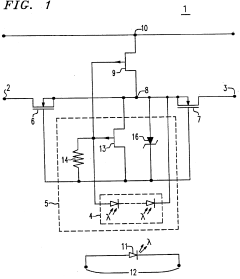
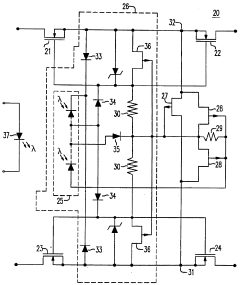
- A solid-state relay design featuring a control circuit driving pass transistors and a shunt transistor, utilizing MOSFETs and JFETs with opposite bias conductivities, to minimize feed-through and maintain high isolation during signal switching, with an optical control signal converting electrical signals to control transistor conductivity.
Thermal Management Considerations for SSRs
Thermal management represents a critical aspect of solid-state relay (SSR) implementation, directly impacting load capacity measurement accuracy and overall system reliability. When conducting load capacity measurements, the heat generated during operation must be effectively dissipated to prevent thermal runaway conditions that can lead to premature device failure or measurement inaccuracies.
The primary heat generation mechanism in SSRs occurs at the semiconductor junction where switching takes place. During conduction, the voltage drop across this junction multiplied by the current flowing through it produces heat according to Joule's law (P = I²R). This heat must be transferred away from the junction through various thermal interfaces to maintain safe operating temperatures.
Heat sinks play a fundamental role in SSR thermal management, with their effectiveness determined by factors including material thermal conductivity, surface area, and airflow conditions. Aluminum heat sinks with anodized finishes are commonly employed due to their excellent thermal conductivity-to-weight ratio. When measuring load capacity, the thermal resistance between the SSR case and heat sink (Rth(c-s)) must be minimized through proper mounting techniques and thermal interface materials.
Thermal interface materials (TIMs) such as thermal greases, pads, or phase-change materials significantly impact measurement accuracy by reducing contact resistance between the SSR and heat sink. The selection of appropriate TIMs depends on the specific application requirements, including temperature range, pressure, and expected lifetime. During load capacity testing, consistent application of these materials ensures reproducible thermal conditions across multiple measurement cycles.
Forced-air cooling systems often supplement passive heat dissipation methods in high-power applications. The effectiveness of these systems depends on airflow rate, direction, and ambient temperature conditions. When designing measurement setups for SSR load capacity, engineers must account for these variables to ensure consistent thermal conditions throughout the testing process.
Temperature monitoring represents another critical aspect of thermal management during load capacity measurements. Strategic placement of thermocouples or infrared sensors allows for real-time temperature tracking at critical points, including the semiconductor junction, case, and heat sink. These measurements enable the calculation of thermal resistance values that characterize the SSR's thermal performance under various load conditions.
Thermal modeling and simulation tools provide valuable insights into heat distribution patterns before physical testing begins. Finite element analysis (FEA) can predict temperature gradients across the SSR structure, identifying potential hotspots that might compromise measurement accuracy or device reliability. These simulation results guide the design of more effective thermal management strategies for load capacity testing environments.
The primary heat generation mechanism in SSRs occurs at the semiconductor junction where switching takes place. During conduction, the voltage drop across this junction multiplied by the current flowing through it produces heat according to Joule's law (P = I²R). This heat must be transferred away from the junction through various thermal interfaces to maintain safe operating temperatures.
Heat sinks play a fundamental role in SSR thermal management, with their effectiveness determined by factors including material thermal conductivity, surface area, and airflow conditions. Aluminum heat sinks with anodized finishes are commonly employed due to their excellent thermal conductivity-to-weight ratio. When measuring load capacity, the thermal resistance between the SSR case and heat sink (Rth(c-s)) must be minimized through proper mounting techniques and thermal interface materials.
Thermal interface materials (TIMs) such as thermal greases, pads, or phase-change materials significantly impact measurement accuracy by reducing contact resistance between the SSR and heat sink. The selection of appropriate TIMs depends on the specific application requirements, including temperature range, pressure, and expected lifetime. During load capacity testing, consistent application of these materials ensures reproducible thermal conditions across multiple measurement cycles.
Forced-air cooling systems often supplement passive heat dissipation methods in high-power applications. The effectiveness of these systems depends on airflow rate, direction, and ambient temperature conditions. When designing measurement setups for SSR load capacity, engineers must account for these variables to ensure consistent thermal conditions throughout the testing process.
Temperature monitoring represents another critical aspect of thermal management during load capacity measurements. Strategic placement of thermocouples or infrared sensors allows for real-time temperature tracking at critical points, including the semiconductor junction, case, and heat sink. These measurements enable the calculation of thermal resistance values that characterize the SSR's thermal performance under various load conditions.
Thermal modeling and simulation tools provide valuable insights into heat distribution patterns before physical testing begins. Finite element analysis (FEA) can predict temperature gradients across the SSR structure, identifying potential hotspots that might compromise measurement accuracy or device reliability. These simulation results guide the design of more effective thermal management strategies for load capacity testing environments.
Safety Standards and Compliance Requirements
Compliance with safety standards is paramount when implementing and measuring solid-state relay (SSR) load capacity. The International Electrotechnical Commission (IEC) has established several standards directly applicable to SSRs, including IEC 60947-4-3 for AC semiconductor controllers and IEC 62314 specifically for solid-state relays. These standards define the testing methodologies, safety requirements, and performance criteria that manufacturers must adhere to when designing and producing SSRs.
In North America, Underwriters Laboratories (UL) standards such as UL 508 for industrial control equipment provide additional compliance frameworks. UL 1577 addresses optical isolators used in SSRs, ensuring proper isolation between control and load circuits. The measurement techniques for load capacity must conform to these standards to ensure accurate and reliable results that can be universally accepted.
The European Union's Low Voltage Directive (LVD) 2014/35/EU and Electromagnetic Compatibility (EMC) Directive 2014/30/EU also impose requirements on SSRs used in European markets. These directives necessitate CE marking, which indicates compliance with health, safety, and environmental protection standards for products sold within the European Economic Area.
When measuring SSR load capacity, safety isolation requirements must be strictly observed. IEC 60664-1 provides guidelines for insulation coordination, specifying clearance and creepage distances based on working voltages, pollution degree, and material group. These parameters directly impact the measurement setup and equipment selection for load capacity testing.
Temperature rise testing, as outlined in IEC 60947-4-3, is critical for determining the true load capacity of an SSR. The standard specifies that temperature measurements must be taken at multiple points on the SSR and heat sink, with ambient temperature carefully controlled. The maximum permissible temperature rise varies depending on the SSR's temperature class and materials used.
Surge withstand capability testing, per IEC 61000-4-5, evaluates the SSR's ability to handle transient overvoltages. This is particularly important for load capacity measurements, as SSRs must maintain their specified performance even under surge conditions. The test involves applying standardized impulse waveforms to the SSR while monitoring its operation.
Environmental testing requirements, including humidity (IEC 60068-2-78), vibration (IEC 60068-2-6), and shock (IEC 60068-2-27), must also be considered when establishing measurement protocols for SSR load capacity. These tests ensure that the SSR's rated load capacity remains valid under various environmental conditions that might be encountered in real-world applications.
In North America, Underwriters Laboratories (UL) standards such as UL 508 for industrial control equipment provide additional compliance frameworks. UL 1577 addresses optical isolators used in SSRs, ensuring proper isolation between control and load circuits. The measurement techniques for load capacity must conform to these standards to ensure accurate and reliable results that can be universally accepted.
The European Union's Low Voltage Directive (LVD) 2014/35/EU and Electromagnetic Compatibility (EMC) Directive 2014/30/EU also impose requirements on SSRs used in European markets. These directives necessitate CE marking, which indicates compliance with health, safety, and environmental protection standards for products sold within the European Economic Area.
When measuring SSR load capacity, safety isolation requirements must be strictly observed. IEC 60664-1 provides guidelines for insulation coordination, specifying clearance and creepage distances based on working voltages, pollution degree, and material group. These parameters directly impact the measurement setup and equipment selection for load capacity testing.
Temperature rise testing, as outlined in IEC 60947-4-3, is critical for determining the true load capacity of an SSR. The standard specifies that temperature measurements must be taken at multiple points on the SSR and heat sink, with ambient temperature carefully controlled. The maximum permissible temperature rise varies depending on the SSR's temperature class and materials used.
Surge withstand capability testing, per IEC 61000-4-5, evaluates the SSR's ability to handle transient overvoltages. This is particularly important for load capacity measurements, as SSRs must maintain their specified performance even under surge conditions. The test involves applying standardized impulse waveforms to the SSR while monitoring its operation.
Environmental testing requirements, including humidity (IEC 60068-2-78), vibration (IEC 60068-2-6), and shock (IEC 60068-2-27), must also be considered when establishing measurement protocols for SSR load capacity. These tests ensure that the SSR's rated load capacity remains valid under various environmental conditions that might be encountered in real-world applications.
Unlock deeper insights with PatSnap Eureka Quick Research — get a full tech report to explore trends and direct your research. Try now!
Generate Your Research Report Instantly with AI Agent
Supercharge your innovation with PatSnap Eureka AI Agent Platform!