
Solid-State Relay: Overcurrent Protection Mechanisms
SEP 19, 20259 MIN READ
Generate Your Research Report Instantly with AI Agent
Patsnap Eureka helps you evaluate technical feasibility & market potential.
SSR Protection Background and Objectives
Solid-state relays (SSRs) have evolved significantly since their inception in the 1970s, transforming from simple switching devices to sophisticated power control components with integrated protection features. The development trajectory has been driven by increasing demands for reliability, safety, and efficiency in industrial automation, power distribution systems, and consumer electronics. Initially designed as alternatives to electromechanical relays, SSRs have progressively incorporated advanced semiconductor technologies to enhance their performance characteristics and protective capabilities.
The evolution of overcurrent protection mechanisms in SSRs represents a critical advancement in power electronics. Early SSR designs offered minimal protection against current anomalies, often relying on external circuit breakers or fuses. However, as applications became more demanding and sensitive to power fluctuations, integrated protection mechanisms emerged as essential features. This technological progression has been accelerated by developments in semiconductor materials, microcontroller integration, and sensing technologies.
Current industry trends indicate a growing emphasis on intelligent protection systems that can respond dynamically to varying load conditions while maintaining operational continuity. The integration of digital control interfaces and communication protocols has further expanded the functionality of modern SSRs, enabling remote monitoring and predictive maintenance capabilities. These advancements align with broader industry movements toward Industry 4.0 and smart grid implementations.
The primary objective of SSR overcurrent protection research is to develop robust, responsive, and adaptable protection mechanisms that can effectively safeguard both the relay itself and connected equipment under various fault conditions. This includes addressing challenges related to thermal management, response time optimization, coordination with other protection devices, and ensuring compatibility with diverse load types including resistive, inductive, and capacitive loads.
Additional technical goals include reducing the physical footprint of protection circuits while enhancing their performance, minimizing power consumption of sensing and control elements, and extending the operational lifespan of SSRs under stress conditions. There is also significant interest in developing protection strategies that can distinguish between momentary overloads and genuine fault conditions, thereby reducing unnecessary system interruptions.
The convergence of power electronics, digital control systems, and advanced materials science presents unprecedented opportunities for innovation in SSR protection technologies. As industrial and consumer applications increasingly rely on uninterrupted power delivery and precise control, the development of sophisticated overcurrent protection mechanisms has become a focal point for research and development efforts across the semiconductor industry.
The evolution of overcurrent protection mechanisms in SSRs represents a critical advancement in power electronics. Early SSR designs offered minimal protection against current anomalies, often relying on external circuit breakers or fuses. However, as applications became more demanding and sensitive to power fluctuations, integrated protection mechanisms emerged as essential features. This technological progression has been accelerated by developments in semiconductor materials, microcontroller integration, and sensing technologies.
Current industry trends indicate a growing emphasis on intelligent protection systems that can respond dynamically to varying load conditions while maintaining operational continuity. The integration of digital control interfaces and communication protocols has further expanded the functionality of modern SSRs, enabling remote monitoring and predictive maintenance capabilities. These advancements align with broader industry movements toward Industry 4.0 and smart grid implementations.
The primary objective of SSR overcurrent protection research is to develop robust, responsive, and adaptable protection mechanisms that can effectively safeguard both the relay itself and connected equipment under various fault conditions. This includes addressing challenges related to thermal management, response time optimization, coordination with other protection devices, and ensuring compatibility with diverse load types including resistive, inductive, and capacitive loads.
Additional technical goals include reducing the physical footprint of protection circuits while enhancing their performance, minimizing power consumption of sensing and control elements, and extending the operational lifespan of SSRs under stress conditions. There is also significant interest in developing protection strategies that can distinguish between momentary overloads and genuine fault conditions, thereby reducing unnecessary system interruptions.
The convergence of power electronics, digital control systems, and advanced materials science presents unprecedented opportunities for innovation in SSR protection technologies. As industrial and consumer applications increasingly rely on uninterrupted power delivery and precise control, the development of sophisticated overcurrent protection mechanisms has become a focal point for research and development efforts across the semiconductor industry.
Market Demand Analysis for Protected SSRs
The global market for Solid-State Relays (SSRs) with integrated overcurrent protection mechanisms has been experiencing robust growth, driven primarily by increasing automation across industrial sectors and the growing emphasis on equipment safety and reliability. Current market analysis indicates that protected SSRs are gaining significant traction in critical applications where system downtime can result in substantial financial losses or safety hazards.
The industrial automation sector represents the largest market segment for protected SSRs, with manufacturing facilities increasingly adopting these components to safeguard expensive equipment and prevent production interruptions. This demand is particularly pronounced in automotive manufacturing, semiconductor production, and process industries where precision control and system protection are paramount.
Energy management systems constitute another rapidly expanding market for protected SSRs. As smart grid technologies and renewable energy systems become more prevalent, the need for reliable switching components with built-in protection features has intensified. Protected SSRs offer advantages in these applications by preventing cascade failures and protecting connected equipment from damage during fault conditions.
Building automation systems represent a growing application area, with protected SSRs being integrated into HVAC controls, lighting systems, and security infrastructure. The trend toward smart buildings has accelerated demand for components that can provide both switching functionality and circuit protection in a single package, reducing installation complexity and enhancing system reliability.
Market research indicates that end-users are increasingly willing to pay premium prices for SSRs with integrated protection features, recognizing the long-term cost benefits through reduced maintenance requirements and extended equipment lifespans. This value proposition is particularly compelling in applications where replacement costs and downtime expenses far outweigh the initial component investment.
Regional analysis shows that North America and Europe currently lead in the adoption of protected SSRs, primarily due to stringent safety regulations and high labor costs that make system failures particularly expensive. However, the Asia-Pacific region is showing the fastest growth rate as manufacturing automation accelerates across China, India, and Southeast Asian countries.
Market forecasts suggest that miniaturization and increased integration will be key drivers for future growth, with manufacturers developing smaller protected SSRs that maintain robust protection capabilities while requiring less panel space. Additionally, there is growing demand for SSRs with advanced diagnostic capabilities that can predict potential failures before they occur, enabling preventive maintenance rather than reactive repairs.
The industrial automation sector represents the largest market segment for protected SSRs, with manufacturing facilities increasingly adopting these components to safeguard expensive equipment and prevent production interruptions. This demand is particularly pronounced in automotive manufacturing, semiconductor production, and process industries where precision control and system protection are paramount.
Energy management systems constitute another rapidly expanding market for protected SSRs. As smart grid technologies and renewable energy systems become more prevalent, the need for reliable switching components with built-in protection features has intensified. Protected SSRs offer advantages in these applications by preventing cascade failures and protecting connected equipment from damage during fault conditions.
Building automation systems represent a growing application area, with protected SSRs being integrated into HVAC controls, lighting systems, and security infrastructure. The trend toward smart buildings has accelerated demand for components that can provide both switching functionality and circuit protection in a single package, reducing installation complexity and enhancing system reliability.
Market research indicates that end-users are increasingly willing to pay premium prices for SSRs with integrated protection features, recognizing the long-term cost benefits through reduced maintenance requirements and extended equipment lifespans. This value proposition is particularly compelling in applications where replacement costs and downtime expenses far outweigh the initial component investment.
Regional analysis shows that North America and Europe currently lead in the adoption of protected SSRs, primarily due to stringent safety regulations and high labor costs that make system failures particularly expensive. However, the Asia-Pacific region is showing the fastest growth rate as manufacturing automation accelerates across China, India, and Southeast Asian countries.
Market forecasts suggest that miniaturization and increased integration will be key drivers for future growth, with manufacturers developing smaller protected SSRs that maintain robust protection capabilities while requiring less panel space. Additionally, there is growing demand for SSRs with advanced diagnostic capabilities that can predict potential failures before they occur, enabling preventive maintenance rather than reactive repairs.
Current Challenges in SSR Overcurrent Protection
Despite significant advancements in Solid-State Relay (SSR) technology, overcurrent protection mechanisms continue to present substantial challenges for designers and manufacturers. The primary difficulty lies in balancing rapid response times with the prevention of false triggers during normal operation transients. Unlike mechanical relays that have inherent current-limiting capabilities through physical separation, SSRs must rely entirely on electronic detection and response systems.
One of the most pressing challenges is the thermal management during overcurrent events. When excessive current flows through an SSR, the semiconductor junction temperature can rise dramatically within microseconds, potentially causing permanent damage before conventional protection circuits can respond. This creates a fundamental timing challenge that requires increasingly sophisticated detection algorithms and faster-acting protection mechanisms.
The integration of protection circuits without compromising the SSR's primary advantages presents another significant hurdle. Additional protection components often increase the device's on-state resistance, leading to greater power dissipation during normal operation and reducing overall efficiency. This trade-off between protection capability and operational efficiency remains a critical design consideration that has not been fully resolved in current implementations.
Nuisance tripping during motor startup or capacitive load switching represents another persistent challenge. These applications naturally produce current surges that can falsely trigger protection mechanisms, leading to operational disruptions. Current solutions typically involve time-delay functions or surge tolerance settings, but these adjustments inherently reduce protection effectiveness during genuine fault conditions.
Environmental factors further complicate SSR overcurrent protection design. Temperature variations significantly affect semiconductor characteristics, potentially altering the response profile of protection circuits. Systems designed for optimal performance at room temperature may exhibit delayed responses or premature triggering in extreme environments, creating reliability concerns for applications in harsh industrial settings.
The miniaturization trend in electronics introduces additional constraints on protection circuit design. As SSRs become smaller to accommodate space-limited applications, the physical area available for heat dissipation and protection circuitry decreases. This spatial limitation forces engineers to develop more efficient protection mechanisms that can operate effectively within increasingly confined spaces.
Lastly, the cost implications of advanced protection features present market challenges. While sophisticated multi-stage protection systems offer superior performance, their implementation significantly increases manufacturing costs. This creates a market segmentation where high-end protection features remain unavailable in cost-sensitive applications, leaving many systems with suboptimal protection against overcurrent events.
One of the most pressing challenges is the thermal management during overcurrent events. When excessive current flows through an SSR, the semiconductor junction temperature can rise dramatically within microseconds, potentially causing permanent damage before conventional protection circuits can respond. This creates a fundamental timing challenge that requires increasingly sophisticated detection algorithms and faster-acting protection mechanisms.
The integration of protection circuits without compromising the SSR's primary advantages presents another significant hurdle. Additional protection components often increase the device's on-state resistance, leading to greater power dissipation during normal operation and reducing overall efficiency. This trade-off between protection capability and operational efficiency remains a critical design consideration that has not been fully resolved in current implementations.
Nuisance tripping during motor startup or capacitive load switching represents another persistent challenge. These applications naturally produce current surges that can falsely trigger protection mechanisms, leading to operational disruptions. Current solutions typically involve time-delay functions or surge tolerance settings, but these adjustments inherently reduce protection effectiveness during genuine fault conditions.
Environmental factors further complicate SSR overcurrent protection design. Temperature variations significantly affect semiconductor characteristics, potentially altering the response profile of protection circuits. Systems designed for optimal performance at room temperature may exhibit delayed responses or premature triggering in extreme environments, creating reliability concerns for applications in harsh industrial settings.
The miniaturization trend in electronics introduces additional constraints on protection circuit design. As SSRs become smaller to accommodate space-limited applications, the physical area available for heat dissipation and protection circuitry decreases. This spatial limitation forces engineers to develop more efficient protection mechanisms that can operate effectively within increasingly confined spaces.
Lastly, the cost implications of advanced protection features present market challenges. While sophisticated multi-stage protection systems offer superior performance, their implementation significantly increases manufacturing costs. This creates a market segmentation where high-end protection features remain unavailable in cost-sensitive applications, leaving many systems with suboptimal protection against overcurrent events.
Existing Overcurrent Protection Solutions for SSRs
01 Current sensing and monitoring techniques
Various methods are employed to detect overcurrent conditions in solid-state relay circuits. These include using current transformers, shunt resistors, and integrated sensing circuits that can accurately measure current flow through the relay. When current exceeds predetermined thresholds, protection mechanisms are triggered to prevent damage to the relay and connected equipment. Advanced monitoring systems may include real-time current measurement with feedback loops for precise control.- Current sensing and monitoring techniques for SSR protection: Various current sensing methods are employed in solid-state relays to detect overcurrent conditions. These include shunt resistors, current transformers, and Hall effect sensors that continuously monitor the current flowing through the relay. When the current exceeds predetermined thresholds, protection circuits are triggered to prevent damage to the relay and connected equipment. Advanced implementations may include digital signal processing for more accurate current measurement and faster response times.
- Thermal protection mechanisms in solid-state relays: Thermal protection systems are integrated into solid-state relays to prevent overheating during overcurrent events. These systems utilize temperature sensors, thermal modeling, and heat dissipation techniques to monitor and manage the thermal conditions of the relay. When excessive heat is detected, protection circuits can trigger shutdown or current limiting functions. Some designs incorporate thermal memory to account for cumulative heating effects over time, providing more comprehensive protection against thermal damage.
- Fast-acting electronic circuit breaker functionality: Modern solid-state relays incorporate electronic circuit breaker functionality that can respond to overcurrent conditions much faster than traditional mechanical breakers. These systems use high-speed semiconductor switches and dedicated control circuits to rapidly interrupt current flow when fault conditions are detected. Response times can be in the microsecond range, significantly reducing the energy delivered during a fault and minimizing potential damage. Some implementations include adjustable trip points and timing characteristics to match specific application requirements.
- Integration of multiple protection layers and redundancy: Advanced solid-state relay protection systems implement multiple layers of protection and redundancy to ensure reliable operation. These designs may combine primary and secondary protection mechanisms, watchdog circuits, and self-diagnostic capabilities. If one protection system fails, backup systems can take over to maintain safe operation. Some implementations include isolated power supplies and communication interfaces to prevent cascading failures and ensure protection circuits remain operational even during fault conditions.
- Intelligent overcurrent protection with adaptive thresholds: Intelligent protection systems in modern solid-state relays feature adaptive overcurrent thresholds that adjust based on operating conditions. These systems can differentiate between normal inrush currents, temporary overloads, and genuine fault conditions. Machine learning algorithms and microcontroller-based designs enable dynamic adjustment of protection parameters based on load characteristics and environmental factors. Some implementations include data logging and communication capabilities for remote monitoring and analysis of overcurrent events.
02 Thermal protection mechanisms
Solid-state relays are susceptible to thermal damage during overcurrent events. Protection systems incorporate temperature sensors, heat sinks, and thermal modeling to prevent overheating. These mechanisms monitor the junction temperature of semiconductor components and implement protective measures when thermal limits are approached. Some designs include automatic cooling systems or thermal shutdown features that temporarily disable the relay until safe operating temperatures are restored.Expand Specific Solutions03 Fast-acting electronic trip circuits
Electronic trip circuits provide rapid response to overcurrent conditions in solid-state relays. These circuits utilize comparators, microcontrollers, or dedicated ICs to detect fault conditions and disconnect power within microseconds. Some implementations include adjustable trip thresholds and time delays to accommodate temporary inrush currents while still protecting against sustained overloads. Advanced designs may incorporate multiple trip levels for different fault scenarios.Expand Specific Solutions04 Integration with system-level protection
Solid-state relay overcurrent protection often works in conjunction with broader system protection schemes. This includes coordination with circuit breakers, fuses, and power management systems to ensure comprehensive protection. Communication interfaces allow relays to report status and fault conditions to supervisory systems. Some implementations feature programmable protection parameters that can be adjusted based on system requirements or operating conditions.Expand Specific Solutions05 Fault recovery and self-diagnostic capabilities
Modern solid-state relay protection systems incorporate self-diagnostic features and automatic recovery mechanisms. These include fault logging, condition monitoring, and automatic restart capabilities after temporary faults. Some designs implement soft-start procedures following an overcurrent event to prevent secondary faults during recovery. Advanced systems may include predictive diagnostics that can identify potential failure conditions before they cause interruptions.Expand Specific Solutions
Key Manufacturers in SSR Protection Industry
The solid-state relay overcurrent protection mechanisms market is currently in a growth phase, with increasing adoption across industrial automation and power management sectors. The market size is projected to expand significantly due to rising demand for reliable electronic protection systems in critical applications. Technologically, the field is maturing with companies like Siemens AG, TE Connectivity, and Fuji Electric leading innovation through advanced semiconductor-based solutions. Toshiba, ABB Group, and STMicroelectronics are developing integrated protection features with faster response times and enhanced reliability. Asian manufacturers including BYD, LG Chem, and DAIKIN are gaining market share by offering cost-effective alternatives while maintaining performance standards. Academic partnerships with institutions like Xi'an Jiaotong University are accelerating research into next-generation protection mechanisms with improved thermal management and fault detection capabilities.
Siemens AG
Technical Solution: Siemens has developed comprehensive solid-state relay overcurrent protection solutions that integrate with their broader industrial automation ecosystem. Their technology employs high-precision current measurement using Hall effect sensors combined with dedicated signal processing hardware for microsecond response times. Siemens' SSRs feature multi-level protection strategies including instantaneous magnetic trip for short circuits, thermal memory algorithms for tracking cumulative heating effects, and I²t protection curves that model thermal stress on protected equipment. Their system incorporates adaptive filtering to distinguish between harmonic-rich loads and genuine fault conditions, reducing nuisance tripping in environments with non-linear loads. Siemens has implemented predictive maintenance capabilities that analyze patterns in minor overcurrent events to identify deteriorating equipment before catastrophic failures occur. Their SSRs also feature configurable automatic restart attempts with progressive timing to handle temporary fault conditions while maintaining safety protocols.
Strengths: Seamless integration with industrial control systems, sophisticated discrimination between normal and fault conditions, and extensive data logging capabilities for post-event analysis. Weaknesses: Premium pricing structure, complex setup for advanced features, and higher heat generation requiring careful installation planning.
Fuji Electric Co., Ltd.
Technical Solution: Fuji Electric has engineered solid-state relay overcurrent protection mechanisms that leverage their expertise in power semiconductor technology. Their approach utilizes high-speed current sensing with dedicated microcontrollers that process current waveforms in real-time to identify fault conditions. Fuji's SSRs incorporate dual-threshold protection that provides both instantaneous trip for severe overcurrents and time-delayed response for minor overloads. The system features integrated temperature compensation that adjusts protection parameters based on ambient and device temperatures to maintain consistent protection across operating conditions. Their technology includes zero-crossing switching coordination with overcurrent protection to minimize electromagnetic interference during normal operation while maintaining rapid response during fault conditions. Fuji Electric has also developed specialized gate drive circuits that can rapidly transition the semiconductor switches to a high-impedance state during fault detection, limiting fault current magnitude and duration.
Strengths: Excellent thermal stability across wide temperature ranges, highly reliable operation in industrial environments, and minimal electromagnetic interference. Weaknesses: Limited customization options compared to some competitors, higher power consumption in certain applications, and challenges with very high current ratings.
Core Protection Circuit Designs and Patents
Solid state relay module with overcurrent protection
PatentPendingEP4447318A1
Innovation
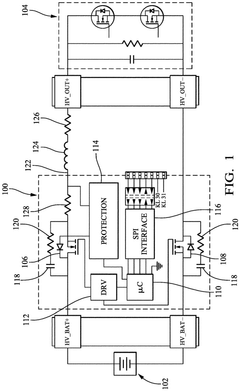
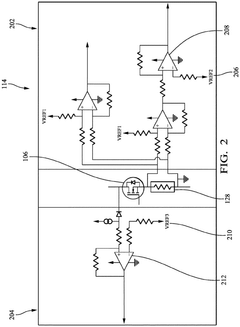
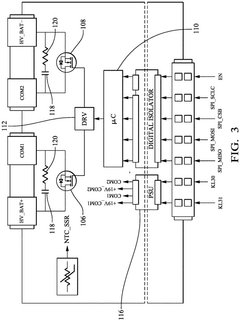
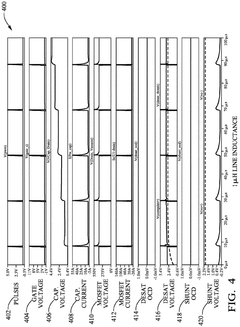
- A solid state relay module with shunt and desaturation overcurrent detection circuits, utilizing MOSFETs for fast and reliable switching, eliminates the need for dedicated bypass relays and resistors by quickly turning off during overcurrent conditions, employing pulsed energy to pre-charge capacitive loads and protect against high peak currents.
Solid state overcurrent protection device
PatentInactiveCA1330451C
Innovation
- A programmable solid state overcurrent protection device using a three-terminal thyristor design with interdigitated cathode and gate contacts, allowing adjustment with an external current sensing resistor to set operation thresholds, and capable of protecting against both overcurrents and overvoltages through appropriate doping, enabling a single device to meet various protection requirements.


Reliability Testing Standards for Protected SSRs
Reliability testing standards for protected Solid-State Relays (SSRs) have evolved significantly to ensure these components can withstand overcurrent conditions while maintaining operational integrity. The International Electrotechnical Commission (IEC) has established IEC 62314 as the primary standard governing SSR testing, which includes specific protocols for evaluating overcurrent protection mechanisms. This standard requires protected SSRs to undergo rigorous surge current tests, typically at 10 times the rated current for specified durations, to verify protection circuit functionality.
UL 508, developed by Underwriters Laboratories, provides complementary testing requirements specifically focused on industrial control equipment including SSRs with protection features. This standard mandates cyclic overload testing where protected SSRs must withstand repeated overcurrent events without degradation of protective functions or physical damage to the device structure.
The Joint Electron Device Engineering Council (JEDEC) has contributed standard JESD22-A108 for power cycling reliability assessment, which has been adapted for protected SSR evaluation. This methodology subjects devices to thousands of power cycles under varying load conditions to verify long-term stability of the overcurrent protection mechanisms.
Military standard MIL-STD-750 provides specialized testing protocols for semiconductor devices used in critical applications, with Method 1080 specifically addressing surge current survival capabilities. Protected SSRs intended for aerospace or defense applications must demonstrate compliance with these more stringent requirements, including operation after exposure to extreme overcurrent events.
Environmental testing standards such as IEC 60068 series complement electrical testing by evaluating how temperature extremes, humidity, and mechanical stress affect the reliability of protection circuits. Protected SSRs must maintain their overcurrent protection functionality across the entire specified environmental operating range.
Automotive-grade protected SSRs face additional requirements under the AEC-Q100 qualification standard, which includes specific tests for transient voltage suppression and inductive load switching capability. These tests are particularly relevant for evaluating overcurrent protection during vehicle electrical system disturbances.
Time-to-failure testing methodologies have been standardized to predict the long-term reliability of protection circuits under various stress conditions. Highly accelerated life testing (HALT) and highly accelerated stress screening (HASS) protocols subject protected SSRs to extreme conditions to identify potential failure modes and verify design margins of safety systems.
UL 508, developed by Underwriters Laboratories, provides complementary testing requirements specifically focused on industrial control equipment including SSRs with protection features. This standard mandates cyclic overload testing where protected SSRs must withstand repeated overcurrent events without degradation of protective functions or physical damage to the device structure.
The Joint Electron Device Engineering Council (JEDEC) has contributed standard JESD22-A108 for power cycling reliability assessment, which has been adapted for protected SSR evaluation. This methodology subjects devices to thousands of power cycles under varying load conditions to verify long-term stability of the overcurrent protection mechanisms.
Military standard MIL-STD-750 provides specialized testing protocols for semiconductor devices used in critical applications, with Method 1080 specifically addressing surge current survival capabilities. Protected SSRs intended for aerospace or defense applications must demonstrate compliance with these more stringent requirements, including operation after exposure to extreme overcurrent events.
Environmental testing standards such as IEC 60068 series complement electrical testing by evaluating how temperature extremes, humidity, and mechanical stress affect the reliability of protection circuits. Protected SSRs must maintain their overcurrent protection functionality across the entire specified environmental operating range.
Automotive-grade protected SSRs face additional requirements under the AEC-Q100 qualification standard, which includes specific tests for transient voltage suppression and inductive load switching capability. These tests are particularly relevant for evaluating overcurrent protection during vehicle electrical system disturbances.
Time-to-failure testing methodologies have been standardized to predict the long-term reliability of protection circuits under various stress conditions. Highly accelerated life testing (HALT) and highly accelerated stress screening (HASS) protocols subject protected SSRs to extreme conditions to identify potential failure modes and verify design margins of safety systems.
Thermal Management Considerations in SSR Protection
Thermal management represents a critical aspect of solid-state relay (SSR) protection systems, as excessive heat generation during overcurrent events can lead to catastrophic device failure. The semiconductor components within SSRs, particularly the power transistors and thyristors, exhibit temperature-dependent characteristics that directly impact their performance and reliability under stress conditions.
Heat dissipation mechanisms in SSRs typically involve a combination of conduction, convection, and radiation processes. The primary thermal path in most SSR designs routes heat from the semiconductor junction through the device package to an external heat sink. The thermal resistance along this path significantly influences the SSR's current handling capability and its ability to withstand transient overcurrent events.
Modern SSR protection designs incorporate multiple thermal management strategies. Temperature sensors strategically positioned near critical components provide real-time monitoring capabilities, enabling protective circuits to respond before thermal runaway occurs. These sensors commonly utilize thermistors, RTDs, or integrated temperature sensing elements that trigger protective actions when predefined temperature thresholds are exceeded.
Advanced SSR designs implement dynamic thermal modeling algorithms that continuously calculate junction temperatures based on measured current, ambient conditions, and thermal time constants. This approach allows for more sophisticated protection responses that account for both instantaneous overcurrent magnitude and thermal accumulation over time.
Material selection plays a crucial role in thermal management effectiveness. Thermally conductive but electrically insulating materials, such as aluminum nitride and specialized polymer composites, are increasingly employed to enhance heat transfer while maintaining electrical isolation. These materials help reduce thermal resistance between semiconductor junctions and heat sinks, improving overall thermal performance.
Cooling system integration represents another important consideration in SSR protection design. Passive cooling solutions utilizing optimized heat sink geometries remain common in lower-power applications, while active cooling methods incorporating fans or liquid cooling systems are necessary for high-current industrial applications. The selection of appropriate cooling methods must balance thermal performance requirements against reliability, cost, and space constraints.
Thermal interface materials (TIMs) between the SSR package and heat sink significantly impact overall thermal resistance. Recent advancements in TIM technology, including phase-change materials and metal-infused compounds, have reduced thermal boundary resistance, enabling SSRs to handle higher currents while maintaining safe operating temperatures during protection events.
Heat dissipation mechanisms in SSRs typically involve a combination of conduction, convection, and radiation processes. The primary thermal path in most SSR designs routes heat from the semiconductor junction through the device package to an external heat sink. The thermal resistance along this path significantly influences the SSR's current handling capability and its ability to withstand transient overcurrent events.
Modern SSR protection designs incorporate multiple thermal management strategies. Temperature sensors strategically positioned near critical components provide real-time monitoring capabilities, enabling protective circuits to respond before thermal runaway occurs. These sensors commonly utilize thermistors, RTDs, or integrated temperature sensing elements that trigger protective actions when predefined temperature thresholds are exceeded.
Advanced SSR designs implement dynamic thermal modeling algorithms that continuously calculate junction temperatures based on measured current, ambient conditions, and thermal time constants. This approach allows for more sophisticated protection responses that account for both instantaneous overcurrent magnitude and thermal accumulation over time.
Material selection plays a crucial role in thermal management effectiveness. Thermally conductive but electrically insulating materials, such as aluminum nitride and specialized polymer composites, are increasingly employed to enhance heat transfer while maintaining electrical isolation. These materials help reduce thermal resistance between semiconductor junctions and heat sinks, improving overall thermal performance.
Cooling system integration represents another important consideration in SSR protection design. Passive cooling solutions utilizing optimized heat sink geometries remain common in lower-power applications, while active cooling methods incorporating fans or liquid cooling systems are necessary for high-current industrial applications. The selection of appropriate cooling methods must balance thermal performance requirements against reliability, cost, and space constraints.
Thermal interface materials (TIMs) between the SSR package and heat sink significantly impact overall thermal resistance. Recent advancements in TIM technology, including phase-change materials and metal-infused compounds, have reduced thermal boundary resistance, enabling SSRs to handle higher currents while maintaining safe operating temperatures during protection events.
Unlock deeper insights with Patsnap Eureka Quick Research — get a full tech report to explore trends and direct your research. Try now!
Generate Your Research Report Instantly with AI Agent
Supercharge your innovation with Patsnap Eureka AI Agent Platform!